Anselm Kiefer: Angeli caduti
Word count: 801
Paragraphs: 8
On View
Fondazione Palazzo StrozziMarch 22–July 21, 2024
Florence
West of Ponte Vecchio and the gold bridge spanning the Arno stands Palazzo Strozzi, refreshingly incognito. Constructed at the end of the fifteenth-century by Filippo Strozzi after his Medici-organized exile from Florence was lifted, it might just be another fifteenth-century palace surrounded by luxury boutiques and hotels—brassy Louis Vuitton out one door, stealth-wealth Celine out another—and not home to Florence’s most humane museum experience, Anselm Kiefer’s Angeli caduti.
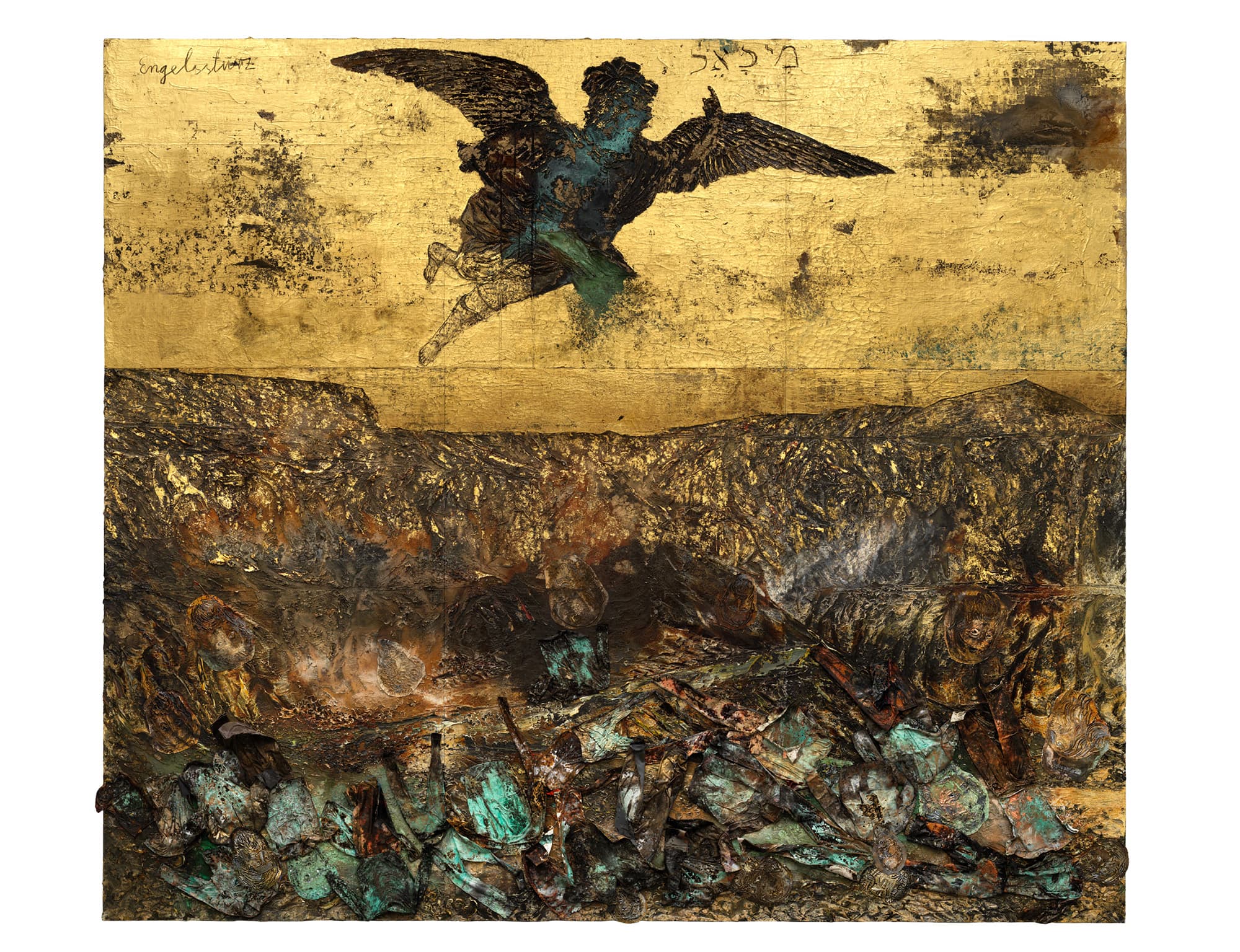
The first work in Kiefer’s staggering, heady exhibition is a painting, Engelssturz (Fall of the Angel) (2022-2023) though with Kiefer it’s never simply a painting. It is an enormous canvas of emulsion, shellac, fabric, sediment (charcoal and electrolysis), acrylic, oil, and gold leaf—enough gold leaf to make Simone Martini and Lippo Memmi’s Annunciation with St. Maxima and St. Ansanus down the street at the Uffizi look modest. And yet how much Kiefer’s Engelssturz has in common with the gilded Sienese altarpiece, where the Archangel Gabriel’s message to the Virgin Mary is inscribed, right there, on the canvas. Like most of the work in Angeli caduti, Engelssturz, the title, is scrawled in the upper left. Hebrew characters spell out the archangel’s name, Michael. A walk around the painting, reveals the stretcher-power necessary to support such a gargantuan canvas, as well as more writing: “Eschaton.” World’s end, yes, and also a reference to the Eschaton-Anselm Kiefer Foundation housed at the artist’s once studio in Barjac, France. (It became a massive excavation project.)

I have no struggle imagining Kiefer unearthing anything, let alone digging holes, building tunnels, or constructing crypts. The sheer scale and accretive materiality of his paintings relentlessly announce their labor. Forty-three steps up from the courtyard, in Luzifer (2012-2023), the figure of Lucifer tumbles from the sky or, in the words of my four-year-old son, a fire airplane. Indeed, a jet wing juts from the canvas like a steel palm frond. Again, an inscription, again “Michael,” scrawled in copper on the underside of the metal. Empty tunics (tight brown houndstooth) rent, rumpled, suggest human remains amidst the wreckage.
Wreckage and ruin, ambition and virtue, Kiefer is an archaeologist of the humanities, a miner of human folly and fallibility. Across the eight rooms of Angeli caduti, the apocryphal breadth of his work is on display. Kiefer’s work requires time; the creation of Luzifer spans eleven years. The artist takes time to read and research, to recreate, to riff on a motif, to let the material erode. This exhibition includes Sol Invictus (1995) an example of the sunflower paintings he’s been making for thirty years, in a room that smells like seeds.
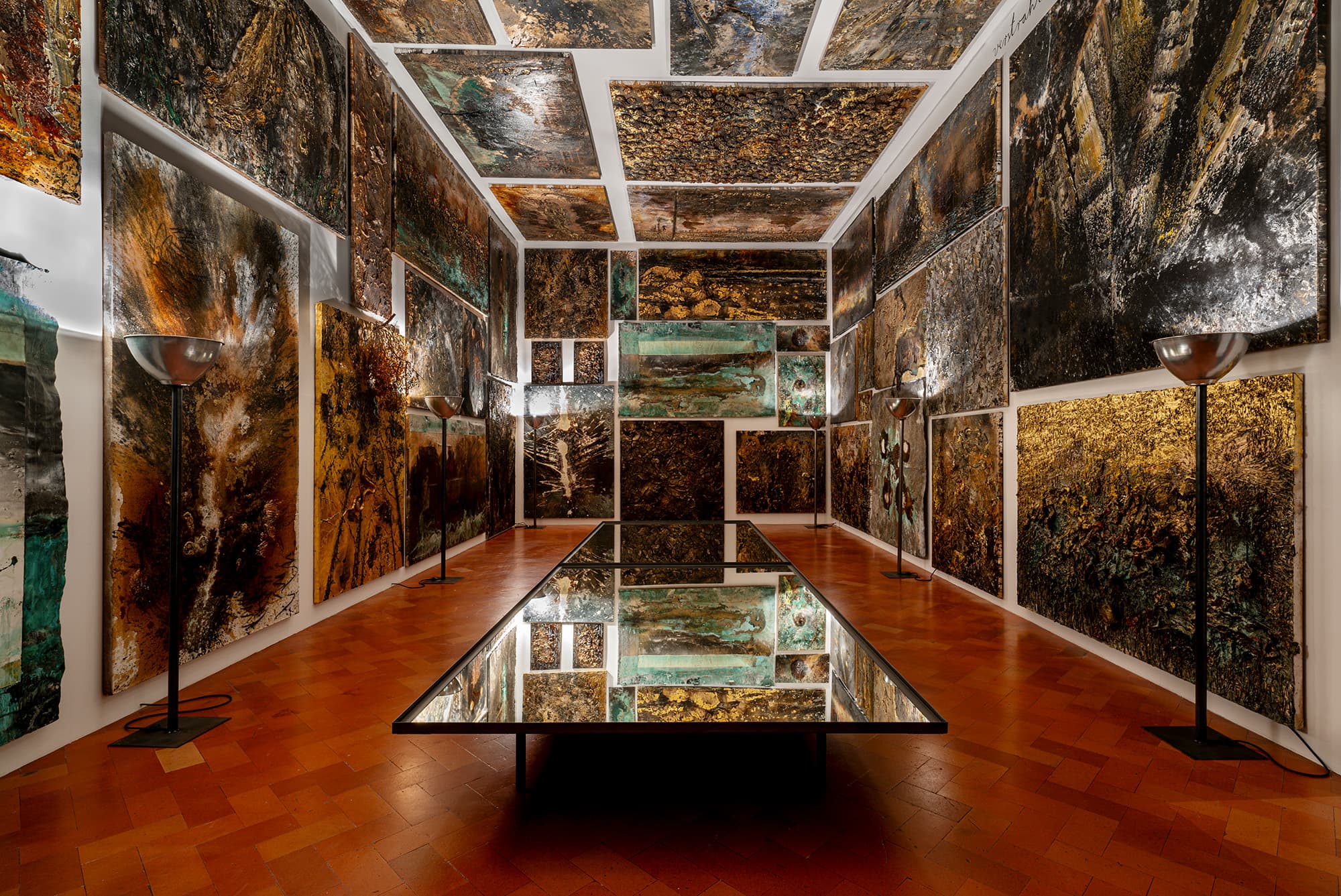
Nowhere is this more on display than in Verstrahlte Bilder (Irradiated Paintings) (1983-2023). Comprising sixty works completed over forty years, covering the walls and ceiling an entire room of the exhibition, Verstrahlte Bilder is an immersion, as close to selfie art as I can imagine Kiefer coming. “I put them in a radiated room to destroy them,” Kiefer says of the sixty works in an adjacent video. In the center of the room, a long rectangular mirror allows you to see the ceiling without craning, so long as you’re comfortable imposing your own reflection into the work. All of us, fallen angels.
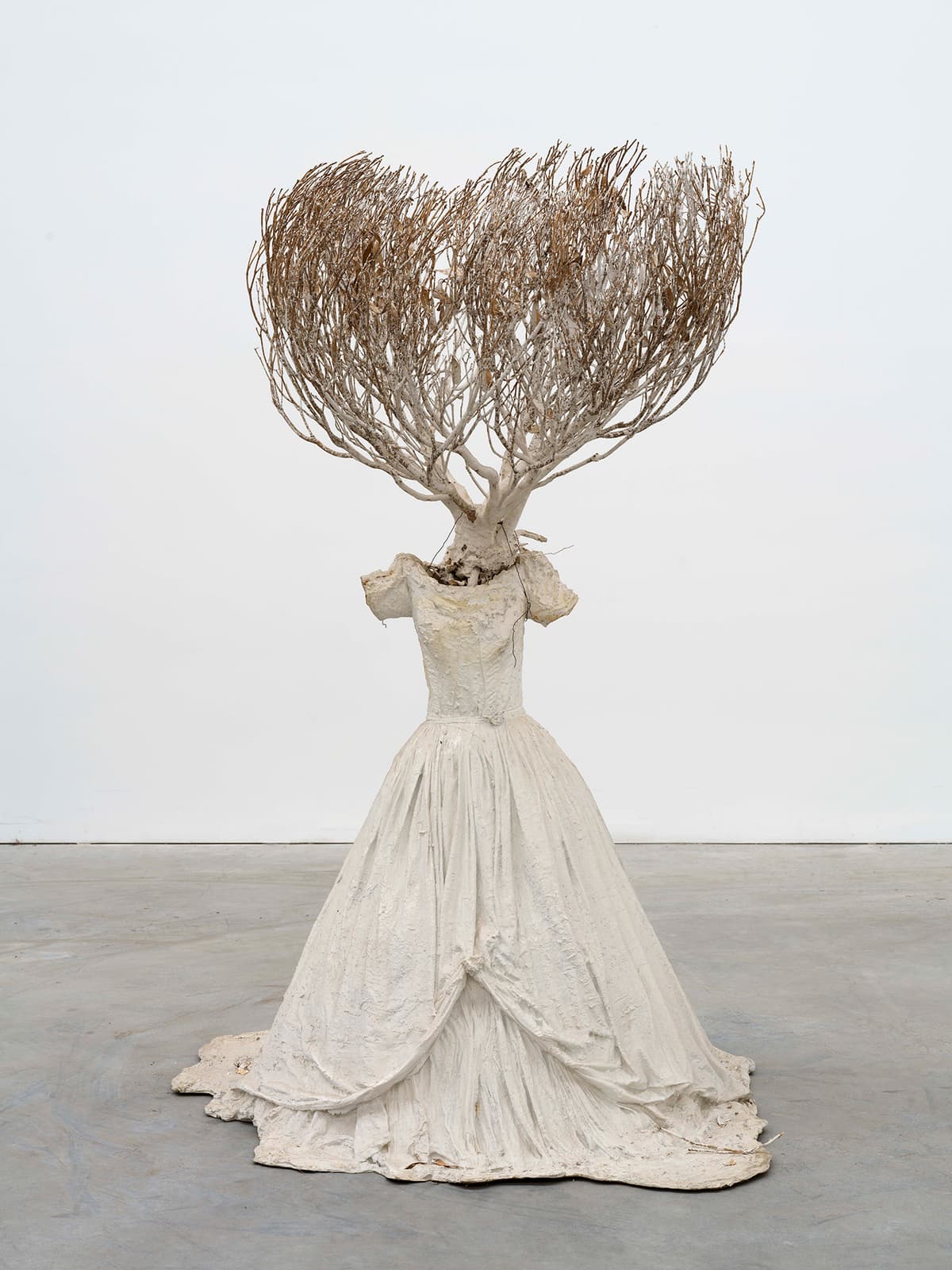
Amidst the falls and the radiation, Kiefer engages with empire and alchemy, religion and philosophy, mythology and literature. My favorite works are the resin and plaster hoop-skirted sculptures, dresses with symbolic heads: Daphne (2008-2011), Nemesis (2017), and Ave Maria turris eburnea (2017). His allusions are esoteric yet legible, often written on the work, if not incorporated in the title: Artaud, Van Gogh, Pre-Socratics and post-Socratics, Raphael’s fresco The School of Athens, the Kabbalah, Roussel, Joyce’s Finnegans Wake. Kiefer’s work urges viewers to read (“I put all these pre-Socratic philosophers in the painting, so people can restart to study this,” he explains in the exhibition video), and it’s the way he lets plaster become powder, oil paint turn tarry, that reminds me he’s such a poet of civilization.
Between my visits to Angeli caduti, I drove to Fiesole, nine-and-a-half kilometers away from Palazzo Strozzi. There, the stones of an Etruscan temple shakily hold the weight of a body. The Roman Baths are grassy and expansive. What will we leave of our time on earth? What beauty have we wrought, and what destruction? Here pools and cistern, there cryptoporticus, there frigidarium, tepidarium, calidarium. Amidst all of it, the rocks, blistered and particolored, mottled and spotted with new life, moss and lichen the gold of sunflowers.