ArtSeenJuly/August 2024Venice
Willem de Kooning and Italy

Word count: 2776
Paragraphs: 11
On View
Gallerie Dell’AccademiaWillem De Kooning and Italy
April 17–September 15, 2024
Venice
Willem de Kooning once famously wrote, “The desire to create a style beforehand is an apology for one’s anxiety.” Those of us who have admired de Kooning’s art, as well as his writings, acknowledge the remarkable yet allusive power of his insights about how he processed his monumental anxiety, and his singular ability to absorb all arts from the past, while at the same time retaining an extraordinary enthusiasm for new forms and new experiences, which he expressed differently during the different phases of his life. Everything he lived for was profoundly inseparable from his art. He painted to live; as Richard Shiff has pointed out, he “intended his art not to make sense but to be sense.”
This condition of simultaneity refers to how de Kooning responded both inwardly and outwardly to the different environments he lived in throughout his life. For example, his pictures from the late 1930s to early-to-mid-1940s, despite their official portraiture-like appearances that oscillate between monumentality and intimacy, evoke both his own feeling of being solitary and marginalized and the prevailing moods of the Great Depression. At the same time, in the early part of the 1940s, de Kooning was undertaking figuration and abstraction as a potential synthesis from his own reading of Surrealist automatism and biomorphism, which he deployed through delicate networks of lines that he gradually turned into painterly gestures, as in the “Women” series from 1951 onward. At the same time, his pictures often reveal his deep affection for New York City streets; we can even think of the artist as a flaneur, who readily embraced the dark, hauntingly gothic scenes of downtown Chelsea and the Bowery. His pictures of that period often contain elemental transmutations of repellent substances (including thick and burned motor oil that spilled from trucks parked during the day and filled the irregular cracks in the gutters, especially when it rained). The ways water resists being mixed with oil and unexpectedly slides on the surface were poetically embodied in the black and white abstractions of the late 1940s. Similarly, de Kooning continued to grapple with the appearance and disappearance of the figure throughout his life, both from the past figurative tradition, embodied in artists such as Veronese, Rubens, Rembrandt, and Cézanne, and in those of his own time, including Soutine, Kirchner, Picasso, and Bacon. By the mid 1950s, however, his hyperactive wide brushworks, painted with staggering dexterity, were liberated from any descriptive function. Twisting, smearing, flaying, dragging, and scraping, often patching-in parts with taping knives (a skill he had gained from being a professional house painter), he creates an inevitable feeling of congestion, compression, and density in what he titled as his urban abstractions.

In this exhibition, exquisitely curated by Gary Garrels and Mario Codognato, we find the links to de Kooning’s susceptibility in whatever environment he encountered throughout his life—and in which he bridged his spatial surroundings. Especially significant are the two visits he made to Italy in 1959 and 1969, and from 1963 onward his life in Springs, Long Island where he lived and worked until his death in 1997. We see in these works the degree to which the artist was endowed with an unusual teleological aptitude, enabling him to see his life’s goal as a purposeful trajectory rather than reacting to endless causes that may arise from life’s circumstances. Still, what seems to be a primal connecting element in de Kooning’s work is water, a substance that unified his hard-won synthesis of form and matter. One understands how de Kooning, who was born in 1904 in Rotterdam, a city surrounded by water, like most other places in the Netherlands, identified himself in relation to water. The artist later spent thirty four years in Springs, by Gardiner’s Bay which flows directly to the North Atlantic Ocean, like how the river Rotte, near Rotterdam, flows into the North Sea. The same can be said of the city of Venice, where this exhibition has been mounted in the venerable galleries of the Accademia.
At the entrance to this exhibition, I was thrilled to be welcomed by de Kooning’s classic sculpture Clamdigger (1972)—a human form, with a surface as if under water, yet existing in three dimensions as a permanent and enduring image. In the first gallery, the curatorial thesis represents the artist’s transitory condition: his impression of traveling back and forth between New York City and Springs, and Rome was visibly alluring. As may be expected, in his early works de Kooning had achieved an unusual mastery of a few pictorial techniques, namely his unfiltered psychic improvisation of Surrealist automatism. This in turn was often set in relation to an expansion of the cubist grid by means of softening the edges of gestural forms, while bringing forth the image to the frontal plane. But we also find the articulation of the interrupted and resumed brushstrokes seemingly constituting spatial breaks in a kind of collage methodology. All these different elements are deployed in ways that totally submerge them in his sensory experience of the surrounding environment. Throughout, the artist is acutely open and receptive to how each picture gets made in its own specific way, whether through the physical application of calligraphic marks or through a fragile balance between robust angular and expressive structures with prevailing moods of lyricism, reverie and suppleness. This is especially evident in his “Abstract Parkway Landscape” series, including Bolton Landing (1957), Detour (1958), and Brown Derby Road (1958), which were populated with muscular rectilinear gestures in the key of brownish yellow with admixtures of black and white, and browns that conjure the allusive intimation of both manmade things and nature—seen through glimpses, as we when are driving through bridges and tunnels, on highways, and passing trees, expanses of grass, and rivers.

In the six black and white pictures on paper de Kooning made during his first visit to Rome in 1959 (which are shown on one wall in the same gallery as the Parkway pictures), we see how he maintained the continuity of the calligraphic gestures in his “Abstract Parkway Landscape” series, which clearly led to his “Black and White Rome” series—a display of masterful mediation. On the pragmatic side, by making pictures on paper de Kooning was able to exploit the temporary space in-between, hence allowing him to think and execute with precise agility. On the formal side, having liberated the brushstrokes from literal translations along with the paradoxical coexistence between the explosive collapse of the scaffolding structure and the lyrical mood, he dramatically reinvented his own collage idiom with the simple application of the cut-and-paste of one or two straight and torn edges, as in Black and White Rome F (1959). We can think of this spatial schism as a pictorial arbitration of the old and new cities, namely Rome and New York. In addition to the search for a new light that approximates New York as a solid island, seen in the upper half of Untitled (1960); while Venice, a city built on a cluster of 126 small islands, can be seen in the bottom half. Here, de Kooning alchemically reactivated the black and white pictures of the late 1940s. Again, by mixing water into oil at times, for example, in the bottom half of Untitled (1960), which includes an inscription to his friend the Italian painter Afro Basaldella, we can see how the fractalized particles that resulted from the vaporization of water created an unexpected variance of scale. Like swirling winds inside clouds that spin water-sodden dust particles into clusters, which get melted to form raindrops, de Kooning deployed his own swirls of wind—the various velocities of his gestures, at times pressing hard against the surface, at other times caressing it with touches of tenderness.

In looking A Tree in Naples, Door to the River, and Villa Borghese (all painted in 1960), I came to realize that in the same way that the series of black and white pictures on paper precipitated the artist’s profound identification with water as an endlessly generative image, the same can be said of these three pictures. For they are each suffused in a shimmering idyllic depiction of true reverie, which in turn soon prompted the reappearance of the human form in his work. Thus, unlike the anxiously painted “Women” series of the early 1950s, from which images were often aggressively punctuated by breakneck pace in brushstrokes, set against drawn black lines, the distinction between painting and drawing is significantly less detectable in Woman, Sag Harbor (1964), Woman Accabonac (1966), and Woman on a Sign II (1967). Having fearlessly experimented with endless potentials of reaching maximal fluidity in paint handling as well as paint medium, de Kooning adapted a new technique of tracing and oil transfer, in which any desirable transposed fragment of one picture onto the surface of another was gleefully added to his technical arsenal. By mixing large amounts of white into some of the colors, including cadmium red and yellow, he created a broad range of pinks, pale yellows and oranges that contained most subtle chromatic effects, which offer utterly new effects– unforeseen tinges of luminosity. As de Kooning fully explored the wide variety of his wet-to-wet technique, his technique of delaying the drying time by using safflower cooking oil, mixed with linseed oil and water, proved to offer bold new advantages.

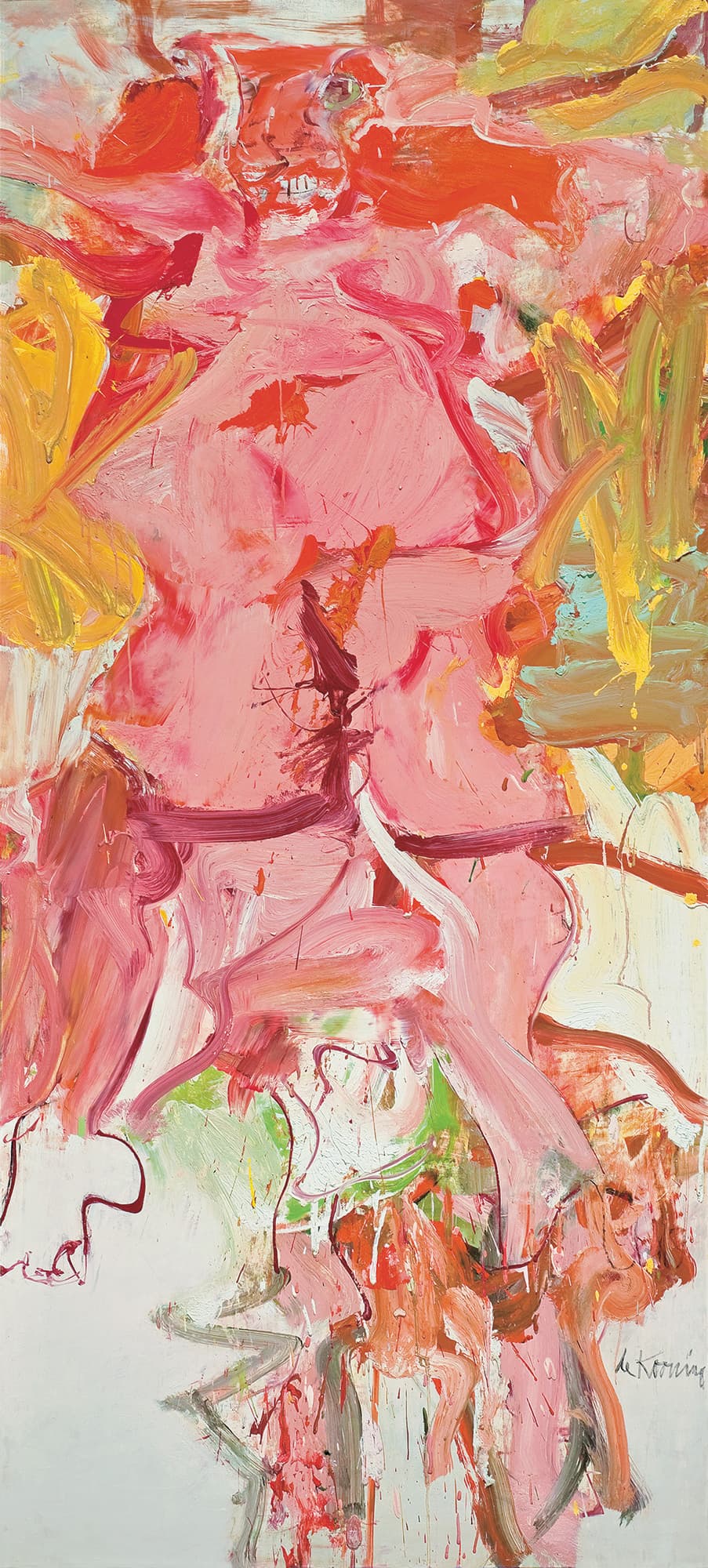
The question is how far could the artist extend his famous slippage? Would it be possible for an artist for whom everything flows as an eternal present, to be able to let go of the past and set no gaze upon the future? Again, upon entering the second gallery, we see in the pictures Woman in a Garden, Man Accabonac, Red Man with Moustache (all painted in 1971), the gradual disappearance of the figures as they melted into the painted surfaces, from which immaterial phenomena of sky and water heighten our awareness of ever-changing moments of light, sound, wind, and even a sense of smell. I think with profound wonderment how certain artists from the past, such as Titian, Michelangelo, Rembrandt, Matisse, Picasso, Rothko, Kahlo, and Bourgeois, would completely surrender in their old age either to regain childlike innocence to resist life’s hardship or to fight against death itself. In either case, their works often reveal various subtle and unsubtle manifestations of their psychological states of mind. I felt, as de Kooning’s figures emerged from what he once called “no-environment,” then submerged below the landscape or water throughout different stages in his evolution, that it wasn’t until the mid 1970s that the total surrender to water as an essential matter was fully achieved: an explicit psychic reference to the artist’s extended journey through knowing in order to be free, without being consciously mindful of either the condition of to be free from or to something, de Kooning at the age of 71 has finally arrived at his lifelong search of cyclical purpose. T.S. Eliot eloquently stated that what we call the beginning is often the end, “And to make an end is to make a beginning. The end is where we start from.” It is from this perspective that I thought of affinities between de Kooning’s state of mind and Cézanne’s profound mind/body predicament, as discussed in Maurice Merleau-Ponty’s famous essay Cézanne’s Doubt (1945). And as I thought about how de Kooning’s own doubt was explored by Richard Shiff in his critical volume Between Sense and de Kooning (2011), I found de Kooning’s identification with water as a poetic aegis deeply moving. Standing in front of North Atlantic Light (Untitled XVIII) (1977), Screams of Children Come from Seagulls (Untitled XX) (1975), and Untitled XX (1976), all installed on one wall, I also thought of the artist’s other masterpiece ...Whose Name Was Writ in Water (1975)—named after the epitaph that appears on John Keats's tomb (Here lies one whose name was writ in water) that de Kooning saw on his visit to the poet’s home in Piazza di Spagna and his grave at the Non-Catholic Cemetery. Like the rest of this body of work that continues till the end of the artist’s life in 1997, these pictures embody what Gaston Bachelard referred to as the formal and material conditions, and how both can be fully activated. While the former arises from our emotions and sensations, the latter yields to the substance of matter while seeking consistency within matter, and extracts power from the substance itself. As our eyes move across these pictures, whether from up close or from a distance, all elements—from sky to water, bubbles to sprays, trough to crest, wind speed to breakers, and so on—were inexplicably integrated through abstraction. And diverse experiences coalesce with natural phenomena to produce moving and enduring images.


Equally intriguing in this exhibition were the two small rooms filled with thoughtful selections of drawings made with graphite, ink, and charcoal, between 1962 to 1980. The same is true of the generous groups of sculptures made between 1969 and 1974, which were perfectly installed in the first and second galleries. As the varieties of lines in his drawings become even more varied, according to their speeds of execution, we notice how the gradual migration from figuration to abstraction, and vice versa, mirrors his aging process. In his sculpture we recognize endless permutations, and their resistance to predictable rhythms, while at the same time the flux of his images is resolutely irregular. De Kooning is known to have made drawings with his eyes closed, from moving images on a television screen, and we realize that both his drawings and his sculptures are essentially representations of his legendary slippages, in two and three-dimensions. The emergence or submergence of the figures on and in water are fluent reveries that thrive in between de Kooning’s buoyant exploration of water surfaces and the feeling of weight and seem to be associated with his sense of his own mortality, mysteriously immersed in the depth of water. And water, like time, runs constantly forward, without any rest, and never returns to its point of departure.
In the last gallery of the exhibition, which includes six pictures from the 1980s, hung not in exact chronological order but rather for the sake of visual cohesiveness, I was delighted to be guided by Untitled XXI (1982) from one wall to The Cat’s Meow (1987) on the opposite wall. The rhythmic continuity visually follows with Untitled II (1983), Pirate ((Untitled II) (1981), then [no title] (1985), and Untitled VI (1984), all installed on the two walls in between. In these pictures we observe de Kooning’s masterful use of white tinted with other colors, creating forms which even when they appear flat suggest volume, and leave the varying degrees of what is considered finished and unfinished substantially visible. With the reduced palette mostly of primary colors and white, with minimal use of black, de Kooning’s late pictures call forth a kind of phantom presence of Mondrian’s imagery, especially Broadway Boogie Woogie (1942-43). We might even think of de Kooning’s late pictures as melted Mondrians, and it’s interesting to reflect on how our spatial perception in the Mondrian pictures, which often is based on the optical vibrations resulting from asymmetrical distribution of rectilinear forms on a grid, informs de Kooning’s quite different sense of plasticity experienced as sculptural forms that are flattened out. We may even think that while one began with contemplating nature yet ended up with the vibrancy of the city, the other found himself in an urban environment and walked himself into his own landscape.

As this exhibition makes clear, even at the very end, de Kooning never lost sight of his lifelong goal of prolonging his allusiveness with staggering agility to escape all habits of reduction. Seeing these works together makes us aware that the artist’s idiosyncratic idiom reflects his acrobatic dexterity, or illusive agility, which allowed him to resist at all costs being easily understood, being labeled. De Kooning’s works reflect a unique personal worldview that recalls the words of Søren Kierkegaard, the philosopher he most admired, who once wrote: “If you name me, you negate me. By giving a name, a label, you negate all the other things I could possibly be.”
Phong H. Bui is the Publisher and Artistic Director of the Brooklyn Rail.