
Word count: 4909
Paragraphs: 46
On View
White CubeAERIAL
April 30–June 15, 2024
New York
Antony Gormley’s Aerial is unlike anything the artist has installed in this country and indeed does not have many direct precedents in his earlier practice. Aerial takes the form of a complex grid that derives its coordinates from the gallery that houses it, and while it completely fills the space, it is not a solid cube that we can only walk around; instead, Aerial is penetrable, both visually and physically. In works such as 2010’s Breathing Room III, Gormley had experimented with the concept of a grid-room, but whereas that installation’s rectangles were closed forms, Aerial’s orthogonals are often left open, with the arms of its aluminum beams extending beyond square or stopping just short of the ceiling, floor, wall, or even the viewers’ foreheads. We must slink and stoop and hitch our legs over horizontals to make our way through. The combination of the lightweight aluminum, natural light entering the gallery from the entrance’s tall double doors and crowning lunette, and the optical effect of parallax—during which our moving eyes perceive two elements as overlapping and thus converging—yields a sculpture that is both resolutely present and dissolves before us; it is undoubtedly very heavy and simultaneously as light as air.
Antony Gormley and I spoke on the 13th of May via Zoom; we’ve edited our conversation for length and clarity.

Amanda Gluibizzi (Rail): I was very excited to see Another Place (1997) with the Aurora Borealis this weekend in a beautiful picture in The Guardian.
Antony Gormley: Well, I don’t think I can call on Aurora Borealis as having anything to do with my work. I guess anybody who’s taking long-exposure pictures wants a still object in the foreground. And I can provide that.
Rail: You talk about stillness a lot in your writings and in your interviews. Stillness seems to be something that is important to you.
Gormley: I think that the two characteristics of sculpture are stillness and silence. And it seems crazy to me not to be able to use them positively. In the stillness of sculpture, there is the invitation for us to exercise our freedom of will in movement. That is perhaps most powerfully materialized in Aerial at White Cube in New York, which is an attempt to disperse the object nature of sculpture in trying to make an instrument that materializes space itself, but it does that in absolute stillness. I think the work attempts to defy gravity, and this allows the language of architecture, its orthogonality, its verticality and horizontality, to emerge from the containing function, to become a fulfilling function, and allow us to move into the space with a higher awareness of our own movement. And I guess that is one of the things that sculpture can do: it invites us to take care of or become more aware of our own sensations, perceptions, and transitions as we move. To that extent, though the work is instrumental and an instrument, it’s an instrument for a kind of contemplation in which we are not being invited to contemplate simply the exquisiteness of a humanly made thing, but the interface between that and our internal condition and our proprioception—the awareness of our own being in space, and therefore in time, is actually preeminent. So maybe those questions that are often asked of sculpture—how is this achieved? how is this done?—disappear or are less forward than the question, what is happening to me?

Rail: I went twice, first just to experience it. Because it’s the first time that I’ve been able to experience one of your environments, as opposed to a sculpture that you would walk around. This is something that I can actually walk through. So I wanted to be sure that I was able to understand that. Then I went back again to really look at the materials and to see how things were built. And it is true that Aerial does take care of that question for us about how this is done, because everything is visible.
Gormley: That’s always been an important principle for me: I didn’t want to hide anything of the story of the object’s making. But it would worry me if that was the first thing that you got engaged with.
I have to tell you, Amanda, that we built this thing, or half of it, in the space here at the studio. And I realized what an enormous risk we were running because the distortions in the natural flexion of the material, given that there is no direct load path, are almost impossible to predict. But you have to, as much as you can, which is why it was so important to pre-build it. But then we had to build compensatory deflections into the construction. I don’t want people to get so obsessed with the mechanics of this thing that they lose the magic. But I was stopped in my tracks because I was aware of what the issues were. You’ve got massive cantilevers that cause massive amounts of deflection from the absolute horizontals and verticals. And I came on Thursday night, and I was stopped in my tracks and just said, “This is amazing,” because I didn’t think that we could do it that well. We had done it, but not to that degree. There it was, holding and vibrating. And the added thing that I had not realized at all was that the light from the front door made this breathing between inside and outside, which is so pertinent to the piece, but I hadn’t realized what an effect it would have.
There is a stage in the day where you get reflected light off the facade of the building on the other side of Madison Avenue that just floods into the gallery, and that light is then filtered through the entire work from the front to the back. I was euphoric. I just thought, “My God, this is what I’ve been dreaming about for years.” Is it possible to structure space itself? Is it possible to materialize air in a way that is respectful of the fact that we are urban animals, and that we live in a humanly constructed world, but at the same time, one that responds to and acknowledges the elemental world and the greater than human world? And I thought, I wish that Mondrian was alive today, because I’d invite him round and get him to look at it and walk through it. The other part of my euphoria was knowing that I could not have done this in a more pertinent context. Here is New York, the longest-lasting social experiment on mass-density living. That’s why Mondrian had to come to New York to fulfill his vision. And I just felt so delighted that this work, which could have been shown in Germany or somewhere else, actually was on the ground floor in Manhattan.

Rail: You said something about materializing air, which is a peculiar experience in this installation. I went in the morning the first time and right in the middle of the afternoon the second time, and I had the same experience with this materialization of the air that you’re describing, but at different moments in the piece. There is an optical illusion that’s created between some of the aluminum blades where you begin to see almost a piece of glass between them. The realization that you’re visualizing something clear, which then mediates the clarity that you see is truly astonishing. I was quite struck by this. In the morning moment, I saw the pane of glass while moving around the installation from the back right corner, while in the afternoon, I noticed it when I was within the installation and looking out to the front left. What an amazing effect that the sculpture produces. But you’re right: you have to interact with it to see it.
Gormley: I do want people to pass into it. There are whole zones, even if you don’t do the full choreography and step over one and duck under the next, which you would have to do in order to pass right through the whole work. I still want people to go into the work: you can get to the core of the work so that it surrounds you on all sides. Rather than blades, I call them spines, because they are in a way. You could also call them elements because they are long bars that are measuring themselves because you constantly see one vertical against another or one horizontal against another. The tuning of the work and getting the spines to be congruent was very much an important part of the whole thing. The thing that excited me is how you could continue the story achieved by perspective that credibly gives the illusion of three-dimensional space on a two-dimensional surface. I believe I have both confounded and continued this investigation of how to give structure to an artwork that gives space materiality, but where you are not just in the picture, but making the picture. So, instead of being fixed in the vanishing point of Piero della Francesca’s Citta Ideale (ca. 1480), for example, here, you are obliged to move through this structuring of space in which every single view is completely unique and independent, even if they are congruent. There’s a long history of dialogue in this work with the history of perspective and its breaking, you could say, in Cubism. But the experience of space and time as congruent participants in the making of real-time experience is flattened in Cubism on the whole, if we think of pictorial Cubism. Here, you are the maker, you are put in the position as the maker of the field. For me, this is a really exciting thing, and that’s what makes this work move things on.
That’s why I’m so happy that it’s in New York. There’s the continuation of a bigger question, which is where human perception, in a time of the urbanization of our species, ends up and how we retain those extended intelligences of our forgotten ancestors. Those were spatial and temporal in an absolute way, where familiarity with the smell of the air, the firmament at night, the direction of the wind, the season of the year, all of those things were totally alive to us, because they were what our lives depended on. And as I see us bequeath more and more to our environment, in terms of control and information, those perceptual elements that I think are so essential to our being are diminishing. That’s the urgency of this work in the time of massive climate catastrophe and a questioning of human futures.

Rail: What you’ve just said brings up so many questions. First, you are thinking about the horizon, obviously, in terms of perspective, but are you also thinking of it in terms of something like what Heidegger would say about the horizon as the boundary which can be the horizon that we see in perspective, but can also be the boundary of our bodies?
Gormley: Absolutely. The Heideggerian idea of the horizon as this final perceptual limit of, as it were, the body, is very important to me. But maybe more importantly as an aspect of that is the idea that it is both entirely subjective, that it moves with us as the edge of our life path, but that we all experience it or can experience it and that it is therefore common, empiric and to that extent, objective. If we relate this to a work of mine that New Yorkers might know better than most, Event Horizon (2010), which was dispersed from the containment of the institution or the private gallery, we were invited to become aware of that elevated horizon where the made world reaches or touches the infinity of the sky.
Rail: Yes. It’s funny that you bring that up. My daughter is young, and she was asking us the other day, “Can you imagine if somebody put a sculpture on the building, and it looked like it was going to jump off?” And I was like, “Yes, I can. Lately, I’ve been thinking about that sculpture all the time!”
Gormley: You saw that work?
Rail: Yes. You mentioned Mondrian, too. The Mondrian that I think of is nearly pre-De Stijl Mondrian, such as Tableau No. 2/Composition No. VII (1913).
Gormley: Yeah, there’s The Flowering Apple Tree (1912). And then I think Composition No. 10 Pier and Ocean (1915) is the most obvious and clear reference to an attempt to recognize these two primal coordinates—the vertical and the horizontal—but use them as a way of describing space without perspective. I suppose Pier is more or less like a tower versus the horizontal of the horizon, but I think Pier and Ocean was the real point of reference for Aerial, except now liberating it into a volume and into three dimensions.

Rail: One of the important things to me for Mondrian’s work is his awareness of when he stops the grid. Some of the lines go all the way to the edge, some of them stop far away from the edge, and then there are some that are very, very close.
Gormley: I’ve done exactly the same in terms of those spines or elements that are penetrating the wall, those that stop a good way away from it, and those that hover just off it. And those were very important decisions.
Rail: Why?
Gormley: Because I think on the one hand, you want to acknowledge the containment, touch the containment, but then you also want, I think, to create a vibration or a degree of separation. And it’s the same in relation to the floor and the ceiling. You could say we need to acknowledge the floor and the ceiling as the necessary support—the walls, floors, and ceiling are equally, well not equally in load terms, but I am trying to equally acknowledge them as definers of the given volume. But at the same time, it was so important to have quite a lot of lateral elements that hovered above the floor, as there were also vertical elements that both touched the floor and hovered above it. This is the first version of this work, and I think that we will go on experimenting with this language, this syntax of a branching system that is constantly making Ts that become Hs where one element of the H has to be horizontal and one has to be vertical. That’s the basic rule, but that rule was broken. If we followed the rule to the absolute, we would end up with something very boring. There was a lot of to-ing and fro-ing. And there will be every time we attempt this again. There are elements now that I would have done differently.
In spite of all of that, this is, to a degree, an organic structure that has its own life and we’ve learned a lot in making it. But I think that we need to make it again and we need to evolve it further. As you come in on the left-hand side, just maybe two feet to the left of the centerline, there is a confluence of verticals that I regret having so strong. There are all kinds of things that we have noted and will improve on next time. But that doesn’t take away from my feeling that this is a really important step for the work.
Rail: When art historians—of which I am one—talk about the grid, we talk about the grid as either having centripetal force moving in or a centrifugal force moving out. And this is a weird grid because it’s clearly centripetal because it’s being defined by the space in which it’s placed. Then, of course, obviously first as we penetrate, it is centrifugal because it emanates out from us, but it also sounds like you have a feeling that it could continue to be built, which suggests as well that it’s centrifugal.
Gormley: Yeah, it is Mary Douglas, who wrote Purity and Danger (1966), who makes a distinction between the grid and the group: the idea of organic groups and the idea of grouping, which, in the end, is a branching system. That’s why I insist that while Aerial is all orthogonal, it is also organic. And this is the tension I think between your centripetal and centrifugal forces. The grid is an absolute and Aerial is not absolute, it is a growing thing, and it is closer to a mycelium than it is to a Haussmann nineteenth-century metropolitan grid plan. And that’s really important for the energy, which has to be aleatoric. The energy, in spite of the orthogonal language, has to be chaotic and untameable in a way.

Rail: That’s tricky, though, because if we think about Mary Douglas, one of the things she talks about is the danger of impurity from internal contradiction. So then how do you deal with that? How do you manage both chaos and the avoidance of collision?
Gormley: Isn’t that what art is? That’s the tightrope you have to walk. We’re being very intellectual, but I want this to be bodily and perceptual and, in the end, that tension is something that has to be translated into whatever feeling the viewer has and projects from the field of the work.
Rail: So, what happens in the work if somebody does hit themselves on it? Are the beams strong enough to withstand that?
Gormley: There’s a tuning kit! We left that with the gallery which, I mean, you would have to attend to the puncturing of the visitor first and then attend to whatever wonkiness was in the work.
Rail: You’ve used the word tuned, but you also have discussed it as tuning. It is both itself tuned, but then it is tuning the air, which is how you described it in your conversation at the Morgan Library. It’s clearly tuning us. Thus, I think, its title. But I was interested in this because of course, in the United States, we don’t necessarily call them aerials. That lets the title have multiple plays on words, both a tuning device and a winged being. I was thinking about this a lot: you have made the Angel Of The North, Gateshead (1998). You also discuss Plato quite a bit. As the theorist William Gass interprets Plato, we’re fallen angels, we were once winged. I was very curious about the potential of Aerial as being a way to allow us to regain wings.
Gormley: I think that in the end, we are spatial creatures, and in a highly hermeneutic world, where we are all to a lesser or greater extent slaves to a late capitalist extractive economy, that part of our nature is not so apparent to us, as it should be. Curiously, for me, the window or the threshold to that experience is meditation, particularly Vipassana meditation. We use so much of our willing powers to achieve very goal-oriented effectiveness, but in the process of turning our lives into mechanical instruments for affecting work, I think we lose that aerial nature, which I think is our true nature. And it is only by stilling the body and liberating the mind into a form of contemplation of being that we can access that part of our natures. That’s a very difficult thing—we’re all working in clock time and trying to achieve outcomes that are predetermined and that whole need for reverie and immersion in the, as it were, non-functional activity is minimized, if not erased entirely, from our world. This is why art is so utterly important and such a vital tool for our full survival. It looks likely that we might survive firstly as cyborgs and then probably by dispensing the body altogether, and this isn’t a good evolutionary story in my view.
Rail: When I went upstairs, I was particularly struck by the abstract drawings that are included, because they made me think about Aerial in a different way. Even though they’re hung next to sculptures that are more traditionally sculptures, if you will. They made me start to think about how Aerial would look, if I looked down from above, particularly Aperture I (2023), the drawing that’s hanging near to the elevator.
Gormley: That was very important, like a coup de théâtre, as the elevators opened, you are presented with a drawing that shows a tunneling aperture of light coming from an uncertain source, in some kind of spatial relationship that might or might not relate to what you had experienced downstairs. But it’s funny, I didn’t have anything to do with which drawings were chosen. I am quite anal about my exhibitions on the whole, but in this case, I just said to Adam Humphries, who’s worked with me for about twenty years, “Adam, you just try some things out, these are some of the drawings.” Anyway, he did, and it was just so good. It was so right, and without any attempt to explain but to allow the drawings to become catalysts for a kind of reassessment of the experience you’ve just had of the objects with which you’re sharing this space. In a way, they unsettle the context enough to allow you to broaden the field you’re experiencing.
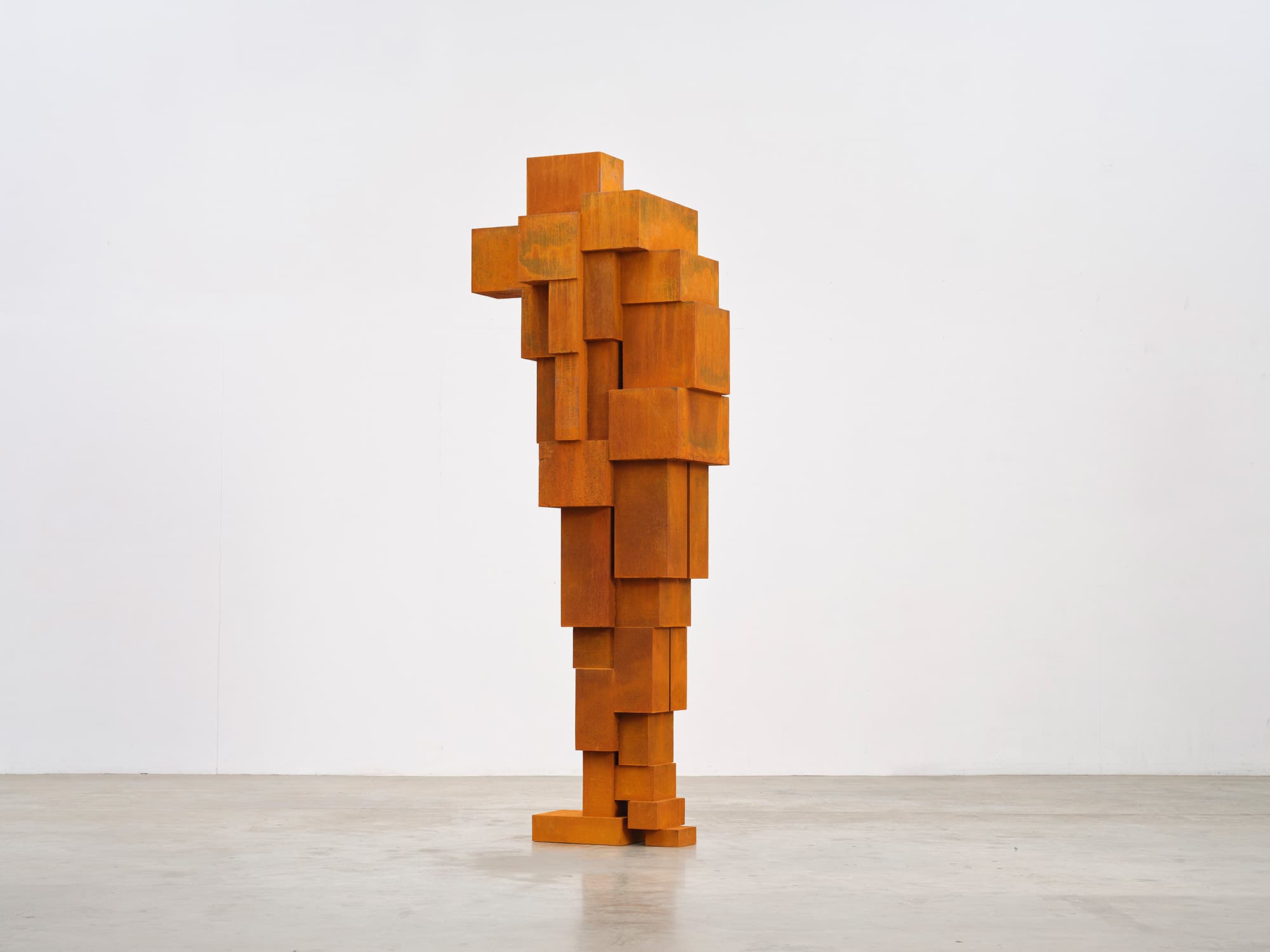
I am very aware of the monumentality of those works upstairs, their materiality, but also you could say their subject matter, the idea of trying to give an account of the human need for love or fellowship or connection that is fraught enough. I’ve avoided it really, as much as possible, because I’ve always felt the last thing I want to do is illustrate emotion. But I do want to make a ground that will be open enough to receive the projected emotion of a viewer. And it was really only as a result of doing the show at the Rodin Museum that I realized how. The first one that you see, Big Tender (2023) is, in a way, very clear: two identical works mirroring one another, slightly offset, and then hovering. But the other two are both the result of having gotten two already-made life-sized works and crashing them together or just literally moving them around and trying them in different orientations with each other until a connectivity was found between the two. One is more extreme and dramatic (Big Bare [2023]), the kind of sky-looking slightly inert body versus the carrier. And then the one that is much more aloof (Big Sidle [2023]): these two bodies have been brought together and one looks over the other’s shoulder—a sort of sly association, one of mutual support in a way, but not so dramatic as the other one. I hope that I’ve succeeded in making works that talk about the body as a still space, but that if the body is a space, the existence of another body extends that space and is a necessary part of self-knowledge.
Rail: It seems important to me that there are moments in those sculptures where you can see through them.
Gormley: Yeah, the gaps are very important.
Rail: Yes, I was thinking of the notes that I had written for you. I just wrote, “Upstairs: ‘being singular, plural.’”
Gormley: Oh, that’s very good. I like that Amanda, I like that.
Rail: May I read you a little bit of that? This is from Jean-Luc Nancy’s Being Singular Plural (2000). He writes:
There is no meaning if meaning is not shared. And not because there would be an ultimate or first signification that all beings have in common, but because meaning is itself the sharing of being. Meaning begins where presence is not pure presence, but where presence comes apart in order to be itself as such. This “as” presupposes the distancing, spacing, and division of presence.
He then goes on to write, “Being cannot be anything but being-with-one-another, circulating in the with and as the with of this singularly plural existence. If one can put it like this, there is no other meaning than the meaning of circulation. But this circulation goes in all directions at once, in all the directions of all the space-times.”

Gormley: Well. That’s pretty good. There are so many things to say, but that is really, really good. The break that I made with perspective, which is a form of control, allowing the freedom of the viewers’ passage to be the freedom of both deciding where to be still and where to be in motion is, I think, complemented upstairs by my absolute refusal of the trope of the artist’s job to use distance, in order to make an illusion for presence. So, the degree to which these works all come from inside: they are all derived from captured moments, whether captured by plaster moulding or now by scanning a lived moment of human life. They are a denial of the artist/model trope—me here, object there—in favor of the idea of holding onto whatever that space is at the other side of appearance and making that present. Then everything that Nancy says in suggesting that it is only through sharing our experience of being that we know ourselves, and that this is the only thing that we have to share and that’s what makes a world, is really important to me as a model of another way of conceiving what the artist’s work is. You could say that what he says about presence is equally true of art, that art only becomes art when it’s shared. That’s the only point of its existence. I guess I’ve spent a lot of my working life thinking about trying to reconcile the body as a space, the body as a place and the Umwelt, or space at large.
There was a moment in the work when I was very obsessed with a kind of Lacanian mirror phase, the threshold of self-determination where you realize that you are a free object in the world. But these new works are a breakthrough for me. I would never have previously dared to do it because of my rejection, if you like, of the pictorial or the narrative or the illustration of emotion, and maybe there is still much more work to do on this. I think Big Sidle is the one that shows that by displacing space while acknowledging space, we can speak to how, with our significant others, we somehow become both ourselves and extended. This sounds a little bit pretentious, and also maybe a little too obvious, but I guess it is? I was for a long time obsessed with Brâncuși’s The Kiss (1907–08) because this is one object that became two, or two objects that became one. The thing about Big Sidle is both the independence and the mutuality that it describes, or evokes. And I guess it’s an attempt for me to acknowledge how, and maybe you can only realize this after you’ve been around on the face of the world for a while, that it is only through others that we become ourselves.
I think the biggest challenge is that we are others to ourselves. And it’s only in understanding our need for others that we can fulfill our own potential. The destruction of the patriarchy or the deconstruction of the certainties that fueled colonialism or the many empires of the world can only be achieved, I think, through a process of reflexivity in which you start with the idea of being a stranger to yourself. This is such a threat to what has made the West successful that I think people are not, well, maybe not prepared enough, to do that exercise. But my view is that sculpture has always been an instrument for reflexivity, self-examination, and self-knowledge. We have always found it necessary to make models of ourselves and, indeed, the world that we live in. It is interesting to me that if you think of Egyptian sculpture, there are equal numbers of evocations of boats and buildings as there are bodies. We’ve had to model both ourselves and the worlds that we have built in order to understand ourselves. This has been an absolutely essential tool of survival. And it is now, but it’s more urgent now than ever before.
Amanda Gluibizzi is an art editor at the Rail. An art historian, she is the Co-Director of the New Foundation for Art History and the author of Art and Design in 1960s New York (2021, paperback 2025).