Word count: 925
Paragraphs: 7
On View
Nancy Hoffman GalleryStill
March 21–May 25, 2024
New York
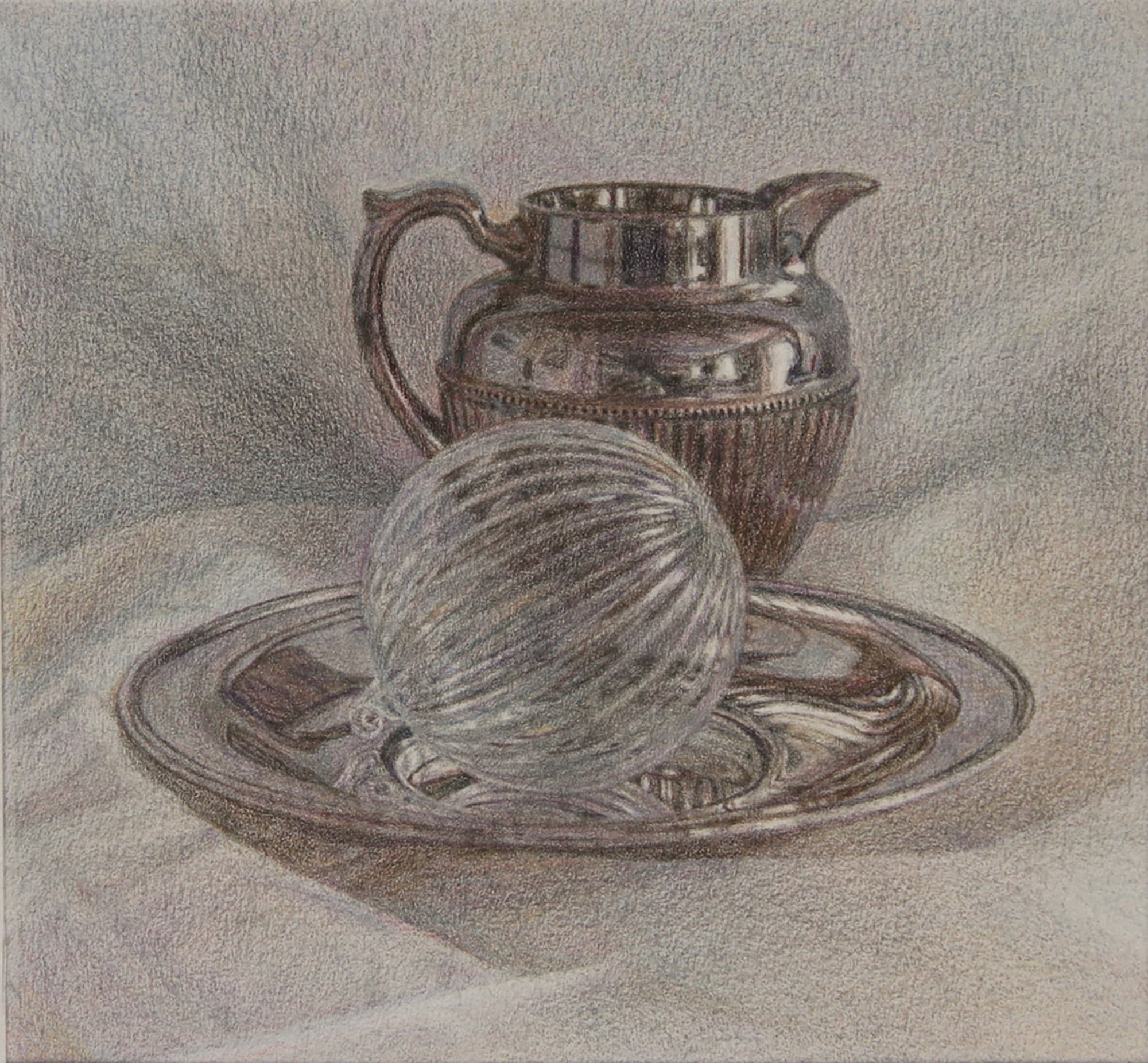
Entering Lucy Mackenzie’s exhibition at Nancy Hoffman, simply (and aptly) titled “Still, the viewer espies a channel of postcard-sized still lifes lining the gallery walls. If one is not familiar with Mackenzie’s work, they might be forgiven for mistaking her paintings for photographs. Upon recognizing the slightest indication of a brushstroke, they might then judge Mackenzie a photorealist, a testament to her painterly skill. But where photorealism, inaugurated by painters like Robert Bethel, involves copying photographs, often with the assistance of a projector, Mackenzie paints from gleaned objects, arranged carefully in her domicile. Her menagerie includes duck decoys, stacked poetry books, Edwardian tableware, folded dress shirts, roseate china, World War II military badges, earthenware mugs, Staffordshire greyhound inkwells, flora, and an indented cinder block imprinted with “LONDON BRICK.” Mackenzie has accumulated these objects over decades of sifting her local English beach and nearby specialty stores, and she paints them with impressive verism. Above all, she carefully attends to the emanation of light and luminous shadow, tinged with faint greens and blue-greys. Mackenzie concerns herself with what some might regard as inconsequential. But from this she reveals consequence, illuminating the light swaying between the folds of a garment or the shadows ambling along the perimeter of branch sockets. Her objects are portrayed, one and all, with a warm, fogged, affection.
Jan Davidsz de Heem’s Still Life with a Glass and Oysters (ca. 1640) features a curling lemon rind arranged in a helix strip, resting atop a roemer. Below this knob-based glass, de Heem has placed shucked oysters whose open flesh receives the ministration of de Heem’s gentle light. Mackenzie, too, has a proclivity for spiral, dipping, twisting forms that cradle and filter sunlight. A towering clare-red citadel of a seashell hangs in the back of Still Life with Two Shells (2023), eclipsed by a second, undulating white crust. Here and elsewhere, such perspectival diminution allows shell ridges, fruit skin, and glassware to shimmer. Yet where de Heem’s pebbled pith rind dances in the air, its tip buoyed in an inch of amber wine, nothing is so dramatic in Mackenzie’s compositions. Furthermore, unlike her Northern Renaissance progenitors—including de Heem, Rachel Ruysch, and Gerard van Spaendonck, who imbued their still lifes with narratives informed by the interior spaces in which objects were housed—Mackenzie is not a symbolist. She is not working with semiotics or iconography. Her work has nothing to do with power dynamics and even less to do with visual culture. Mackenzie is simply sharing what is dear and visually sensuous to her.

Mackenzie’s interests tread through and along the borders of the beauty we find dormant in prosaic things. Her work calls to mind the idea Kant outlines in the Third Critique’s “Analytic of the Beautiful,” that the “pleasure [in beauty] must necessarily rest on the same conditions in everyone, since they are subjective conditions of the possibility of a cognition in general, and the proportion of these cognitive faculties that is required for taste.” According to one particular interpretation of this passage, Kant is arguing that all cognizing is pleasurable but habit attenuates us, eroding the beauty latent in the commonplace. Mackenzie’s work thus reacquaints us with such lost beauty. The viewer’s eye can spend a great deal of time with these small paintings, tracking, in French Cup and Paper Cases (2020) for example, the way the edges of one overturned pleated cupcake holder balance atop the rim of another. Elsewhere, poised beside a looming minute goblet, a porcelain mug’s cream colours drift into adumbrated yellows. Mackenzie scrutinizes the quiet beauty of muted drama.
In Model Aeroplane on a Chair (2023), the eponymous aeroplane is mounted atop a wooden stool. The model plane’s diaphanous fuselage and wings are skeletal, as if constructed from wax paper. Shot through with light, they resemble the veiny wings of a dragonfly. Shadows and sunlight patches trade along the penumbra to reveal the wooden chair’s grains. The plane’s wrinkles appear coordinated with the seat’s fibroid russet sinews. Such is Mackenzie’s poetry, a lyrical casting of optically pleasing pattern-based relations.

The modernization of the nature morte has, following the reductive arc of orthodox modernism, increasingly contracted the picture plane. Foreground, background, and studied objects alike have been progressively flattened, each element dissolved into strident lines and invariable colour hues. One sees this proclivity in the modernist bastions of the genre, be they Morandi’s porcelain vases fit with lush bouquets, Euan Uglow’s glowing lime-green pears, or Matisse’s dried lemons prostrated on a pewter plate. Mackenzie is out of step with this chronology, closest perhaps to the Nicholson family of painters (viz., Winifred, Ben, and William) who, to quote Claudia Tobin, “fashioned a space in which the everyday was given renewed attention.”
Enduringly and arduously painting with many layers of gesso oil glaze and foregoing canvas for board, Mackenzie paints slowly. The exhibition presents thirty-two pieces completed over eight years. There is little indication that her interests, temperament, or style have changed during this period. In an epoch where artists churn out pieces and work in variegated media, this, too, makes Mackenzie seem anachronistic. Her work delights in beauty so simple it feels antiquated—one ought not approach Mackenzie’s work expecting conceptual convolution or avant-garde-ist posturing. Instead, admire the enduring value in painting for beauty’s sake.
Ekin Erkan is a writer, curator, and researcher whose writing has appeared in the Journal of Value Inquiry, the International Journal of Philosophical Studies, and Hyperallergic, among others.