Word count: 4806
Paragraphs: 52
On View
Almine RechThe Wilds and the Shore
May 7–June 15, 2024
New York
February 28–May 25, 2024
Los Angeles
Although I’ve followed Leelee Kimmel’s work ever since I saw her first solo exhibit Channels at The Journal Gallery, New York in 2018, it wasn’t until September 16, 2021, that we finally met at a festive dinner gathering for an artist on the Upper East Side. I must confess that whatever the impending conditions of our viewing experience—from being moved, perplexed to being deeply curious as to how artists make certain decisions capable of breathing life into their works of art—having in-depth conversations with artists is one of the profound joys of the Rail’s living organism. Leelee’s case is no exception. I remember being in full rapture before many of her paintings, due, at least in part, to the maximal stimulant of urban energies made up of numerous tightly edged regions of bright colors evoking a post-Surrealist geography of imagination. What remains is a persistence of ornamental mystery that is simply an allure of hallucinatory dream turning a Song Dynasty landscape and painting Willem de Kooning’s congested urban abstractions of New York City of the mid-1950s into a dizzying psychotropic entrancement. The following is an edited version from a longer conversation for your reading pleasure.
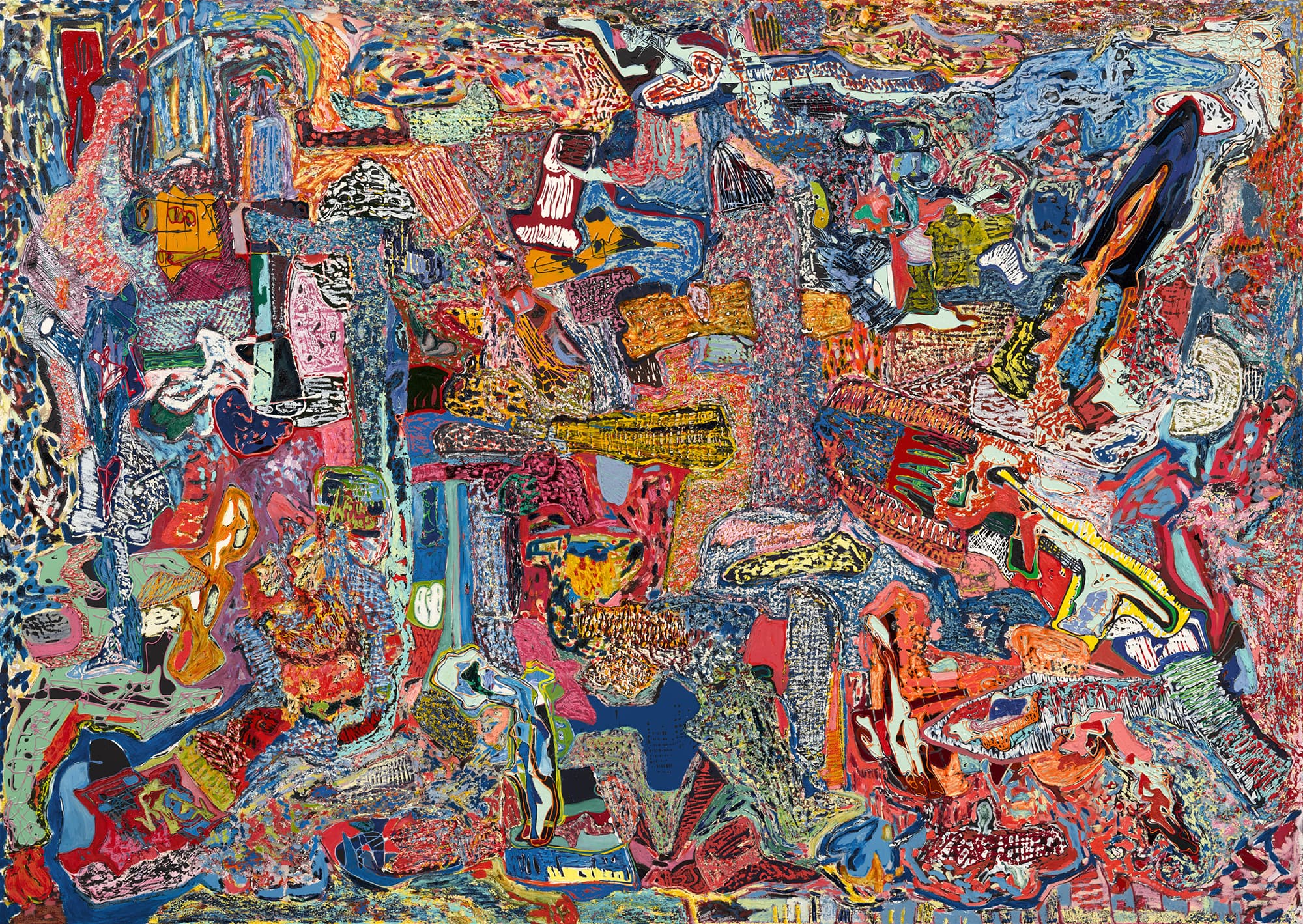
Phong H. Bui (Rail): When I first came to your studio sometime in September 2021, I remember my first response on seeing the body of work then, due to the vibrancy of high-key color that creates such a pulsation breathing across the canvas of an otherwise compressed, claustrophobic, air-tight terrain. I remember telling you about Picasso’s small painting Crucifixion (1930) …..
Leelee Kimmel: Yes, I remember….
Rail: It has elements of such ferociousness or the sadistic treatment of the deformed human body, the body in spasm of pain, including the distorted limbs, the disorienting sense of space and scale, from the tiny soldier on the horse in profile, a figure with the longest extended limbs on top of the ladder piercing to the Christ bodies torso. Also, elsewhere in the painting we see different treatments of the human figure in various depictions and scales. Lastly, the two small crosses, one on the lower left, and one on the middle of the right of the painting, for both are shifting while anchoring the space of the painting at the same time. I was feeling what appears figuratively in Picasso’s Crucifix, the similar ethos and intensity is being conveyed in your language of abstraction. My first question now is since you had said early on, in one interview, “there are so many masters of the brush, and [you] couldn’t compete with that, so [you] have to start something else, and do it your own way.”
Kimmel: When I said that, it was true. I didn’t really use the brush so much at the time. I used to use the brush before that time before 2015, but then I gave it up for a while. Now I’m back on the brush, so that’s the truth. Sometimes I start with the brush and then divorce myself from it. I keep getting back together with the brush, but the brush is back.
Rail: Well, I want to go a little bit deeper into the process, the variety of gestures, how different segments or forms get painted differently. We talked about how early on in your formation, you didn’t feel you had discovered a path not taken yet, but rather felt trepidatious, anxious of this potential multiplicity, which is one of the words that our friend David Rimanelli had chosen to describe your work—multiplicities that bump and burst. He also thought your work is at once primordial and futuristic. Where does it all begin? Do you feel protecting your initial vision or clarity was something that you recognized early on that would guide you to make this kind of work?
Kimmel: Yes, at that time around 2010, I didn’t feel like showing my work to anyone, it just wasn’t developed enough. David is an amazing writer. The only things that interest me are the things that are primal and futuristic at the same time, while also being in the present. I only like it when things are classic, which means if they had existed hundreds of years ago, they could certainly exist into the future. I mean, like, a classical painting depicting, for example, a man or a woman or a landscape, even if a style wasn’t then invented, there are certain classical elements that you can feel and identify with through the structures or their forms, all of which would exist through time. We are just remixing or redistributing what was before and that’s what’s fresh. There is no new invention that’s wholly new, we are just taking and making nothing from something. You know, the books we love are the ones we can revisit at different times in our lives, and maybe you identify more with one character over another at the first read and then you see from another character’s point of view for the first time at second read or the meaning of the book completely shifts. I try to make paintings kind of like that, where different battles or moments in the canvas can interest you at different times. That said, when I paint, I don’t really distinguish so much between different moments. I’m not thinking about how to fit one thing into something else. I just want it to be truthful. And I just want it to come from me, the person who is living in this moment, on one hand…. But I want to remove myself from it at the same time. And the least amount of me that’s in the painting, and the more of everybody else that’s in it, the better it will be. And so, in that context, I feel it may have a chance to connect more to things that have come before and will come…
Rail: But when you say when less of you and more of others, do you mean ….
Kimmel: All humans. I don’t just mean specific artists. I mean, all humans, being alive, the will to be alive. An example I saw on the way to meet you was a little plant in the small crack of a huge brick wall, managing, fighting, figuring out its way to live, to thrive in this improbable environment that was made to exclude its existence. I love things like that plant. For the sake of discussion, if I’m seeing the plant struggling its way to rise above such dire circumstances, I too become my own witness of the moment. I’m doing the same when I paint. Hopefully the painting has nothing to do with me. It’s just that I’m the witness.
Rail: Do you think that your interest in VR might have affected the way you think pictorially in your painting?
Kimmel: Well, when I did make one VR piece (I started it in 2017 and it was in the Journal Gallery show in Brooklyn in January 2018), it liberated me at that moment because of how rapidly you could design things in three dimensions that are ginormous. I felt like anyone who went into that piece could understand how it felt to live inside my paintings, or my brain. My answer is yes, but I felt I always saw things in three or four dimensions. I just couldn’t make them. In the sense of scale VR is very special.
Rail: That makes sense. I was talking to a friend of mine the other day about Italo Calvino, one of our favorite authors, and Calvino once said that “literature remains alive only if we set ourselves immeasurable goals, far beyond all hope of achievement.” It’s interesting in reference to David’s wonderful use of the word multiplicity again in the small text he wrote for your exhibit—in Calvino’s chapter five on the subject of multiplicity, from his 1986 lecture Six Memos for the Next Millennium (which ended up with only five chapters as he died while preparing it 1985), he quoted Carlo Emilio Gadda who sees the world as a “system of system” in which each individual system conditions the others, and is conditioned by them in turn. In other words, in your painting, would it be fair to mention that the multiple points of view and interconnected system lie in the tension and your awareness of irreconcilable ability of the polar opposites, namely precision and disorderliness?
Kimmel: One-hundred percent. Kinda phenomenology style? Because it’s the same thing as in life, it’s not different in painting or in anything, any relationship, any anything, everything in life. I really feel the most beautiful thing about being alive is freedom of choice. And within freedom of choice, you have to make mistakes to learn, for it’s always the mistake, or the accident, the kismet, the chance, the blessing, the whatever. One moment that happens that leads to the next thing, like a chance meeting of two people that creates another life force on the earth. I love the moment the most when I go back to my studio the next day, and I have no idea what happened in the night, like Dr. Jekyll and Mr. Hyde. I come back, and I say to myself “what happened here?” And then I make sense of all the intentions from the night before, but not too precisely, without being precise to any rule. Unlike following a self-help book, where you must follow these steps, which simply means you’re following somebody else’s step, in somebody else’s self-help idea, and it doesn’t work. Even just arranging your tools, your materials for future use, after the chaos from the night before, there’s a counterbalance in everything you do. Even in a relationship between two people, there is always one that is taking more while the other one is giving more, then the relationship shifts on the opposite, hopefully. [Laughs] It’s a constant interplay, which I find quite similar in each painting, with the issue of texture, of color, of form, of overlapping, of each surface even being matte or glossy or thick. Whatever else, it always comes with strength and vulnerability, and I discover more of what the painting needs when I pay attention to that interplay.
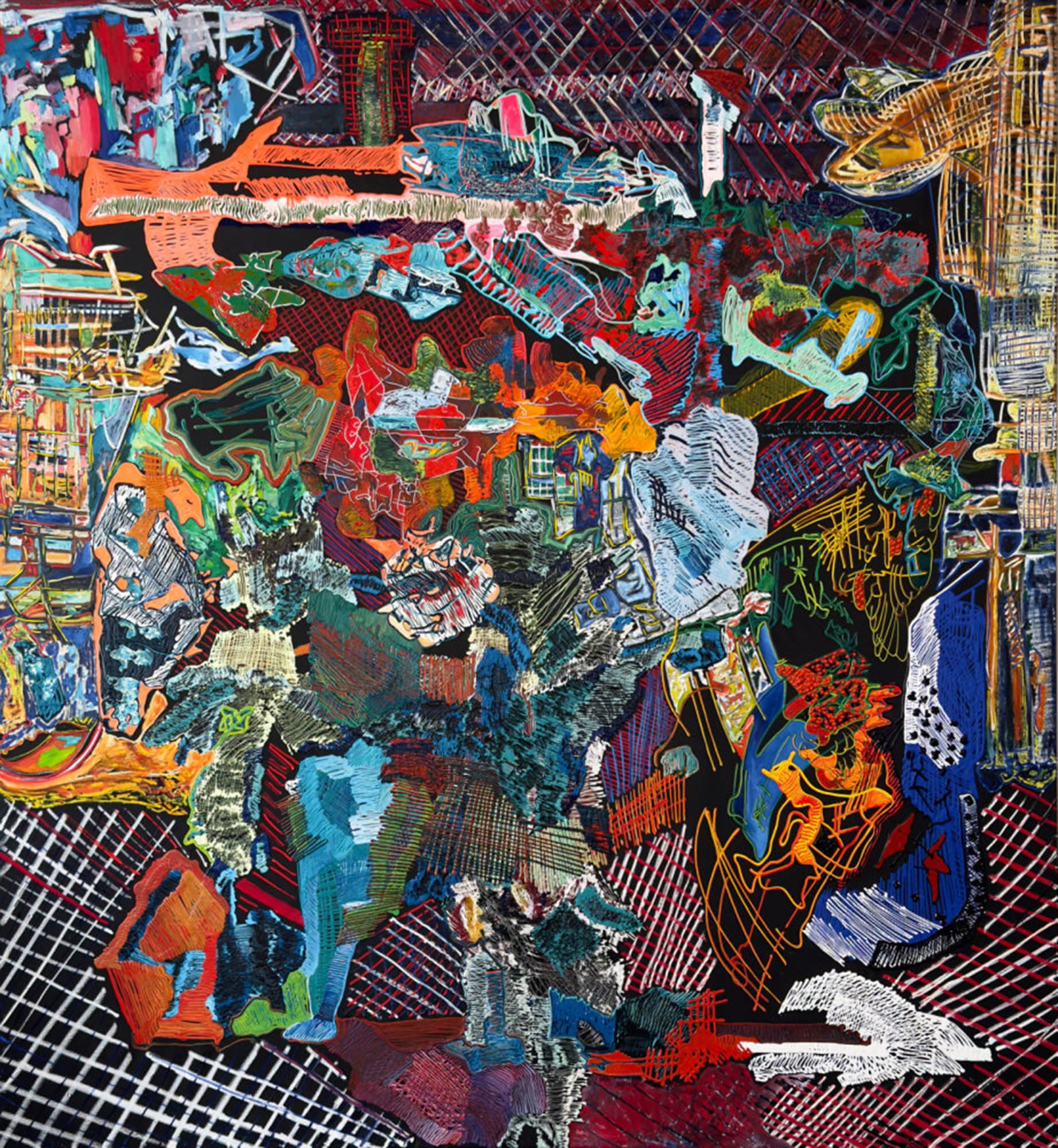
Rail: Well said Leelee! I remember once talking to Diego Cortez about Jean-Michel Basquiat, and whether he had this book called Symbol Sourcebook: An Authoritative Guide to International Graphic Symbols, by the legendary industrial designer Henry Dreyfuss in his possession? This book has countless codified graphic symbols that have been used in different cultures in the world essentially from geometric forms, like the square, the circle, the arrow, to human representation in varieties of gestures like Jean-Michel’s symbol of the skull, copyright, the crown, etc.! Diego said yes, but it only plays a small role in Jean-Michel’s pictorial lexicon. My question is: were you conscious in creating your own visual language from the beginning, partly because there were distinct mark-makings or shapes that were either floating on white or black backgrounds, for they were yet clustered together with such spatial compression as in the recent paintings?
Kimmel: What I’ve been working on since the beginning, maybe without realizing it, is to remix languages that existed before. For me, if I look at any work of art, representational or abstract, old or new, that moves me, I tend to project myself and dive into it totally. I’d often imagine that it’s certain things, certain places, and there’s a story in approximation so I can transpire that connection in my abstract language, which is not as definitive as say an icon or a symbol that means something, although I’m interested in both the universal, and the particular. Take Forrest Bess, for example, even though what he had invented, a wide range of symbols that represent the different things that were very personal to him, yet we love them partly because we felt the urgency of his needs in creating them and painted with the same urgency as his ways of bringing order to his life. I can say the same for me: to make sense, I need to paint. That’s it.
Rail: You were saying that it’s the abstract equivalent of what you feel you would project, say, a lake, a park, even a city seen from above, whatever you would approximate as potential abstract forms that get painted, can you describe it in your approximation?
Kimmel: If somebody looks at a painting of mine and sees and feels something completely different than myself, or the next person, that’s great.
Rail: I should mention that when I look at your painting, I think of the culture of textile, of embroidery, and the varieties of action of how each gets made, from weaving, sewing, stitching, patching, lacing, cross-stitching, etc. Have you thought of your making process of it in similar terms?
Kimmel: Not really, although I do use all sorts of paint applications, from working with the brush, pouring the paint with the right measure of liquid-like consistency, to say, squeezing out the paint from the different sizes of syringe. Each of those actions changes how I feel, which means I know what to do next. It’s very unpredictable, adding to the fact that I never work from a sketch or preparatory study.
Rail: And you always start the painting on the floor?
Kimmel: Yes, I like to be inside of it. On the floor everything seems so open. A canvas on an easel or a wall, right in front of you, can become too much like an intellectual exercise for me. I switch to that later if I feel like it. But being immersed in the painting removes my brain, when it’s on the floor, whether I’m standing on it or around it in different angles, sitting and squatting and on top of it, walking around. I can start from any space when I feel it and find my way back from there.
Rail: How long would a painting stay flat on the floor?
Kimmel: It depends on the drying time or how much I go back to work on them in different layers. I like to work wet on wet, and I like to work wet on dry. I tend to work on two paintings at a time from one to the next as they lay on the floor, so I kind of switch between the drying times, the desire and the need to work certain areas. There is no specific order as to how one thing follows another whatsoever. It’s quite similar to my cooking unfortunately, [laughs] as I have an aversion to following a recipe. All are subject to changes.
Rail: Were you ever trained traditionally?
Kimmel: Not really, but I grew up with my dad, Jean Sobieski, being a painter. He studied at Beaux-Arts for architecture but he is self taught as well. So living with my dad for sure influenced me. Most of the time we had no living room, because that’s where he painted. But when we lived in NYC he had a studio on 101 and Broadway. So I didn’t distinguish too much between painting life and home life as such separate things. I think that was easier for a dad, at that moment in time. I personally, at this moment, like to keep everything very separate, but it’s weirdly slowly changing. My mom Elizabeth Sobieski is a writer. And she loves art. She is writing a lot of good stuff on Medium lately.
Rail: But you were born in New York?
Kimmel: Yes. Although I acted early on, I always wanted to be a painter. I went to Brown University for about two years, studying mostly liberal arts. I would have been a painting major had I stayed longer. Following September 11, which was my first year in school, my parents separated, among other complicated circumstances at the time. I was fortunate enough to move into the attic of the home of a remarkable married couple, Wendy Edwards, who was my painting teacher, and her husband Jerry Mischak, both excellent artists. While she was head of the art department there on and off, he was an art teacher at RISD. They rescued me, kind of, and became my surrogate family for those two years.
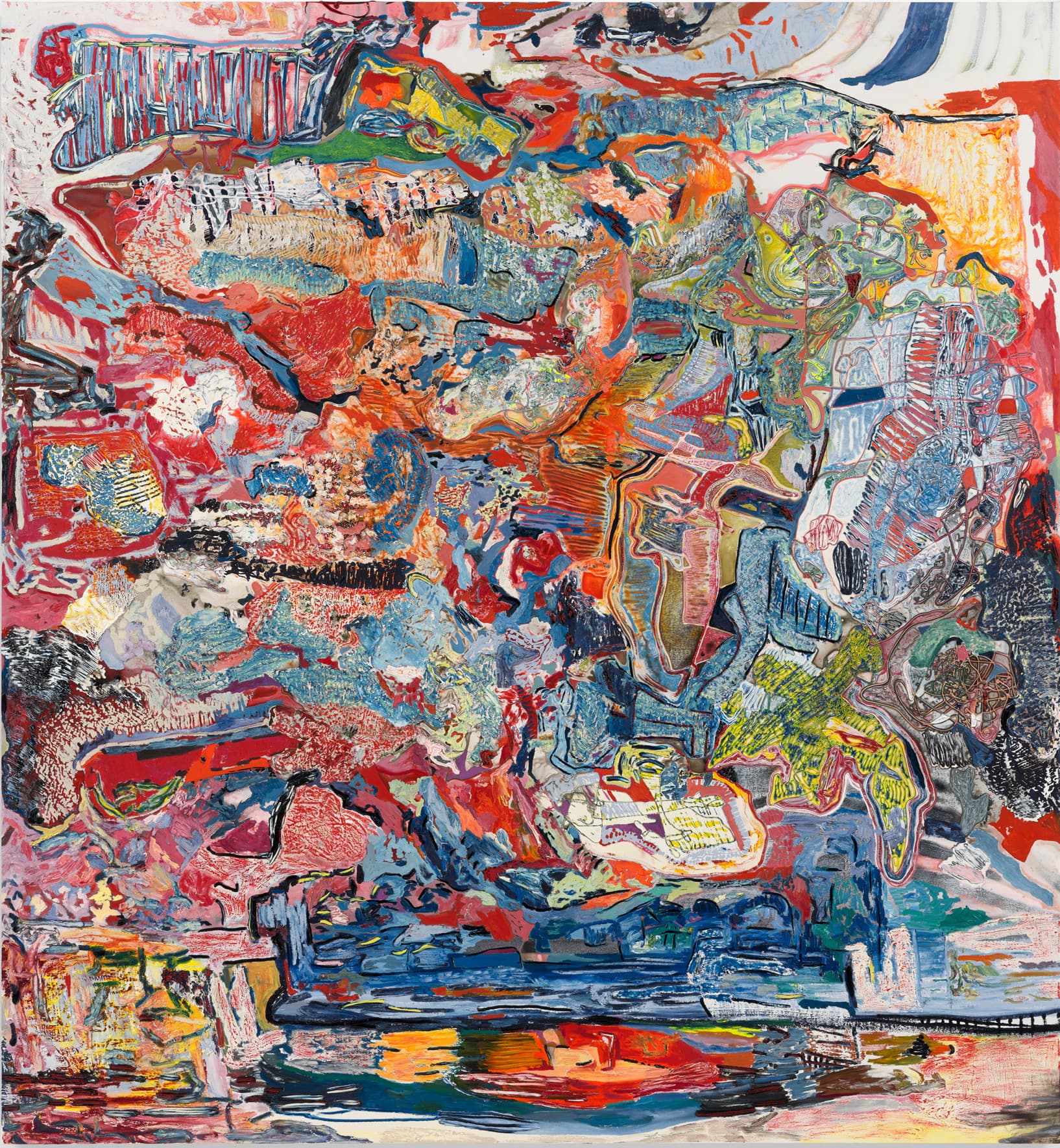
Rail: When did you feel the confidence to create a new life as a full-time painter? I ask partly because I didn’t get to see your work until your first solo exhibit Channels at the Journal Gallery in 2018.
Kimmel: I always painted wherever I was, as much as I could, I would say, in college. And then around the age of twenty-four is when I was more serious about it. Then I had a daughter and my married life. So around twenty-seven I was able to make space to devote myself fully to painting. I’m forty now.
Rail: And what kind of work were you making leading to your first exhibit?
Kimmel: They were large abstractions. Interestingly, they’re not that different from what I’ve been making now. Thinking back to my very beginning: when I was a child, my mom would give me a pen, markers, crayons, and paper. Whenever we went out to dinner or a party, especially when I had a temper tantrum, drawing was the remedy of choice. It only calmed me down. [Laughs] It still does. In fact, my dad and I would make drawings, doodling really, while we were watching something on TV. I would draw on my leg and he would draw on his. I used to have contests with both my dad and mom where on the same canvas, each of us would try to paint after the other’s style, and/or destroy it, and ask at the end who did what.
Rail: How would you describe when you had created this highly personal style, which is so distinctly your own, that is at once filled with a network of complex confluences in so far as how lines, forms, colors are integrated, weaved into endless vibrant patterns? For they are both at odds to each other, like one noise cancels the other noise out as it can be read in some instances on one hand, and yet they’re so harmoniously orchestrated, as though if one small segment in the painting isn’t performing its part, the whole thing will collapse.
Kimmel: From the beginning, since I was a little kid, whatever I was doodling I always filled up the page with my marks. Maybe what I’m doing now is not at all different from what I did as a child. Sometimes I wonder if that’s a lack of evolution or a full circle. The time, the rhythm, and how things get made is different of course.
Rail: Rupture or discontinuity?
Kimmel: I kind of fight with different parts of myself, beat them into submission through the painting and the different parts of the painting. Sometimes I’m kind to myself and certain parts of the painting. I try to win and also lose a fight with each painting until I feel it’s its own entity and I’ve made peace with it. I’m sure, like most artists, I'd rather let the painting tell me what to do, which happens on some occasions. The more I’m not there, the better for the painting. But generally, self-doubt and everything else that makes you look too hard or think too hard or edit too much, they can cripple you. When something is perfect looking, it’s not that looking at all that can easily lead to the death of the painting. The energy died with perfect balance, for me.
Rail: Super true, for the energy of the painting is the aura of the painting.
Also, since you have a very specific way to deploy your material which elicits textural response, I wonder whether you’ve ever thought that your made surfaces would directly affect the subtle or unsubtle physiological comfort, I mean the way it may feel on our skin, as much as what we may wear in relationship to our surroundings? Let me put it differently: as David has also pointed out that your painting surfaces are stitched together with different patterns of what he calls hypothesize-grid, wrap and flail, you know, as topographical “bodies” under duress, under stress, as topographical maps, interior maps, or say demented interiors for fantastical bodies, I would put this so-called fantastical body, along with its vulnerability of both comfort and discomfort, in the context of tactility, as well as sensuality, all of which get sublimated in the language of abstraction.
Kimmel: I mean I don’t want the world to come to this really, but let’s say a million people were wearing full body suits with physical sensation. You could smell and taste things also, for example, like John Waters’s Smell-O-Vision then maybe I would feel I could add to that or make something new with that but I felt satisfied with the one VR piece I made and then just any virtual game is a work of art to me.
I’m not sure how much my experience with VR might or might not relate to this sense of fragility aside from the fact that you could lose a file or not see what’s actually happening around you IRL. A VR creation could not auto-save, and everything can easily disappear, which is why it’s so exciting. Maybe they have gotten a lot better. I just spent too much time in there kinda overdosing the VR. Also, at the same time, creating in VR is like a game engine situation. It’s like if you’re a racecar driver, and then you look at the other person next to you, he or she not only has a better car, a faster car, a better driver, better wheels, better everything, their skill set is also better. And there’s hundreds of people working on it, and they’re far better than what I would have wished myself to be. Basically, that’s why I’m not doing it anymore. I just remain a fan of their work. When I think of VR and going to a chat room, talking to people, every single experience is literally like a performance, an installation or a work of art that already is virtual. It already is an invention. You’re in fact entering an invention, so you don’t need to invent any invention anymore. However, it’s not interesting to me to continue in that virtual realm, aside from just experiencing it as a paying user. So as a user, it’s great.
Rail: How would you describe your sense of scale?

Kimmel: I don’t have a sense of direction. I tend to bump into things, so I assume I don’t have a good sense of scale, or space. But when I’m working on my paintings, I’m constantly shifting their orientations, by say turning them upside down on the wall, left and right, walking on top of them on the floor, walking around them. In fact, I don’t sometimes know how to walk linearly even in a city such as New York City, which is built on a grid. I have a natural tendency to wander and get lost. When I make the paintings, it’s the same. I’m always lost.
Rail: How would you describe your revision process?
Kimmel: It all depends. I attack and then keep attacking them until they tell a story and maybe it’s boring or discordant or I’m not interested in that story anymore, so then I put them away. Sometimes for a year. And then I take them back out and if I disagree with something strongly it’s kind of exciting because I can really be loose on the canvas. When I’ve worked on something for years there are moments where it could be a little scary to be so loose, because you’re destroying so many hours of work. But I think that’s why when I’m a little delirious in the middle of the night the magic happens, or it doesn’t. So sometimes I then work toward building different parts of the painting, and then there’s a new story. If it doesn’t have a story to tell, I’d eventually declare it’s a dead painting. In which case, a la poubelle, to the garbage.
Rail: Since every surface seems to be filled with high-keyed colors, which gives the impression of both intense lightness and density at the same time, I can’t imagine it needs to be painted too thickly, which could lead to elimination of air altogether.
Kimmel: I don’t like it when things get too noisy.
Rail: Noise can cancel out other noises, which is another issue I need more time to think over until our next conversation. As for now, is there a sense of theatricality in your work?
Kimmel: Do you mean theatrical in the sense of bold primary colors? Or large canvases? I’m confused.
Rail: That’s also true. But I also mean theatrical that implies possibilities of things, of experiences that can bring about unusual sparks, surprise glimpses into real life, which is not controlled by convention. I’m thinking of Antonin Artaud’s concept of the “Theater of Cruelty” or the “Theater and Its Double,” which advocate for earlier times of ceremonial experience intended to liberate our subconscious and reveal us to ourselves, so to speak, including means of violent rigor or whatever else that can shake up the stage convention by intensifying extreme concentration of theatrical experimentation that brings new life to theater. This is not to say whether there exists a direct relationship that brings your previous work as an actor to where you are now as a painter.
Kimmel: Well, I’d say the only connection I feel about such things is about being truthful. Take, let’s say an actor’s performance like Christopher Walken, for example, who is kind of always Christopher Walken. And we love him as different characters , but ultimately, we love them all because we love Christopher Walken. So if he was a painting it would probably be a good one. And very Christopher Walken. Then there’s other actors who really transform themselves and become specific characters, including learning the new physicality, languages, skills, inner thoughts and so on: Daniel Day Lewis becoming Christy Brown in My Left Foot (1989), or say, Meryl Streep in anything. In fact, little kids are good actors, because they don’t think when they play a role. Any kid, when they pretend to be a cat, they just say “I’m a cat. Meow!” That would be a good painting too. You have to believe it. The good actors are the ones who are able to trick us and trick themselves. They make the trick the truth. The connection with painting is, if you’re thinking, does this look good, look pretty, sound good? Then it’s crap. The truth is it’s the soul of the person that you’re interested in. How they grow. How any human or animal or situation grows and adapts is fascinating. The change is the thing. You can write well with perfect prose, but if you’ve got nothing to say, who cares if your prose is pretty. If it doesn’t mean anything then it’s just a style.
Rail: If one embraces one’s life with all its imperfections, asymmetries, and so on, one has a better chance to live more fully at the least. I love what Toni Morrison once said, “if you surrender to the wind, you can ride it.”
Kimmel: Need wings first.
Phong H. Bui is the Publisher and Artistic Director of the Brooklyn Rail.