ArtApril 2024In Conversation
Albert Oehlen with Mark Hudson
Word count: 5331
Paragraphs: 98
On View
GagosianNew Paintings
March 21–May 11, 2024
London
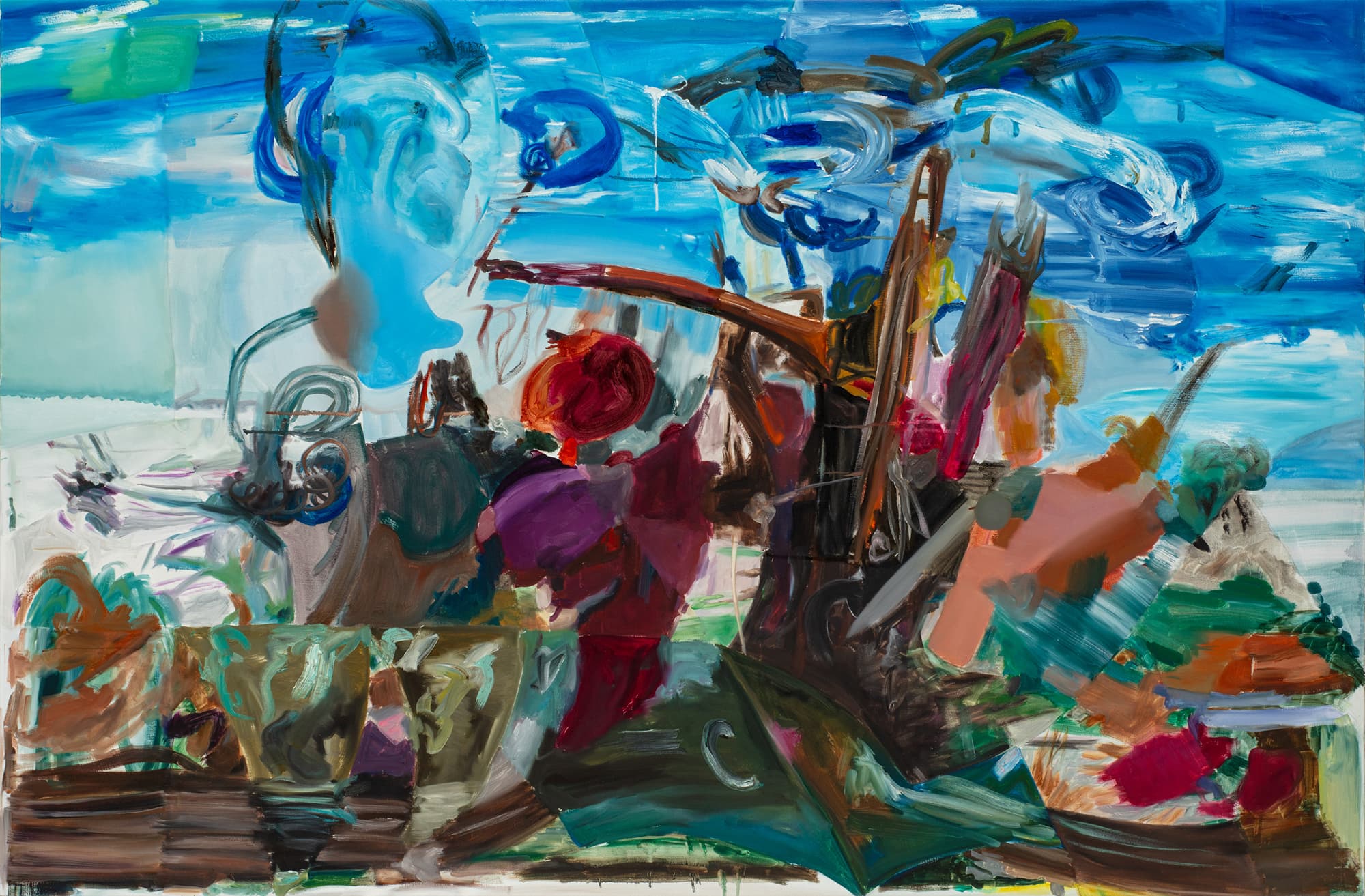
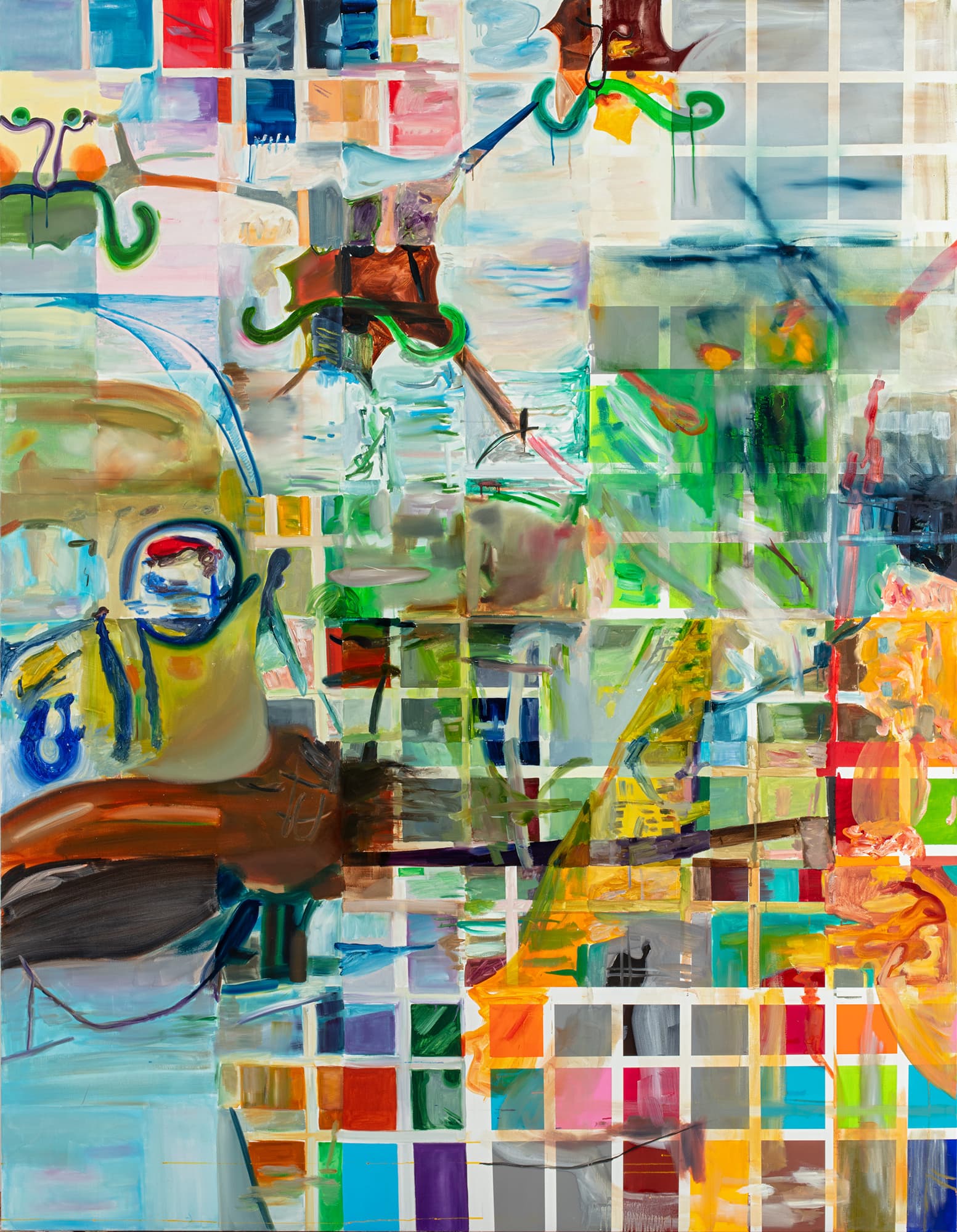
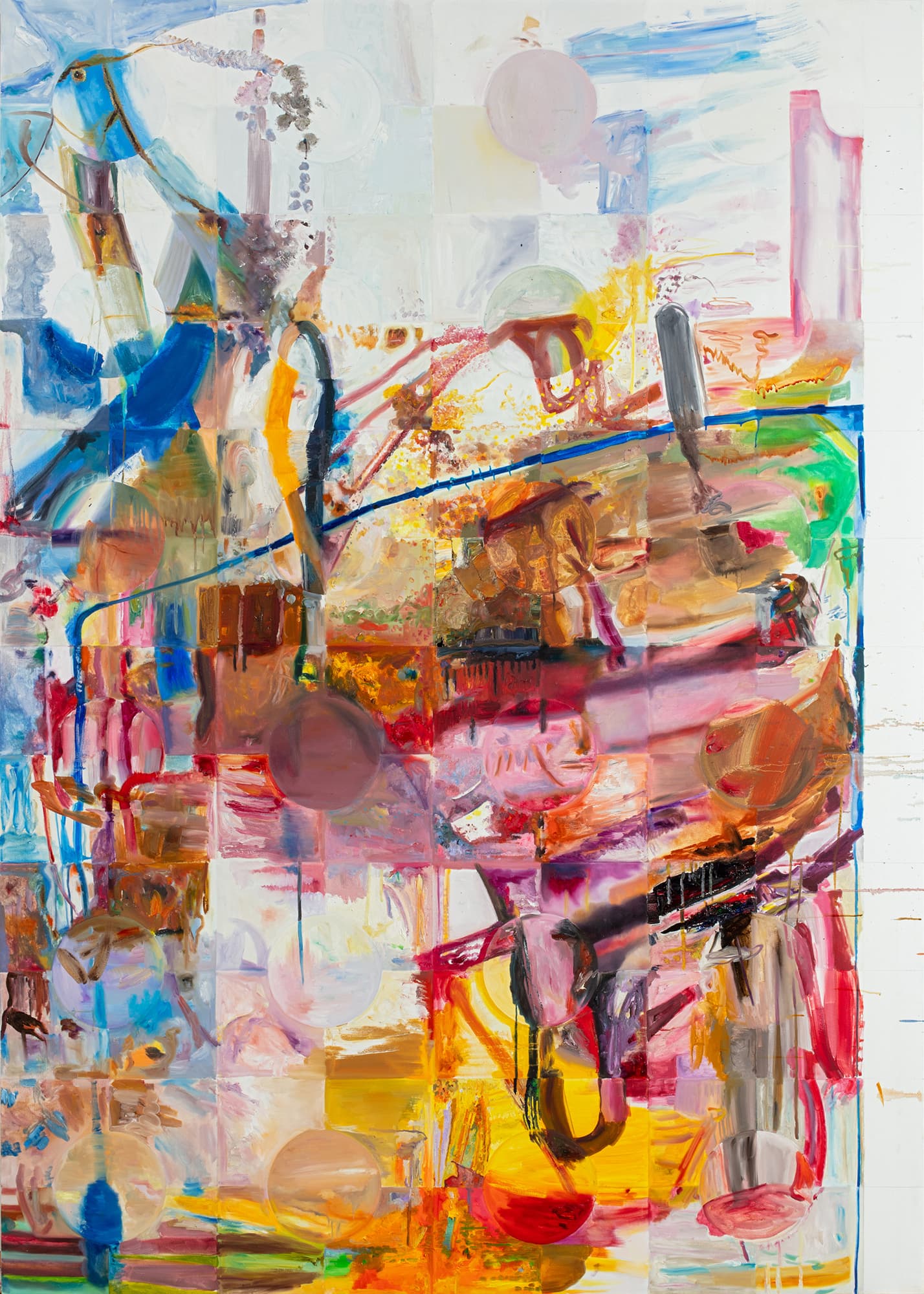
German artist Albert Oehlen began painting as a teenager and has continued working throughout the decades, moving from figuration to abstraction in a manner that makes the distinction less meaningful than it is for most painters. Oehlen’s interest in artificiality and the formal processes of layering and of experimentation underlie his recent work. On the occasion of his exhibition at Gagosian in London, Oehlen met with art critic Mark Hudson to discuss his formative years as an artist, his thoughts on composition and color, and what it was like to make a movie about Vincent Van Gogh.
Mark Hudson (Rail): You’re sometimes referred to as one of the “bad boys” of German art. Is it possible to still be a bad boy when you’re approaching seventy?
Albert Oehlen: That’s not a very interesting image.
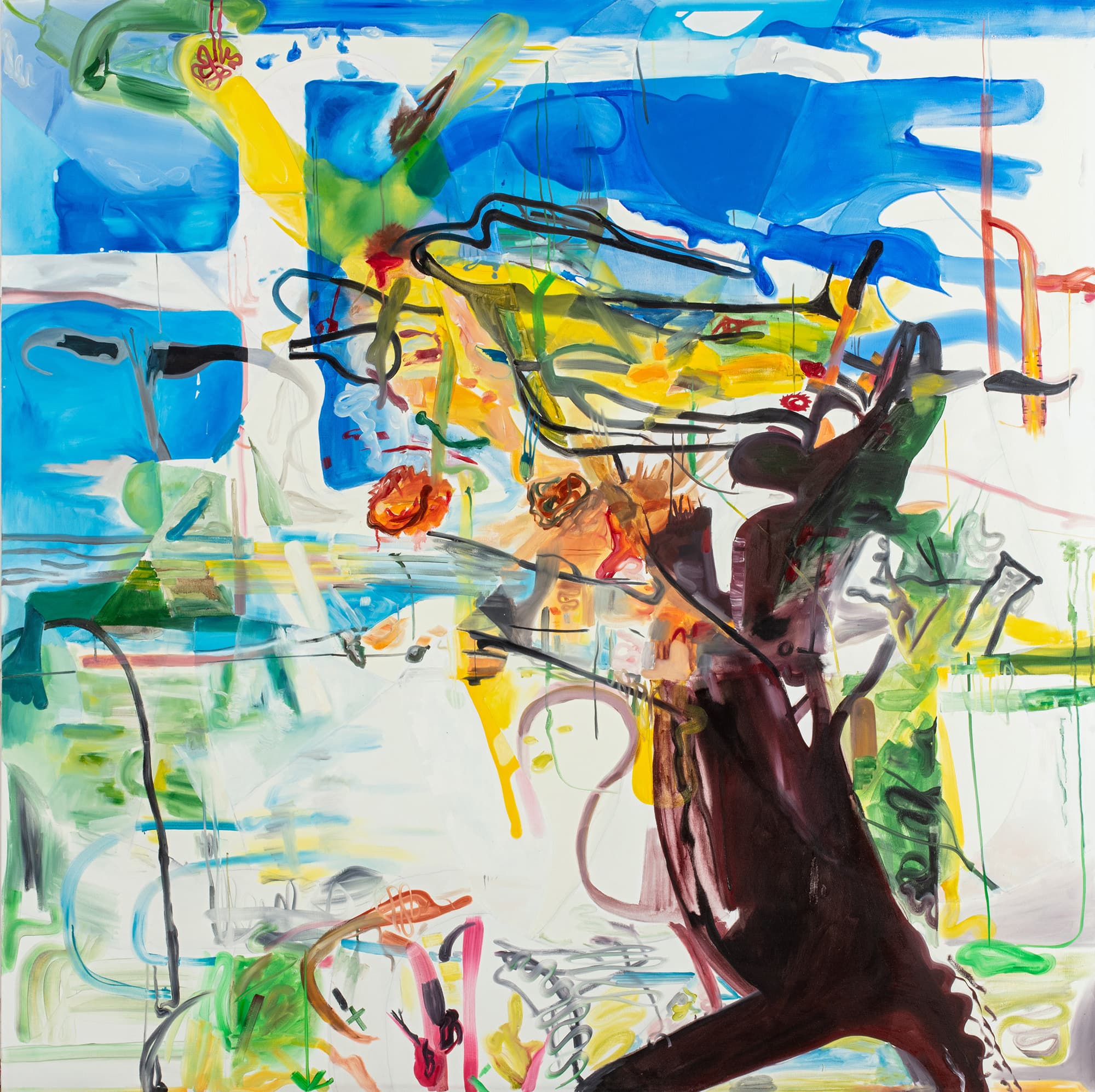
Rail: Looking at some of the paintings in your London exhibition, there’s such a diversity of form and space and mark-making it occurred to me that if you looked hard enough you could find everything that’s happened in painting over the last one hundred years, in just one work. How do you feel about that?
Oehlen: That’s nice to hear. I didn’t calculate that effect, as I never calculate any effect. But it’s interesting to hear.
Rail: In fact, looking at a lot of your paintings, I feel the way some commentators talk about you moving between abstract and figurative phases kind of misses the point. Because it all seems to be about the impossibility of anything being definitively one thing or the other. Look at one of your abstract paintings, and you’re probably going to find something quite figurative in it, and vice versa. And there’s also a very strong conceptual background. So it seems almost to make a nonsense of these different terms. Or maybe for you, they still are significant, that one work is figurative, another abstract.
Oehlen: It’s a question of how you position yourself in relation to these terms. Before I started painting, I was friends with Jörg Immendorff in his political phase, and we were Maoists. I was very young, a teenager. So that was my background. When I got into practicing art, my first impulse was that it has to be political, I have to convey a meaning. So for some reason I started painting. And I didn’t think about it being anything but figurative. I put some images on the canvas. And then I started thinking about what interests me. It was a list of negatives. Most of all, I found out what doesn’t interest me. There was not much left!
Rail: Right!
Oehlen: It took just a handful of paintings to figure out that I don’t believe in representation. I have big doubts that it can achieve the things it claims to do. So I saw myself as an abstract painter, because I saw painting itself as abstract. Then later, I worked out that I was mainly interested in the cliches of abstract painting and what the history of it is, and what it means to me. And then quite soon, I thought it was an interesting challenge, to have recognizable elements in the painting, but to not believe in them. So I thought, how does it change the painting, if you include things you don’t believe in? It must make a difference to someone who believes in it, no matter what the actual look of the painting is. These are still problems that interest me very much.
Rail: Some of the new paintings took me back to your paintings of the early 2000s, where the surfaces have an incredible sense of spatial depth. I’m thinking of works like Born to be Late (2001) and DJ Techno (2001), where the receding levels and planes give a feeling of looking through to earlier stages in the creation of the work. It’s all coming to the surface towards the viewer. They’re really rich paintings, as though no sort of painterly form is off limits. Considering you sometimes express ambivalence, even hostility towards the formal language of painting, they’re highly seductive as a visual, sensual experience.
Oehlen: Yeah. It’s funny. This feeling of depth in my paintings is a thing that I never aimed for, and never thought about. But when I look back at my paintings, it seems to be a thing for me. But that was actually unconscious.
Rail: But you must obviously keep reworking the surfaces, so you must be aware of that.
Oehlen: Yes. I guess it has to do with the process of how I paint. I’ve thought a lot about the history of abstract painting, and the elements of authenticity, spontaneity and other things that have played a role. And I’ve thought, how can I reverse them? How can I do the opposite? I see the whole thing as very artificial. And I’m interested in the artificiality of it, in knowing the parameters, messing it up and experimenting with that. And one thing I was thinking is that some paintings give an impression of having been painted very fast. So what’s the relationship of the speed of the painting and the result? And how can I mess this up? Can I fake it, or can I do it as slowly as possible? These thoughts entertain me very much. I never have a visual image that I want to have on the canvas. I never imagine that the painting will look a certain way, that I want this effect. I never think about the final appearance of the painting. I think of what I want to do. Of the things I want to try out, and that means that I work in layers. So I don’t know where that comes from. But I think working on the computer with the computer graphic stuff made me think a little bit differently. That’s probably the only good thing that came from it.
Rail: So is each layer an instance of you trying out something different? Or how does that work?
Oehlen: No, it’s a painting method. Building something up. But doing something different on each layer is an interesting challenge. Normally a painting has a plain area that is the background and linear stuff is put on top of it. What if you reverse that? See the painting from the other side. Perhaps it is impossible. But I tried. If only to get somewhere I wouldn’t get otherwise. That’s one thing you can do with layers.
Rail: When you say you were very aware of the artificiality of it, what exactly are you referring to? You mean the painting process itself?
Oehlen: That was not an analysis of what was in the work. That was the direction I wanted to go in, this artificiality.
Rail: Is that in opposition to the perception of the authenticity of the painted mark?
Oehlen: Yes.
Rail: Funnily enough, when I was looking at those paintings with that sense of depth, I realized I have probably always misunderstood your work. Which was an interesting idea, considering I was going to meet you the next day. I’ll try and explain what I mean. I think that, particularly from an American or British perspective, and maybe even from a German perspective, German art comes with a weight of history. When you look at the history of the last one hundred years, that’s hardly surprising. And however awful it’s been, it’s given artists a lot of rich material to explore. With that comes an analysis of mythic ideas of Germanness. And I’m thinking obviously of people like Joseph Beuys and Anselm Kiefer, who have done a lot of things with this and made big careers from it. And I got the impression that your generation—I’m thinking of you, Martin Kippenberger, Werner Büttner and others—were in a way rebelling against that.
Oehlen: Kippenberger and I were both big admirers of Beuys. We talked about him a lot. He was one of the really important artists for both of us. And of course, I think about what you’re saying. I’ve always thought about that. And if we were against something, then that was the pathetic self-importance of some artists. You don’t even need to criticize that, because it’s ridiculous as it is. So we were against that. But I should better talk about myself. I didn’t want to distance myself from this dealing with history at all. I mean, I’m German, and when I learned in school about German history in that century, that was a shock for life. And for all my generation, for all of my friends. It determined our thinking. I have to say that. No one denies that. No one wants to get frivolous and…. So why am I saying this? It plays a role. Definitely. Even if you can’t see it in my work. It’s a project: what can you do after the Holocaust? To think about that is elemental for me and my generation. But what are the consequences? I think some artists went the wrong way with this. But we can skip that.
Rail: Never mind the names, but in what way did they go the wrong way.
Oehlen: I mean, it becomes kitsch and bombastic, and they’re full of self-importance, and so on. You know what I mean?
Rail: Yes, I do. It’s interesting that wherever you get Expressionism, the idea of the painterly mark intrinsically embodying the personality of the artist, there is always a strong counter reaction, whether it was Die Brücke, with the reaction of Dada and Neue Sachlichkeit. Then you had Abstract Expressionism followed by Rauschenberg and Johns. And then there is the idea that Neo-Expressionism arrived in the late seventies with Kiefer, Georg Baselitz, Markus Lüpertz and others, and you and your friends, and others of your generation reacted against that. Is that true? Or has that become myth?
Oehlen: It’s an interesting subject, because the press in the early days, when they wrote about us, they assumed we were protesting against conceptual art, because that was the established form of art at the time. But we were never a group and we never discussed what we wanted, and where we were. Some of us were friends. Others not even that. But it’s funny, I never felt that I was rebelling against Conceptual art, though it looked like I was trying to do the opposite. Just recently, I was thinking about what I was really against, and wanted to be different from. And suddenly it was clear that the figure who would symbolize all of that was a musician, the saxophone player Peter Brötzmann.
Rail: Who?
Oehlen: Peter Brötzmann. He’s a saxophone player! A German free jazz pioneer. It was just recently that I thought, yeah, the image of that guy was what I was against. It’s funny because I really like his music, and I admire him as a person. But when you’re young, you have to position yourself for what you want to do. I think that example was really striking to me, because the thing you decide to oppose may not be something you totally dislike. But still, that was what I was against. But even then I loved his music.
Rail: Why? What was it about it that you were against?
Oehlen: It was all these cliches of expression. Putting more emotional power into the work, you know. I thought that was kitsch and stupid. And it was the same thing in art. Especially in my generation, there were some really banal examples of wild painting. And you could extend that further.
Rail: Do you mean Neue Wilde?
Albet Oehlen Yes. Some was banal. Some of it was not really wild. Wild painting is not something I was aiming for, not an ideal. But an interesting challenge.
Rail: So you and your friends were like punk rebels against the establishment, aged about twenty to twenty-two, rebelling against a kind of false expression? Or were you just trying to draw attention to yourselves?
Oehlen: This was about a couple of friendships. I was close with Werner Büttner and with Kippenberger and we spent a lot of time together talking. And with my brother Markus, and Georg Herold, who was more of a sculptor. We just exchanged ideas. Maybe we wanted to do something crazy, something new. But there was not so much aggression in it. Punk was fascinating to me. It made me think about certain things. It was really impressive what happened in those two years, 1977–78, which was the punk time in Germany. None of us was a punk or wanted to be one. But I still find it super interesting. Also, I must say, it was purely European punk we were interested in. We only knew about the British part of it.
Rail: I was interested to see that in the publicity for the new exhibition they refer to the term “bad painting.” “He champions self-consciously, amateurish bad painting. He infuses spontaneous and expressive gestures with surreal attitude.” I was surprised, because I imagined that your bad painting period would have been forty years ago. Is it still a meaningful concept for you?
Oehlen: It’s interesting. There was this show forty years ago in New York, where the name comes from. I heard the term and I liked it. It fascinated me, and then a bit later, I thought, what happened to that? I mean, what is it? Is it even possible now to do bad painting? You know what I mean?
Rail: Yeah.
Oehlen: I thought I might set an example. Because I like the contradiction. It’s a blurry thing. But it’s a nice term. It sounds good.
Rail: So which of your paintings do you think of as exemplifying bad painting? Which of your bad paintings are you proud to have made?
Oehlen: Oh, I would actually say all.
Rail: All? My God, okay. Because some of your earlier paintings, the ones you first got attention with, have a very awkward figurative quality, don’t they. There’s one of a Dutch woman, and Kippenberger said that even he couldn’t do a painting as bad as that. But that’s not what you think of as your bad painting period?
Oehlen: I mean, if you do a lot of nasty things, and you still have something good at the end, there’s kind of a triumph in that, which I like very much. I mean, I don’t want to interpret myself. But I spoke about the negative list before, the things I decided I wasn’t interested in. This list can change. When I’m starting work on a group of paintings I make a list of things I absolutely don’t care about. It could be color, composition, anything. And I want to show that I don’t care about that thing. There’s a provocation in that. So bad painting could mean being against the rules. Which would be a statement I’d sign right away. I mean, what rules? Still too many people, artists and audience, believe in the rules.

Rail: So what do you think the rules are today in art?
Oehlen: I can’t answer that question. I wouldn’t know how to put that in words. But you feel it all the time.
Rail: Do you think there’s a standard of what good art is now? I mean, you can imagine in the nineteenth century, there was the Academy sitting in judgment. Does that still exist now? In some way?
Oehlen: I don’t know. I mean, there are certainly fashions. But I’m not so well informed. I don’t go to town and see all the gallery shows. I don’t do that.
Rail: There seems to be quite a landscape element in some of your current paintings. Or so it seemed to me. Am I imagining that?
Oehlen: Yes. Or I didn’t see it.
Rail: There seems to be a lot of sky and some space.
Oehlen: Oh no, you’re right. Yeah. That’s from the motif I used. The original motifs were paintings of landscapes, some of them connected to my Van Gogh movie. I painted a lot—twenty, maybe thirty paintings on motifs from Van Gogh. But I painted them differently. I wanted people to recognize the motif—isn’t that a Van Gogh painting? But it looks different. So I took these paintings and made them the source for a couple of the new paintings.
Rail: And when you were doing your Van Gogh inspired landscapes, were you painting from real landscapes?
Oehlen: No, I had the book.
Rail: All right. Okay. So they’re interpretations, maybe remixes of Van Gogh?
Oehlen: I mean, I needed them to put on the wall in the movie. And I made right away the decision that they’re not supposed to look like the real thing. They’re not copies of the real paintings, but they make you think of them somehow. And when I painted them, I thought what I’m doing is totally worthless. And I was able to ignore the possibility of making art at that moment. And that’s a very fortunate situation to be in. You get looser. It’s fresher. So it happened with these paintings, and some of them are totally crap. But who cares? I mean, these paintings, even the ones that are total crap, they could be the source of a good painting.
Rail: So what brought you to Van Gogh? Why did you want to make a film? Is he a big figure for you?
Oehlen: Yes, even when I was a child. I will always love his paintings. So when Julian Schnabel made his Van Gogh movie, I thought okay, I’ll make one too. I like to be in a field where someone else already is. I’m not looking for a space in art where I’m alone. Then I found this story that I wanted to tell.
Rail: About his models.
Oehlen: Yes, exactly. I read the letters he wrote to his brother and just underlined what I thought was interesting. Then I transcribed the parts that I marked, and the story was there. So I didn’t look for it. There was this struggle Van Gogh had with the models and money and being poor. I found a lot of interesting stuff, but it came by itself.
Rail: You’ve talked about your interest in the artificiality of painting. But at the same time, Van Gogh must be the artist who most represents the completely authentic real artist, the traditional tragic artist, where every single mark is completely meant. Another artist you’re obsessed with is de Kooning, another of these heroic gestural artists. Why are you interested in those people if your real sense of painting is of something artificial?
Oehlen: I would say that in Van Gogh’s time, art theory and thinking about art weren’t where they are now. So art was whatever people were capable of doing or thinking. And with de Kooning, I don’t agree with you, because I think he was reflecting very much on what he did. His process was very different from Van Gogh’s. I don’t see so much spontaneity in his work. I think he was actually of that group, the one that thought more than the others.
Rail: I was thinking earlier that I’m at a disadvantage in interviewing you because I haven’t spent a week in your studio hanging out with you, looking at your paintings and processes. However, I have seen the film The Painter. So I’ve spent an hour and a half with a sort of egomaniac alter ego of you, who seems very different to you.
Oehlen: This movie has two faces. On one hand, it’s a real document of me painting a painting. Because my statement about authorship would be that you have to be in control. You have to have the last word in the whole process. And that happened here. Because I was standing next to the actor and painting, and he repeated that. I was talking and he repeated it. But the whole thing was filtered through his personality. And so it came out very differently. Towards the end I started narrowing it down, giving him more predictable things to do, where he couldn’t fail. And in that final moment, it was my painting, as if I’d done it with my own hand. So in that sense, the whole movie is a real documentation. And on the other hand, it’s full of funny things. I mean, the way the actor performs, the way he moves—to the extent he doesn’t feel recognizable to me as me. But also I worked against the expectations of the viewer because I tried to construct the painting through the most ridiculous moves and brushstrokes. So I gave the actor deliberately idiotic things to do in terms of painting. Because I thought, it doesn’t matter. It doesn’t help if the gesture looks elegant or intelligent. So if you don’t get a painting through that, you might as well do really ridiculous things. I thought, Okay, if those are the conditions, I’ll go for the most ridiculous stuff, to prove my thesis.
Rail: When I was preparing for our conversation, I looked through various books, and I saw the phrase "After the death of painting," in relation to you. And then another critic said that you embody the moment when painting was in decline, when it became apparent that painting was no longer the primary medium of Western art. So there’s almost the sense of a kind of aftermath in your work, that we’re living after something. And I’ve always had the feeling, and this is where I’m going to say I probably had it wrong, that your work exemplified postmodern fragmentation, the impossibility of finding a single overarching narrative. But after all the fragmentation, maybe you’ve come to a kind of wholeness, almost in a Romantic sense. Okay, forget Romantic. But a wholeness.
Oehlen: Well, there are contradictions, certainly. [Laughter] When I was studying in the eighties, it was common to say that painting is dead. And I kind of agreed. When you look at painting at that time, there was not much happening. There was a lot of this Beuys influence of extending the terms of art. There was Warhol. But how much of a painter is he? My teacher was Polke, we knew he had made paintings, but we didn’t see him as a painter. Baselitz and Lüpertz were around. They were unique, special figures. But they weren’t superstars. They were just German artists. And it felt like the one big painter who was still alive was Francis Bacon. Okay, there was Rauschenberg and Johns. These people were good, but they weren’t superstars for me. They were not Picasso. It didn’t feel like a time of great painting, so I thought it was a good moment to step in.
Rail: So how did you get to the idea of the artificiality being the interesting element? Because most of the artists you’ve spoken about seem very kind of genuine and earthy.
Oehlen: Well, it started with my first painting. I had no idea what to do. But I had a friend who was helping me put the canvas on the stretcher, prepare the canvas and then I didn’t know what to do. And I enjoyed that moment of not knowing what to do. I thought, Oh, this is great. And then came this negative list. I said, Do I want to prove anything with color? Do I want to be the artist who has this wonderful feeling for which color goes with which color? Absolutely not. And I had other things that I didn’t want to do. So I went to a store for builders’ supplies. And there was a pallet piled with bargain paint. I said okay, if I want to paint a nature piece I need brown, lighter and darker, ochre, blue for the sky, maybe green. I tried to keep the range small. So I came home with eight bottles of cheap paint. And I painted like that. When it’s a figure I take this orange, mix it with black-and-white. And I have what I suppose is a skin color. So I started painting like that. Then I thought how can I avoid composition? So I thought okay, I’ll put the figure in the middle. That’s it. So as long as it’s in the middle, composition is solved. And so that was the beginning and that developed till today. And this kind of thinking could also turn into the opposite, like saying, Oh now I am interested in color. There were moments where I thought I wanted to have everything very colorful, moments where I wanted the maximum variety of color. So it could also be the opposite. It doesn’t matter. So this kind of thinking was always there from the beginning. That’s what I mean about the artificiality.
Rail: That’s very interesting. So these early manifestations have a kind of punk-Dada feel, a to-hell-with-you attitude. A young person’s bravado!
Oehlen: Yes, it felt like that. That was the attitude.
Rail: Was this when you were in your beer and speed period?
Oehlen: [Laughter] Beer and speed?
Rail: This is what I read. Your period of beer and speed. Amphetamines?
Oehlen: Yeah. I drank beer. And speed? I didn’t have to take it because I already had it in me.
Rail: I understand. And you used to go out with Büttner and Kippenberger and sing coal miners’ songs, communist songs at gallery openings?
Oehlen: That was mostly Kipppenberger. I mean, it was ninety percent Kippenberger’s show. Sometimes he liked to force people to sing a coal miners’ song from his hometown.
Rail: Do you have a favorite memory from that crazy time?
Oehlen: Just sitting together and developing ideas is a nice memory. That was intense, but we never had a feeling of competition. We were just brainstorming.
Rail: Which ideas that you’ve spoken about came particularly from that period?
Oehlen: I don’t know. All of it. I mean, I went my own way. Büttner certainly did not go that way. And Kippenberger did his own thing. So it split up. We went in different directions.
Rail: How was Kippenberger different to you? What was that particular difference between you?
Oehlen: I mean, material-wise, Kippenberger was very open. He was a showman. A lot of his ideas had to do with the exaggeration of something. I didn’t want to do that, you know? For me the one elemental decision was to be in a field where others are, like painting. I like the idea of being a painter, not for romantic reasons. I don’t feel that at all. I just thought there are so many paintings. [Laughter] So I wanted to be between them. I wanted to be in the history of painting, to compete with what’s there.
Rail: You’ve used a lot of digital strategies in your art in the past, and I think maybe you were saying you don’t feel you got so much out of them? Is that right?
Oehlen: Yeah, these were the first black and white, so-called computer paintings. They are not looking for the effect of Futurism or for unseen elements, spacey stuff, you know. They were the opposite. They were aiming in the other direction. So it was like, what can I do with it? What can I do to them? So I wasn’t hoping that the computer would give me a visual world I haven’t seen before. It was more about, this goes so far, and then I come in. So it has an ironic element of not believing in the computer.
Rail: That’s fascinating. And do you still use elements of that?
Oehlen: No, I don’t like to sit at a computer.
Rail: You don’t?
Oehlen: No.
Rail: Do you follow social media? Or spend time on the internet?
Oehlen: Too much. I just hate it. I don’t like it.
Rail: Oh, really? Why is that?
Oehlen: It’s dirt. I think if your life is a building, which floor is the internet? I think anyone would say it’s the basement.
Rail: Do you think it’s had an effect on the way we look at art, the way we consider art, and the way we make it?
Oehlen: I believe it has. I couldn’t explain it. But images, the importance of images, the availability of images, that must have an impact on how we see.
Rail: Could that be good? Maybe people are more visually literate as a result.
Oehlen: I wouldn’t try to judge that effect. But I think it’s probably good, because you get rid of stuff that’s not necessary. There’s an element in the human character that I count on, which knows when it’s had enough of something: the tiring effect and the boring effect—which is part of the learning system. And I trust in that, and that’s why I’m not a cultural pessimist. I think it will always develop. There will always be fascinating culture.
Rail: And you’ve stuck with painting. Looking at your work over a long period, it feels like you have a real physical enjoyment of painting.
Oehlen: Not at all. I’ve never had that. I might have it a little now, after all this time, but I didn’t have it in the beginning. So I had fun in my thoughts, in my mind. That was where I felt comfortable. But with the painting? It was never a pleasure for me to hold the brush in my hand.
Rail: Oh, no?
Oehlen: Nor the opposite. When I hold the brush, it’s not that I’m actually disgusted, but it’s not a pleasure, in itself, you know?