Hannelore Baron
Word count: 883
Paragraphs: 7

On View
Michael Rosenfeld GalleryHannelore Baron
January 27–March 23, 2024
New York
More than half a century after Hannah Hoch (1889-1978) sat at a kitchen table in Berlin constructing her iconic image of a collapsing world, the collage Cut with a Kitchen Knife (1919), a Jewish refugee from Germany sat at another kitchen table, in the Bronx, cutting and pasting small fragments into cryptic and intense meditations on her own condition and the forces, often dark, that she saw at work in the world. Hannelore Baron (1926–1987) used paper as the foundation for a vulnerable art, one that redeemed ordinary materials and reconfigured language in ways that offered the possibility of other meanings.
We mention Hoch as an antecedent to Baron not because their approaches correspond but because of the explicit reference to an art made in a domestic space, with associations of smallness and isolation, not to mention unsanctified methods and materials. Hannelore Baron never had a proper studio, and the kitchen-table scale of her art has almost certainly contributed to its relative critical obscurity. The largest working space Baron ever occupied was her son’s former bedroom. Her life as an artist unfolded during a period in which the dictum “Go big or go home” truly had its origin. Eva Hesse (1936–70), another émigré from Nazi Germany went big, in her way, and her work is justly celebrated, but Baron went small and stayed home. For all that she was exposed to via travel into Manhattan from the Bronx for museum and gallery visits and art classes, the work sometimes feels as if it were made on another planet.

But it wasn’t, and the most important thing about this exhibition is that Michael Rosenfeld has not allowed us to enter Baron’s hermetic and haunted world without a trip though the solar system in which it orbited. In the long corridor gallery leading to the elegant display of Baron’s collages and box constructions, Rosenfeld has staged a mini-reprise of William Seitz’s legendary 1961 Art of Assemblage exhibition at MoMA. Though it doesn’t reach as far back in time as Hoch, the varieties of transformation by association that is collage point toward Baron’s work as a missing chapter in the story. Yet the setup is more resonant than that. A small fierce wall sculpture by Lee Bontecou (untitled, 1963) and a pendulous, testicular hanging piece by Bruce Conner (Buffalo Bag, 1959) provide a visceral, even surrealist complex of material associations, and Joseph Cornell’s Taglioni’s Jewel Casket (1940), one of the most serene and precious of his box constructions, heralds the theme of memory, which runs through all of Baron’s work.
It's almost too effective an introduction. The white-cube presentation of Baron’s small pieces insists on their importance within a tradition of modern and contemporary art, but that can threaten to overwhelm what intimate peering alone reveals: These are forays into an inner world of loss and anguish. In a piece from 1982, the paper looks disturbingly like human skin, and in a series of frames across this surface—almost like cartoon panels—there is a swatch of plaid fabric, a human form, a striated crowlike form next to a compartment of indecipherable letters, and at the bottom, more tiny panels of green elements and almost lettering. A story in emblems seems to be told about a universe in which carrion feeding birds, humans, and personal remnants have a place but the nature of their relation remains obscure.
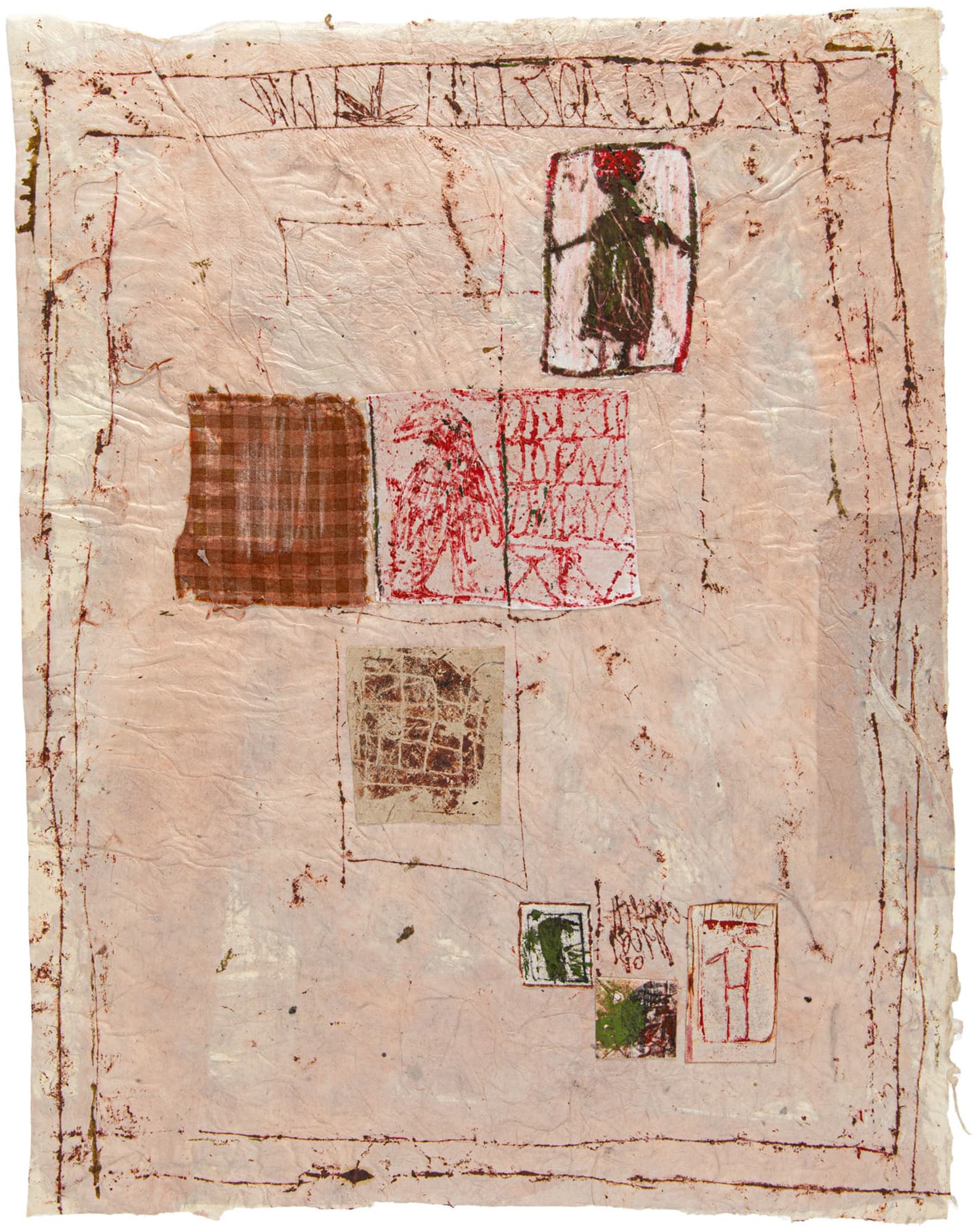
For such works on paper, Baron developed a kind of glyph language. From paper and thin pieces of metal she cut out forms—some birdlike, some human—she could ink and apply to a paper ground in various combinations. To these she often added swatches of fabric and hand drawing—more like scratching, really. Those scratches sometimes approximate lettering, as if telltale signs were all that was left of communication. Often organized as rough grids, the collages seem archaic, almost archaeological, more raw and primitive than, for example, the aboriginal pictographic schemes of Joaquín Torres-García’s paintings. Red appears over and over in these collages as a bloody smudge, and the promise of a public narrative seems to withdraw to a private place of affliction.
That place is symbolized—embodied—by the boxes Baron constructed along with her collages. Many of them, made of distressed wood, wire and other materials, were sealed and unopenable, suggesting and withholding revelation. But the boxes in this exhibition for the most part stand open, like the ark when the Torah scroll is removed, or, in at least one case, an artist’s empty paint box. But here, too, significance remains elusive. Rough colored blocks, scrawled numbers, a small Star of David, a human form—elements barely salvaged, hoarded, then left behind as a testimony or a reliquary for rituals of remembrance. The contrast with Cornell’s boxes could not be starker. Cornell precisely congregated memory, dream and desire in chapels of metaphoric splendor. Baron shored up ruins against loss and annulment. They strike us now as messages—warnings?—from a deep past to a future perhaps even more incomprehensible than the era the artist herself endured.
Lyle Rexer is the author of many books, including How to Look at Outsider Art (2005), The Edge of Vision: The Rise of Abstraction in Photography (2009) and The Critical Eye: 15 Pictures to Understand Photography (2019). The Book of Crow, his first work of fiction, parts of which first appeared in the Brooklyn Rail, has recently been published by Spuyten Duyvil Press.