Cindy Sherman
Word count: 674
Paragraphs: 6
On View
Hauser And WirthCindy Sherman
January 18–March 16, 2024
New York
Cindy Sherman keeps a work diary, and she can be frank in its pages. In late March of 2023, as she was shooting her current body of work, she wrote, “No one has to see anything I don’t like.” It’s a message from Cindy to Cindy, but it’s available to the public, published (and presumably polished) in a tidy catalogue for the exhibition. There is no getting around the feeling of perversity, however slight, when reading the supposedly private meditations kept in a person’s journal. There’s a voyeuristic aspect that is unavoidable and links itself to the specter of surveillance, which has always been an active component of Sherman’s art practice.
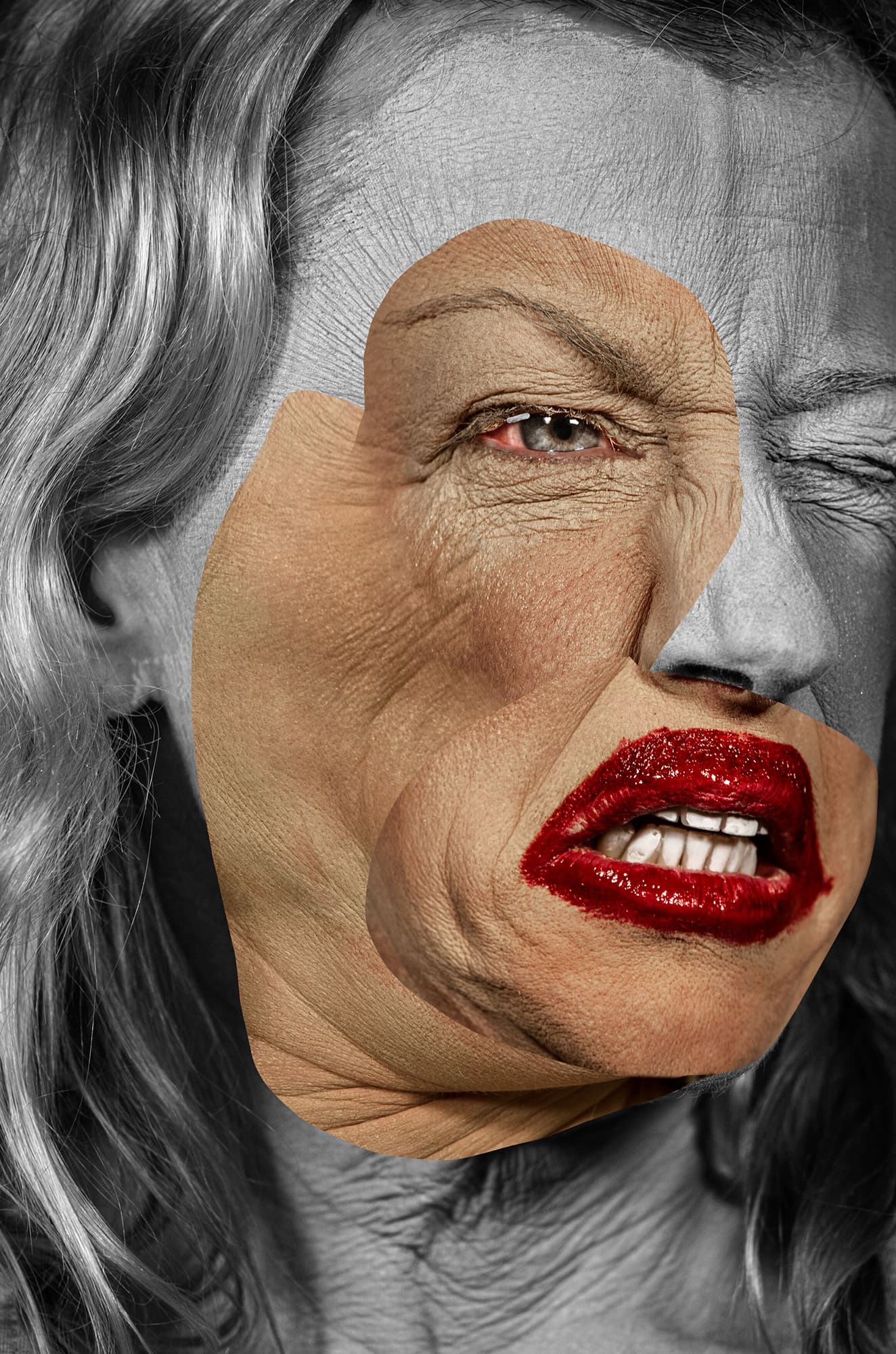
Sherman didn’t need to publish her diary notes, but she did, and the act of doing so enhances the experience of being with the artist as she moves through her creative process. It establishes a narrative arc that supersedes any individual image, grouping them serially and grounding the exceptional in a layered process of aesthetic decision-making. This is classic Cindy Sherman, but the story stops abruptly where I find her new work to be most interesting. The diary presents the artist as photographer and model—the twin peaks of Sherman’s métier—but makes no mention of her as collagist. It makes no mention of what it must feel like to take a sharp knife to high-quality chromogenic print, or how difficult—and unnerving—it must be to attach a C-print to the face of a silver-gelatin print. Not in all, but in many of the works, this is what she does. The room for error seems exceedingly slim, and her cuts are so precise. This is the new punctum in Sherman’s photographs.
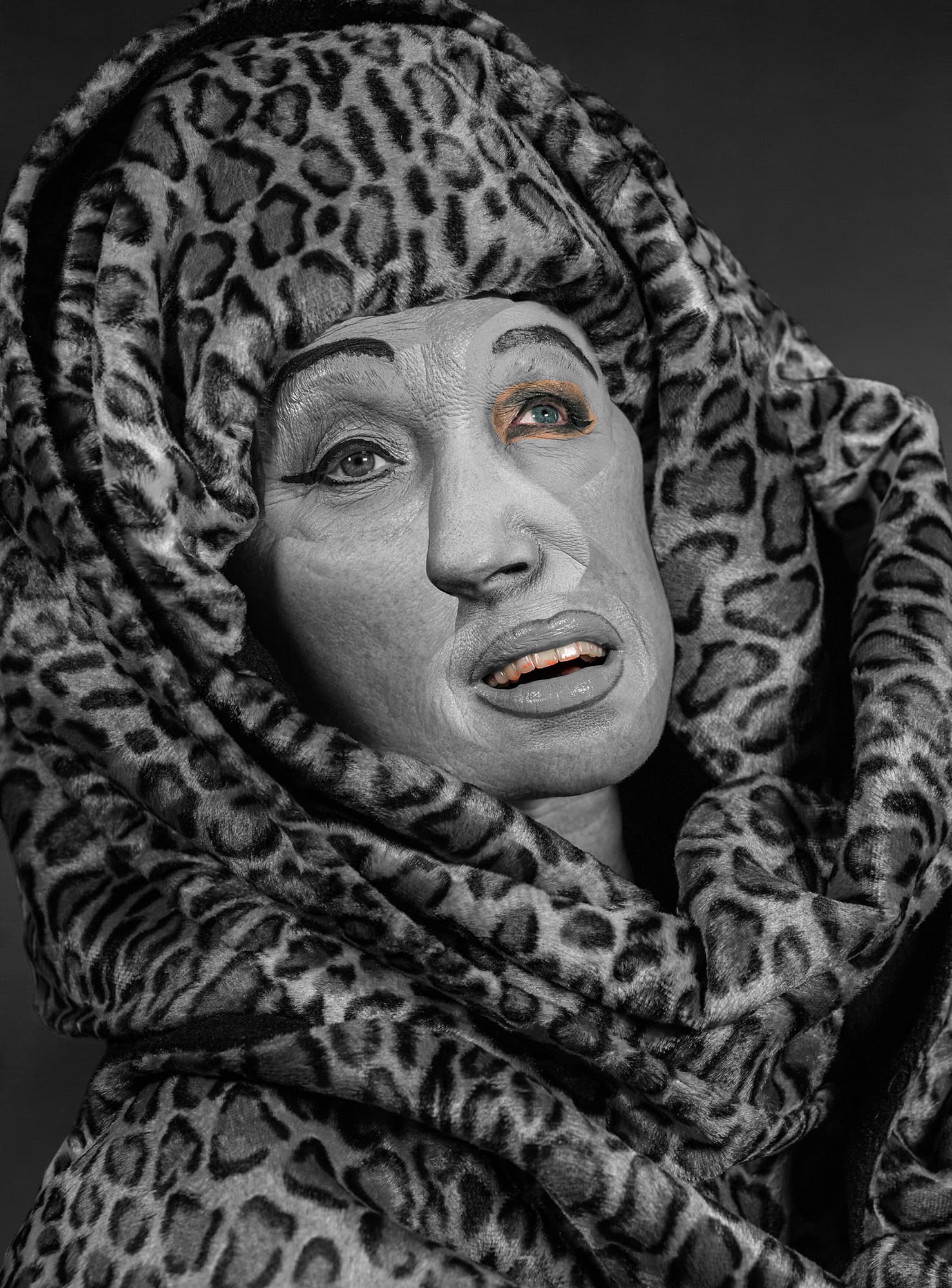
Despite the distortion and disfigurement that makes each face grotesque, Sherman’s photographs are remarkably attractive. The basic compositions correspond in a way that makes them start to feel familiar, though the nearer you get the stranger they become. Sherman’s face is always centered, super-enhanced, and tightly framed by hair or fabric. Heavy make-up, painted teeth, and big wigs accentuate the comedic and campy aspects of Sherman’s performance. The images can be quite funny, but her technique is so skillful and her materials so exquisite, that the amusing quality of the imagery is countered by the stunning sophistication of the physical objects.

Sherman has made terrific use of digital tools to manipulate her imagery. The flesh in these photos looks geomorphic. Areas of impressionistic blur meet zones of high contrast that accentuate the neck folds and nose wrinkles, the crow’s feet and marionette lines. Facial features don’t always align: In Untitled #661 (2023) the nose seems to fit, but it turns in the wrong direction; in Untitled #659 (2023) the eyes sit well in the sockets, but they follow different lines of sight. All these tweaks and adjustments come into focus at near range, and they give the pictures a churning, frozen quality that is perhaps akin to how geologists read certain beds of rock formation.
The cutting-and-pasting is the most stunning aspect of the exhibition. Where sliced-out sections of C-prints overlay the fine silver-gelatin surface, a different degree of tension forms in the work. The C-prints are vibrant, and the little bits Sherman uses add lusciousness to the images. The natural moisture of eyeballs and lips is over-enhanced against the dry fields of caked-on make-up. In some instances, the collaged element is cunningly placed to conceal its edge, in others the edge is distinct. It’s the discrete edge that captivates and surprises, because to function well, that edge must disrupt the image in just the right way. It must simultaneously allow the eye quick passage and cause hesitation. That Sherman succeeds in creating this delicate transition, and doing it differently in each composition, is a testament to her lasting and masterful practice.
Charles Schultz
Charles M. Schultz is Managing Editor of the Brooklyn Rail.