Leon Polk Smith: 1940–1961
Word count: 1138
Paragraphs: 7
On View
Lisson GalleryLeon Polk Smith: 1940-1961
January 11, 2023–February 17, 2024
New York
What is it like to be “of one’s time” and not? Leon Polk Smith was a prime progenitor of American hard-edged abstraction whose non-objective pedigree as a protégé of the painter and philanthropist Hilla Rebay, and subsequent track record of showing in the Betty Parsons and Egan Gallery early on, puts him squarely in the pocket of post-war American art ascendancy yet his legacy has subsequently remained a relatively independent part of that particular epic.
This unique position was undoubtedly the result of Smith overcoming his disadvantaged social circumstance with an indomitable will to shape an independent destiny in art. Born in 1906 into a hardscrabble farm family of nine siblings, in what was then called the Oklahoma Territory, Smith knew the realities of carving a living out of one’s bodily capacities. He grew up amongst remnants of the Choctaw and Chickasaw tribes that had been dislocated to the territory a century before by the Indian Removal Act of 1830. Smith’s parents were of Cherokee heritage, and he identified with his neighbors closely, in experiences that would later resurface, in related formal permutations, in his mature artworks. He ultimately found a bridge to a further range for his life’s ambition in pursuing a degree in teaching, first in Oklahoma and eventually at Teacher’s College, Columbia University. After earning his master’s degree at Columbia, he met Hilla Rebay while working at the Museum of Non-Objective Painting who mentored him and supported his award of a Guggenheim fellowship in 1943. When he finally settled in New York in 1952, (after a series of travels for both blue- collar work and teaching positions), The New York School was already in its dynamic ascendancy. Smith would befriend much younger artists such as Ellsworth Kelly, whose work took on a pseudomorphic relation to Smith’s which was cause for an abiding friction between the two, especially when the “anxiety of influence” was ascribed primarily to one or the other. But while Smith’s biographical progress might be chronologically similar to another contemporary western expat, Jackson Pollock, he never achieved the kind of cultural prominence, an embeddedness in the “Triumph of American Painting” that his painter compatriots Pollock, and eventually even the younger Kelly would. But what if one were to look at such oversight as a benefit to the artist’s continuing relevance in today’s environment where such canonical discourse is shot through with a panoply of alternative narratives?
The legacy of hard-edged and formal abstract painting, particularly that championed by Clement Greenberg, has too long been burdened with an attendant perception of cultural confinement and repression. It’s refreshing, therefore, to take in this show that presents fragments of Smith’s developmental periods as a way to recalibrate one’s own interpretation of an American heritage of the non-objective. Freed of the feints of Formalist stalking horses, one can more openly perceive the starts, stops and resolutions of Smith’s experimentation which would comprise his ultimate formal authority.
Mondrian was among the most significant influences that Smith readily acknowledged, having first encountered the older painter’s work (along with Arp and Brancusi, also, ultimately of prime importance to Smith) in person at the Gallatin Collection at New York University in 1936.
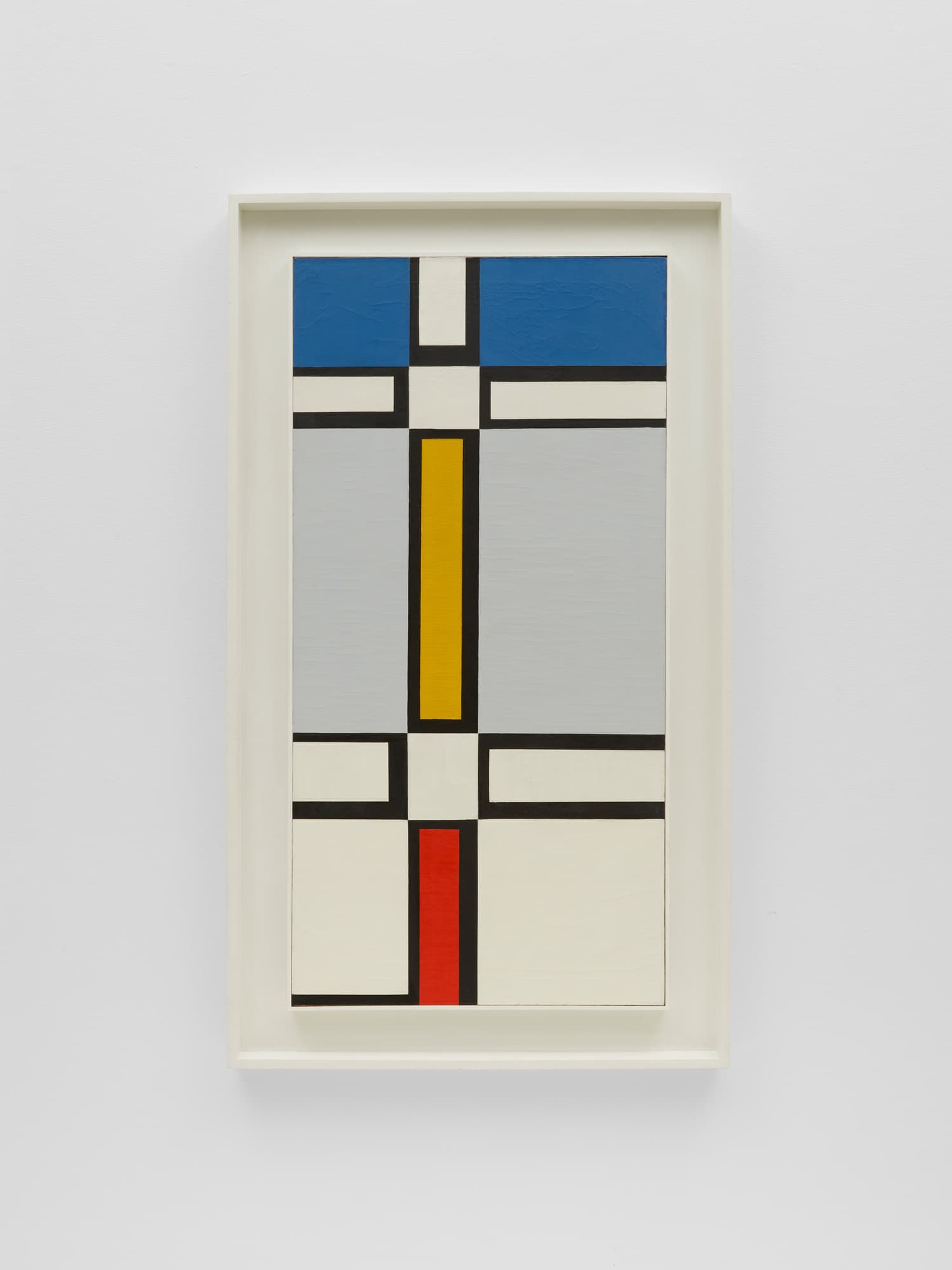
In works such as Diagonal Passage No. 2 (1946–47) and Diagonal Passage No. 4 (1949–50) on display here, Mondrian’s influence is most obvious in Smith’s adoption of Mondrian’s deployment of an asymmetric grid punctuated by varying proportions of white, gray, red, and blue. Mondrian famously eschewed the diagonal and so Smith was both quoting the older artist’s influence and undermining it simultaneously. This inclination toward the diagonal was to dominate Smith’s work for the rest of his life, a formal strategy elegantly elucidated by art historian Elizabeth Buhe: “a painting’s slanted line or capacity for rotation necessitates a perceptual recalibration not because we need to ‘line up’ with the laws of objective space but because its orientation is a remainder of a bodily action in the world.”1 Buhe connects Smith’s reaction to Mondrian’s constrained coordinates to an impulse toward phenomenal agency, and such a reaction is a prime example of how Smith’s personal formal inventions played off of art historical influence rather than comfortably nestling inside of it. Tracing the artist’s leaps in development from Four Blue Diagonals (1950) to Red Black Rock (1955) one sees Smith move from the rectilinear suggestion of the diagonal to a more flowing line. The formal innovation of the latter painting was prompted by the artist’s response to drawings of tennis and baseballs in a sports catalogue. Their serpentine stitching gets translated by Smith onto a tondo canvas which resembles a yin-yang spiritual symbol, yet such symbolism wasn’t as important to him as the way in which the curved line embodied the more certain grace of spatial perception. In Ada (1958) this curvilinear space is stretched taut across a rectangular canvas in which the positive and negative spaces fluctuate in dominance. Smith had just begun to discover the endless possibilities of the irrevocably embedded, yet taut and visually active image that would characterize his mature period. Relatedly, critic Lawrence Alloway remarked on the artist’s distinction from his art-historical lineage: “ …the free forms of Smith are not biomorphic; the curves are concrete and non- associative. The derive neither from Arp nor Matisse...”2 There’s a remarkable work here in low relief Cumulus A (1961) which reflects Smith’s stated belief that it was perhaps Brancusi who was his biggest influence after all. The work’s columnar format of five rhomboid-approximate wood forms is a rough-hewn complement to Smith’s more elegant paintings, and its stacked sequence “turning” in space recalls Brancusi’s groundbreaking Endless Column (1918).

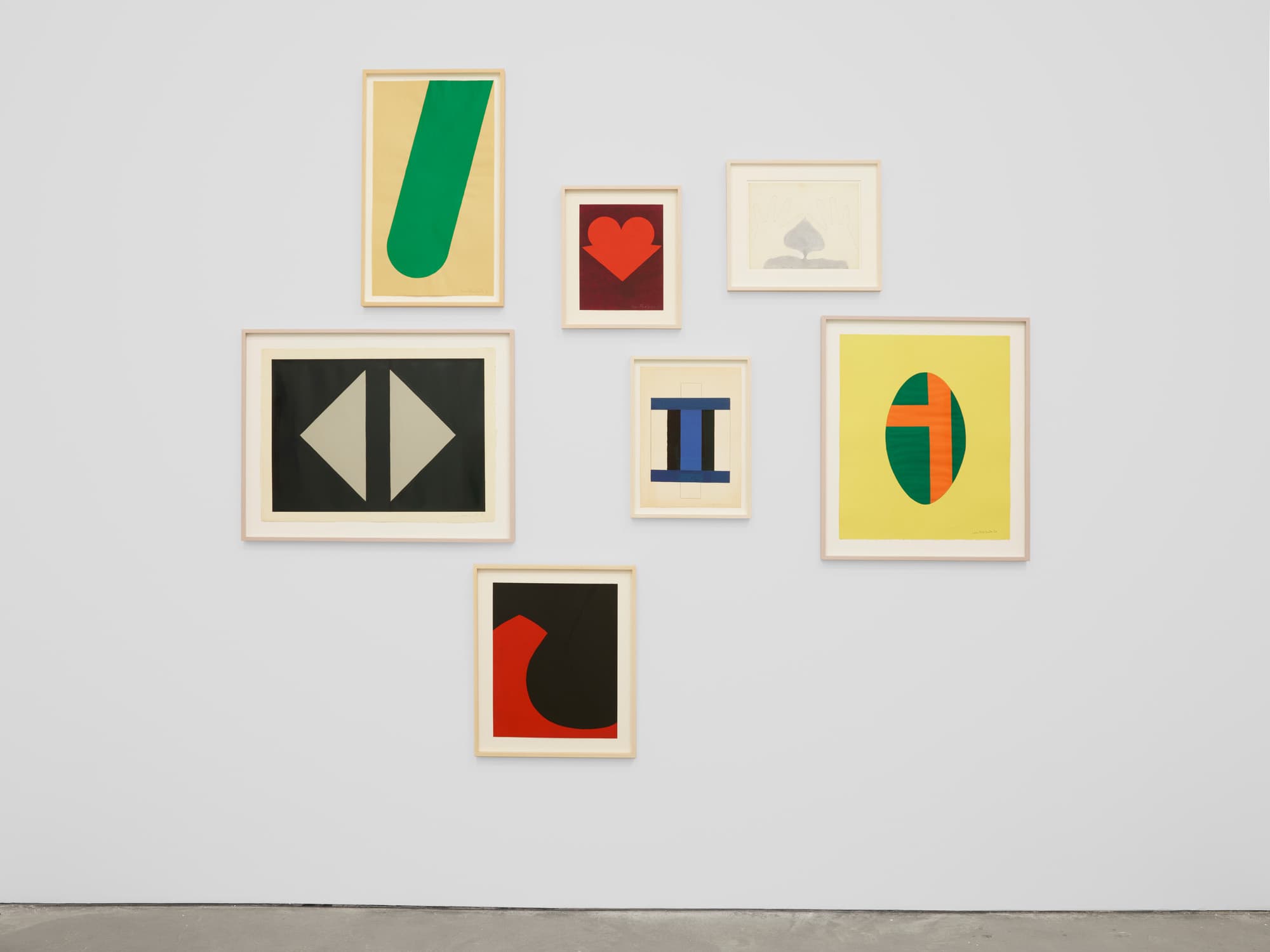
One wall of the gallery is occupied by a variety of paintings on paper from the 1950s that evokes an exploratory rebus of the artist’s ever- inquiring mind. These have a very contemporary feel, as if a glossary of digital prompts and icons. Untitled (1951) looks exactly like the “doors open” symbol for elevators with its opposing triangles on a black ground, while others resemble corporate logos, indicating how the specificity of generalized form can feasibly work a broad spectrum of application from fine to applied arts. A contemporary familiarity with such formal shorthand is just one important way one can enter Smith’s work with a renewed awareness, steering clear of tired bromides equating reductive form with reduced perception.
- Elizabeth Buhe, “To Turn, Obliquely,” in Leon Polk Smith, Prairie Moon, Lisson Gallery catalogue, 2021.
- Lawrence Alloway, Leon Polk Smith, exhibition catalogue, San Francisco Museum of Art, 1968.
Tom McGlynn is an artist, writer, and independent curator based in the NYC area. His work is represented in the permanent collections of the Whitney Museum, the Museum of Modern Art, and the Cooper Hewitt National Design Museum of the Smithsonian. He is currently Adjunct Assistant Professor at Parsons/ The New School.