Ed Ruscha: Works on Paper
Word count: 916
Paragraphs: 6
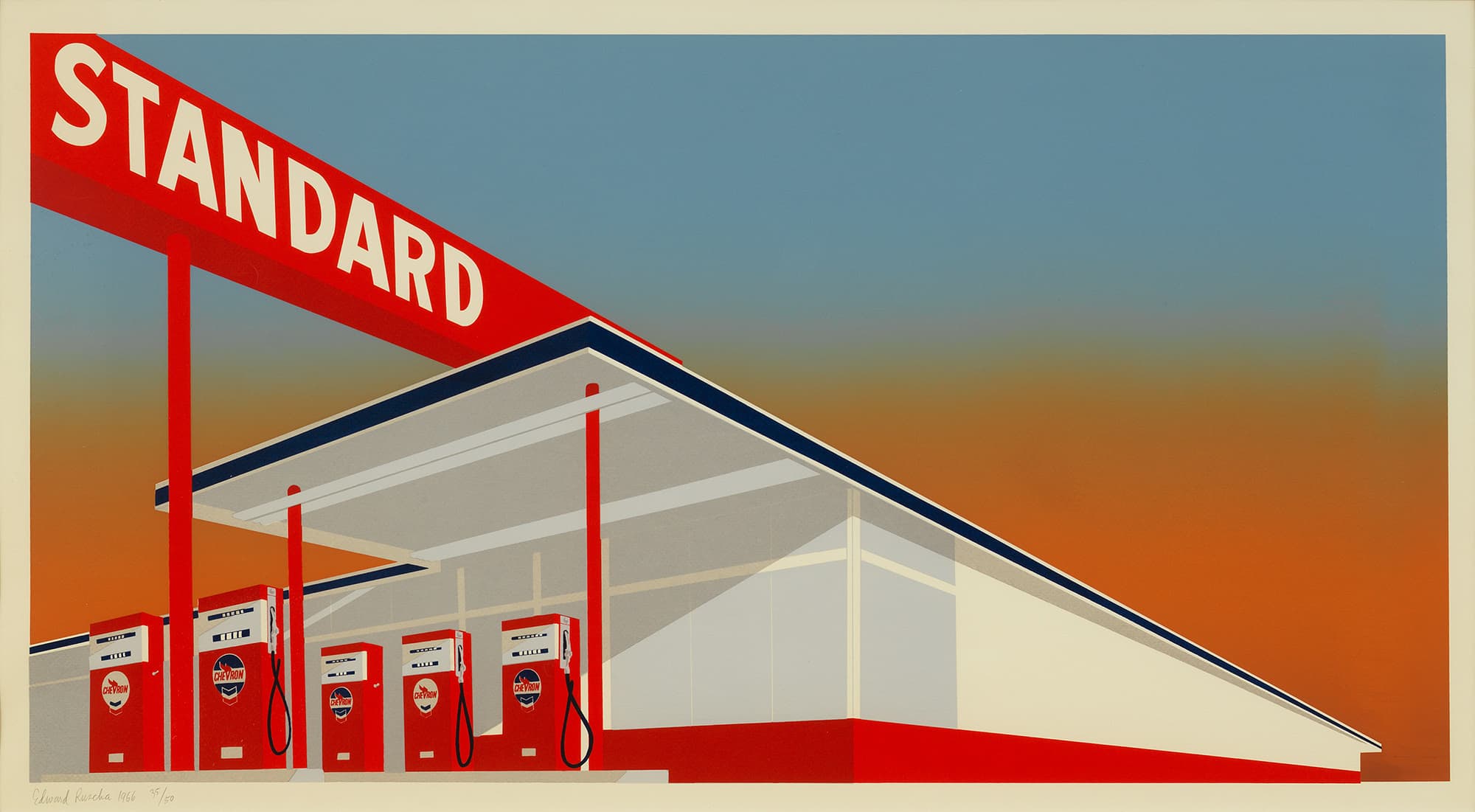
Ed Ruscha, Standard Station, 1966. Color screenprint on commercial buff paper, 25 5/8 x 40 inches. Edition of 50. Courtesy the artist and Craig F. Starr Gallery.
On View
Craig F. Starr GalleryNovember 2, 2023–March 2, 2024
New York
Craig Starr has often exhibited Ed Ruscha’s work, with a number of highlights including a 2005 survey of Ruscha’s “Standard Stations,” a 2007 review of Ruscha’s “Gunpowder Ribbon Drawings,” a 2018 trek through the artist’s monosyllabic word paintings, and a 2021 showcase of Ruscha’s “liquid words” from the late 1960s. The gallery’s current Ed Ruscha: Works on Paper comprises a modest sampling of pieces from these past exhibitions alongside a handful of additions. The standouts are not the iconic pieces. For instance, although there is a Standard Station (1966) on view, the screen-print on commercial buff paper is inferior to the substantially larger ivory-woven paper version at the Art Institute of Chicago, where the “split fountain” tangerine-gray blended skyline is more vibrant and the flat blocks of crimson and white gas station paneling more pronounced. Ruscha’s archetypal Amarillo, Texas, and Route 66 chronicles aside, the exhibition has other gems illustrative of developments in Ruscha’s career from the mid-to-late 1960s. These include pages from the planning of his artist book, Various Small Fires and Milk (1964, printed 1970), featuring Ruscha’s own hand-written notes, alongside trompe l’oeil experiments. For audiences less familiar with Ruscha’s earlier typeface efforts and more acquainted with his block-face, sans-serif, and Futura-limned orthographic witticisms from the seventies through the mid-eighties—the period featuring letterforms Ruscha called “Boy Scout Utility Modern”—this exhibition will be of particular interest.
As Bob Monk summarizes in “Words and a Few Thoughts,” during the late sixties and early seventies, Ruscha began to feel restless with the status quo and stopped painting for two years. He started experimenting with various materials, especially organic substances like chocolate, axle grease, and caviar. Around this period, Ruscha also executed a series of drawings of everyday words, using pastel and organic materials in the process of “reverse stenciling.” This process involves applying pigment to the page before peeling a mask off such that the negative space of the white paper reveals letters that serve as subject and image.
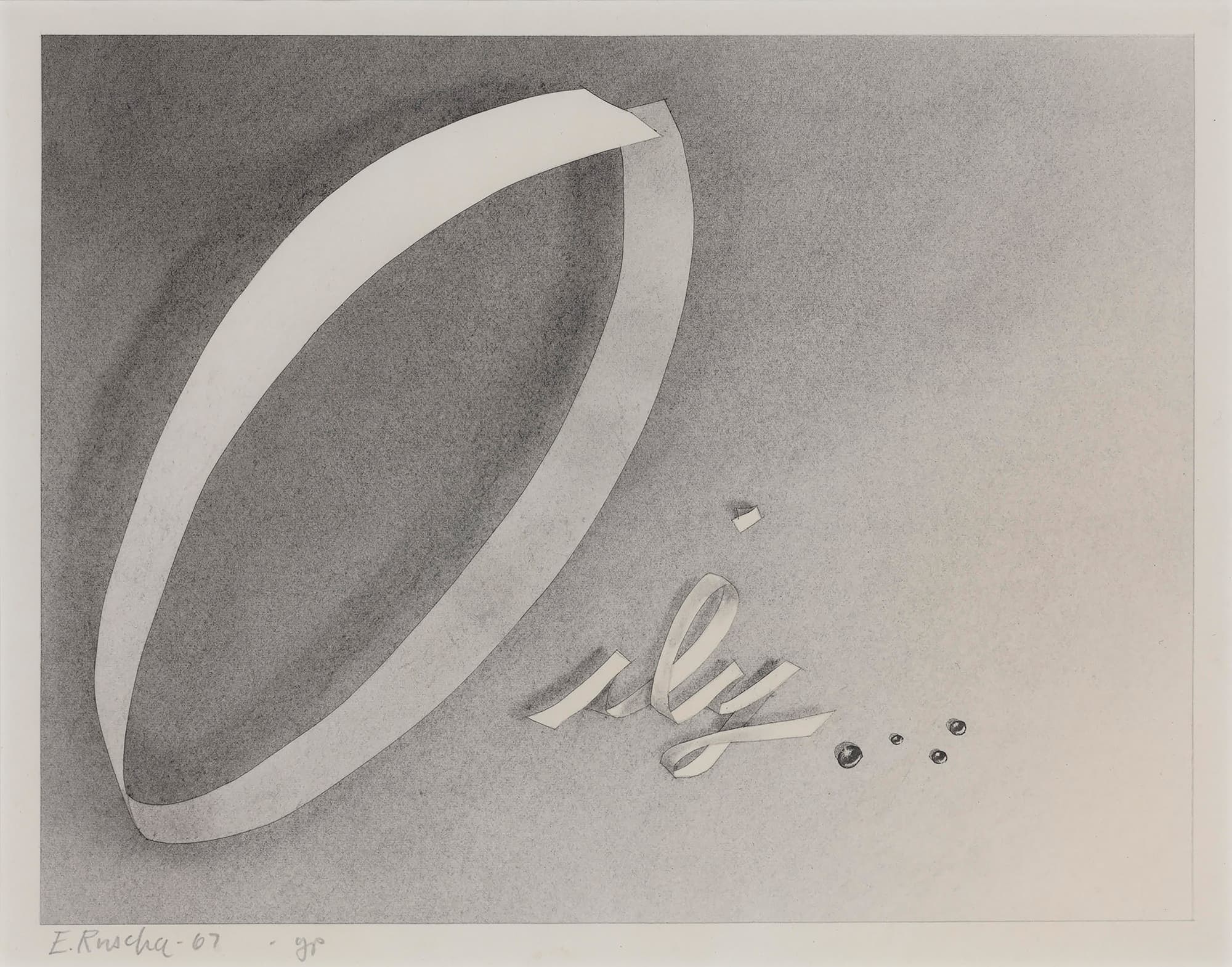
Ed Ruscha, Oily, 1967. Gunpowder on paper, 6 3/4 x 8 3/4 inches. Courtesy the artist and Craig F. Starr Gallery.
Although Ruscha initiated his treatment of words as three-dimensional objects in 1960 with VICKSBURG, his “liquid words” in drizzly adumbration and “gunpowder drawings,” with words folded in ribbon plaits, work in a horizontal mode. These drawings are heirs to a tradition inaugurated by Cubism as practiced by Braque and Picasso, in which letters and numbers generally indicated the flatness and abstractness of the picture plane, dissolving the possibility of illusionistic space. Ruscha’s embodied dribble-and ribbon-words are closer to Oldenburg’s sculptures from the late fifties and sixties (e.g., C-E-L-I-N-E, Backwards [1959], Soft Calendar for the Month of August [1962]), which hypostasize letters with cloud-like buoyancy. Ruscha’s alabaster-pearlescent Oily (1967), 3 Forks (1967), and Corn with Screw (1968) stage words against gunpowder grounds. The individual letters resemble strips of rolled paper poised within mises en abyme, and the gunpowder backgrounds realize a diffuse effect comparable to soft-focus photography. Ruscha’s sharpest morphological jape is Corn with Screw, in which the eponymous screw looms below the silvery ringlet letters. Ruscha occasionally smuggles such figurative titular concessions. For instance, Oily features a trickle of sable-black beads of the ostensible oil to the right of the “y.” But the relationship between morphological form and signified content is not always so clear. City (1969) breaks into a trail of lustrous water droplets, and Rodeo (1969) hides a horsefly at the far-left margins. The associations Ruscha draws subvert expectations: what does a gadfly have to do with the rodeo? What is a “cornscrew?” Why is "city" written in rain—does it have something to do with "city-slicker?" These presage the comic non-sequiturs Ruscha would go on to produce in the mid-seventies and eighties.

Installation view: Ed Ruscha: Works on Paper, Craig F. Starr Gallery, New York, 2023–24. Courtesy Craig F. Starr Gallery.
In these works, we also see Ruscha working against the Greenbergian formalist idiom, which identifies the telos of Modernist painting with flatness and the canvas’s edges. Ruscha’s words-cum-characters sail over indeterminate space coterminous with the picture plane’s expanse. Compositionally, this is a byproduct of Ruscha’s horizontal-landscape format, a device that, as Ruscha informed Bonnie Clearwater in a 1988 interview, is “influenced by the movies, particularly the panoramic-ness of the wide screen.” It is fitting, then, that the two lithographs that make use of this spatial relay are Hollywood (1969) and Hollywood in the Rain (1969). In both works, the rolling hills underneath the Hollywood sign swell while the picture plane closes up.
This modest exhibition thus illuminates a subtle device that runs through much of Ruscha’s early works on paper: the horizontal-diagonal scopic expanse. This discovery permits us also to see Ruscha’s “Standard Station” paintings under a different light. The works are often understood as responses to Los Angeles car culture, with the rectangular dimensions of the works signaling an isomorphism between the canvas, the car windshield, and the billboard. However, as Cécile Whiting has highlighted, the point of view in the “Standard Station” paintings places “viewers significantly lower than the driver’s seat and reveal[s] much more than can be seen through the windshield.” This sunken perspective, also utilized in the gunpowder pieces and the “Hollywood” lithographs, allows for the represented content to protuberate with speed and depth. Although this recurrent compositional device may not have informed the curation of Ed Ruscha: Works on Paper, it is reason enough to visit and plumb the show’s riches.
Ekin Erkan is a writer, curator, and researcher whose writing has appeared in the Journal of Value Inquiry, the International Journal of Philosophical Studies, and Hyperallergic, among others.