Robert Ryman: 1961–1964
Word count: 1140
Paragraphs: 6
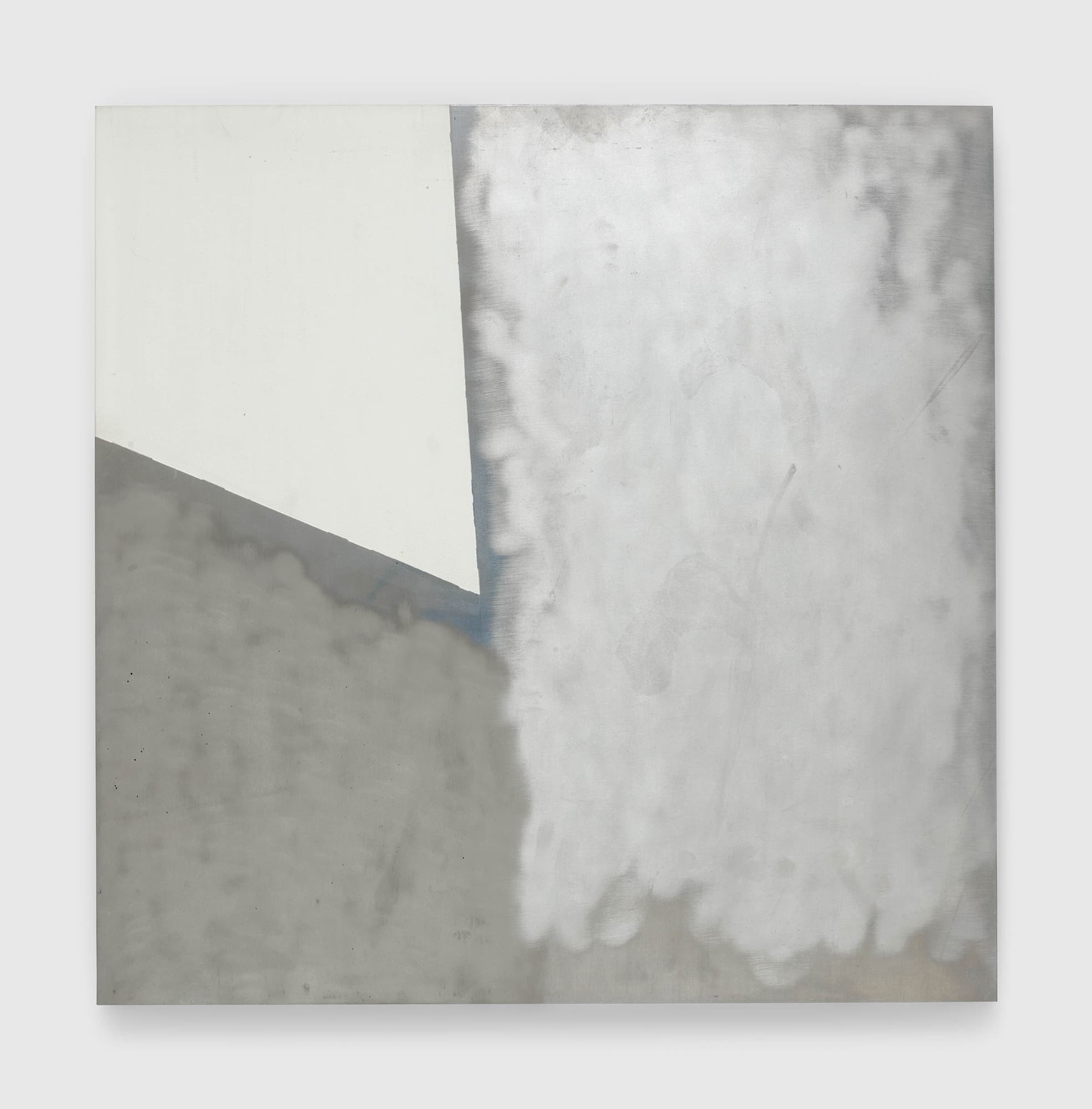
Robert Ryman, Untitled, 1964. © 2023 Robert Ryman/Artists Rights Society (ARS), New York. Courtesy the artist and David Zwirner.
On View
David ZwirnerRobert Ryman: 1961–1964
November 9, 2023–February 3, 2024
New York
Robert Ryman: 1961–1964 is a valentine. It follows a tightly focused 2022 hang of eight paintings, Ryman’s last, uptown (this latter exhibition was the artist’s first show at Zwirner, which announced representation of his estate in 2021), and coincides with a presentation of drawings in London. Curated by Dieter Schwarz, the Chelsea installation, as framed in the press materials, focuses on “a critical moment in Ryman’s development,” which “elucidate[s] many of the fundamental ideas that he would continue to explore throughout his prolific sixty-year career.” In truth, the same could be said of his work a few years earlier, in the late 1950s, as Ryman moved away from his initial, demimonde experiments in partial biomorphism. At this point, he already favored the more durable devices for which he is best known: the analysis of the stroke and the game appropriation of his name as a pictorial unit that might be substituted for it; the consideration of where a composition ends and how the painted field relates to the space it effectively separates from itself; the inventive use of supports and implements of moving paint onto them; the patent deliberation as to how to affix these images-cum-objects to a wall plane; and so on. He was increasingly using a square armature as a format and layering all manner of white atop jewel-toned or verdant grounds. And he was introducing elements in stacks or sectioning them, often introducing a grid without presuming that its matrix would necessarily delimit what might arise in its vicinity.
Yet 1961 is decisive for different reasons. Ryman settled into his first proper studio, at 163 Bowery, a dark loft cut only “where filthy glass windows masked a narrow airshaft,” as Lucy Lippard recalled. In fact, he and Lippard were married that year. The show includes Wedding Picture (1961), a small, luscious field of white marks dissolving into atmospheric smears at its edges, which he completed in Kennebec Point, Maine, on their honeymoon. It somehow still looks wet. Unusual in bearing the memorializing title, it also harbors an unwitting and otherwise eschewed connection to landscape in the would-be mimeticism of the underlying green that Lippard’s grandmother saw “as a depiction of pine trees in a foggy landscape.” If 1961 is a biographical more than an artistic crux, 1964 marks another such moment of transition. His first son, Ethan Ryman, was born that year. In an interview with Robert Storr, Ryman rendered his incipient maturity punctual: “One day in 1965 I felt I had just finished being a student. I felt very confident. I felt I knew exactly what to do.” Many exhibitions historically have reinforced this demarcation, commencing with one at the Guggenheim Museum, New York, in 1972, which started the clock in 1965. Amidst a critically institutionalizing minimalism, Ryman’s reduction of means assumed an essentializing telos despite his equivocation—what Ryman articulated as doubt—that remained the consequence of ensuing experience as well as its means.
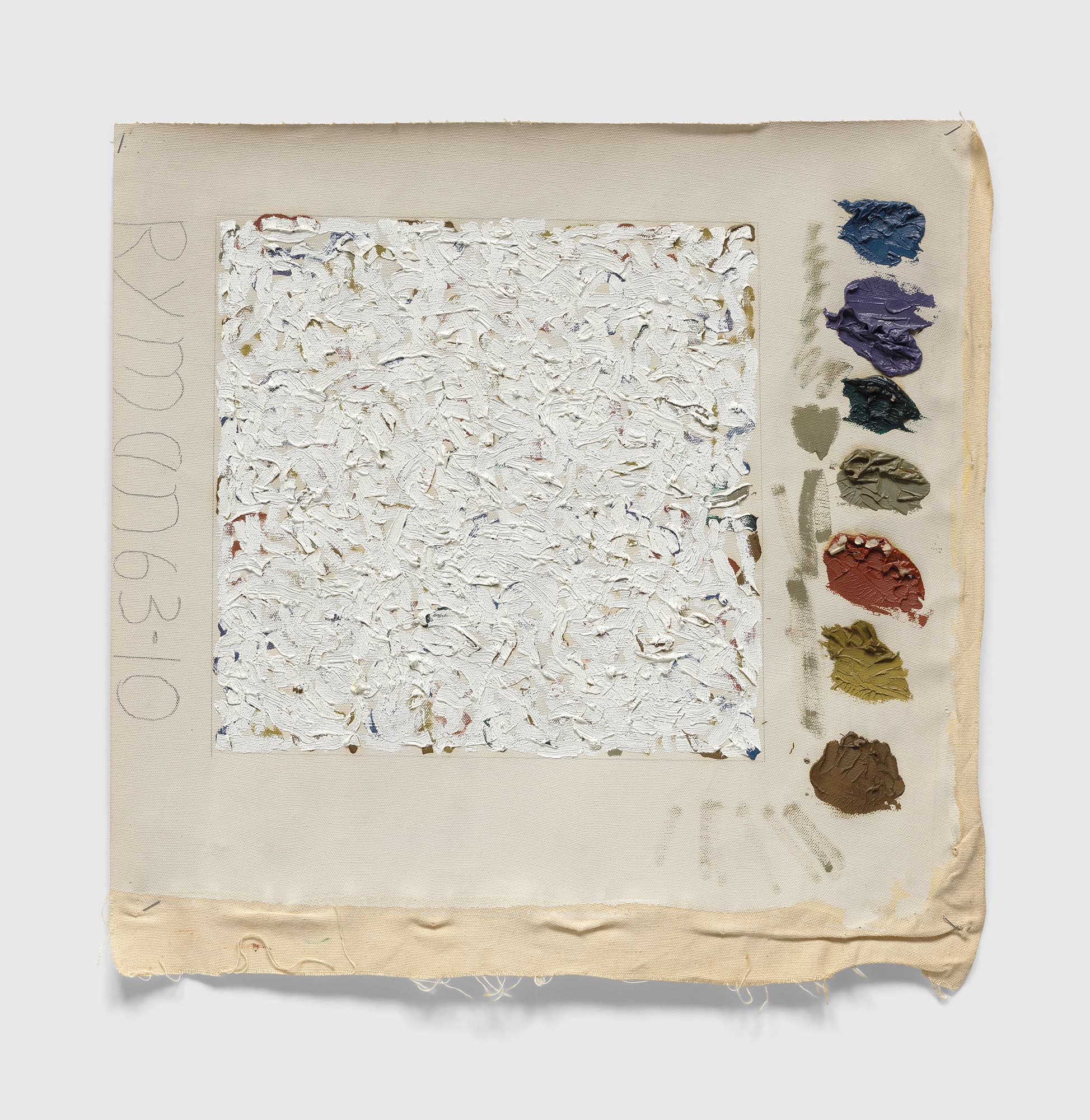
Robert Ryman, Untitled, 1963-2010. © 2023 Robert Ryman/Artists Rights Society (ARS), New York. Courtesy the artist and David Zwirner.
To look again at the early 1960s works, then, is to be reminded of how claims for austerity were always already undercut by the stubborn persistence of underpainting and the importance of gestural application. More broadly, these works emphasize the need to find meaning in how continuously questioning and indeed recursive Ryman’s project was. Robert Ryman: 1961–1964 implicitly proposes such a reading in unfurling from Untitled [Background Music] (ca. 1962), in the first gallery, where we are cued to Ryman’s decision to move from Nashville to New York to play jazz. (He was painting by 1953, when he started working as a guard at the Museum of Modern Art, though he maintained a cabaret license at least through 1955, and he may well have played gigs until then.) John Szwed recently has written of the title’s reference to a Warne Marsh composition that Ryman likely would have known. In his words, it models placing “one thing over another, but not in a deceptive way,” soliciting a transparency of address. Untitled [Background Music] likewise layers: its linen ground is smeared with mustard, fig, and deep cardinal red, which remain no less compositionally active than the white dabs placed atop in keen response. This is another way of proposing a dialogical relation between ground and figure, visually plainspoken about their mutually constitutive means of becoming.
Palpably emergent, so many strokes in these pieces change direction mid-course in something like a painterly act of building the ship while sailing it. This activity is all the more conspicuous as the paintings get larger, an upshot of the new workspace, where, even absent adequate illumination, Ryman could nonetheless scale up. A few related pieces—One Down (1962), Untitled (ca. 1962), and Untitled (1962)—reveal Ryman working to dispose forms and manage a surplus of canvas. As with a tendency to plot, or arrange items in rows, each is marked by squares within squares: five, one, and one, respectively, with the last a diminutive painting-within-the-painting hovering near the lower right corner. They made me think of Ryman’s earnest enthusiasm for Henri Matisse, and his The Red Studio (1911) especially, as memorably recorded in interviews and manifest most directly in Ryman’s Studio View (1959): a photograph looking out of the window of his 11th Street residence, its interior walls painted a saturating bordello red and the floorboards—undulating as if liquified—an aqueous emerald, amidst other sea-greens. Indeed, beyond the structural nesting of works within works that this precedent suggests, the red paintings clustered in the innermost gallery here owe much to Matisse. These paintings from 1963 and 1964 are fiery, one with a ground coated to opacity, and another holding a small monochrome of the same color. The last is situated between a modulated white covering and a light grayish square, a triptych of possibilities crowning a red-rimmed square with more frenetic strokes, green together with white.

Installation view, Robert Ryman: 1961–1964, David Zwirner, New York, November 9, 2023–February 3, 2024. Courtesy David Zwirner.
Like those in more characteristic “Ryman” palettes, these red paintings play with issues of framing and margins, shifting zones of priority without resolving beyond a registration of difference without hierarchy. Color—red but also green, and, in two examples, a brilliant lapis-like blue—is the focus of Robert Ryman: 1961–1964, and justifiably so. In his last works, Ryman applied white paint on darkly saturated grounds, the better to push the former into relief. This was the game of these 1960s pieces, too, a moment of chronophilia within a body of work that largely coaxes similar effects out of less obvious contrasts. Holding its own in the winter light, the show comprises a selection of both, and redoubles Ryman’s own attentiveness not only to how he painted, but to how we see.
Suzanne Hudson is an art historian and critic. She is Professor of Art History and Fine Arts at the University of Southern California in Los Angeles.