Marie Laurencin: Sapphic Paris
Word count: 1549
Paragraphs: 10

On View
Barnes FoundationMarie Laurencin: Sapphic Paris
October 22, 2023 – January 21, 2024
Philadelphia
Just when we thought we knew the landscape of French art in the first quarter of the 20th century, Marie Laurencin: Sapphic Paris, co-curated by Simonetta Fraquelli and Cindy Kang, shakes up the narrative with a fresh exhibition of a major Parisian painter largely neglected by art history. A bisexual woman (already two reasons for her prior invisibility in that now dated story), Laurencin (1883–1956) carefully crafted a “feminine” aesthetic into a significant body of work that was ahead of its time. In contrast to such contemporaries as Picasso, Matisse, Braque, and Brâncuși, she deliberately fashioned her unique style with a delicate evanescence. Her friend Jean Cocteau got it right away: “A painting by Marie Laurencin watches and listens like a roe deer. If a person who does not like animals, if a hunter approaches, the painting disappears.”1
Writing in the exhibition catalogue, art historian Rachel Silveri sees this gambit as part of pursuing “a queer representation of femininity, but one whose queerness was strategically coded, enabling her to achieve success in a masculinist art world while nonetheless picturing nonnormative desires.”2 As early as 1909 when Laurencin painted The Poet Guillaume Apollinaire and his Friends—her most famous work—the enveloping embrace of the three women to the left of Apollinaire (Gertrude Stein, Fernande Olivier, and the poet Marguerite Gillot3) discreetly suggests a ubiquitous theme in Laurencin’s oeuvre: the closeness between women.
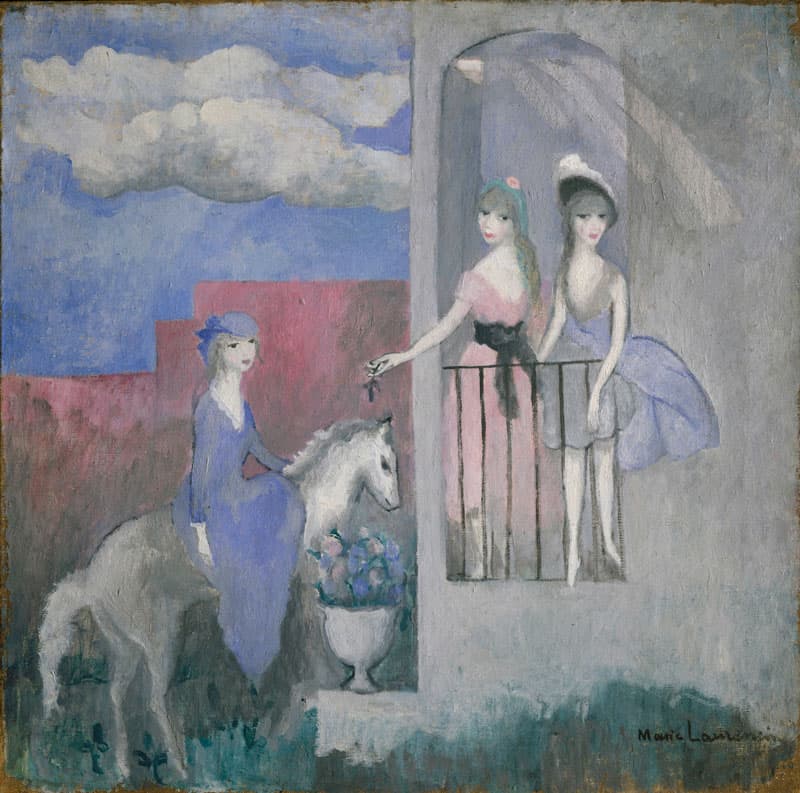
Both then and today, Laurencin’s work speaks to a broader audience with a unique and fully articulated contribution to the defining, complex, cultural palimpsest that was Paris in the teens and 1920s. Always a prescient collector of his contemporaries, Picasso acquired her painting The Dreamer around 1911, soon after she made it. He already recognized her singular style emerging in the gentle, flowing softness of the painting’s forms: a flat figure that seems to lack any bones, set in shallow space, and the delicate touches of color accenting the overall wash of soft greys. Her signature scheme of translucent pastel blues and pinks—an homage to the blue and rose periods of Picasso, yet with a different blue and rose of her own—only appeared in the mid-teens with works such as The Visit (1916). In addition, Laurencin always inscribed her signature with her first name, Marie, prominently visible so as to leave no doubt that a woman created her compositions.
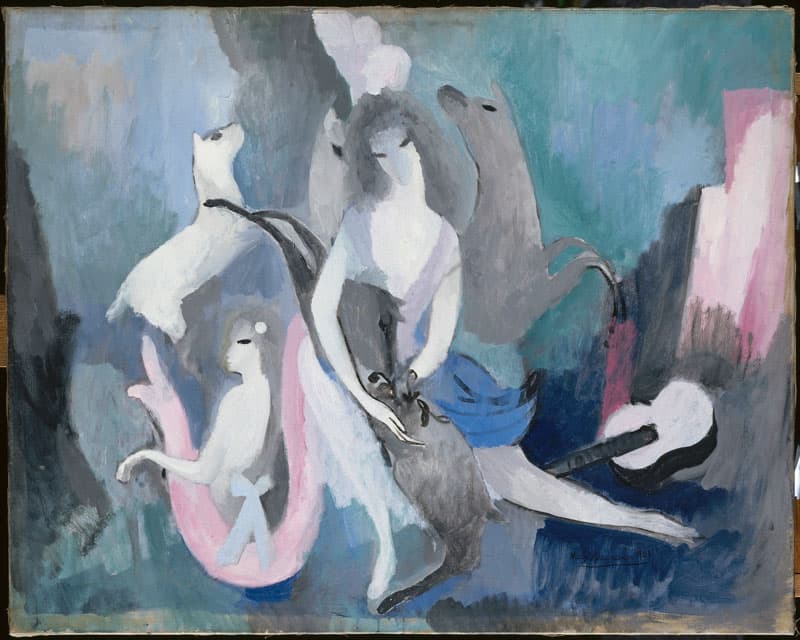
Laurencin lived with her working class, unwed mother Pauline until her mother’s death in 1913. Her father, whom she never knew, nevertheless paid for a good early education. At age twenty, Laurencin studied porcelain painting at the École de Sèvres and enrolled in drawing classes, mastering academic drawing. The decorative arts served as a gendered occupation for women in the avant garde of the early 20th century, and Laurencin continued to work in fashion, interior decor, and other applied arts. In the 1920s she designed costumes and sets for ballet, most notably for Francis Poulenc’s Les Biches, commissioned by Sergei Diaghilev in 1923 for his Ballets Russes. She worked closely with Poulenc, deeply influencing his conception of Les Biches from the outset.4
In 1907, aged 24, Laurencin had her exhibition debut as a painter in the Salon des Indépendants. At the opening, Picasso introduced her to the great poet and art critic Guillaume Apollinaire, calling her Apollinaire’s future “fiancée.”5 That Laurencin immediately fell in love with Apollinaire—their affair went on for the next five years though they never lived together—while at the same time cultivating amorous relationships with women expresses a fluidity of sexual identity that also defined her painting.
Without meaning to be condescending, Henri Rousseau painted a now famous portrait of the pair in 1909 entitled The Muse Inspires the Poet. Apollinaire, who wrote frequently about Laurencin during these years, described Laurencin’s paintings as “the tender manifestations of this childlike and fabulous aspect of the feminine mind.”6 Writer Marcel Jouhandeau, who published a laudatory book on her art in 1928, also meant well but referred to her as an “eternal little girl.”7 The persistent allusions to Laurencin as childlike, though trivializing, nevertheless connected her to one of the most radical influences then gripping modernism—children’s art. Picasso had asked Henri Matisse for his Portrait of Marguerite (1906-7), done in a “childlike” style with Marguerite's name awkwardly scrawled in block letters across the top, as though a child had done it), when the two artists traded paintings in 1907. The picture reveals the impact of children’s art on Matisse’s revolutionary turn toward simplification, chronicled in the two versions of the Young Sailor (1906) and then in the magisterial series of large figure compositions of 1909-17, culminating in The Dance, The Music, and Bathers By A River. Picasso himself experimented with a child’s way of seeing soon afterwards in the simultaneously frontal and profile faces of the two central figures in his 1907 Demoiselles d’Avignon.8
Laurencin split with Apollinaire in June 1912 and two years later married a would-be German artist, Baron Otto von Wätjen, making her a German citizen (women were required to assume their husband’s nationality at the time). Consequently, when France declared war on Germany in August of 1914, two months after her marriage, she had to leave France as an “enemy alien.” Von Wätjen had no stomach for military service, so the couple exiled to Spain until 1919. Despite complaints about missing her beloved bohemian world of Paris, by October she would write to her dealer Paul Rosenberg that things were beginning to go better for her in Spain and “if I go to the Prado in Madrid it is impossible, despite all that is going on, to forget that I am a painter.”9 Knowing that she was looking at Goya, The Visit (1916), for example, subtly suggests this Spanish influence in the generic faces and black eyes of Laurencin’s figures, and in the balcony setting.
In May 1915, Laurencin described her relationship to von Wätjen as more like siblings than lovers. He was drinking heavily and during visits by her Parisian friend Nicole Groult, the two women commenced a love affair. Laurencin returned to Paris in April 1921 to an exhibition at the Galerie Paul Rosenberg, which catapulted her to art world prominence. In her paintings of the 1920s she fashioned her mature style more deliberately than ever in works like The Shepherdesses (1922) and in designs for the ballet. The Shepherdesses, rendered in her palette of blue, pink, and grays, represents Laurencin (in an Art Deco checkerboard skirt) and Nicole as Arcadian shepherdesses, accompanied by a puppy-like sheep. Laurencin continued to paint self-portraits, as she had done throughout her life, but in her later career she also became one of the most sought-after portraitists of society women like Lady Emerald Cunard, Coco Chanel, and Helena Rubenstein. No longer a footnote in the circle of prewar Cubism, she had become the art star of Sapphic modernism, a style that appears and disappears at will.
Endnotes
- Jean Cocteau, undated manuscript for an article on Marie Laurencin, Carlton Lake Collection of Jean Cocteau Papers in the Harry Ransom Center, University of Texas at Austin, box 45.12; cited in Simonetta Fraquelli and Cindy Kang, “Marie Laurencin: A Woman’s World,” Simonetta Fraquelli and Cindy Kang, eds., Marie Laurencin: Sapphic Paris (Philadelphia: The Barnes Foundation and New Haven: Yale University Press, 2023), 8.
- Rachel Silveri, “No Modernism without Marie Laurencin: Picturing Queer Femininity,” in Simonetta Fraquelli and Cindy Kang, eds., Marie Laurencin: Sapphic Paris (Philadelphia: The Barnes Foundation and New Haven: Yale University Press, 2023), 123.
- John Richardson, A Life of Picasso, volume II: 1907-1917 (N.Y.: Random House, 1996), 67. Apollinaire sits enthroned in the center with Picasso to his left. Richardson identifies the figures to Picasso’s left as Marie’s mother and the poet Maurice Cremnitz. Laurencin portrays herself seated below right.
- See Cindy Kang, “Designing a World: Marie Laurencin’s Decorative Projects,” in Simonetta Fraquelli and Cindy Kang, eds., Marie Laurencin: Sapphic Paris (Philadelphia: The Barnes Foundation and New Haven: Yale University Press, 2023), 76.
- John Richardson, A Life of Picasso, volume II: 1907-1917 (N.Y.: Random House, 1996), 8.
- Guillaume Apollinaire, “The Salon des Indépendants” (1908), Apollinaire on Art: Essays and Reviews 1902-1918, ed. Leroy C. Breunig, trans. Susan Suleiman (New York: Viking Press, 1972), 44.
- Marcel Jouhandeau, Marie Laurencin (Paris: Éditions des Quatre Chemins, 1928), n.p., cited in Rachel Silveri, “No Modernism without Marie Laurencin: Picturing Queer Femininity,” in Simonetta Fraquelli and Cindy Kang, eds., Marie Laurencin: Sapphic Paris (Philadelphia: The Barnes Foundation and New Haven: Yale University Press, 2023), 128.
- See Jonathan Fineberg, The Innocent Eye: Children’s Art and the Modern Artist (Princeton: Princeton University Press, 1997).
- Paul Rosenberg, October 9, 1914, The Morgan Library & Museum, N.Y. MA 3500.122; cited in Simonetta Fraquelli, “Life in Exile: Becoming ‘Marie Laurencin,’” in Simonetta Fraquelli and Cindy Kang, eds., Marie Laurencin: Sapphic Paris (Philadelphia: The Barnes Foundation and New Haven: Yale University Press, 2023), 52.
Jonathan Fineberg is Director of the new PhD in Creativity at Rowan University and author of Modern Art at the Border of Mind and Brain (University of Nebraska Press) and the career survey Christo and Jeanne-Claude: On The Way To The Gates, 20th Anniversary Edition (Yale University Press, 2025).