Ed Ruscha/Now Then
Word count: 1400
Paragraphs: 4
On View
The Museum Of Modern ArtEd Ruscha/Now Then
September 10, 2023–January 13, 2024
New York
One of the singular accomplishments of Ed Ruscha’s long and varied career is to bring the hyperbolic image of the American billboard down to its actual size. Whether revealing the ass-end of the Hollywood sign or the lateral sprawl of Manifest Destiny down to its cinematic Sunset end, he’s served as sardonic witness to the country’s love/hate, super/under-sized relationship with itself. He’s done this so effectively because his own conjured identity as an artist comes from a deeply conflicted relationship to the “official” art world. As Okies like Woody Guthrie and Merle Haggard before him created personas cobbled from the quick-witted ironies and plain-talking lingo of working folk they ultimately dedicated their best songs to, Ruscha has developed his idiosyncratic relation to American vernacular language and generic illustration as double foils to the sanctioned pretense of “high” art. In this same spirit (riffing on one of his most infamous word “pieces,” I Don't Want No Retro Spective, from 1979), one might be tempted to chide him, “Be careful what you don’t wish for,” on the occasion of this, his most comprehensive retrospective to date.

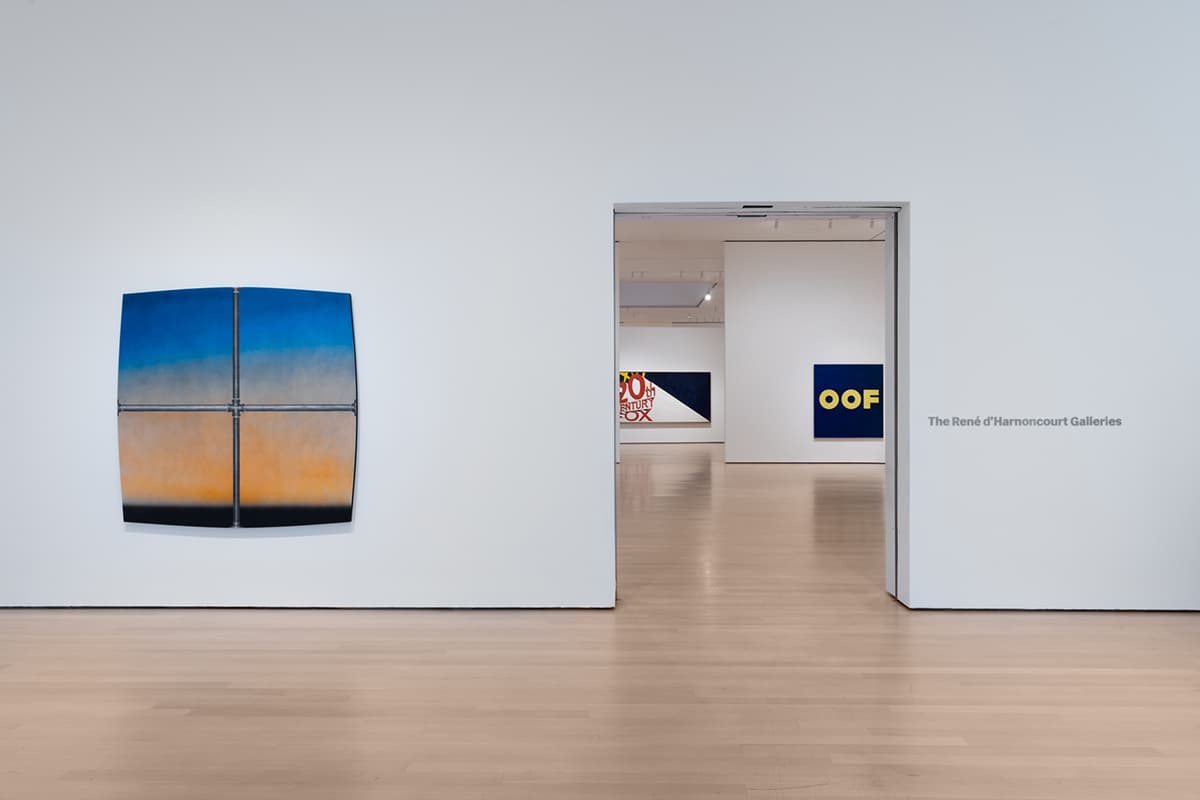
Ruscha was raised in Oklahoma but “headed West to grow up with the country.”1 In 1956, he made it to Los Angeles to attend art school at Chouinard Institute, later called CalArts, then a feeder school for Walt Disney Studios. It was undoubtedly here that the conflicted distinction between legitimate “commercial artist” and “no-count” fine artist (the societal expectations and confusion between the two) took shallow root in the young artist’s deep consciousness. Some of his seminal collages, like Su (1958), Vicksburg, and Dublin (both 1960), evince the split-persona of a commercial artist by day, fine artist by night, in their quirky combines of specific typeface and Abstract Expressionist painting. One imagines, while taking these in, that the artist wasn’t comfortable with either a high or low art category but intent on eternally playing those ends against the middle. And as is evident from these earliest efforts, Ruscha, from the very beginning, was always more of a Pop-adjacent than a Pop artist. He did travel to New York in 1961 to meet Pop practitioners Andy Warhol and James Rosenquist, yet he seemed to come away almost unencumbered by their influence. The New York art world at the time may have seemed too dedicated to maintaining its own cultural provenance. The West Coast undoubtedly offered Ruscha a blanker slate. Their popular sources aside, consider the pictorial originality of some of his most iconic works in this light such as Large Trademark with Eight Spotlights (1962) and Standard Station, Amarillo, Texas (1963), depictions of the 20th Century Fox logo and a Standard Oil gas station, respectively. Both are drawn in an exaggerated perspective that diagonally bisects their large landscape-scaled canvases in a way that any advertising art director could almost admire but for the fact they are executed with just a little bit too manic a panache, as if the assignment went a bit awry when a hungover layout artist took a bump too many of speed to get things back on track. They are funny because they are true to the inherent hyperbolic address associated with selling America’s “pure products” to the middlebrow masses. And in this opportunity for retrospect, such canvases can’t help but take on a nostalgic patina for a time when the subliminal seduction behind such icons remained inside a tinsel curtain of commercial flash, when it took an ironist like Ruscha to tease it out. In America’s exhausted Pop present, when insider irony seems to be the very caricature that one’s spirit haunts, such cocky semiotic play can feel downright quaint. This aspect, this American perspective for when it was (and then wasn’t) so great, is an unexpected yet salutary outcome in this survey of the artist’s progression from close-up investigation to distant disillusion. Ruscha’s later career preoccupations have become more focused and reflective upon the passage of time as an index of moral turpitude and social decay. By the late 1980s, his canvases took on a darker tone. In Jumbo (1986), what looks like a black and gray spray-painted circus elephant, trunk curled in resigned labor, labors forlornly uphill to the right of the painting. The disingenuous “big tent” of American populist politics is at play here. Another group of paintings featuring low-lying industrial park buildings that began as his “Blue Collar” series (1992), he eventually paired with a newer series in the same, yet altered, format as his contribution to the US Pavilion for the 2005 Venice Biennale. Presented as Course of Empire (making explicit its conceptual link with Thomas Cole’s entropic allegorical landscape cycle “The Course of Empire” [1833–36]), this grouping of ten paired paintings tracks, in one instance, Ruscha’s own course from a twilight Blue Collar Trade School (1992) to a smog-tinged dawn and cyclone-fence-enclosed The Old Trade School Building (2005). The inference of radical displacement of both blue-collar jobs, together with the technical training that would facilitate such, gains a powerfully elegiac poignancy as it is envisioned by the artist in his characteristic deadpan illustrative style. Here Ruscha’s errant commercial artist deploys his skill toward the end of illustrating the inevitability of his own trade’s demise. It’s implicit that the vacant shopping malls and erstwhile box stores fronting an increasingly isolated American empire will follow a similar trajectory. Ultimately the two-dimensional edifice of the Fox News façade cannot hold. There is also, however, much in the exhibit that veers from direct social commentary, offering some respite from the critique of American exceptionalism that oozes from Ruscha’s more pointed moral allegories. His 1970s works on paper in particular exude a Left Coast beatnik cool or what Dave Hickey identified as the artist’s “wacky kind of bumptious innocence.”2 Their modest scale, quirky materials, and deconstructed vernacular language have had an undoubted influence on multiple generations of artists such as Jenny Holzer, Kay Rosen, and Mel Bochner, to name just a few examples, who have similarly deployed wordplay as immediate social address in their work. In a work that spells out (and is also titled) Psychedelic-Indian-Guru-New Mexico-Fadeout-Photo-Realism (1976), the text is set against a rainbow pastel background in a typical Hippie tie-dye pattern. All sorts of allusions abound, including (but not limited to) a ventriloquizing of incipient New Age psychobabble and a critique of trendy art movements at the time. Another, I Live Over in Valley View (1975), reports like a proud suburban dad bragging at a backyard barbeque about his real estate stake in The American Dream. The fact that this statement is cast over what looks like a brown smoggy haze descending on a bright yellow sky conditions the statement’s panoramic bluster as wishful thinking. In both, Ruscha perfectly exemplifies what William Carlos Williams has termed the “variable foot” or irregular meter of American vernacular speech that so imbued his own poetry.

Many other aspects of Ruscha’s expansive artistic investigations including his inventive early book works such as Various Small Fires and Milk (1964) and Every Building on the Sunset Strip (1966) are on display here as well, along with documentation of their creative genesis. Also on display is his self-published, performance-related book work Royal Road Test (1967), a collaboration with the artists Mason Williams and Patrick Blackwell in which they threw an old Royal typewriter from the window of a 1963 Buick going ninety miles an hour. Its smashed remains are then meticulously picked over in the book’s photo-documentation in what seems a light-hearted mockery of the forensic seriousness of Conceptual Art. The “bumptious innocence” of such an offhand gesture exemplifies the ludic power of West Coast wit to undermine East Coast discretion. Fortunately, as this survey shows, Ruscha grew out of the temptation to such polarizing jibing to become the finely sharpened commentator in his work that both the State of the Union and artworld, as a whole, deserve.
- Gram Parsons and Tom Brown, an excerpt from their composition, “Return of the Grievous Angel” (1974).
- Dave Hickey, “Available Light,” in The Works of Ed Ruscha (San Francisco; New York: San Francisco Museum of Modern Art; Hudson Hills Press, 1982), p. 24.
Tom McGlynn is an artist, writer, and independent curator based in the NYC area. His work is represented in the permanent collections of the Whitney Museum, the Museum of Modern Art, and the Cooper Hewitt National Design Museum of the Smithsonian. He is currently Adjunct Assistant Professor at Parsons/ The New School.