Eberhard Havekost's Paintings 1998–2016
Word count: 910
Paragraphs: 6

On View
Anton Kern GalleryPaintings 1998 – 2016
September 7–October 21, 2023
New York
It is a daunting task to find new language to discuss Eberhard Havekost’s work. The critical analysis of the artist is exhaustive, including from some of the best theorists and critics working today. As a writer, its density feels encroaching, leaving few places on the map left to discover and explore. His exhibition COPY + OWNERSHIP at Anton Kern Gallery opened in 2012, when I had just started grad school, and it was a formative event, in the Badiouian sense, to my practice—a point of tension that required either my acceptance or rejection, attraction or repulsion. The takeaway for me as a young artist was that the painter is a trickster, able to simultaneously embody positions to be totally poetic and subjective while also engaging in post-modern forgery, LARPing, and destructive karaoke. It was my introduction to Havekost (1967–2019), and also to a philosophy I hoped existed somewhere: that artists didn’t need to pick between extremes, but instead could luxuriate in irony and the tensions formed in taking opposing stances. I left feeling that whatever it is, painting can handle it.
Havekost imposes an awkward subversion to much of his subjectivity in the works on view in the present show at Anton Kern, Paintings 1998–2016 . I think of Manet and awkwardness in relation to his work. Similar to Manet’s The Dead Christ with Angels (1864), where the hand of Christ becomes a puddle of oil and wound, a magnificent stone of pigment that retains the gaze of the viewer through its strangeness, Havekost delivers a gaze trap in Bath/Flashlight (2002) and Auto, WD 98 (1998), in which the body is shaped into a hard outline in the former and a stationary car sits next to an impossible blur of gardenia in the latter. Both are made from the abrasive act of dragging the brush, with little to no medium, across the surface of stiff canvas. There are no fancy tricks to them. To Havekost, the simpler the images are, the more they become uncertain. It is what Diogenes might call “the plainness of living,” seen in images for what they reveal about the ordinary.
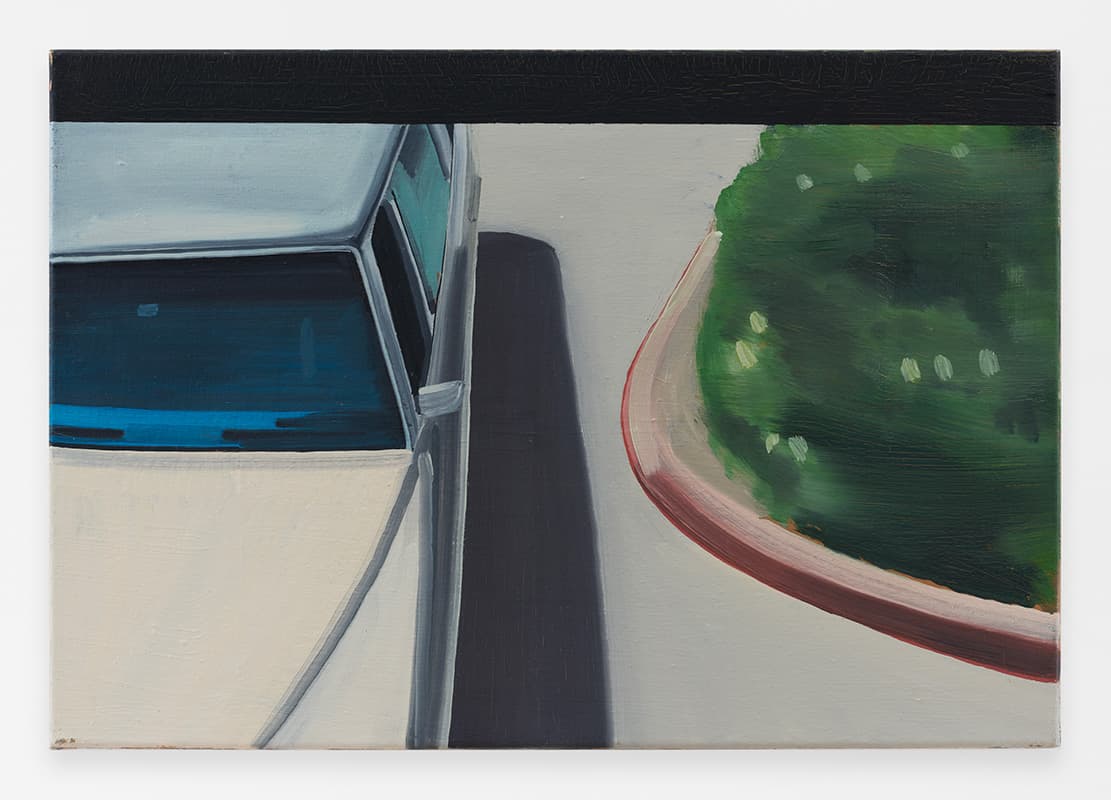
Havekost seems to seek out uncrowded thoughts, a reticent technique aimed at finding a clarity of vision through painting, and earning a chance of really getting to know the thing he’s portraying. Earlier work depicted decipherable subjects, like car wrecks with airbags deployed—images that evoked their own narrative animation through the implied sequence of before and after. This current exhibition is more subtle, closer to aphasia. Again, this is Manet: the vitality of the sketch, that what is indecisive and unfinished, ill-rendered, produces difference which forms in us a sense of the ideal. It is a unique depth of painting, that which never resolves itself—painting as woolgathering that produces and rewards long looking without ever leading to language.
The effect of his work towards digital manipulation has been written about extensively as a will to resist the dematerialization of the image through facture and strangeness. By stress testing his works through digital editing, Havekost attempts to find their reality through what is lost and changed in their stored data. His images and their relationship to time, or lack thereof, deserve revisiting. Havekost often relied on a dingy orange that seems dated upon application. I can only think that this is an effort to produce a time outside of time, an image that doesn’t feel immediate and instead feels impossibly deferred, even as to when it happened—an impossible, unfamiliar nostalgia.

I think about how difficult it is to make a painting like Nuclear War, Let’s Talk About It (2011). As a painter, it feels like a painting about how complicated black can be, how floating and deep chromatic blacks are; how something that seems so simple can remain so remote. For this exhibition—or obituary—the stray markings of time qualify the work. Island B12 (2012) and Saurier (2016) are most revealing. Island B12 depicts a simple tattoo on marmalade-hue skin, a cheap landscape inscribed as a form of escapism or aspiration. Saurier is the depiction of an ancient nightmare, or rather the speculation of what it looked like from the evidence of its bones. Now extinct, it is its fiction as an image that releases it again, to dwell in terror again, with a relationship to what was real always and forever uncertain. It reminds me of the strange act of author Cormac McCarthy’s character Judge Holden from his 1985 novel Blood Meridian, who draws a cup in his sketchbook as he sits by the fire and then destroys the cup when he is done. Havekost sees the relationship between the fossil and the image, the image to dream a way forward or still haunt our reality. It is hard to not interpret this exhibition through an existential retcon, to see these paintings and their awkwardness as a need to ward off eventuality, to keep a space from ever enclosing. The destruction of the image and Havekost-as-Virgil, guiding it into painting through suspicious truths and their closed range of movements, releasing its force to exist somewhere else, displacing it within us. As above, so below.
Andrew Paul Woolbright is an artist, gallerist, and Editor-at-Large at the Brooklyn Rail, living and working in Brooklyn, NY. Woolbright is an MFA graduate from the Rhode Island School of Design in painting and is the director of the Lower East Side gallery Below Grand. He currently teaches at Pratt and School of Visual Arts in New York.