On the Nonexistence of Morton Feldman’s For Mark Rothko
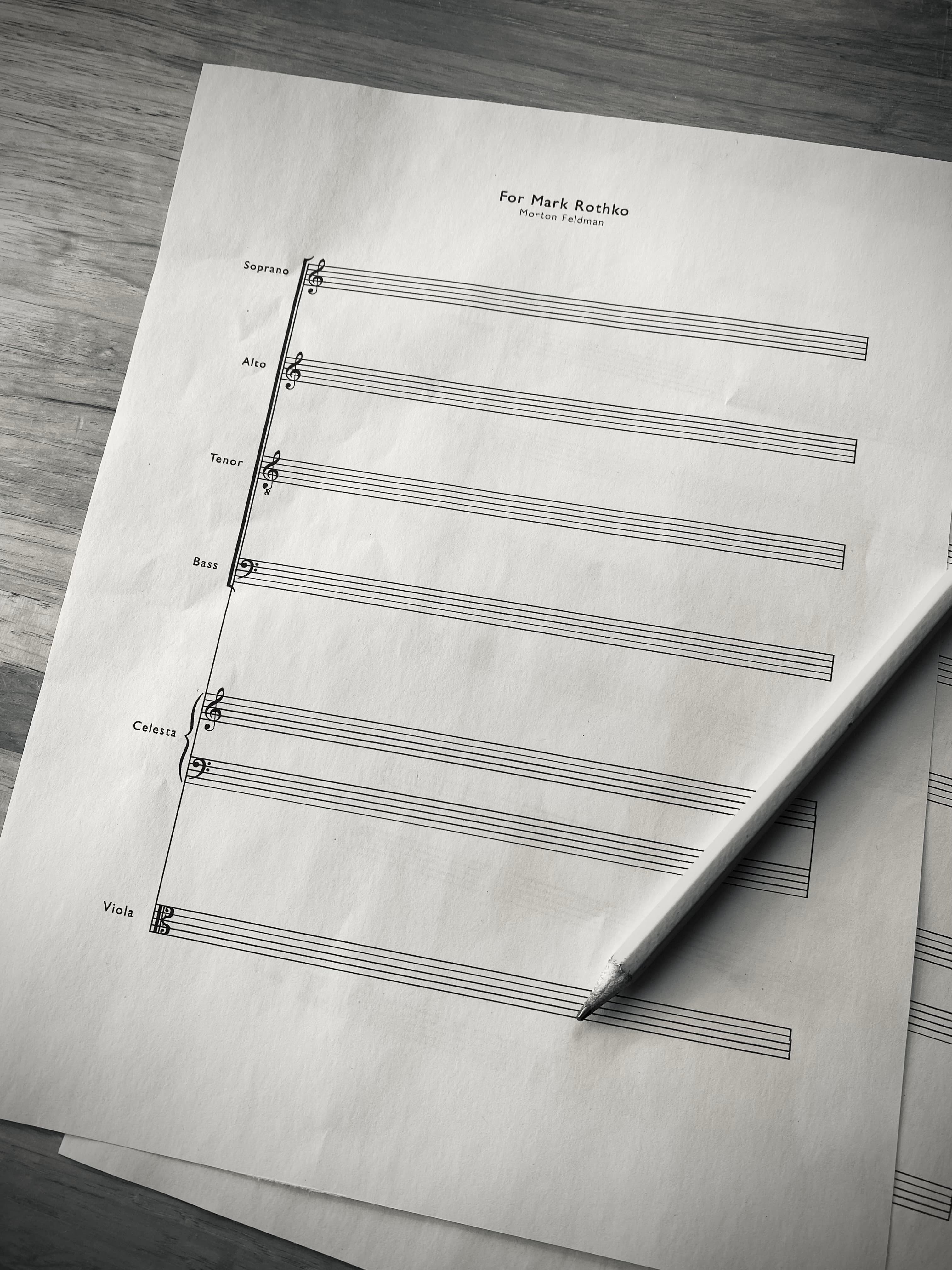
Courtesy the author.
Word count: 1694
Paragraphs: 15
I recently found myself listening to a wonderful piece of music that I’ve always had a somewhat ambivalent relationship with: Morton Feldman’s Rothko Chapel (1971). My old friend Tobias Fischer, a music writer known for his excellent Fifteen Questions series of interviews, was working on a book about the relationship between the painter Mark Rothko and music and had asked for my thoughts on the piece, which is Feldman’s only composition that directly addresses one of his most foundational influences.
Going back and listening to it again, I found myself struggling to understand why I was so hesitant about what is clearly a very beautiful and compelling composition. I said to Tobias:
I just feel like there’s a degree to which Feldman—in his music itself—never really fully addressed the influence of Rothko. Not like he did with, for example, Samuel Beckett, and his exhaustive engagement with his work. And that was the realization I had, going back and listening to Rothko Chapel again. It’s not For Mark Rothko! Whatever we might imagine that piece to be.
Think of it this way. Let’s travel to a different universe, an alternate timeline, another world. The year is 1993. Feldman never got pancreatic cancer, he’s still going. He’s working on a piece called For Mark Rothko. What does that sound like? It definitely doesn’t sound like Rothko Chapel! Whatever it is, it’s a completely different piece, a completely different relation to time and temporality, a totally different music. It’s maybe five hours long—totally disorienting, an infinite flat plane, dissonant and mystical. I’d love to hear it.
Late in life, Feldman had fallen into the habit of titling pieces with a dedication to a friend, teacher, or influence, starting with the word “For.” There’s a For John Cage, a For Bunita Marcus, a For Philip Guston. There’s a For Samuel Beckett, one of several major works that interrogate his relationship with his other great extra-musical influence. But he never wrote a For Mark Rothko.
Morton Feldman has always been closely associated with the Abstract Expressionists, who were his friends and fellow devotees of the Village’s Cedar Tavern, on University and Eighth. And while he may have been personally closer to others within the group, there is no painter whose work speaks more deeply to Feldman’s music than Mark Rothko. Rothko’s vast, flat canvasses reduce painting to its most basic elements of form, color, and texture, while projecting a simultaneous sense of both intense materiality and focused tranquility. They’re works of infinity and eternity expressed in the simplest possible terms, evoking feelings of stillness, stasis, and timelessness while nevertheless remaining profoundly, physically tactile. They seem like the closest possible visual analogue to what Feldman’s music would ultimately become as it expanded outward in the last decade of his life to encompass works of tremendous duration and tremendous stillness. These are the pieces—like Triadic Memories, Three Voices, String Quartet 2, and Piano and String Quartet, to name a few personal favorites—for which Feldman is best known and most widely appreciated. Ranging up to six hours in duration, the late period works stand like slices of frozen time stretched across eternity, hovering on the edge of silence, yet fractured into ever-shifting, endless complexities of pattern.
It would therefore seem like there should be no greater confluence of the Rothko-Feldman connection than Feldman’s most overt homage to the painter, Rothko Chapel. Yet there’s something oddly antithetical about it to the very aspects of Rothko’s work that so appealed to Feldman, and that so spectacularly came to dominate his large-scale, late period compositions.
Rothko Chapel, written in 1971, arrives a full decade before the great temporal expansion that would mark the start of Feldman’s late period. Commissioned for the Rothko Chapel—an octagonal space for contemplation in Houston, Texas structured around fourteen Rothko paintings—Feldman’s piece is scored for choir, viola, celesta, and percussion, and was written in the wake of Rothko’s death by suicide in 1970. Set against our expectations of late-period Feldman, Rothko Chapel is a different beast; it has a drama to it, a narrative and directionality, a sense of linearity, with distinct breaks in the score that are sometimes characterized as actual movements (a formal structure seen rarely if ever in his work). There’s timpani, and big, dramatic hits that sound like church bells ringing. A soprano line, written on the day of Igor Stravinsky’s funeral, almost feels like fragments of a song. But most striking of all is a beautiful and emotional “Hebraic melody” Feldman wrote at age fifteen as a student at what we now call LaGuardia High School, a melody that he picked up from his childhood draft and incorporated into Act V of the piece, closing the work’s dramatic structure with what can only be described as a dénouement.
Rothko Chapel is a gorgeous piece, and if I had never heard, or heard of, Feldman, I’d be desperately asking who this composer was and rushing out to find their music. But I always knew it was Feldman. And the dramatic arc of the piece sits uncomfortably with our sense, today, of both Feldman and his work’s unique relationship with Rothko’s. Of course, Rothko Chapel is a decidedly middle-period piece, and it’s unfair to judge it in reference to the late-period masterpieces that hadn’t yet been written. The more human-scale storytelling of a Rothko Chapel shouldn’t have to conform to the cosmic vistas of the late-period works, with their extremities of duration and their scrambling of our notions of temporality. Yet somehow the significance of Rothko’s influence on Feldman doesn’t seem satisfied by the piece we have as Rothko Chapel.
Feldman’s recurring interrogations of the work of Samuel Beckett provide an instructive counterexample. His first major encounter with Beckett was the “opera” (or sometimes “anti-opera”) Neither, which germinated from a single line scrawled down during the one meeting that took place between the playwright and the composer. In accounts of that meeting, the starstruck Feldman comes across almost as a stalker-fan, and one gets a sense of Beckett quickly jotting down that single (brilliant) line on a napkin with one eye on the door, as a means of hastening his escape. But he later followed up with a completed poem, a text that would become the “libretto” for the undeniably Beckettian Neither.
The year Feldman died, 1987, saw him take on not one, but two ambitious Beckett-focused works. There’s 1987’s For Samuel Beckett, a dense, churning flow of unbroken dissonance for chamber orchestra. But for me, the Feldman-Beckett relationship is expressed nowhere better than in the lesser-known Words and Music, one of Beckett’s radio plays for which Feldman was reluctantly talked into composing a retrospective score. There, we find Feldman directly embedded—via the ever-exacting stage directions—into Beckett’s world. To me, Words and Music clarifies that what Feldman drew from the playwright was not so much Beckett’s famously bleak worldview or his reliance on black humor in the face of an absurd cosmos, but rather his fascination with combinatorics: the mathematical study of all possible ways of rearranging a set of objects. From Lucky’s “thinking,” to Molloy’s stones, to the ominous permutations of What Where, we find everywhere in Beckett a simultaneously playful and futile exhaustion of all possible recombinations of objects, as an innate part of the struggle for meaning in an indifferent universe.
This fascination carries over almost directly to Feldman, whose late-period music becomes an obsessive combinatorial study of all possible ways of arranging and rearranging discrete sets of musical objects. If, as Gilles Deleuze suggested, Beckett’s art was one of the “exhaustion of the possible,” then there is no doubt that Feldman fully exhausted, through his many investigations, the playwright’s influence on his music.
With Rothko, the case is less clear. And that’s how I found myself listening again to Rothko Chapel and imagining that alternate universe where Feldman lived long enough to dig more deeply into the impact of the painter on his music. It’s not necessarily such a distant universe, perhaps only a cosmic ray and a few nucleotide changes away. But what, in that other world, would a For Mark Rothko sound like?
The Rothko Chapel we have feels almost like a premonition; we can dig into its interstices and find the components, already well under development, that would make up our For Mark Rothko. Those hovering choirs; blurred, distant, dissonant. The celesta’s beating, metallic decays of semitone against semitone. A scrape of high viola notes, but broken now from melody into flickering patterns refracted against themselves in every possible combination. Instead of a story, the space within silences. It’s as if the piece is already there, with only a few elements waiting to be removed. We could excavate our For Mark Rothko out of the shards and fragments of the extant Rothko Chapel, from all the fractured foreshadowings the 1971 piece gives us.
But does the fact that we can so easily imagine the piece suggest, somehow, that we don’t need it? Feldman, in his greatest music, had shown us something we couldn’t imagine, something fully unexpected and truly new. All of those great late-period compositions are deeply suffused in the aesthetic he drew from the Abstract Expressionists, and all of them are perhaps the most Rothko-esque music that has ever been written. It almost feels as if imagining For Mark Rothko is too easy, as if Feldman had, in a sense, actually written it. But it’s a piece we’ll never hear in this universe.
Would our world be so different if Feldman had lived to write a For Mark Rothko? The vast eternities present in the late-period compositions had already been shown to us. Do we need more eternities? To Baruch Spinoza, all of the cosmos was a single substance, and we, as limited creatures, receive only partial, fleeting glimpses of its geometrically necessary infinities. That’s a vision we can perhaps—occasionally, momentarily—stumble across in paint on a canvas, or a very long piece of music. And while it’s true that we don’t have a For Mark Rothko, we’re fortunate to live in a universe with so many late-period Feldmans, all of them, in their own way, for Mark Rothko.
Kenneth Kirschner is a Brooklyn-based composer of experimental music.