The Mets at the Movies
Word count: 1223
Paragraphs: 16
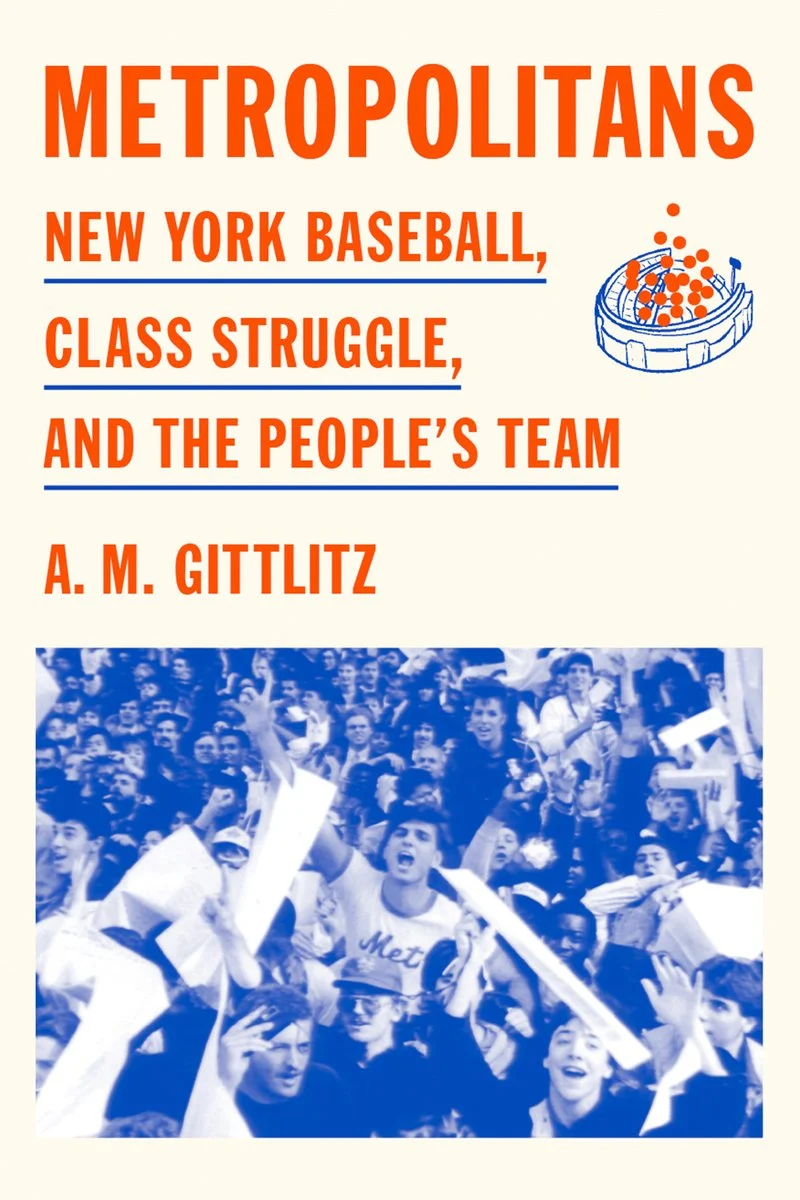
Metropolitans: New York Baseball, Class Struggle, and the People's Team
Penguin Random House, 2026
Directed by Sidney Lumet, written by Paddy Chayefsky
Metro-Goldwyn-Mayer
No one cares about Mr. Met anymore. Baseball’s first modern mascot, the fatuously grinning hybrid of athlete, fan, and ball, has been decisively outplaced since his 1964 debut by his zaftig partner Mrs. Met, and a slew of fan-chosen mascots during their thrilling comeback 2024 season. There was the swaggy Rally Pimp, a hot-dog guzzling Italian greyhound named Glizzy Iggy, and, of course, McDonalds’s spokesthing Grimace.
Perhaps the best minor messiah of that perfectly Metsian year, however, was Howard Beale. From time immemorial, the protagonist of the 1976 film Network appeared on the Shea scoreboard to hype the crowd for late-game rallies. “I want you to get up right now,” the trenchcoated newsman, zealously dripping with sweat commands. “Go to the window, open it, and stick your head out and yell…” The madman’s rant then cuts dramatically to a three-word motion graphic, chugging the crowd along for mandatory recitation: LETS GO METS!
The clip was retired shortly after Shea’s demolition. Promoters likely thought the Citi Field generation wouldn’t get the reference to an old film largely about the sex lives of the elderly. But in August the social media fandom, led by former center fielder Mike Cameron, demanded a reboot on the largest scoreboard in sports. By September, Beale, blown up the size of a hockey rink, was bellowing anew.
The campaign seemed to me about more than simple nostalgia. While the unexpected playoff push was a joyful distraction for some, others yearned for the tradition of improvised mass catharsis. Israel had begun a new rampage in Lebanon that month. Trump rose in the polls. The NYPD opened fire on a fare evader and the commuters behind him. Beale’s original monologue, conceived as an on-air suicide note, described a similar moment of existential despair, in which retreats to consumerism and private amusement intersect with feeling powerless in the face of inflation, crime, and wars overseas. “I don’t want you to protest. I don’t want you to riot. I don’t want you to write to your Congressman, because I wouldn’t know what to tell you to write,” Beale admits. He instead exhorts us to join in a communal shout of: “I’m mad as hell, and I’m not going to take it anymore!”
The primal scream harkened back to an earlier cultural explosion in which the original Amazin’ Mets played a role. Screenwriter Paddy Chayevsky’s inspiration for the scene came from beatnik radio monologist Jean Shepherd. In the early sixties, the proto- culture-jammer, best-known today for writing and narrating A Christmas Story (1982), encouraged his WOR-AM listeners to turn their radios full blast and point them out their windows so he could “hurl invectives”—non-sequitor lines designed to freak out the squares, like “You filthy pragmatist!”
Shep was a Mets fan, too. He was among the first to join the 1962 “New Breed” of ironic die-hards for the inaugural team that proved to be the worst in professional history. Their incompetence liberated the sport from its Yankee-like expectations of perfection, he told his audience, allowing it to become an “amalgam of all the human frustrations.” “You see all the frailties, all the hopes, the desires, and the beautiful moments of instantaneous victory, to be followed only by the inevitable.”
The Polo Grounds soon became something like the bohemian flash-mobs Shepherd organized at Astor Place. The rowdy and ironic happenings combined old-timers—still mourning the Giants and Dodgers, vanished into the deindustrializing abyss—and hoards of their cynical baby-boomer children, returned from white flight feral in bizarre outfits, improvising chants. One emerged from impatient, individual jeers of “Let’s go!” combining via collective frustration into the now iconic chant: “Let’s go… Mets!”

Howard Beale, mad as hell in Network (1976). Courtesy of Warner Bros. Discovery.
Geoffrey and Tatiana Hoover’s 1963 semi-satirical fan documentary The New Breed hints at the sociological undertones of the early “Metomania” in dozens of interviews with the teams’ first fans. Many of the dozens Mets fans interviewed for the short film appear uncannily similar to the rioters depicted in Emile de Antonio’s “Sunday,” a newsreel about the 1961 Washington Square Park “folk riot.” There’s also a tough-talking beer vendor praising the fans’ wildness, a New Frontier psychologist speculating on their sadomasochism, and a beatnik praising their wabi-sabi: “You see, baseball is an art, and losing’s an art. … As far as I’m concerned that makes them giants!”
The crowd became somewhat more conventional mid-decade as the politically freakier New Breeders drifted towards more militant or psychedelic happenings. But in 1968, the insurgent team boycotted games scheduled before the funerals of Dr. Martin Luther King, Jr. and Robert F. Kennedy, and dedicated their miraculous worst-to-first ’69 championship to ending the war in Vietnam. The East Village Other began lauding the Mets, as did Jerry Rubin. “Politics should be as exciting as the New York Mets,” he proclaimed in a Yippie manifesto. “People are always asking us, ‘What’s your program?’ I hand them a Mets scorecard.”
The good vibrations didn’t last very far into 1970, however. The war expanded to Cambodia. Thousands of construction workers violently stormed a Wall Street peace protest. A sleeper hit film, Joe, pornographically portrayed a blue-collar New Yorker murdering hippies in crash pads and communes. The National Guard opened fire on protesting students at Kent State, killing four. The Mets considered boycotting games again in response to the massacre, but succumbed to the atmosphere of reaction. “I really don’t know in which direction to head or what to do,” reliever Tug McGraw wrote. “Why? Because I’m a people and I’m screwed up.”
McGraw would breathe a last gasp of sixties self-affirmation three years later. His slogan “Ya gotta believe!” revived the 1973 Mets from last place to the World Series. They fell in seven, in prelude to the fall of social-democratic New York that offseason. A corporate austerity junta seized the bankrupt city, setting the scene for the hopeless populism of Howard Beale, and the Mets’s chairman and stockbroker M. Donald Grant trading away the ’69 core. The Mets became unlovable losers thereafter, so disrespected that even Rodney Dangerfield could punch-down: “The Mets have been in the cellar so long, they’re thinking of decorating.”
The Mets’s fortunes and identity continued to fluctuate with the times, but some sixties spirit remained. They are a uniquely progressive-coded team, with a unique zest for Pride Month and Mayor Mamdani. They have stretches in which they’re as bad as ’62, and streaky as ’69. For a new miracle to occur, however, perhaps there’s more to learn from Network after the clip is cut.
Beale’s renegade rant earns him his own hit show. Live audiences fill his studio each night, cheering each of his humanist, anti-corporate polemics with recitation of his “mad as hell” catchphrase. Ratings flag as the slogan goes rote. Eventually, the network hires a Maoist cadre to assassinate him live on air.
It’s much harder to cancel a sports franchise, of course. Even if few remember their political past, or that “Let’s go Mets!” was itself something of an invective shouted at straight society, they will continue playing, through wars, pandemics, and economic crises, on schedule. A few subversive sickos will always keep watching them, waiting for some window to open.
A.M. Gittlitz writes about counterculture and radical politics. He is the author of Metropolitans: New York Baseball, Class Struggle, and The Peoples Teams, I Want to Believe: Posadism, UFOs and Apocalypse Communism and co-host of This Wreckage podcast.