DanceJuly/August 2026In Conversation
RENNIE MCDOUGALL with Phoebe Roberts
Word count: 2276
Paragraphs: 23
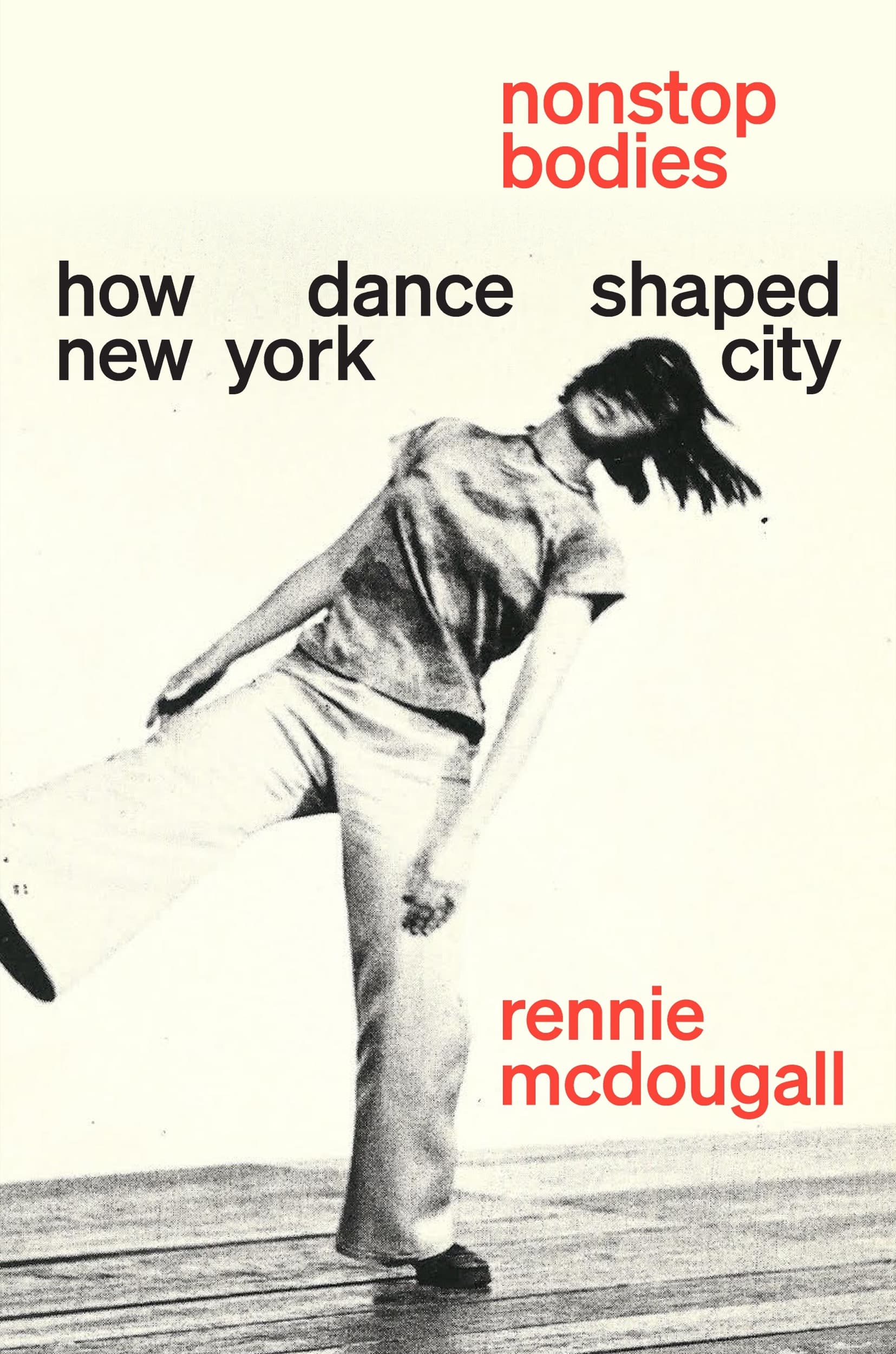
Nonstop Bodies: How Dance Shaped New York
Abrams Press, 2026
New York City, the real-life land of a thousand dances, has long been a hotbed for new movement styles. From all over the world to all five boroughs, hoofers, tappers, stompers, and shufflers have flocked en masse to partake in what one could only assume is the greatest party, with the greatest music and the greatest drinks, on earth. That is, at least, how the city comes across in Nonstop Bodies: How Dance Shaped New York City, Rennie McDougall’s sweeping new cultural history of dance in twentieth-century New York. A writer, critic within these very pages, and former professional dancer, McDougall brings both a practitioner’s understanding and a historian’s eye to his subject, tracing everything from mambo’s rise at the Palladium on 53rd and Broadway in the 1940s, to ballet’s modernization in the studios of Midtown in the 1960s, to breakdancing’s birth in the lobbies and playgrounds of the Bronx in the 1970s. Across these diverse genres, McDougall employs both ease and flair, utilizing time and space as only a dancer could to tell the stories of countless movement cultures and the movers who made them.
On the occasion of the book’s publication in May 2026 by Abrams Press, I spoke with McDougall over Zoom, discussing his research process, dance as a form of care, and what gets lost when spaces for collective movement begin to disappear.

Rennie Mcdougall.
Phoebe Roberts (Rail): What was it about New York, particularly in the twentieth century, that made it such a fertile environment for so many different dance cultures to emerge simultaneously?
Rennie McDougall: The twentieth century in general was interesting. I picked it almost arbitrarily at first, because I needed some kind of container, and a lot of the dances I was looking at were in that time frame. But then, because I was tying dance to these big social and liberatory movements, I realized that the twentieth century was all really about the body, particularly about people seeking freedom or liberation through their bodies. It began with the anti-puritanical movement at the turn of the century, and then continued through the sexual revolution and the civil rights movement of the 1960s, and so on. People were discovering their own bodies and freedom through their bodies, but then also pointing out the repression, or oppression, that occurs when people define other people’s bodies. That made dance seem like a really apt lens to look at all of those tensions across the century, because they are about embodiment.
And then, if you look at the significant American choreographers in the twentieth century, they were all based in New York. Also, all of these movements—the Lindy hop, breaking, the New York mambo—were tied to the city. It felt like a kind of book that could only exist when talking about New York. Somebody asked me recently, “Are there versions of this book that could be written about other cities?” And obviously, there are dance histories in other cities, but the way that so many different people and movements and artistic expressions were all coming out of one place side by side, and the way that just by being in proximity they influenced each other, felt specifically New York.
Rail: Something this book does so well is show the network of influences that contributed to dance cultures and how they were all in conversation with one another.
McDougall: The thing I really wanted to do with this book is to look at dance history through the lens of people’s lives and the way that they’re living their lives in the city, their social dynamics, and how those things infiltrate the dances. I wanted to tell the story of why these dances were so significant to the communities that created them, and then also how they reverberated out and said something about the social and political tensions at the time they were being created. The chapter on the Lindy hop is a very clear example of that. Mura Dehn, who was one of the documentarians of that period, wrote in her diaries about the fact that there are no authors of this dance. It’s a shared, communal thing being recreated afresh every night by the dancers.

Jerome Robbins directing Jay Norman, George Chakiris, and Eddie Verso during the filming of West Side Story, Jerome Robbins Dance Division, the New York Public Library for the Performing Arts. Nonstop Bodies, p. 170.
It was modernism, really, that helped establish this idea about individual genius-type of artists. People like Martha Graham exemplified this idea of the excellence of a single person who was the genius in their field. Culturally, we are trained to historicize dance that way, to elevate these individuals as giants, but we lose something about what those artists were doing and how they were working and the people who were working with them. Something that was really interesting to me was going to the archives and researching the oral histories of Martha Graham’s original dancers. Graham was creating this new, very specific embodiment that really was her own language. She was working with a group of dancers who had to cultivate and translate that in their bodies in order to create the performance, so to hear the story through their own voices—about the creative act they were doing—was a nice way to reframe the history. So it isn’t just about these single figureheads.
Rail: You open with this idea that dance is a form of dissent, which becomes something of a thesis statement. Throughout, dancing bodies repeatedly emerge as sites of disruption, whether in illegal dance marathons, interracial social dancing, or queer nightlife. What is it about the form that so powerfully unsettles authority?
McDougall: The fact that dance is about our bodies and bodily autonomy is a big part of it. It’s funny, because dance often imposes a codified language on the body. There is a way that dance can have a want for order over people’s bodies, but the dance that I’m looking at is about kind of shaking out of that order. Many of the moments I focus on are when improvisation is a big part of the creation of new dances, whether that’s choreographers utilizing improvisation, or social dances where improvisation and individual expression and autonomy and a kind of playful disorder is really a part of what’s going on on the dance floor. To speak in political terms, any oppressive regime is going to be fearful of that kind of expression living in people’s bodies.
Rail: Another recurring idea in the book is that anxiety around dance is often really anxiety around sexuality.
McDougall: It does seem, especially in the examples in the book, that those concerns are typically coming from men. I’m thinking of the critics of disco in the 1970s, who discredited it as a kind of masturbatory ritual of the vibrator sex era. Or looking at mambo in the forties and fifties, which was all about the pelvis and the frenetic energy and the sweat, and how there was a real fear and excitement around the sexuality of it. But then the dancers would often talk about how it had nothing to do with sex for them while they were doing it. I think that’s also true of disco. Tim Lawrence, in his book Love Saves the Day [Duke University Press, 2004], says something about it being an erogenous experience without there being any kind of genital eroticism. So, there is an eroticism to it that is not entirely divorced from sex, but isn’t necessarily sexual. I’m just hypothesizing this now, but maybe men looking at women, or queer people discovering a version of sexuality that doesn’t include them kind of set something off.

Dance Marathons: “No. 56,” Jerome Robbins Dance Division, the New York Public Library for the Performing Arts. Nonstop Bodies, p. 32.
Rail: It’s interesting that this anxiety doesn’t seem to carry over to a more codified form like ballet. At one point, you invoke Joan Acocella’s lecture from 2005 “Ballet and Sex,” where she speaks about George Balanchine’s focus on the pelvis and his reported passion for giving oral sex to women.
McDougall: Acocella’s framing is fascinating there. Balanchine was granting women this freedom through their bodies and through the sexual instrument of their pelvis. But ultimately, it was his to give. That maybe has less of a kind of anxiety around it than the self-owned sexuality of someone like Graham, who was generating movement through the pelvis and spoke explicitly about sexual organs and how they connected to her choreography.
Rail: Another aspect I loved was how you showed the city itself as a kind of choreographer. For instance, you write about how rumba’s side-to-side step evolved into mambo’s forward-and-back motion partly because New York dance floors were so crowded.
McDougall: That’s definitely a huge part of the history: space and where people find it. Another interesting through line was: where were the spaces that dancers were able to get into without permission? Whether that was in the street or playgrounds for breakers, or Judson Church for Judson Dance Theater, or all of these empty factories and lofts downtown that turned into discos, these spaces definitely shaped how the dances evolved. When the breakers were kicked out of discos in the Bronx, they started dancing in the foyers of buildings where the floors were slickly polished, which allowed them to do lots of spins. It was like, “Oh yeah, of course that makes sense.” There’s also another facet, which Mura Duhn describes: she talks about the kind of nerve-strained city person, when she’s writing about why New Yorkers were attracted to these jazz dances like the Lindy hop that had them kind of slumped over and with their elbows out. There was this quick twitch and agitation to them.
I was also interested in looking at the way that different eras of drug use in the city affected the way that dance was happening. Disco basically started with people just getting together to drop acid; when cocaine flooded the city in the eighties, it infiltrated the dance scene and affected not only people’s lives but also the way people were dancing. I think it comes back to this idea about the tyranny of language in our lives being a bit like the tyranny of order or of categorization. Dance is really about slipping out of that or slipping into something less definable. Of course, people come in and shape it and define it. But those performers or artists who are playing with dance are playing in that slippery space. I imagine a lot of people come to New York for some experience of that—to lose themselves in some kind of unfamiliarity or dangerous undefinition.

Isadora Duncan dancing, Genthe photograph collection, Library of Congress, Prints and Photographs Division. Nonstop Bodies, p. 6.
Rail: You also write beautifully about dance as a form of memory, even hypothesizing it as a form of care. Can you tell me more about that?
McDougall: That comes back to the idea of getting to some kind of way of historicizing dance that takes into account the different connections we make in the world, and the kinds of bodies we encounter in the world, that then get into our own bodies and influence us. That’s especially true in a city like New York, where there is just so much information. And there is also the sense that dancing is a way of conjuring a memory of somebody. In the breakdancing chapter, I thought it was really interesting that the breakers now will still go back to the funk music from the seventies. Even as hip-hop music evolves, those records are fundamental. Current b-boys or b-girls, when they break to those records, understand that they’re making a connection to their history and it’s really important to them. Similarly, some of the voguers today are going back to the house records from the eighties that are fundamental to the origins of vogue. That’s an important practice, to have this form of communion with the past or with dancers who came before you that created and evolved these forms with which you're in communion.
Rail: Toward the end of the book, there’s a sense of loss around the disappearance of spaces that once enabled collective movement, like clubs or studios. You end with the question a performer once posed to you: how long can you hold an absence? Are you, in a way, reflecting that question back to New York?
McDougall: I wonder about this question, specifically about how personal it is to me. I stopped dancing, and so I often ask, “Do I have the feeling that there is a different relationship to that creative energy just because I am no longer dancing, or does it feel more widespread?” I do ask a lot of people I know who dance or who are involved in dancing in New York this question of, “Has something shifted? Where is the energy right now for you?” And I think there is a collective sense that there isn’t an intense concentration anywhere of something that feels really urgent. But honestly, I don’t know. Many people have asked me about the ending. I come back to the idea that in the twentieth century, there did seem to be this kind of urgency around our bodies, on both personal and political scales. Obviously, we still have it, but maybe it’s less attended to now. We live more through mediation. We’re doing this interview right now through computers—we live so much of our lives through screens. We experienced the pandemic where we were completely divorced from each other. I think that does have an impact on what dance means for us culturally right now. But I also think because of that, people are hungry for live dance, so maybe we’re at the very beginning of a wave of something new.