Indigenous Knowledges as Living Histories: What the 250th Narrative Misses
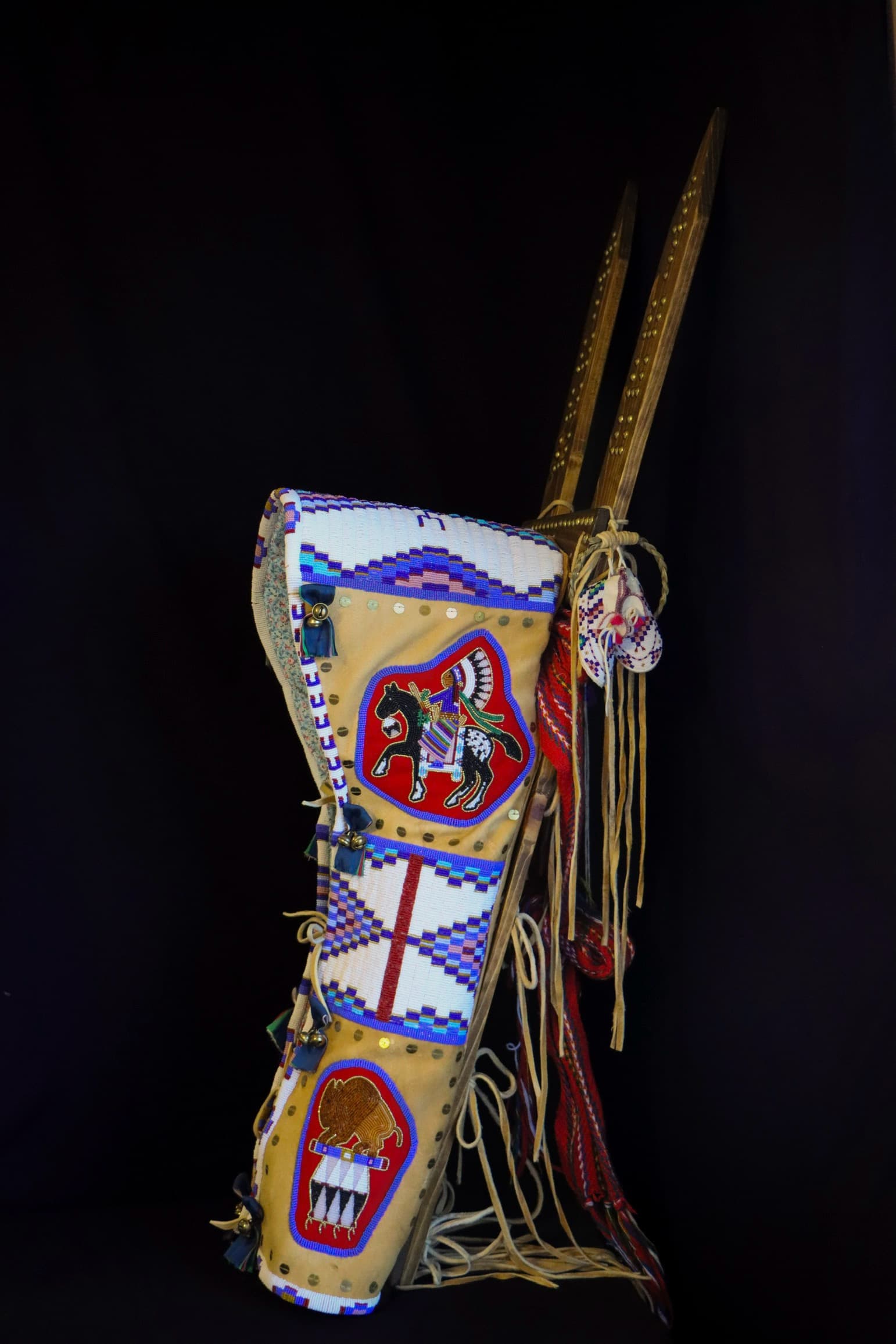
A cradleboard by Jessa Rae Growing Thunder for her daughter Winuna Growing Thunder, 2020. Courtesy the author. Photo: Nando Silvers.
Word count: 825
Paragraphs: 13
This year, the United States will celebrate its 250th anniversary as a nation. History, as the West has always written it, will be recited as fact. But whose history? And by what measure of time?
While America counts 250 years, the Haudenosaunee count well over a thousand. The diverse Pueblo peoples of the Southwest have lived in continuous relationship with their landscapes for millennia, not in legend or approximation, but in documented, transmitted, embodied knowledge passed with precision across generations. The Diné, the Lakota, the Anishinaabe—each Tribal Nation carries archives that predate the United States Constitution by centuries, in some cases by thousands of years. These are not myths or fictions; they are living histories. The fact that this country does not recognize them as such, does not make them less real. It makes them more resilient.
What America is celebrating this year is not the birth of civilization on this continent. It is the birthday of a government, one founded on the erasure of the civilizations already here and the continued disenfranchisement of truly remarkable cultures.
The Western tradition of history is obsessed with the written word. If it was not transcribed, signed, and filed in an archive, it is characterized as folklore, as something softer and less reliable than “real” history. This hierarchy is constructed specifically to delegitimize Indigenous knowledge systems and to clear the legal and moral path for dispossession. This is a colonial act.
Consider what those knowledge systems actually contain. Oceti Sakowin winter counts are pictographic calendars painted on hide that record events going back centuries, maintained by designated knowledge keepers whose sole responsibility was accuracy and transmission. Pueblo oral histories encode astronomical knowledge, agricultural cycles, migration histories, and diplomatic relationships with such precision that contemporary archaeologists routinely use them to interpret archaeological record. Haudenosaunee wampum belts are not decorations but are treaties, constitutions, and historical records, many of which directly influenced the framers of the very document that America will celebrate this year, a debt never acknowledged in the anniversary speeches.

Lone Dog, Nakota (Yankton Sioux), Winter Count Recording Events from 1800 to 1870, 1870–85. Buffalo hide and paint, 102 × 81 inches. National Museum of the American Indian, Smithsonian Institution. Photo: NMAI Photo Services.
And there are more. A cradleboard beaded by a Dakota/Nakoda woman carries within its stitches an entire design philosophy that understands color psychology, the visual weight of contrasting hues, the way a deep navy can tame a sky blue and direct the eye like a sentence directs the mind. Each stitch is a deliberate act. Each color choice, a decision rooted in generations of accumulated knowledge about beauty, function, and meaning. And each design a reflection of her sociopolitical surroundings, including the land she is in relation to while laying down her stitches. This is history.
The 250th anniversary asks us to begin the American story in 1776. This is a political choice dressed as chronology. Tribal Nations have always known who we are and where we come from. We did not need to write it down to remember it. Our landscapes remember for us through the place names, the migration routes, the ceremony sites, and the very soil that holds the memory of our ancestors. We will continue to pursue land back, we will leave tobacco out, we will talk to the land, and we will make and uphold our promises to Unci Maka. This is the continuation of a knowledge system that was never interrupted, only suppressed. To start the clock in 1776 is not history; it is amnesia with a flag draped over it.
This suppression is violent and deliberate. Boarding schools targeted language and culture. Federal policy criminalized ceremony. Museums extracted objects and severed them from the living communities that made them meaningful. And yet, here we are. The knowledge endured because it was never stored in a single place that could be burned. It lives in hands, in voices, in bodies, in the land itself.
The 250th anniversary cannot account for knowledge systems that were not built for the archive, but for survival. Indigenous ways of keeping history are not inferior versions of Western record-keeping. They are sophisticated multi-sensory systems designed to outlast paper, outlast institutions, and to outlast empires. Ceremony is a form of record-keeping. Beadwork is a form of record-keeping. The way a mother wraps her child in a cradleboard—each stitch a prayer, each porcupine quill a promise—is an act of transmission as deliberate and precise as any document.
Our lineages to our landscapes are not historical claims. They are living relationships, maintained through practice, renewed through ceremony, confirmed by the land itself. These relationships did not begin 250 years ago. They did not begin when contact was made, or when treaties were signed, or when reservations were established. They began at the beginning, and they continue now.
America is 250 years old. We have been here, keeping record, for time immemorial. The question the anniversary should be asking is not how far this nation has come, but how much it refuses to see.
We have always been, and will always be, the historians of this land.
Jessa Rae Growing Thunder comes from the Fort Peck Assiniboine (Nakoda)/Sioux (Dakota) tribes. She is a third-generation beadwork and quillwork artist, educator, and historian. Jessa Rae holds a M.A. and Ph.D. in Native American Studies from the University of California, Davis.