History Doesn’t Repeat Itself, but It Does Rhyme. Dumile Feni: African Guernica
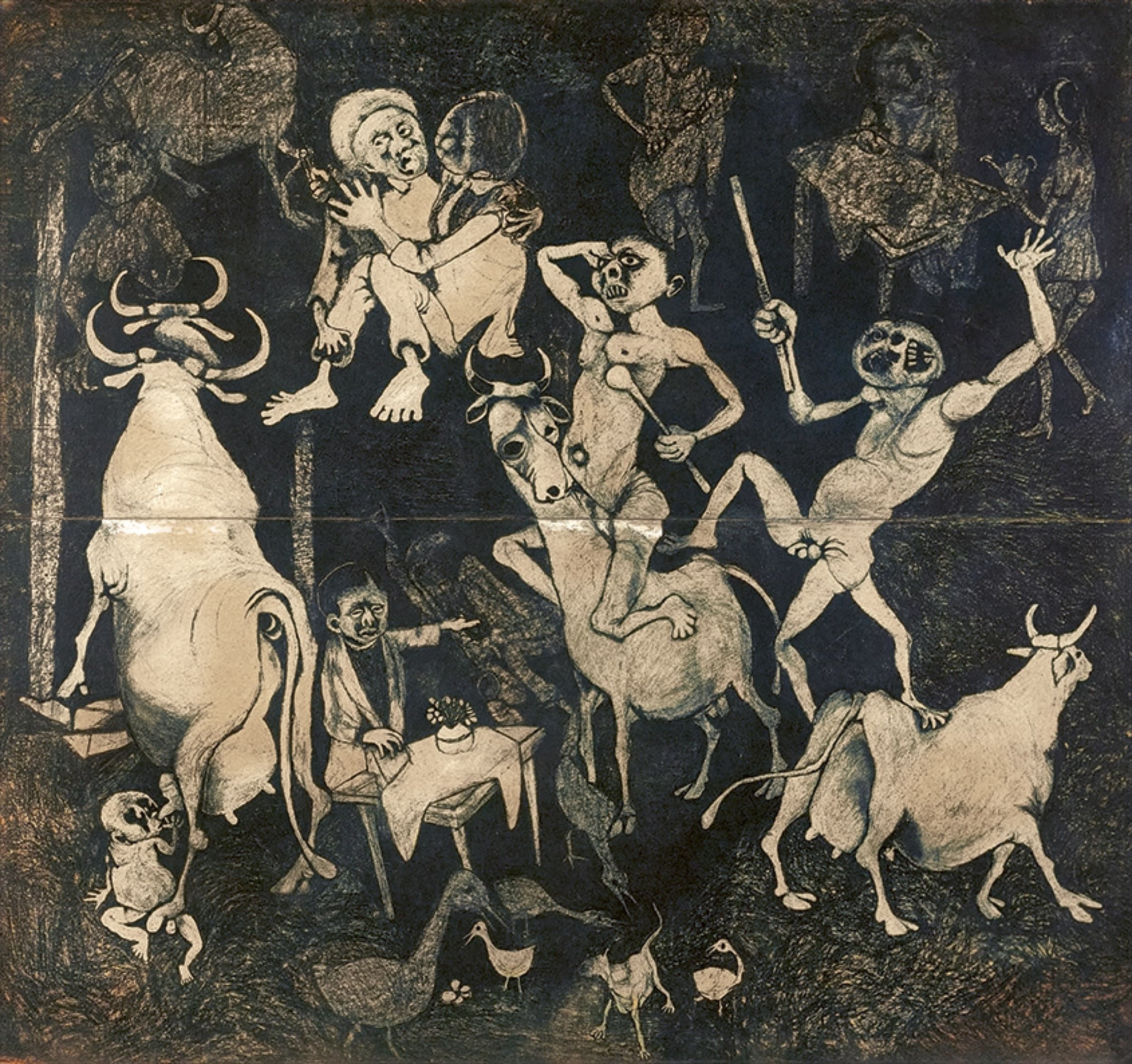
Dumile Feni, African Guernica, 1967. Charcoal and pencil on paper, 85 ⅘ × 89 inches. © Estate Dumile Feni and Dumile Feni Family Trust. Courtesy National Heritage and Cultural Studies Centre, University of Fort Hare.
Word count: 945
Paragraphs: 9
Museo Nacional Centro de Arte Reina Sofía
March 25–September 22, 2026
Madrid
African Guernica (1967) had never left South Africa. When Dumile Feni (b. 1942, d. 1991) first showed the work at Gallery 101, one of the few Johannesburg spaces where Black artists could exhibit at the time, the charcoal and pencil drawing was an act of transgression. Now, for the first time, it has traveled. At the Museo Reina Sofía in Madrid, African Guernica is presented alongside Pablo Picasso’s Guernica (1937) as part of the museum’s new program “History Doesn’t Repeat Itself, but It Does Rhyme,” curated by Tamar Garb. Yet does placing Feni in direct dialogue with Picasso liberate his work, or does it risk anchoring it permanently in Picasso’s orbit?
The installation is shrewder than it might at first appear. Feni’s works occupy their own gallery, with high white walls and a pale marble floor, and each piece is given space to breathe. Guernica is not in the room, though it is visible through a wide doorway at the far end, large and gray and horizontal, cast in its own visual register. The viewer encounters Feni first, in this way, and Picasso recedes into the background. The arrangement refuses the hierarchy the pairing might otherwise imply.

Dumile Feni, Saying no, 1967. Charcoal on paper, 70 ⅘ × 39 ⅘ inches. © Estate Dumile Feni and Dumile Feni Family Trust. Courtesy Museo Nacional Centro de Arte Reina Sofía, Madrid.
African Guernica dominates the wall in a heavy black frame, flanked by smaller works that register its scale immediately. About three meters square, it is not a work whose audience approaches from a distance and then decides to examine; the viewer is already inside it. Working against a near-black ground, Feni packs the picture plane until it feels airless, subjects’ mouths wrenched open, limbs pulled in striking directions, cattle multiplying across the surface. Rather than depicting a specific event, the composition evokes a landscape of entrapment in which human and animal bodies press against one another, movement arrested, collapsing into the image’s density. A large pale bull anchors the left, while a skeletal figure rides another animal at center. At the lower left, a seated man at a small table holds a bowl of flowers, a fixed point of calm around which everything moves. Near the apex, a woman in a headscarf cradles a figure too large for her arms. Look at the hand resting at her shoulder, and the viewer can just make out what resembles a drawing instrument held loosely in its grip, the work hinting at its own making. Feni came to drawing without institutional training, an autodidact who taught himself by doing. Nothing about African Guernica reads as a limitation of that.
The formal resonances with Picasso are genuine. Both artist’s works are monumental and monochromatic, built around distorted figures and animal-human conjunctions. Yet with Feni’s drawing, there is no incident at the center, no before and after around which to orient oneself. The composition turns inward, almost as if darkness presses in from all sides. This is what separates Feni from the tradition of protest art he is sometimes grouped with, work that represents injustice and asks the viewer to respond. Feni’s drawing doesn’t point at its subject so much as it pulls audiences into the texture of what it felt like to live inside a system organized by race and enforced by law. Picasso’s visual language was itself indebted to African sculpture and form, which means this line of influence was never straight in the first place. What the series makes visible for the first time, physically, is that the relationship between the two works is circular, not hierarchical. One might argue that Feni looked at Picasso more than he looked up to him.

Dumile Feni, You Wouldn’t Know God if he Spat in your Eye (detail), 1975. Ink, pencil, crayon, plastic laminate, 10 ¼ × 2 inches. © Estate Dumile Feni and Dumile Feni Family Trust. Courtesy Museo Nacional Centro de Arte Reina Sofía, Madrid.
The other works in the exhibition confirm his range. In The Classroom (1965), bodies cascade downward until figures at the bottom are inverted and trapped inside rectangular frames, the composition enacting the suffocation it depicts. Saying no (1967) clusters figures underneath bare trees in a darkness so dense it feels physical, a body on the ground at the frame’s base. While Picasso fractures and energizes Guernica’s surface, Feni blends weight and dark. Hector Pieterson (1987) responds to Sam Nzima’s iconic photograph of the twelve-year-old boy killed by police during the Soweto uprisings of 1976, the child’s fragmented form gripped by a figure in bold lines.
The rest of his life in exile runs along an adjacent wall. You Wouldn’t Know God if He Spat in Your Eye (1975) is a 53-meter scroll partially displayed behind a transparent protective case. Audiences must imagine it in its entirety and are only invited to read a fragment of it. Musicians and beastly figures move across the paper in ink, pencil, and crayon, alongside handwritten text in multiple colors: “Exile / Exile / Exile / Exile and Sons” in red, fragments of political thought, references to apartheid scrawled as though text and image are equally urgent.
Feni left South Africa in 1968 and never returned. Showing African Guernica alongside Picasso’s Guernica is, on one level, a corrective acknowledgment that Feni belongs in a conversation that European art history has long conducted without him. On another level, making his work legible through the Picasso framework risks reproducing the same hierarchy it intends to disrupt. True decolonial work would not simply add Feni to the canon: it would ask what the canon missed by excluding him, and what it costs to include him now. The installation’s spatial intelligence, Feni in the foreground and Picasso glimpsed through the door, suggests the curators understand this tension. In Madrid in 2026, nearly sixty years after it was made, Feni’s work holds the room.
Charles Moore is an art historian and writer based in New York and author of the book The Black Market: A Guide to Art Collecting. He currently is a first-year doctoral student at Columbia University Teachers College, researching the life and career of abstract painter Ed Clark.