The New Museum
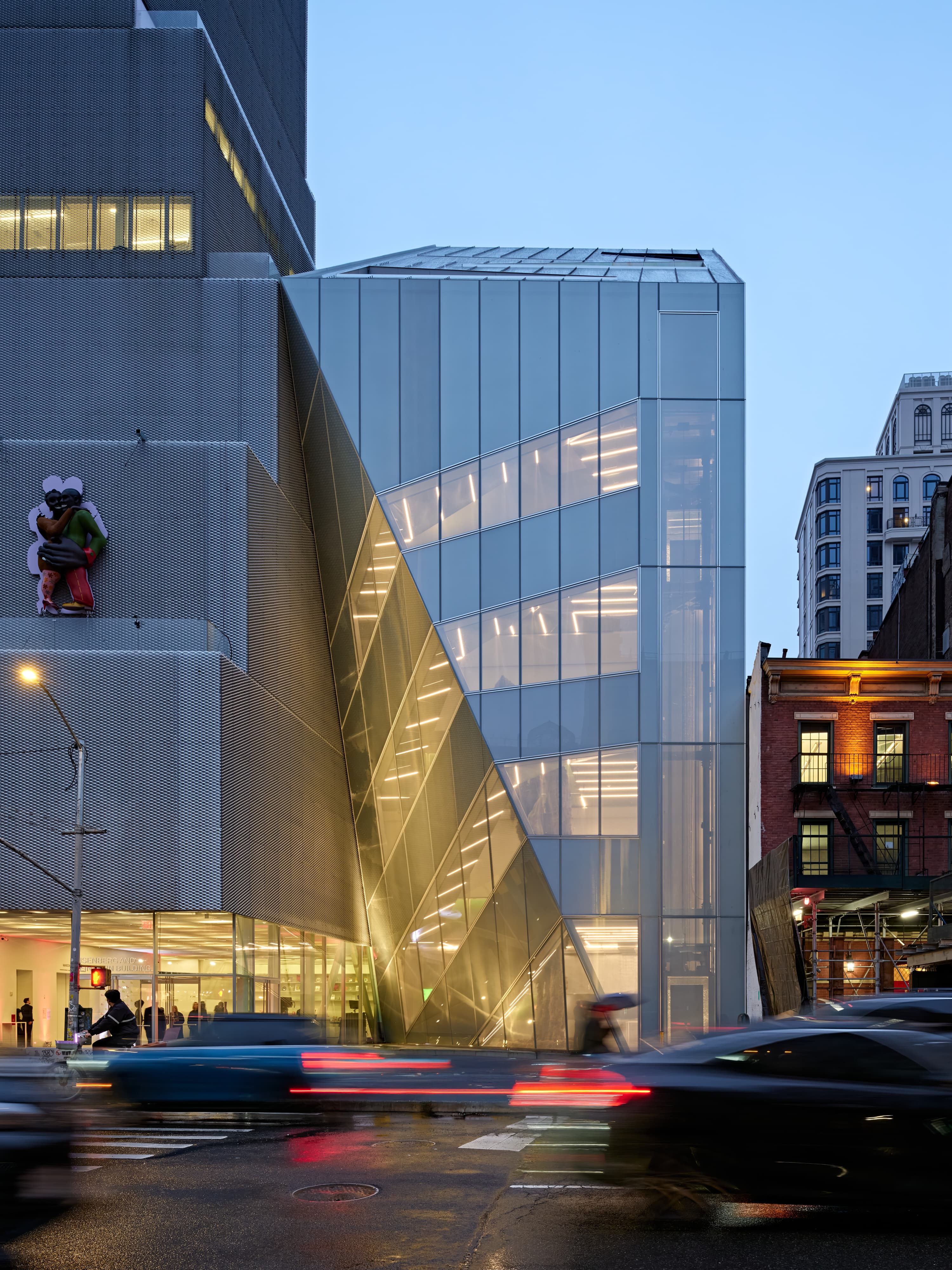
New Museum. Courtesy New Museum. Photo: Jason Keen.
Word count: 340
Paragraphs: 5

New Museum. Courtesy New Museum. Photo: Jason Keen.
SANAA’s building for the New Museum is conceived of as an infill of a gap in the block. It is also meant to stand alone—a series of stacked boxes that do not line up with anything else along the Bowery. The institution knew that they were building in an unfinished block. That is what makes New York architecture so appealing. We can make objects and yet they are full of constraints—the grid first and foremost. This is OMA’s Rem Koolhaas’s take on New York as theorized in Delirious New York. How do we all fit into this grid? What do we do with the freedom it paradoxically produces? We can do more or less whatever we want and it still works: this was the SANAA New Museum strategy. The new extension by OMA is rather less free.
The new building has two diagonals in elevation and one horizontal, and this combination produces a triangular plaza. The diagonals are a mystery to me. The horizontal is not quite the setback; it is perhaps closer to the European idea of the roofline, and by extension, an urban strategy that unifies the block. Or, it’s designed to make sure that light hits the ground. More likely the new building’s kink is where the old SANAA building has a shift in its boxes.

New Museum. Courtesy New Museum. Photo: Jason O’Rear.
I called Kazuyo Sejima (who, with Ryue Nishizawa of SANAA, designed the original building), and we ended up texting a bit. She had seen the building just that day; I could not get her to say anything about it. She is a wise architect. I did get Florian Idenburg of SO–IL, one of the project architects, to admit that extending the original building is not an easy thing to do. He had some sympathy.
Back to this little exterior corner—maybe we can celebrate the triangle of public space created. I love a triangular public space: rare in the orthogonal grid, but it remains to be seen if anyone can figure out how to use it.
Sam Chermayeff is an architect from New York City and based in Berlin.