Word count: 1653
Paragraphs: 50
Karley Wasaff
Noo Arts
June 20, 2026
Brooklyn
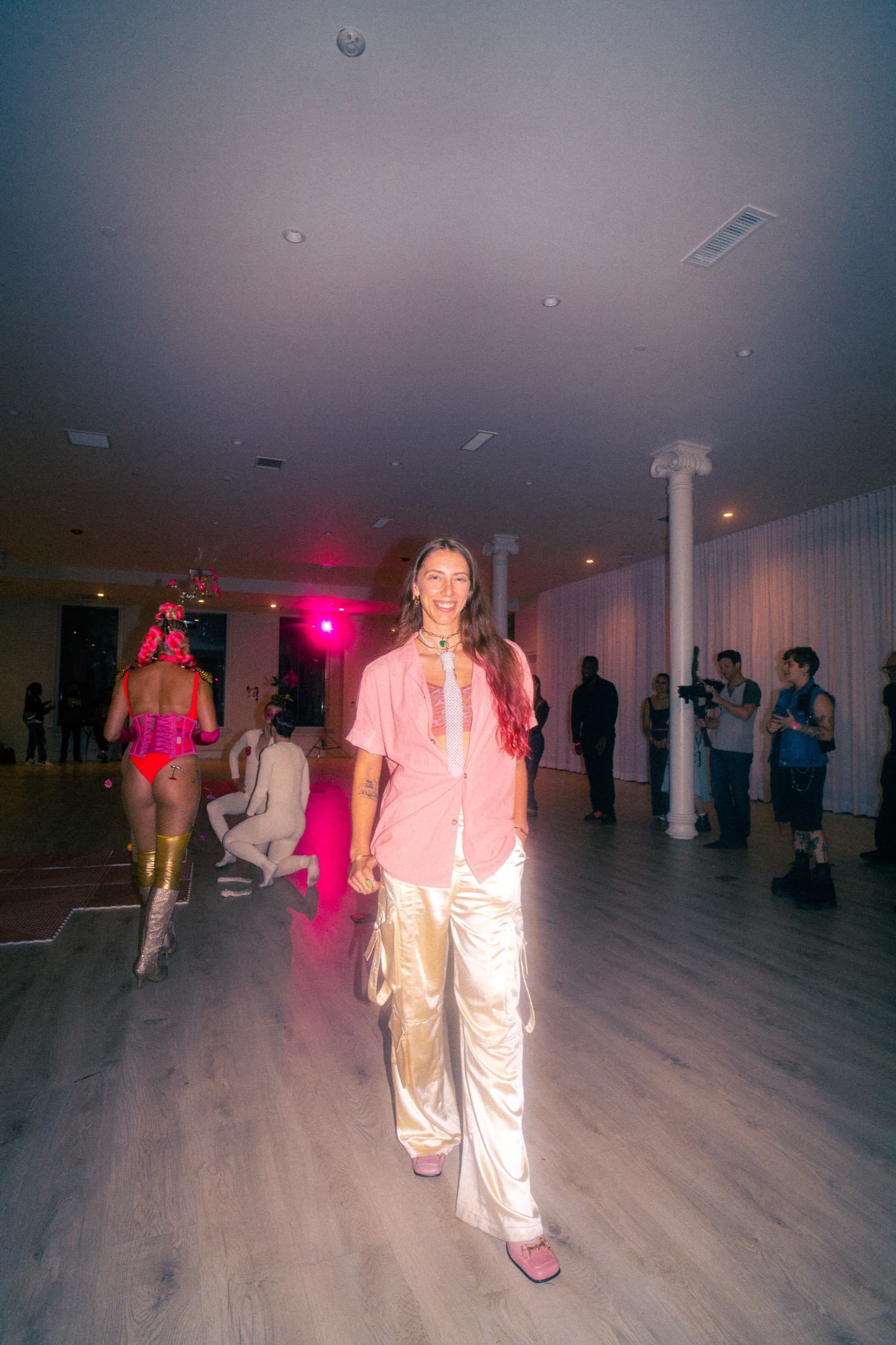
Walking into Growing Takes Time, the space immediately feels alive with movement, sound, and a kind of structured play. There’s a balance between choreography and unpredictability where nothing feels fully fixed, but everything still feels intentional.
The audience isn’t positioned as observers but as participants inside a shifting system of games, tasks, and collective decision making. In their New York State Council of the Arts grant-winning and site-specific play coming to Noo Arts in Greenpoint on June 20, Karley Wasaff builds a world that blends contemporary dance, immersive theater, and game logic into something playful and physically present. What unfolds feels less like watching a performance and more like being inside a shared experiment in attention, trust, and cooperation.

Growing Takes Time. Photo: Josh Sauceda @joshsauceda.
Bleu Pablo (Rail): You have a show coming up, Growing Takes Time. Could you tell us a little bit about it?
Karley Wasaff: Yeah. Growing Takes Time is a real-life video game disguised as a dance performance where audiences don’t just sit and watch—they become part of the system. Inspired by games like Pikmin 4, the performers act as Pikmin, guiding audiences through playful missions, movement props, conflict-resolution games, and cooperative challenges.
The work blends contemporary dance, immersive theater, and the whimsical unpredictability of New York’s experimental gallery scene. Audiences can expect a beautiful wildflower rooftop run by Noo Arts, gorgeous sunset city views, live gameplay, unexpected interaction, absurd humor, and a strange little world where collective problem-solving becomes choreography.
Rail: That sounds fun. I’ve actually been a participant in your past two shows, and they were really amazing experiences. Walking into the space, there’s an immediate sense that everything is intentional, but still open. Everything feels placed there for a reason, but there’s also room to breathe. What were you hoping people would notice or feel when they stepped into the space?
Wasaff: I’m hoping people feel an immediate sense of whimsy and play. I think that’s largely lacking in communities right now. Part of why conflict never seems to get resolved is because it requires self-presence and self-worth to engage with play and vulnerability in conflict.
Growing Takes Time is weird, messy, fun, physical, and sincere all at once. I’m asking people to play together at a time when genuine collective interaction can feel surprisingly rare.
I want people to walk away with something. I’m interested in people leaving a little more connected to themselves and community, and feeling lighter than when they walked in.
Rail: That’s beautiful. Can you walk me through what’s physically happening in the exhibition?
Wasaff: Yeah. There are about three or four stunning rooftops that audiences travel through. There’s also going to be a digital art exhibition co-curated by Josh Sauceda and myself.
That’s actually one of my favorite parts of the show, because these digital artists are helping fund underserved performance art and helping create a collective community that expands beyond just one scene. It’s kind of like when one person says something kind to another person, and it ripples outward. That’s the goal.
I think it’s exciting to see a more privileged art form supporting a more underprivileged one.
Another part of the show includes Not Your Muse hosting a live painting session at the end of the performance. The work focuses on accessible ways to regulate emotions, which audiences will also experience throughout the show itself.
All of the games and levels throughout the performance are rooted in somatic practices that help people become more connected to themselves and better support their communities.
There’s also a collaboration with Tribe and Vibe Collection involving hydroponic systems that are self-watering. They’re implementing them into schools, and my collaboration with them is about bringing those systems into community spaces like No Art.
And throughout all of this are these whimsical animated Pikmin-inspired characters. You’ll see combinations of contemporary dance, jiu-jitsu, and gameplay mechanics where audiences mirror movement together.
A big throughline in the work is how contemporary partner dancers and jiu-jitsu practitioners often develop a stronger presence in stressful situations because they regularly train in close-contact, high-pressure environments. My goal is to help people navigate those high-stress moments together with more ease.

Growing Takes Time. Photo: Josh Sauceda @joshsauceda.
Rail: I love that. You mentioned jiu-jitsu, and I wanted to ask about that briefly because it’s really interesting seeing how it influenced the work. Did you actually practice jiu-jitsu for the show?
Wasaff: I did. I’ve been practicing it for a while now.
Rail: How was that experience?
Wasaff: Oh my god, it was amazing. I used to work at a gym where some of my peers practiced jiu-jitsu, and I would watch them flowing and moving on the floor. I realized I was already doing similar things in contact improvisation dance, so I got curious.
I’d been looking for something connected to self-defense, and this felt right for me. I ended up training privately with one of the best senseis in Manhattan because he wanted movement training sessions from me in exchange.
I trained privately for about six to eight months before joining an amazing queer-friendly jiu-jitsu gym in Brooklyn called Chop & Chops. Practicing it made me realize how quickly I can go into high-stress reactions when things become overwhelming. Instead of staying present and making strategic decisions, I’d panic. Jiu-jitsu forced me to confront that.
It taught me how to sit with discomfort and face something scary head-on without immediately running away. That closeness and trust within conflict is something so rare. We rarely get to practice conflict safely and intentionally with other people.
Rail: That’s beautiful.
Wasaff: Ultimately, growth requires conflict. That’s part of the whole point of the work.
Rail: As Growing Takes Time continues evolving, it really feels like the exhibition grows alongside the audience. How did your ideas for the show start forming? Is it something built slowly over time, or do ideas hit you all at once?
Wasaff: I think it’s a mix of both. There are two major things that shaped this project: inspiration and my relationship to control.
Around the same time I started practicing jiu-jitsu, Pikmin 4 came out. Revisiting that game while exploring movement and martial arts made something click for me.
The game is deeply rooted in cooperation, ecosystems, and collective survival. Watching these tiny creatures work together to carry things bigger than themselves reminded me of how communities function.
At the same time, I was spending more time in dance spaces and realizing how disconnected many art communities can feel from each other, even though we’re all trying to build meaningful things.
That’s when everything came together for me. Conflict is necessary for growth. Community is necessary for survival. Jiu-jitsu, contemporary dance, and Pikmin all somehow connected.
The other major aspect was letting go of control. This isn’t a fully choreographed, traditional dance performance. I’m creating a game structure with rules and systems, but the audience determines the outcome. The show literally cannot complete itself if people don’t cooperate together. That was terrifying for me as an artist because I couldn’t fully control what happened. But it’s also what makes the work exciting.
Rail: So this exhibition feels humbling for you, too.
Wasaff: Absolutely. And I hope it’s humbling for everyone else too.
Rail: I love that. One thing I noticed about your work is how intentional the visual world is—the outfits, the set design, the materials. Can you talk a little bit about those choices and how they connect back to what you’re trying to express?
Wasaff: Yeah, definitely. I’ve been working with a lot of 3D-printing artists, because even though this show is funded by the state now, it originally started through support from visual artists. I’m really interested in how technology can support community and environmental care if we use it intentionally.
For example, guests receive these cute little 3D-printed flower clips. I know plastic can be harmful environmentally, but I also think technologies like 3D printing can contribute to more sustainable futures if approached responsibly.
As for costumes, I’m very honest about the fact that I buy materials from places like the Flower District in Manhattan and sometimes even Amazon. Even with grant funding, there still isn’t enough support for many artists to sustainably produce large-scale performance work in fully environmentally conscious ways. I think it’s important to speak honestly about that reality. Artists often don’t have affordable access to sustainable materials, costumes, or equipment. So while I care deeply about environmental impact, I’m also navigating the realities of survival and production inside larger systems.
Rail: When people first encounter your work, what do you think they tend to misunderstand?
Wasaff: A lot of people misunderstand sensuality as sexuality.
My work involves close physical contact, vulnerability, and somatic practices. Some people immediately interpret that as sexual when it really has nothing to do with sex. Close human interaction is sensual because it involves presence, touch, trust, and connection. But sensuality and sexuality are not the same thing.
Rail: Does this show feel like a continuation of what you’ve been building, or does it feel like a new direction?
Wasaff: Both. Every project I make grows from the last one. This piece evolved out of another project called Glitch, which was rooted in improvisation, collective movement systems, and letting go of control in large group settings.
And even Glitch grew from an earlier solo work focused on body trauma and movement. So for me, every piece is a continuation, but every piece also opens a new path. The central idea of using movement to create change has always been there.
Rail: What do you hope people take with them after leaving the space?
Wasaff: I hope people leave feeling lighter and more connected than when they entered. You can’t control how a seed grows. You can only create the conditions for growth. That’s really the core of the entire experience.
Bleu Pablo is a Bronx-based abstract artist, curator, and Editor-in-Chief of Bleucalf Magazine. His work explores identity, texture, and contemporary Black experience through painting, publishing, and exhibition-making, bridging visual culture with immersive, community-driven storytelling.