Word count: 1246
Paragraphs: 38
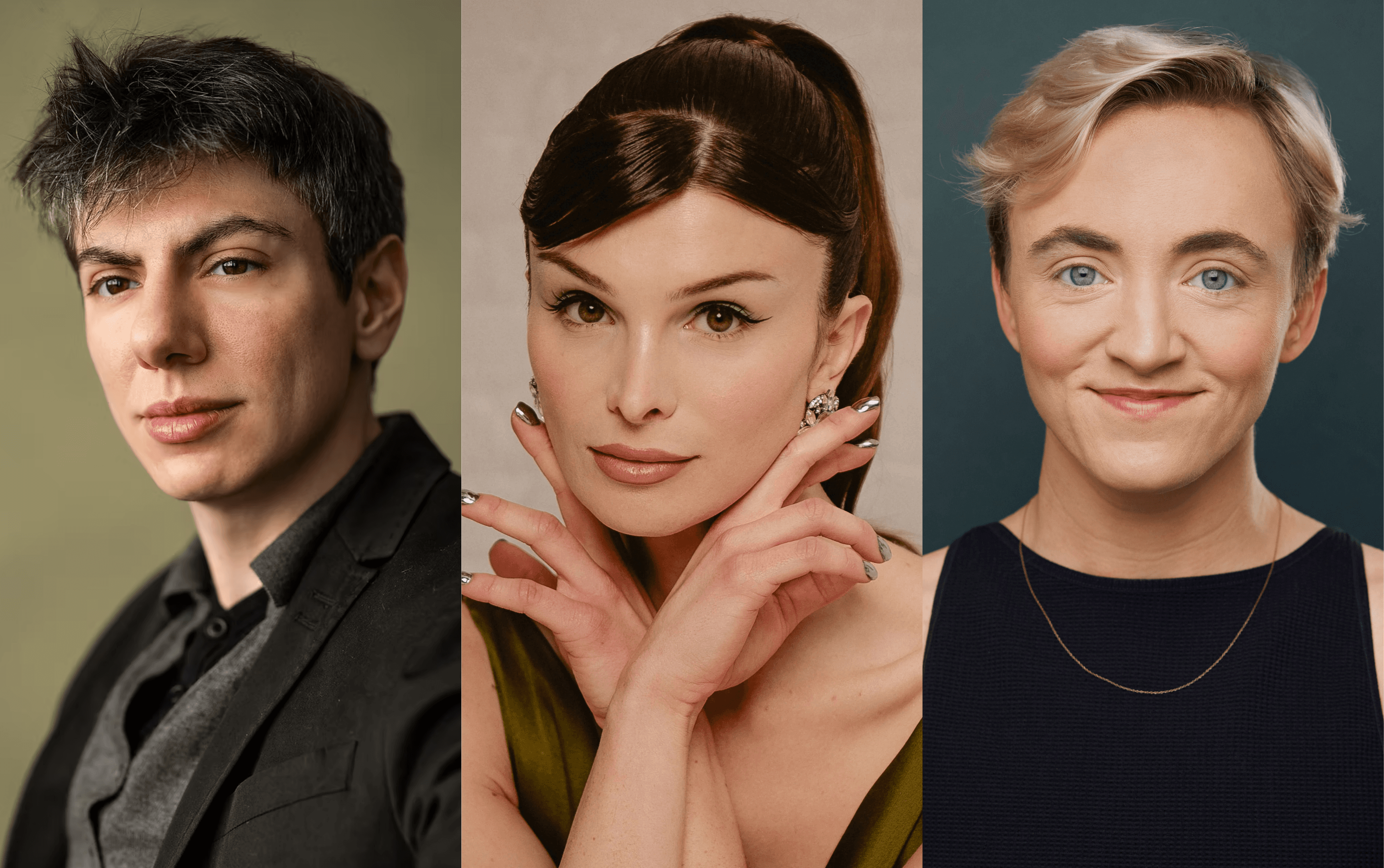
L–R: Charlie Hano (photo: Yellowbelly Photo), Dylan Mulvaney (photo: Michaelah Reynolds), and Max Raymond (photo: Shani Hadjian).
The Green Room 42
June 20, 2026
New York
For the past three years, casting director Charlie Hano and performer/producer Max Raymond have co-produced a one-of-a-kind annual variety show. Let’s Hear It For the Boys: A Transmasc Cabaret features an all-transmasculine team of creatives, musicians, and performers who showcase new work by transmasculine writers alongside songs from the existing musical theater canon. Ahead of the 2026 show on June 20 at the Green Room 42, Hano and Raymond sat down with Dylan Mulvaney—who recently made musical theater history as the first trans woman to star in Six on Broadway—for a conversation about trans representation. Below is a condensed and edited version of that conversation.
Dylan Mulvaney (Rail): How did Let’s Hear It For the Boys start?
Max Raymond: Charlie talks about this in the show every year in a speech about the state of transmasc representation on Broadway.
Charlie Hano: Here’s part of the speech—when I point to you, you’re going to say the number zero.
Rail: Okay.
Hano: How many openly trans men have directed a play on Broadway?
Rail: Zero.
Hano: How many trans men playwrights have had a play on Broadway?
Rail: Zero.
Hano: And on and on. When Let’s Hear It For the Boys first started, I thought the numbers would have grown by now. I’m the first openly trans man to join the Casting Society (CSA)—
Raymond: First openly trans man to cast on Broadway, too—
Hano: And I’ve dedicated my life to knowing as many trans performers as I can. Since 2018, there’s been at least one trans woman on Broadway every year. It really started with Miss Peppermint in Head Over Heels. And 2026 is a historic year for trans women and nonbinary performers, which is deeply deserved. But it hasn’t trickled over to trans men. This is the second year in a row that there are no transgender men on Broadway, even though the talent pool is there, showing up to auditions, contributing to the community. So this is a way for us to uplift artists who are not getting the opportunities they deserve.
Rail: What kinds of acts are there?
Hano: Because we both come from a bit of a traditional theater background—Max is an incredible musical theater performer—there are a lot of traditional musical theater acts, but it’s always important for us to have variety acts. We’ve had a drag king every year, we’ve had some amazing dancers, we’ve presented poetry.
Raymond: We do an ensemble opening number that always changes. The first year it was “The Bitch of Living” from Spring Awakening, last year it was “Seize the Day” from Newsies, this year… Well, you’ll have to come to the show to find out.
Rail: What have the audiences been like?
Hano: Every year, the Telsey Office (where Charlie works) attends online or in person. Other casting directors who I’m close with attend. Sometimes it feels like every cisgender actor I’ve ever made feel special shows up and has a great time—we’re throwing a party and everyone’s invited.

Let’s Hear It For the Boys 2025 ensemble. Max Raymond at left of center in yellow jacket and Charlie Hano at right of center in open black and white skull shirt. Photo: Marie Finch-Koinuma.
Rail: You’ve made so many trans and cis people feel seen and safe in your audition processes, and this is an opportunity for them to be able to celebrate you. Why does this show matter?
Raymond: I think there’s something special about this space where masculinity looks like so many different things. The transmasc people in the room get to embody all the idiosyncrasies of their own masculinity, which might be very feminine in relation to another transmasc person. And it’s exciting for audiences to see that transmasculinity doesn’t mean one thing, that it can show up in a million different ways.
Rail: I think being able to ask each other, “What was your experience working on that show?” or “What key are you changing this to?” is priceless, because we’re all trying to work with this system that doesn’t know how to work with us.
Raymond: Right. In our first rehearsal last year, there was a whole conversation that emerged about navigating vocal changes on testosterone, and it felt like a conversation that could only happen in that space.
Rail: What’s the dynamic between the two of you as far as running the show goes?
Hano: Max is the lead producer. The way he leads this production is beautiful and insightful and should be studied.
Raymond: Charlie has a huge job on this show, since he handles casting, and most of the open call submissions are from performers. The first year, we thought, “We’ll be lucky if we get twenty folks who are interested,” and we got three times that number. Then last year, that number almost doubled. It was even higher this year. And we select a very small pool. If we cast based on talent alone, the show would have one hundred people in it.
Rail: Where should trans talent showcase their work if not at Let’s Hear It For the Boys?
Hano: Instagram. I tell every performer to get a website. Show up to Equity Principal Auditions (EPAs), whether you’re in the union or not, to get in front of casting directors. And if you feel safe and comfortable doing this, make it easy for us to know you’re trans, since casting can’t legally ask.
Raymond: “We are looking for the flags in your bio,” is something I’ve heard Charlie say before. [Laughs] I’ve also heard him say, “Invite casting directors to see your work.”
Hano: Closed mouths don’t get fed.
Raymond: On that note, I’ve been really surprised and overwhelmed by how many people are eager to support this show, and I think that’s something that trans artists specifically should internalize. When you open up about your dreams to your community, they want to help you realize them.
Rail: Everything good that’s happened, at least for me, is because I told somebody that I really wanted it. Max, you are a multihyphenate through and through, but what would you selfishly say is your biggest dream in life?
Raymond: I’d love to originate a role on Broadway. And there’s also something really exciting about getting to reinterpret an existing role. I mean, I was never as excited about playing female roles as I am now after transitioning—suddenly I’m like, “I wanna play all the female roles as a twink.” But it’s really rewarding being able to create opportunities for other people. This show is my favorite thing I do. So one of my biggest dreams is just getting to do this show on a bigger scale, like at an off-Broadway house with a three-week run and a ton of production roles.
Rail: Charlie, what is your biggest dream in life?
Hano: I want every single movie and TV show and commercial and play and musical to have trans people in it, and if there aren’t, I want there to be a very specific artistic reason why. And for me, I’ve been a casting associate on Broadway, but I will and I want to lead productions on Broadway. I want to work in film and TV. I want to work in commercials again.
Rail: I think about commercials as being a way that somebody could see someone like us in a CVS, you know, in a makeup campaign. Like, there’s so many ways to be visible.
Hano: Yeah. I want us everywhere because we are everywhere.
Rail: Fierce.
Dylan Mulvaney is an actress, comedian, and New York Times best-selling author who is best known for her viral “Days of Girlhood” series. She is a proud graduate of University of Cincinnati College-Conservatory of Music and loves opossums.