Word count: 2107
Paragraphs: 32
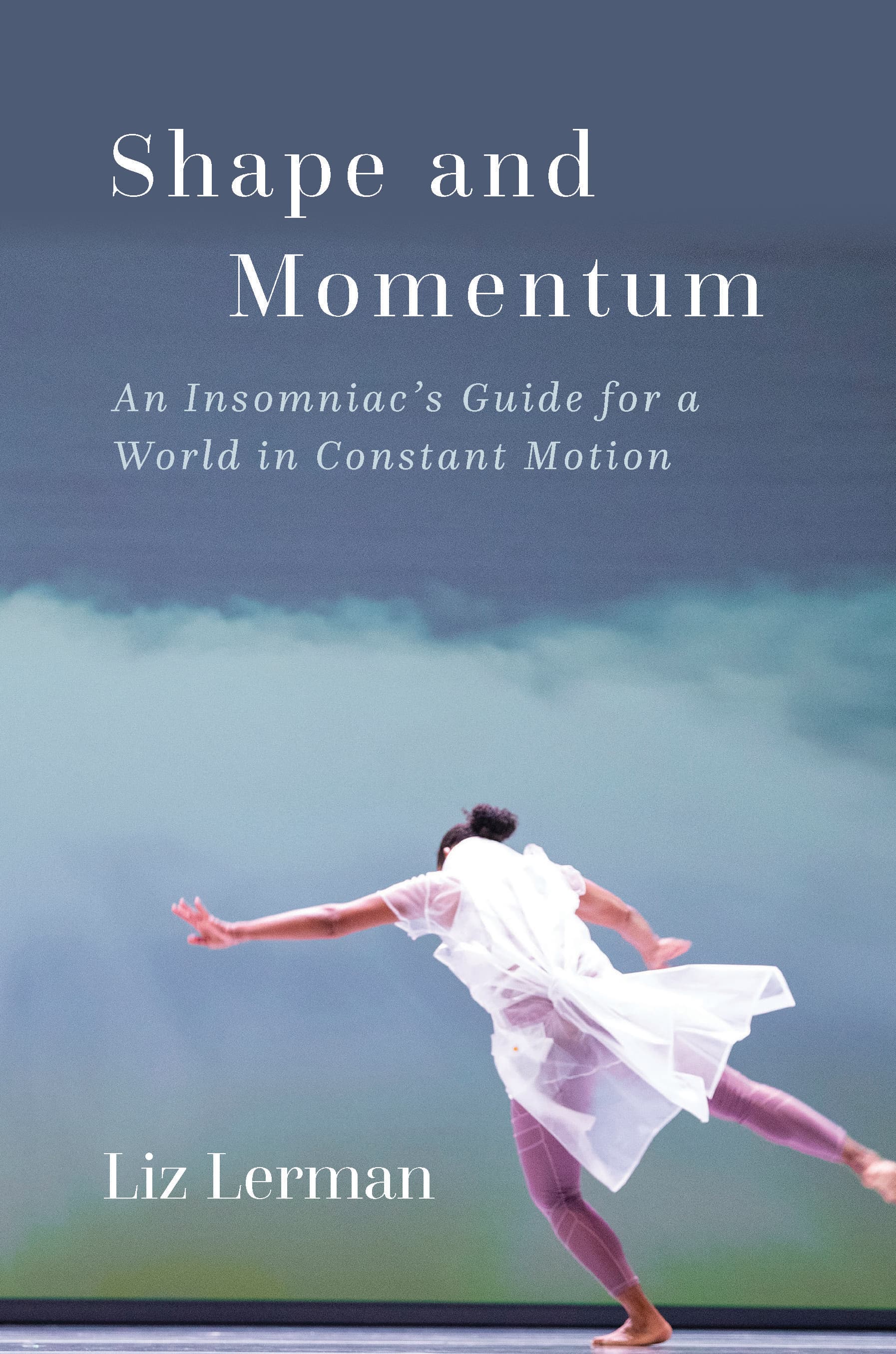
Shape and Momentum: An Insomniac’s Guide for a World in Constant Motion
Wesleyan University Press, 2026
Liz Lerman is not only a mover; she’s a thinker. She is perhaps most well-known for founding Liz Lerman Dance Exchange, an age-inclusive contemporary dance ensemble that she led from 1976–2011. Through collaborations with unlikely people and places—from the Portsmouth Naval Shipyard to scientists at the European Organization for Nuclear Research (CERN)—Lerman expanded what dance could look like and the disciplines it could illuminate.
Lerman has also developed an array of theories and strategies that offer ways to similarly shift our perspective on life, exploring its deeper queries. Her 2011 book, Hiking the Horizontal: Field Notes from a Choreographer, presents a nonhierarchal way of viewing life through the lens of art. Her latest book, Shape and Momentum: An Insomniac’s Guide for a World in Constant Motion, continues in this vein through an examination of the uncertainty inherent in art and in life.
Lerman spoke with the Brooklyn Rail about her new book, embracing the flow of shape and momentum, and what we can learn from witches.

Author Liz Lerman engages in a gestural dance for the witches while visiting the Steilneset Witch Memorial in Vardø, Norway, 2023. Photo: Anna Spelman.
Sophie Bress (Rail): Shape and Momentum is described as a follow-up to your 2011 book, Hiking the Horizontal. How does it build on the ideas you presented in the first book?
Liz Lerman: Essentially, the proposition in Hiking the Horizontal is that we can have more than one way of thinking about something. Hiking the Horizontal presents this idea in a multitude of forms in the hopes that people feel less stressed about the nature of the decisions they make. Inherent in this is managing multiplicity, and we have a hard time with that. One of the ways we handle multiplicity is creativity. This book, Shape and Momentum, is more about the nature of the creative tools that can help us. For example, making a “thinking grid” is something the book walks through.
Rail: That’s right. A “thinking grid” is essentially a simple grid with ideas or images along both the x- and y-axes. The boxes of the grid are filled in as you explore what these ideas or images could mean in relationship to one another, and it’s a tool you’ve used in your own creative work. In fact, in both books, you weave in dance, choreographic thinking, and anecdotes from your work. Why are dance and choreography such apt ways of thinking about life’s changes and challenges?
Lerman: Hiking the Horizontal really spends a whole lot more time in the world of dance than this book. In this book, I’m transforming those ideas. The essential idea is: if the world is in constant motion—which it is—then maybe the way dancers and choreographers experience the world would be useful if we could translate that for other people.
Rail: I’m curious about the insomnia aspect of the title. In the text, you mention insomnia itself several times, as well as the fact that several of the essays were written during sleepless nights. I’m also someone who, if I can’t sleep, gets up and writes it out. I’m curious how sleeplessness played into the structure of the book and what it became in its final form.
Lerman: I love talking to other insomniacs. There’s a certain quality to restlessness that informs me. Sometimes I think of insomnia as a kind of gift. It gives you more hours to live—there’s something about it that’s like a persistent pursuit. I know sometimes when we’re in insomnia, it feels like an obsession—it’s like circling. But, from a dance and choreographic perspective, the idea of spinning is amazing. The way you can slow down or speed up—when you speed up, suddenly, the spinning is all internal, and when you slow down you can see more.
My insomnia has changed with my aging. It has an urgency about it that I don’t think was there before. Before, I was curious and I would get up like you and I would write, or I’d clean the house. Now it’s almost like my skin is burning, and it’s like a fight for being present. I don’t mean to be overly dramatic, but with the current war, it’s like, “I can’t believe this is happening, and I’m trying to lie here in this bed. Shouldn’t I be up?” But sometimes it’s more like a musing. I happen to be living at a time when there have been many deaths in my family. The more people disappear into wherever they go, the more looking back becomes almost like a weird movie. The book is kind of like that too. There are very concrete essays and then there are other parts that are more like the blur that happens in the middle of the night. Is that your experience with insomnia?
Rail: Mine often has to do with spinning and trying to solve a problem, but oftentimes it’s a problem that contains multiplicity, so there’s no one concrete solution. I definitely relate to the quick spinning in my head, and now I’m thinking about, “Okay, where’s the slow spinning as well?”
Lerman: That’s a really good question. It may just be in the slight rotation of our body from laying down on our backs. And now I’m back to your earlier question about dance and choreography—if we can see our actions as kind of a dance, then the awkwardness, aesthetics, beauty, and repetition of it become familiar places to rest, even though we’re not resting.
Rail: I like that—it brings a sense of comfort. Oftentimes spinning does feel really uncomfortable, and I think as humans we’re preprogrammed to try to get away from that discomfort.
Lerman: This is important. This is one of the things I stress in the book. For artists, addressing discomfort and confusion is an essential motivation for the actual act of making art. Maybe this is why people think we’re weird. I don’t think it makes us weird—I think it makes us more human. It’s my desire to share these tools because I wish everybody understood that discomfort is just a signal. It’s a signal to pay attention and then to look at the possibilities within that discomfort for change. And change can be just the smallest shift. If I just shorten my step, I can walk more easily with the person I’m trying to walk with. But this idea of discomfort and the way people run from it is also part of why people run from their creativity. I’m advocating throughout the book that you can nurture and even practice your creativity so that you can have it when you need it or want it.

Nia Love, Vincent Thomas, Miko Doi-Smith, Paloma McGregor, Will Bond, Leah Cox, Elisa García Radcliffe, and Ruby Morales in Liz Lerman’s Wicked Bodies, ASU Gammage, Tempe, Arizona, 2022. Photo: Tim Trumble.
Rail: Definitely. I think that’s the source of why people want to create: to make their internal experience external.
Lerman: Yes. The opening section of the book is about trying to understand what we mean when we say “lived experience.” This idea of harvesting personal experience is really important. And it’s not just for artists.
Rail: I think it’s vital for all of us, and it’s what connects us. There was a section in the book that I particularly loved about particles, at the end of an essay called “Choreographic Thinking in Times of Chaos.”
Lerman: It’s this idea of the Big Bang as a fable. What got me thinking about this was entering into the first year of the second Trump presidency. Since the whole book is about shape and momentum, I realized that we’re not even in momentum; we’re in chaos. That just led me to ask myself: “When have we been here before?” And then I realized we have been here before.
Rail: One of the anchors within the text is meditations on shape, momentum, the Heisenberg uncertainty principle, and how these things connect to both dance and life. Can you explain that theory and how it’s supporting and propelling your current creative era?
Lerman: This particular idea—shape and momentum—began because we were doing a project at CERN, where they’re smashing subatomic particles to simulate conditions from the early universe. I was an artist-in-residence there. We met all these fantastic physicists who, it turned out, loved talking to artists. They handed me a bunch of equations and, from a choreographic standpoint, I saw the numbers and the symbols that form an equation as scores for movement. The physicists told us what they mean, and one of the equations was the uncertainty principle. They explained it this way: “Measure the shape of something and you will not be able to feel its velocity or its momentum. If you measure the momentum, you will not be able to see the shape.” This was instantly fascinating to me, both metaphorically and literally. As a choreographer, I know shape dancers, and I know momentum dancers. Because I was raised in classical ballet at a particular time in history, I’m a shape person, sadly.
Rail: I am as well.
Lerman: I yearn to be one of those people who can just fly.
Rail: I’m most comfortable with my left hand on the barre, and I don’t love that about myself, but it is what it is.
Lerman: There are absolutely times when shape is essential—like when my mom was dying. Honestly, I just really wanted everything to be clear. I was already off balance. In the book, there’s quite an extensive story about the dancer Sarah Ramey, who worked with the Heisenberg equation during the residency. Although she was a momentum person, she became a shape person while she worked on the project. This caught my attention—she just shifted. She began standing on one leg, arm out, one leg up high, and she said, “I don’t know this,” because she wasn’t a shape person. And then she would say, “I do know this,” and she would fly, roll, fall around the stage. But she got better and better at standing on one leg—she taught herself how to do it. Then I started thinking about this in bigger terms. Institutions hold their shape for a long time. In fact, it’s hard to get institutions to change. In order to change your shape, you have to drop into momentum, even for a second. And if you don’t like momentum, you don’t know how to be in it. You don’t know how you can reverse yourself and come out of it and form a shape again. My hope is that we can understand that shape and momentum are both important. We want to be able to move between them, and we want to have the capacity as human beings to be in each of them.

Elisa García Radcliffe, Leah Cox, Will Bond, and Nia Love (hidden are Miko Doi-Smith and Ruby Morales) in Liz Lerman’s Wicked Bodies, Yerba Buena Center for the Arts, San Francisco, 2022. Photo: Scott Chernis.
Rail: I think all of us relate to that when we’re experiencing times of change or internal turmoil, or at times when we feel very steady. Sometimes, for me, when I’m in one of those states, there’s somewhat of a yearning for the other.
Lerman: This is the thing that interested me about Sarah—she had to re-learn how to throw herself into momentum.
Rail: Another anchor for the text is the recurring image and meditation on witches, usually in the context of your 2022 work, Wicked Bodies. I’m curious how these vignettes weave in with everything else in the book.
Lerman: If a reader decides to read the whole book straight through, the witches are a reminder of the storms—they’re a reminder that we can’t control everything, and that mystery and learning how to live outside of the norms is useful.
Rail: The book contains shape and momentum at the same time. You mentioned earlier that there are both very concrete parts and then there are elements that feel more difficult to pin down. What are your intentions for the book? What do you hope readers will gain while going through its pages?
Lerman: My dream for the book is that it gives people an opportunity to experiment with their own living. For example, think of the stress higher education is under right now. People are being educated in semi-momentum toward shapes that are safe and clear, but most of those jobs aren’t going to be there. I think creativity is as good an umbrella as any for exploring other options, particularly when you think of it as rigorous and not just woo-woo. You can come into the world and create the shapes you need. Creating the shape you need is hard, and you have to convince other people that it’s real. Sometimes you have to find another person who has the same shape so that the two of you together can form a shape and get people to see it.
Sophie Bress writes about dance, art, and culture. Her work has appeared in the New York Times, Dance Magazine, Fjord Review, and elsewhere. She is based in New York City.