Critics PageJune 2026In Conversation
Pieter Schoolwerth with Molly Warnock
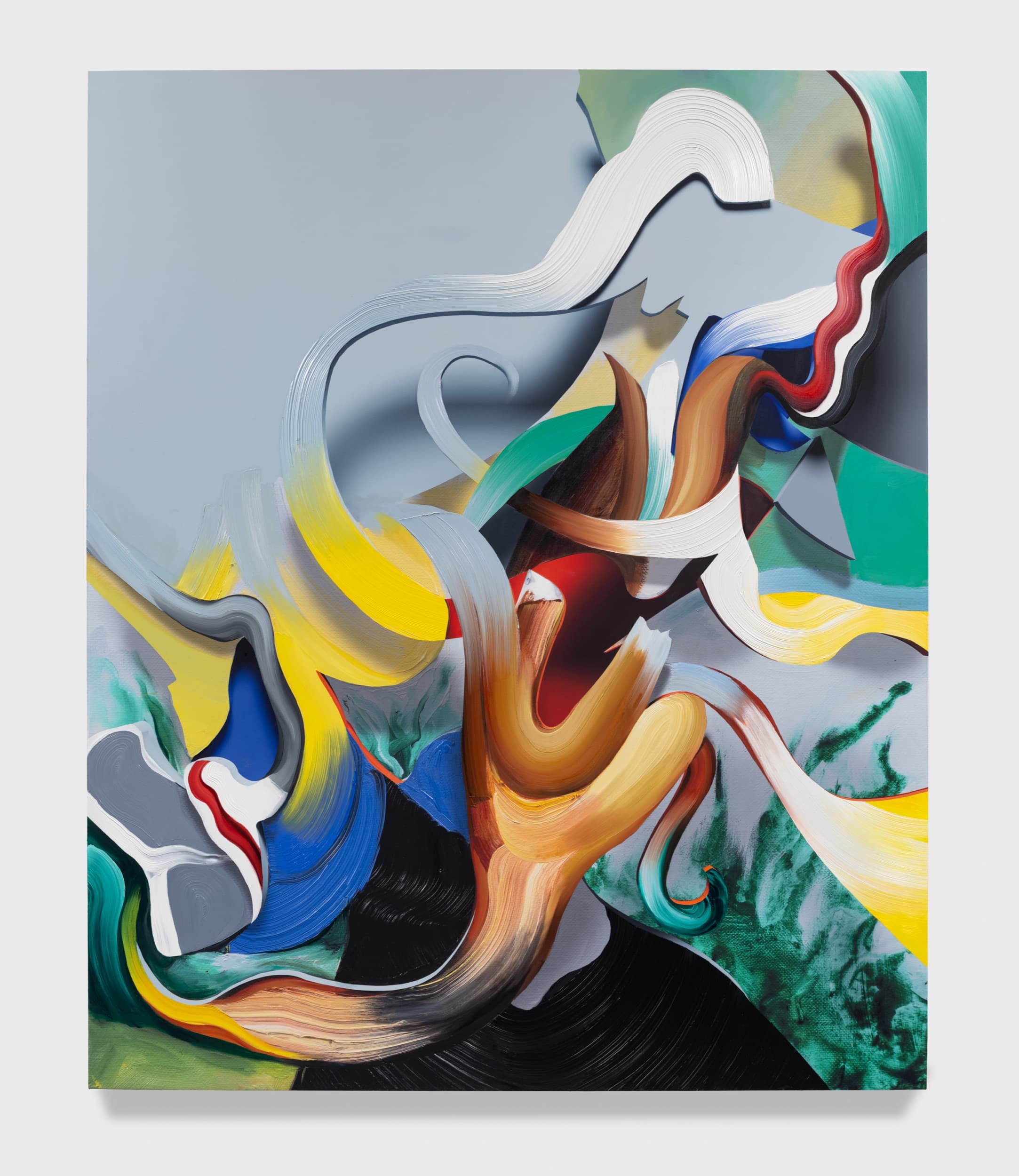
Pieter Schoolwerth, Descending, 2026. Oil, acrylic, and inkjet on canvas, 81 × 67 inches. Courtesy the artist and Petzel Gallery. Photo: Jason Mandella.
Word count: 1372
Paragraphs: 22
Molly Warnock: We first met in 2016, in the run-up to your Model as Painting exhibition in Berlin.1 Since then, you’ve created multiple successive bodies of new work. Each deploys a specific combination of digital and analog processes to address what you’ve characterized as distinctive “forces of abstraction” in the contemporary world: the internet and digital technology. Each group nonetheless involves a specific modification of your working method. Why is it important to you that your way of making paintings should continually change?
Pieter Schoolwerth: There are different ways you can change. I like to think that the change in my work is more structural than stylistic. Stylistic change leaves the basic structure intact and just swaps in different coordinates. It doesn’t require that the viewer slow down and understand how something developed as a worldview.
I think changing one’s work on a structural level is a political act. It’s connected to the desire to continually try to find freedom in the stuff of paint, while questioning traditional notions of what a painting can be. It involves a certain restlessness, a material struggle with a specific set of tools.
At the same time, I have a passionate interest in keeping painting relevant. If young people aren’t inspired by going to museums and looking at paintings, maybe they’d rather design a game or create content for social media. Painting could fall into an irrelevant artisanal category of nostalgia culture.
I’m continually looking at my life and asking, what can I do to make painting be of this moment—not 1948, 1971, or 2012? I want the work to express what I’ve experienced in the last few months or year.
Warnock: More than in any of your projects to date, the paintings you are making right now can almost appear initially as large gestural compositions in the tradition of lyrical abstraction. Yet each is obtained through a decidedly hybrid method—by feeding a much-smaller, rapidly improvised painting through a laborious process involving photography, CG effects software, printing, and the manual re-introduction of paint. What is at stake for you in this multimedia reimagination of painterly gesture?
Schoolwerth: By forcing the initial, spontaneously improvised painting into an incredibly slow form of processing, I’d like to think that the result encodes a tension between speeds: an apparently fast and loose gestural study is compressed into the slow grind of a delicately orchestrated digital composition. This amounts to filtering conventional gesture through a contemporary lens. I like that our brains want to read the final form as fast, yet we’re forced to slow down and see its complexity.

Pieter Schoolwerth, Silent Pilot, 2026. Oil, acrylic and inkjet on canvas, 71 × 87 inches. Courtesy the artist and Petzel Gallery. Photo: Jason Mandella.
Warnock: The results are certainly confounding, especially insofar as the brushstrokes appear to occupy different planes in a shallow, three-dimensional relief—an illusion enhanced by various shadows. This spatial play has become a hallmark of your work in the past decade.
Schoolwerth: I think there’s something uniquely contemporary about this form of shallow space that everyone who plays video games or watches animated films is familiar with to the point where we don’t even notice it anymore. And it’s not a space you can replicate through the direct application of material to a support by hand. It requires new techniques that allow for the seamless merging of a gestural mark with its own image, to pose the key question today: “Is this real?”
I like the somewhat unpredictable aspect of using new tools and giving up a bit of control just to see where I can take this. But it’s not about the technology as such. I just want to look at something I’ve never seen before.
I’m also thinking about the feeling of loss, and information being lost through the reception of art nowadays. When you see an artwork on a screen versus in person, you’re missing ninety percent of the sensory or neural effects of that thing by scrolling past it. I’m trying to build that sense of loss into the painting itself. If the final painting is already once removed from an original, then the status of the original is contingent. What happens to this thing when it’s been used up to make this other thing? That bears a direct relationship to what is lost when you don’t go to the gallery, you just see the show online.
Warnock: It seems to me that’s long been a dimension of your work. I’m thinking back to the sculptural reliefs that you created for Model as Painting—and the idea of that sculpture as an uneasy remainder relative to the final paintings.
Schoolwerth: The difference is that now the starting point is an actual painting, although it’s been used up and is not exhibited in the gallery. I would like to connect that back to painting as a discipline—say, the idea that painting is antiquated, or a thing of the past. Can this method speak to painting’s supposedly outmoded status?
I’d be very happy if someone looked at one of these things and asked, “Where’s the real painting?” It’s never happened, because people don’t yet have a sense that this started from a painting that’s been lost. I don’t feel a need to talk about the process as I did a decade ago. In fact, as time goes on, I’m more interested in just having people look for themselves, because I think the work itself speaks in the most powerful way. But it does take some time and investment to wonder, “How was this thing made?”

Pieter Schoolwerth, Thinking Through 2014 (13 Years), 2025. Oil, acrylic, and inkjet on canvas, 72 ½ × 89 inches. Courtesy the artist and Kraupa-Tuskany Zeidler. Photo: Jason Mandella.
Warnock: Is the difficulty part of the point?
Schoolwerth: I wouldn’t say I intentionally make works that are difficult, but they certainly aren’t complicit with second-screen viewing from a doomscrolled rot on the couch.
My recent paintings don’t photograph well because it’s difficult to discern what I’ve done and what the machine has done.2 But I like to think that they really encourage and reward in-person viewing in real space, ideally with other people. This is the way I used to think about analog synthesis in music twenty years ago with the Wierd Party3: how can I inspire people to leave the house and come hang out with other people? I saw a political metaphor in building a world with my friends in the night, and coming together in a gallery in 2026 feels similar: we’re here, looking at these objects.
I was completely surprised at the opening of my recent show at K-TZ in Berlin.4 I walked into the gallery and dozens of viewers were stopped, really studying the paintings from six inches away. I like the idea that the result of this human-machine collaboration could be a return to a slower and more active mode of apprehension, as opposed to just walking by and taking a picture with your phone.
Warnock: Your insistence on structural change suggests that much of the meaning of your work can be found in this very commitment to development over time—that its ethical and philosophical significance has to do with maintaining certain capacities for curiosity, openness, and conversation vitiated by digital culture. Do you see formal renewal as a metaphor for renewal in a broader sense?
Schoolwerth: The nature of social life has become very sectarian; a lot of people can only talk to people whom they’ve sanctioned as having the exact same ideological beliefs, the exact same cultural interests as they do. And that could be seen as a logical consequence of our submitting to platform algorithms for the past ten years or more. It’s as if these filters that serve up our information have become biological and now format our desire. This unconscious lack of openness has a lot to do with the fragmentation of the political left, and thus the despair of the world today.
But there’s also a sense of digital fatigue from the news cycle that is palpable with everyone I talk to. I think that now more than ever we need art to protect ourselves from being worn out to the point of resignation. I think focusing visual attention within the frame can inspire others to believe in and make art. A serious exploration of form, and a belief in the imaginative power that drives formal invention, is about keeping hope in a better future alive.
- Molly Warnock and Pieter Schoolwerth, “1000 WORDS: PIETER SCHOOLWERTH,” Art Forum, January 2017, https://www.artforum.com/features/1000-words-pieter-schoolwerth-232061/
- Do Not Research (blog), “Pieter Schoolwerth & Austin Martin White in Conversation,” posted September 22, 2025. https://donotresearch.substack.com/p/pieter-schoolwerth-and-austin-martin?utm_source=publication-search
- https://wierdrecords.com/liveevents/
- Pieter Schoolwerth, Thinking Through (13 Years), K-T-Z, 2025. https://www.k-t-z.com/exhibitions/78-thinking-through-13-years-pieter-schoolwerth/
Pieter Schoolwerth is a visual artist based in New York. He has exhibited internationally since 1994, his monograph Model as Painting was published by Sequence Press/MIT in 2019, and he presented his mid-career survey show No Body Get a Head, 1991–2020 at the Kunstverein Hannover in 2021. From 2003–13, Schoolwerth ran Wierd Records and the Wierd Party on the LES of NYC.