Critics PageJune 2026In Conversation
Jane Swavely with Molly Warnock
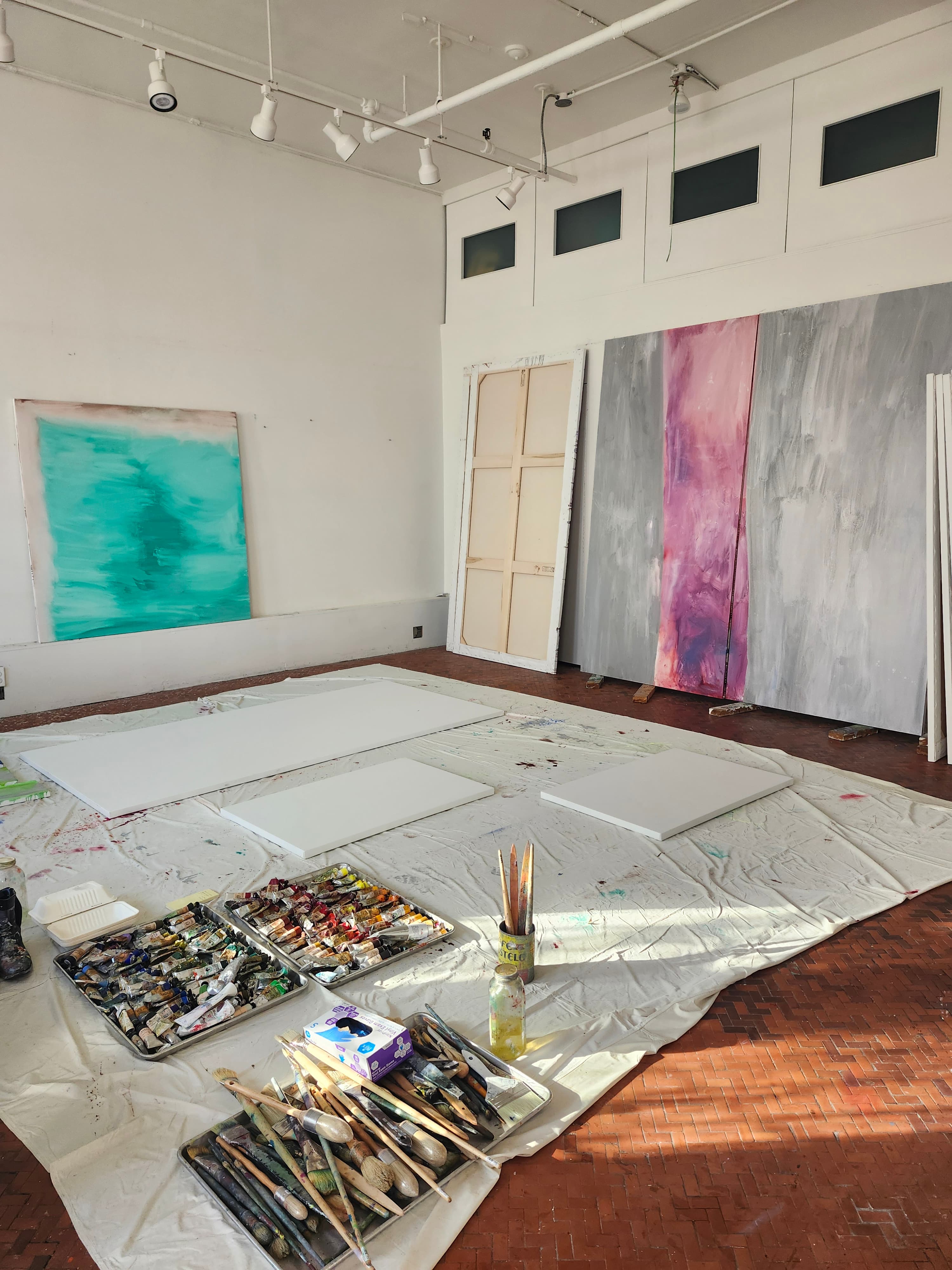
View of Jane Swavely’s studio on the Bowery, March 2026. Photo: Molly Warnock.
Word count: 796
Paragraphs: 16
Molly Warnock: An important, largely undiscussed aspect of being an artist is developing habits that enable work to happen, like simply getting yourself to your studio. Can you describe your day-to-day?
Jane Swavely: It takes years to discover what your practice actually is. You think it’s making work, but it’s really everything around it. Making work is the final bit—for me, anyway. When my children were little, my studio time was when they were in school. And I used to beat myself up because I wouldn’t get any painting done in between doing everything else, and then l had picked them up from school and that was that. Then I finally realized that, even if you don’t do anything, you have to come and sit with the work, you need time to ruminate, to come up with ideas, to be in your head. You have to be alone. I don’t even have music playing. I’ll sit in here for hours, sometimes days, and circle around starting a painting—just lounging on the sofa, looking at books, you know.
There was an Art21 video that I saw about a year ago where Susan Rothenberg says that it’s important to be in your studio, even if you’re sitting and reading a detective novel. Maybe you look up from that novel and see something that needs to be done on a painting and you do it. Even if it’s one mark, you’ve done your work for the day. And I thought, yeah, it took me years to figure that out. But that’s a mark that could make a difference.

Installation view: Jane Swavely: My Little Pony, kaufmann repetto, Milan, 2026. Courtesy the artist and kaufmann repetto Milan / New York. Photo: Andrea Rossetti.
Warnock: You’ve talked about wanting to free up your practice, avoid overworking. What are some strategies you’ve developed to help with this?
Swavely: When I discovered white rags and attrition, taking away rather than adding, that was a revelation. I feel a real liberation knowing that I have boxes of rags; I can wipe things out if I don’t like them—sometimes to the bare canvas, sometimes to previous layers.
I have a dear friend that lives on the Bowery. She’s studied painting and is a landscape designer. The first time I ever made a painting that I was really unhappy with, I wiped it out, and all that was left was this brown center and this Day-Glo sort of outside. And the underlying stretcher bars showed through. She came up and I said, “I wiped this painting out.” And she said, “It’s finished.”
Now I never mind the stretcher bars coming through. In fact, it can really add to the composition, and then you’re not adding it with paint, you’re adding it with the actual structure of the support, which is interesting to play around with.
I also like the unexpected events—like paw prints, footprints, handprints—that sometimes go unrecognized until much later.
Warnock: What role do your pastels play?
Swavely: Until recently, I didn’t show my works on paper. They were only for me. I’m only now realizing that the more that I do them, the more they inform the paintings. It’s something that I practice every day. After dinner, I’ll sit down at my table and work on these pastels on colored paper. I also make leporellos, which I find lead to paintings. Not necessarily, but they get me in the mood. They’ve gone from separate practices to joining together.
Drawing is a way of staying engaged. If I’m away from the studio, I like to have a sketchbook or a little set of watercolors.
Warnock: Some of your paintings on canvas have special kinships. Can you tell me about the works you call “sister paintings”?
Swavely: When I say “sister paintings,” they’re often really worked on together, sometimes beginning as a diptych but then separated, like separated at birth. The first time that happened, the paintings were like fraternal twins. I saw that one represented me, and the other, my twin sister. And they did go their separate ways to two different places. That was kind of huge.
Other times, they’re paintings that are done in proximity, that have similarities. I used to shy away from that because I thought every painting had to be totally different, but I think it’s fine to explore the same thing. It always ends up very differently anyway, in terms of the color and the way things move.
The paintings unfold and they are quite a surprise by the time I’m finished with them. It’s a series of muscle memories, happy accidents, materials behaving in a way that you can’t entirely control. A painting could look like it took me five minutes, and it doesn’t bother me. People will say, “Well, how long did it take you to make that?” It took me years to come around to making that.
Jane Swavely attempts in her abstract paintings to reconcile romanticism and minimalism while referencing natural and cinematic elements. Swavely is shown by Magenta Plains Gallery in New York and lives and works in her loft on the Bowery. Her current show, Strawberry Fields, is on view at Magenta Plains through June 20.