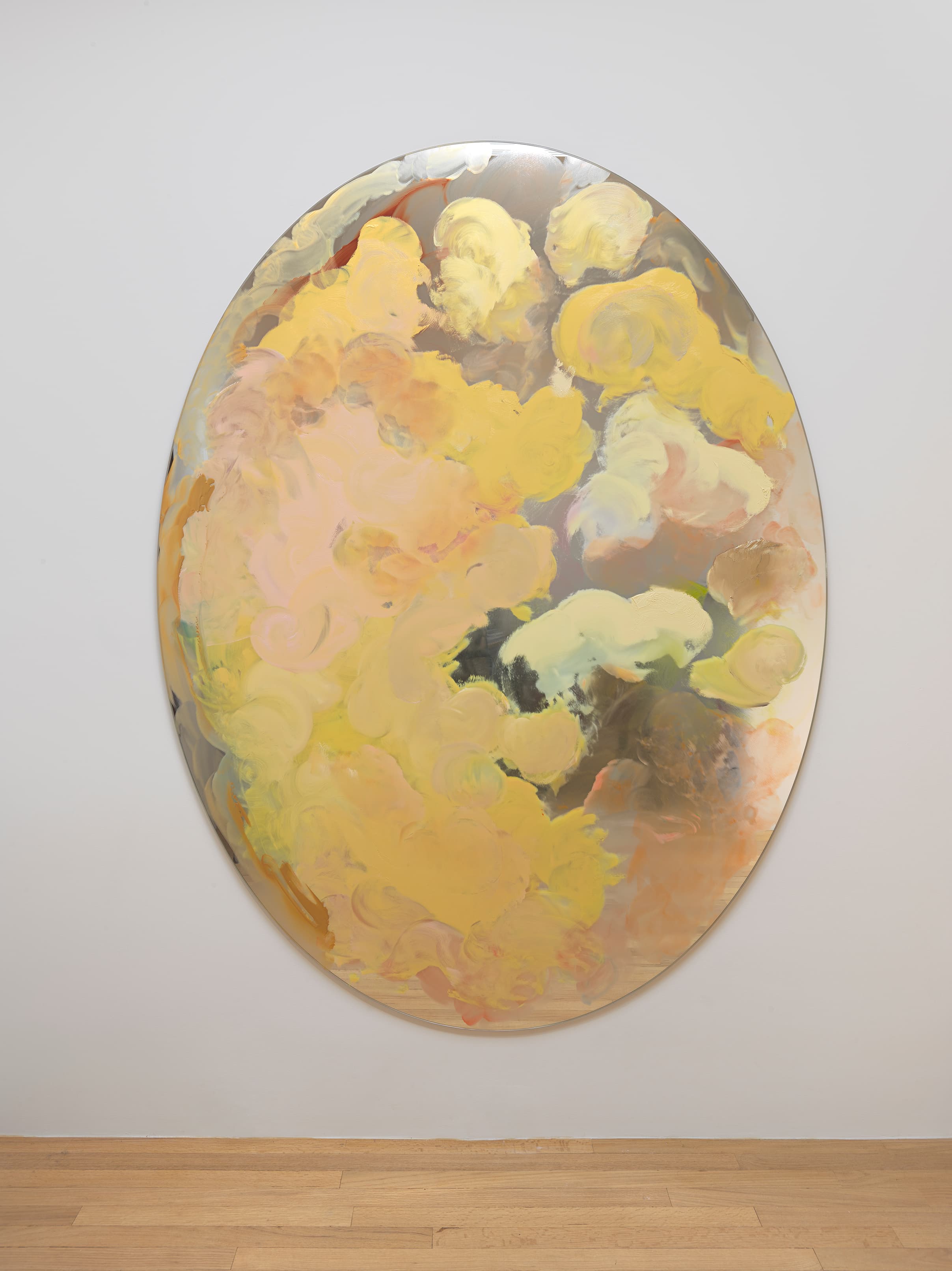
Karla Black, Looking Glass (traditional soon), 2026. Oil paint, glass paint, mirror, 70 ⅞ × 53 ⅛ inches. Courtesy the artist and Rodder. Photo: Genevieve Hanson.
Word count: 532
Paragraphs: 8
May 5–June 18, 2026
New York
The art of disarray holds particular fascination for Karla Black, who has become increasingly emboldened to test its limits throughout her extensive career. A Post-Minimalist warrant to respect materials, those materials’ natural inclinations to form however they do, and their temporal ways and means inform the core of her practice. For Black, the growth and decay of substances found in land but transposed to rooms is the cultural intervention she takes as her remit. Exhibitions installed in museums and art halls are frequent standard practice in recent years, and these spaces, larger than rooms, have suggested to her that she expand somehow, with overgrowth surely, in the realm of installation threatening to explode its surrounds.
Anticipating that matters would change in the apartment dwelling which has become Rodder, a new art gallery, was part of the intrigue: would the art absorb aspects not only of scale, but also, more significantly, of an art history anticipating the artist’s own practice?
Once upon a time, the apartment was an escape, a refuge from the ceremonial formalities and protocols ongoing in public life for those in aristocratic power, where informality inviting conversation—together with music overheard, board games, and laughter—was welcome relief. The décor for such in furniture ensembles—to be assembled and reassembled impromptu—expressed informality, and the rooms were light-filled. Daylight’s shifting patterns invited unpredictable visual play upon elaborated surfaces, the shape-shifting further enhanced by mirrored décor.

Installation view: Karla Black, Rodder, New York, 2026. Courtesy the artist and Rodder. Photo: Genevieve Hanson.
Enter Karla Black. She has noted the Neo-Renaissance apartment that has become an art gallery brings to it a domestic informality decidedly Rococo in sensibility. Her installation, emphatically ornamental, once again brings mirror into the rooms, sited on floor and wall alike through stencils derived from Rococo pattern books freely interpreted in some instances, yet all smeared in oil paints to cosmetic effect. So the disposition to undermine the propriety of the room through disarray of paint on mirror is Black’s way of challenging the structures most related to sculpture. Mirrors smeared with pigments pose a visceral experience, the surface, then nearly covered, becomes a painting on its own terms: oil paints in pastel overlaying each other like a cloudscape.
The contrarian position well-established in her exhibition history over the years continues here. Where sculpture is meant to be on the ground and grounded, Black’s sculptural riffs are gestural, made of fugitive materials affiliated with cosmetic painting, and decidedly predisposed to complication rather than complexity. So it is with this show, which does feature three large gestural works resting yet oblivious of weighty matters. Nature at the Court (2026) is most interesting for flaunting gesture, confection and confusion all at once. Bulging from one vantage, the hollows from another viewpoint are gestures brusquely cut off in tension with the shapely sculptural gesture. After all, how often does one encounter meringue with attitude?
Disarray continues through décor gone awry; the artist’s fondness for clutter and a sense of impropriety where good taste is expected features prominently. The mirrored elements are crowded in corners or on shelves, and a bookcase has been subject to a spill of tiny things, a miscellany of individual works, as through this mess, décor gains some autonomy from sculpture.
Marjorie Welish is an artist and writer. Welish’s recent art exhibitions have occurred at Art-3, Brooklyn, Emanuel von Baeyer Cabinet, London, and La Terrasse, Nanterre. A presentation on her Fulbright occurred at Edinburgh College of Art.