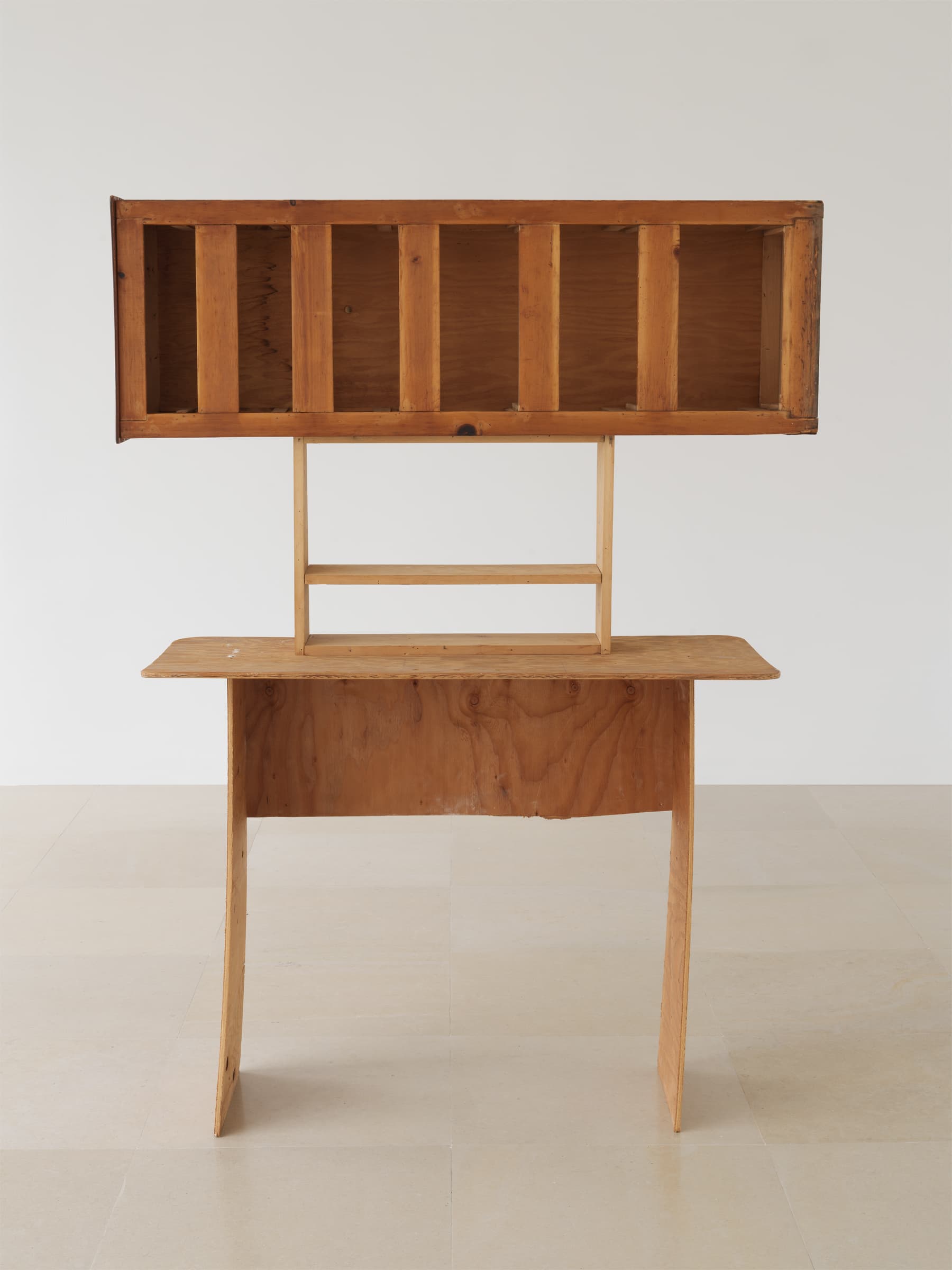
Gedi Sibony, Endowed with Inexhaustibility, 2025. Wood, plywood, dresser, nails, 72 ¼ × 54 × 22 ¾ inches. Courtesy the artist and Greene Naftali, New York. Photo: Photo: Júlia Standovár.
Word count: 1063
Paragraphs: 8
Greene Naftali
April 30–June 20, 2026
New York
We cannot live this way day in and day out, going about errands in a sustained state of enchanted amazement, turned on by the tease of immanence electrifying empty space and filling all the air between things and bodies. But with the help of the right exhibition on the right day (or the right psychochemistry), we can, for a brief spell, tap into that acute frisson that lies in wait all around us like a hidden dimension and builds between two things observed in focused proximity.
Gedi Sibony has always had a sensitive eye and rarified sensibility, a somehow patrician elegance generated by looking intensely while physically doing as little as necessary. His refinement has long been belied by a penchant for recycling found scraps and urban detritus. As a sculptor, he is far less interested in mass, gravity, or solidity than levitation, lightness, and limned space. He exercises a light touch with such consistency and deliberation that it amounts to conviction, modeling an aspirational relation to the world. In The Invisible Point, his latest exhibition of six recent sculptures in his characteristic mode, paired with eight fresh paintings in a surprising new one, Sibony continues to gently manipulate (mostly preserve) items plucked from the street—wooden bookshelves, a dresser without its drawers, a wire basket, a metal plant stand, a broomstick, a tiny white bench or stepstool—to draw our attention to their raw edges and dimensional drama in the round. He turns found wooden furniture on its side and stacks them into vertical configurations of rectilinear frames like vaguely anthropomorphized viewfinders freestanding on two legs. I suppose the body-as-lens, or figure-as-frame, is one of their implied propositions, while their direct effect is to temporarily impose a reassuring sense of order and containment on the art and architecture cropped through their many openings. Two of the most ethereal sculptures are mainly wire and hang from the ceiling, their suspended figures all line and shifting negative space like doodles daydreamt in the air.

Installation view: Gedi Sibony: The Invisible Point, Greene Naftali, New York, 2026. Courtesy Greene Naftali, New York. Photo: Júlia Standovár
The artist’s new paintings give Fauve vibes so strong they suggest a Borgesian attempt to mind-meld with Henri Matisse circa 1904 when he painted Luxe, calme et volupté, as though Sibony could transport from New York in winter, 2026 (when these were painted) to Saint-Tropez or some other sunny beach idyll through sheer aesthetic concentration. In fact, his most developed canvas, Inner Areas Turning Sun into Substance (2026) basically replicates Luxe’s landscape: arcing shoreline, glittering sea, distant blue hills, slanted yellow clouds, and telephone-pole pine with swooping branches in the far-right foreground. A prelapsarian sketch of heaven as uninhabited open space in psychedelic technicolor. This painting was the starting point for the rest, which are increasingly sparer scenes with even more unpainted white ground and that often include a second upright tree form planted as a faraway partner for the first. The paintings eschew the formal certainty and solidity of rendered shape and line in favor of tentative presence, hints, hypotheticals, limbo, and, again, light touches. Forms are whispered and barely there, emergent through a few strokes of a smallish brush the width of a finger—withholding more information than is shared. A minimal pencil sketch faintly underwrites the painted marks. Scarceness heightens the tension amongst disparate smears and makes each mark’s materiality and chroma matter more. I compared densities of dabs between the paintings: two are markedly denser, while the others are very spare, and the largest is the sparest of all. Benefiting from the comparison, the sparest gained in strength and glowed brightest. With all that open white space, the paintings began to merge with the gallery’s white walls to make an enveloping panorama of a coherent imagined place via select scenic vistas. Everything is mostly empty space anyway, both in the paintings and sculptures Sibony makes and in the physical universe in general.
Being barely-there, the landscape is illusory and, in two paintings in the small side gallery, it morphs into a face with curved boughs for closed eyes and a lake for an open mouth (echoing the compositional broad strokes of Paul Cézanne’s Les Grandes Baigneuses (1894–1905), which in turn greatly impacted Matisse and his Luxe dream). Whether face or landscape, they image a need to reach for something, a yearning captured in romantic titles like Made of Jewels, Swept by a Fragrant Breeze, and From the Waves of a Honeyed Sea . The paintings’ bright colors may be too insistently bright, somehow not just cheerful but desperately cheerful. As with Fauvism, the vision is so pastoral, sunny, and filled with bonheur that, for a cynic, it borders on parody, a cartoon of someone’s happy place. In notes that didn’t make it into the press release, the artist wrote, “When you see that sparkling horizon it looks like an impossible place to be. Over there in it. But it is the space between it and you that is actually magical.” The depth and thickness of space can be as heavy as solid matter and as ineffable as nothing at all—airy, immaterial, and psychological.

Gedi Sibony, The Utterance Itself Did Not Suffice, 2026. Oil and pencil on linen, 44 ½ × 56 ¼ inches. Courtesy the artist and Greene Naftali, New York. Photo: Photo: Júlia Standovár.
Sibony describes this everything-and-nothing cautiously, with dabs of paint that palpate the surface bit by bit with shy touches that seem to accent or highlight a form that is not there. Where long lines do appear—trees, branches—they are dotted, jittery, and quivering like live wires. Atomized strokes function not only to define negative space but to expand the stretches of time we imagine between the moments of their making: painting as the pacing of and worrying over points of contact. Registering an accumulation of sensory pings and blips, this touch-and-go modality is one of care and curiosity.
A half hour or so spent in this world felt like escapism in the strong sense, opening access to a warped and dialed up alternative experience of the real. Titling the whole thing, The Invisible Point gets at the elusiveness of his art’s aims as it names distance, thresholds, vanishing, and conceptual conundrums (what is an invisible point?) as its subjects. An eye in the storm of ever-louder topicality and shirt-sleeve moralizing, Sibony continually labors, perhaps quaintly, to slip the cuffs of identity and summon the fleeting sublime, chasing a state of ego-less viewing that looks elsewhere, as Agnes Martin put it, with one’s back to the world.
Sarah Lehrer-Graiwer is a writer and curator in Los Angeles where she co-runs The Finley Gallery and edits Pep Talk. She is the author of Lee Lozano: Dropout Piece (Afterall Books).