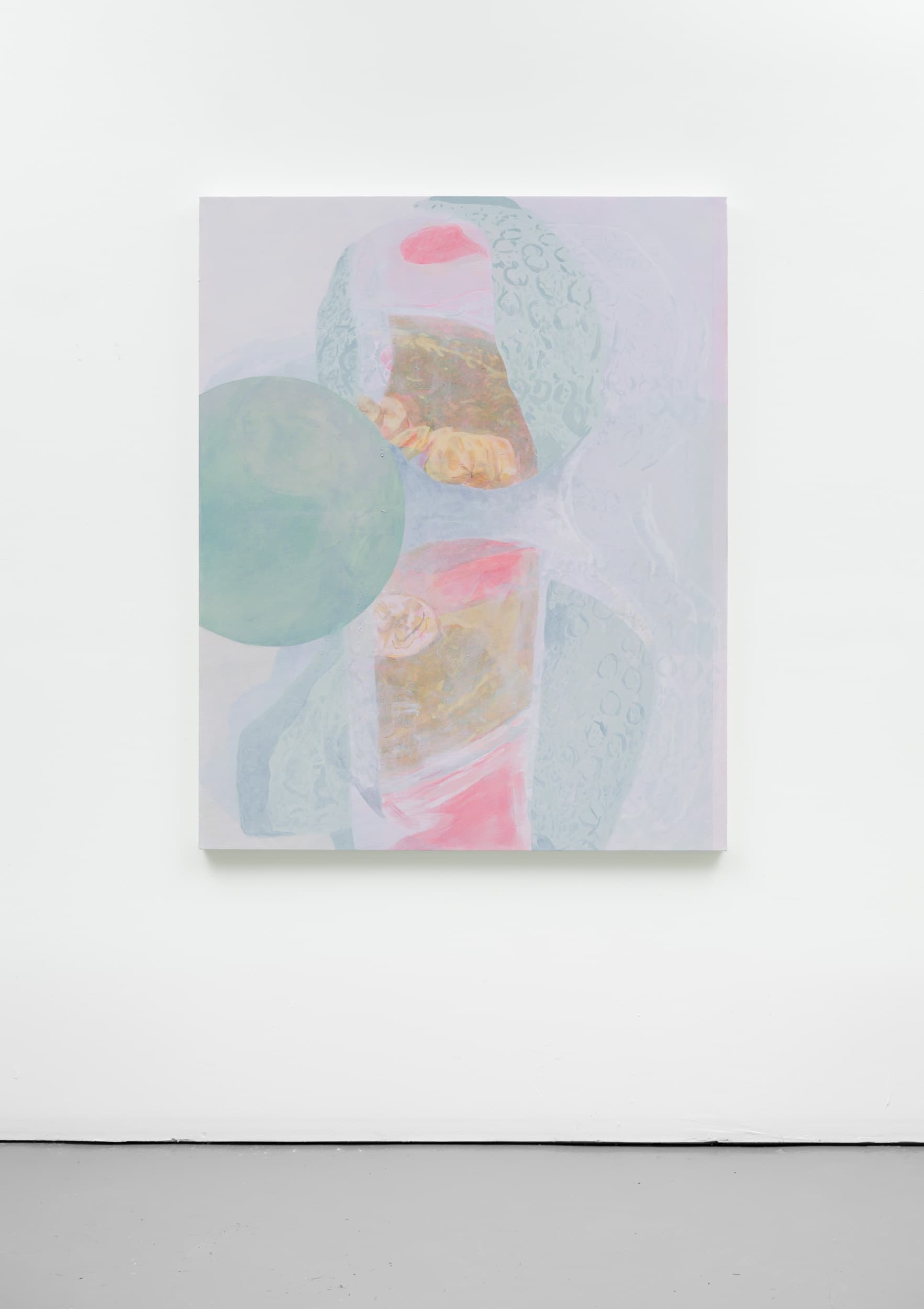
Derek Franklin, TOS #53, 2026. Oil on canvas, 62 × 50 inches. Courtesy the artist and Elizabeth Leach Gallery Portland, OR.
Word count: 685
Paragraphs: 7
Elizabeth Leach Gallery
May 6–May 30, 2026
Portland, OR
Perhaps it’s the bright and cloud-like whiteness of their surfaces or their looming verticality that imbues Derek Franklin’s newest oil paintings with an atmosphere of foggy spiritual luminosity. The whiteness that Franklin has achieved doesn’t possess the patches of yellow warmth we expect from the sun, for instance, as it caresses the face on a summer morning. It is cool but not clinical. This white is astral and cosmic, like salt, or the chalky pigment created by the anonymous makers of Tantric meditation paintings across generations.
These are the thoughts that flooded my mind as I absorbed Derek Franklin’s recent paintings in his one-person exhibition The Poet’s Lips at Elizabeth Leach Gallery. Franklin borrowed the show’s evocatively embodied title from Danish philosopher and Christian existentialism founder Søren Kierkegaard’s 1843 Either/Or. Still widely influential, Kierkegaard espouses a romantic vision of the poet’s lips as a tortured yet magical threshold. Franklin includes a quote from the philosopher in which he reveals the origins of poetry as an Orphic phenomenon, born in an ancient Greek torture device, that transforms the poet’s suffering into beauty as it exits the poet’s body into the light of day and poetic language. It’s this sensorium of light, in all of its painterly and lyric radiance, that propels these sensitive works of art into communion with the viewer.

Installation view: Derek Franklin: The Poet’s Lips, Elizabeth Leach Gallery, Portland, OR, 2026. Courtesy Elizabeth Leach Gallery Portland, OR.
The Poet’s Lips’ nearly monochromatic oil paintings and slender floor-to-ceiling sculptures garland the gallery’s smaller room with intimacy. Viewers can’t help but move closer to the work as they search the paintings’ surfaces for clues to their making and meaning. As I eavesdropped through the opening reception, I heard discussions about everything: science fiction, new-genre horror, and life after death, as well as the Beatles’ White Album, the beauty of snow, and the paintings of Kazimir Malevich and Robert Ryman. In a recent conversation in front of the work, Franklin raised the specter of Willem de Kooning’s late paintings—the diaphanous phantoms that, in some respects, traced the artist’s changing subjectivity as his cognition declined. While notorious for scraping down sections of accumulated paint until the raw canvas reappeared like battered skin, de Kooning began subtracting paint more gently as he aged, resulting in velvety white surfaces sparsely covered in curvilinear swaths of darker paint—black and the primaries.

Derek Franklin, The Songs That Enkidu Would Sing #1 (detail), 2026. Cast bronze and threaded rod, 160 × 1 ½ × 1 ¼ inches. Courtesy the artist and Elizabeth Leach Gallery Portland, OR.
There’s no scraping across Franklin’s canvases. Each glazed layer and miniscule patch of delicately tinted white has been added and worked by the artist. The ethos of the work exists within a responsive choreography of forms in motion—large orbs, vertical bands, and curvaceous polygons that drift across the paintings—eclipsing and floating through one another. Here, the pictorial and durational become one, and the sensation of time meets the mise-en-scène of the paintings. A fluid, situational geometry is at hand. The other primary iconographic dimension of the paintings lives in veiled, but perceptible, scenes of everyday life and moments of unearthly portraiture. These take the form of classic American sustenance: bowls of green salad and simple plates of food. Some of the large orbs possess indistinct faces, both human and monster-like. When such representation coheres, our attention is snagged—at least for a moment. And this leads us to the sculptures installed in the room.
In two diagonal corners of the space, set apart from the wall, slender columns rise from the floor and attach to the ceiling. Their forms feel familiar, and closer inspection reveals that they’re recorders, the first musical instrument learned by children in elementary school. The sculptures also appear like demure lightning rods. What do they capture here? What do they feed to the paintings? The patina of the sculptures is humble and unpretentious. These are not the elitist trappings of the high-rent courtyard, but rather, the walking sticks of the poet, waiting to be detached and put to use on the next journey. The recorders reinforce the imagined sound in the room, and together with the paintings, they awaken and stimulate the senses, but particularly the mind’s eye—the third eye—whose wisdom and guidance we desperately need.
Stephanie Snyder
Snyder curated more than seventy original exhibitions, several of which traveled to collaborating museums across the country. These include: Gregg Bordowitz: I Wanna Be Well, (Art Institute of Chicago and MoMA PS1) and Wynne Greenwood: Kelly (the New Museum). She has received two fellowships from the Getty Foundation, Los Angeles: the first to support her curatorial research, and the second to participate in the Getty’s Museum Leadership Institute. In 2013, her critical writing was recognized with an award from the International Association of Art Critics (AICA). She is currently working as an independent curator, living between the US and Greece, and authoring the first definitive book in English on the life and work of Romanian Swiss artist Daniel Spoerri.