Illuminating Women Artists: Anne Vallayer-Coster
Despite success in her lifetime, this painter hasn’t seen much scholarly attention because she mostly painted still lifes, a frequently ill-regarded genre.
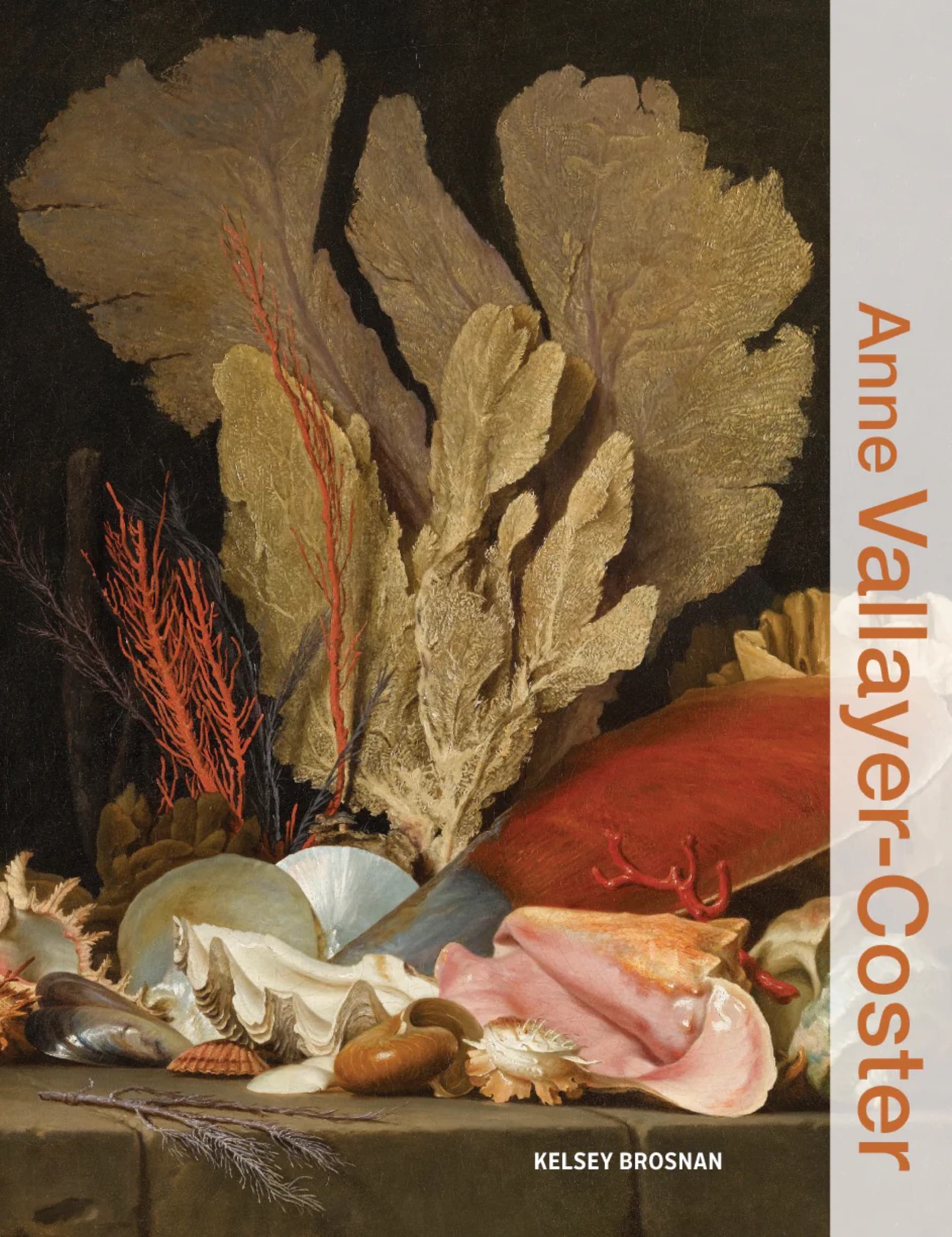
Word count: 833
Paragraphs: 14
Kelsey Brosnan
Lund Humphries, 2026
A miniature self-portrait of painter Anne Vallayer-Coster peeks out at us from the glistening surface of a silver tureen, nestled behind a lobster. She dons a fiery shade of orange in this tiny self-portrait, like the bulbous boiled crustacean cast as the main character of her painting Still Life with Lobster (1781). “I painted this,” her teeny reflection seems to maintain. “Don’t you forget it.”
Notwithstanding her best efforts, eighteenth-century French painter Vallayer-Coster was somewhat forgotten and overlooked in the years following her successful five-decade career in Paris. In her day, she was one of only fifteen women artists ever admitted to the prestigious Parisian Académie royale de peinture et de sculpture [Royal Academy of Painting and Sculpture] throughout its roughly 150 year history (a fraction of the over four hundred artists who studied there overall). Her clientele included Queen Marie Antoinette, other members of the French court, and Empress Joséphine; she regularly exhibited at the official Salon between 1771 and 1817. Despite this success in her lifetime, she hasn’t seen much scholarly attention until recently, however, because she mostly painted still lifes (a genre that, historically, has not been as well regarded as others).
It’s been over twenty years since the publication of the first English-language monograph of Vallayer-Coster, a catalogue for her first major retrospective exhibition which opened at the National Gallery of Art in Washington DC before travelling to the Dallas Museum of Art and New York’s Frick Collection. The monograph was preceded by a 1970 French catalogue raisonné by Marianne Roland Michel. Now a new English publication about the artist by Kelsey Brosnan, part of Lund Humphries’s Illuminating Women Artists book series dedicated to highlighting historic European female artists, builds on those two books while offering a new look at her life and work.
The new book is organized with chapters dedicated to the inanimate subjects of Vallayer-Coster’s paintings, with an introductory chapter providing some biographical context. Allegories, food, guns and game, flowers, and one especially intriguing chapter on shells. Brosnan explains the fascination with shells during the artist’s time, peppered with interesting details (such as the fact that Rococo painter François Boucher had a personal collection of over 2,500 shells that he displayed in a cabinet near his apartment at the Louvre). The shell chapter is one exemplar of Brosnan’s deep dives into the cultural significance of objects that appear in Vallayer-Coster’s work. When discussing her still lifes with bread, the author breaks down the different ranks of French bakers during Vallayer-Coster’s time.
In every chapter, the author writes descriptions of the still lifes that match the artistry of the paintings themselves. “Vallayer-Coster’s fish flop, one over the other, in a sensual embrace. She employed delicate yellows and silvery grays to evoke the feel of the mackerel’s slick belly and jelly eyeball, as well as the waxy rind and citrusy tissue of the halved lemons next to them,” Brosnan writes in reference to Still Life with Mackerel (1787). “Quick, unblended dabs of vermillion at the mackerel’s gills, for example, stand for residual blood—the only reference to the violent means through which the fish were extracted from the sea.”
Wherever possible, the text is embellished with names of other historic women artists, creating curiosity about individuals who might also benefit from a bit of scholarly spotlight. Brosnan notes other female students of the Académie and women in Vallayer-Coster’s orbit, such as her early teachers, Marie-Thérèse Reboul Vien (who mostly painted natural history subjects) and Madeleine Francoise Basseporte (the official draftswoman of Paris’s royal botanical gardens, and first woman to hold that position). Another noteworthy name is that of anatomist Marie Marguerite Biheron who, like Vallayer-Coster, studied drawing with Basseporte. Biheron was ineligible for membership to the Académie des sciences due to her gender, but nonetheless had collegial relationships with prominent scientists and supported herself by sculpting anatomical wax models and offering private anatomical lessons to young women (basically educating them about their own bodies).
A noteworthy contribution to Vallayer-Coster scholarship is the appendix listing the paintings she exhibited at the eighteen salons in which she participated, consolidating new information about several of these works. Brosnan adds that there is still work to be done on this front and that she hopes this will serve as a jumping off point for future research, since many works are still in private collections or untraced.
“This study belongs to a growing tide of research into the roles of women in the visual, material and intellectual culture of Europe in the eighteenth century and beyond,” writes Brosnan in the book’s conclusion, noting how many of Vallayer-Coster’s female peers are the subjects of recent and forthcoming publications and exhibitions. “For now, however, we remain frustrated by the dearth of documentation of many earlier académiciennes, to say nothing of those working outside of the official auspices of the Académie. Indeed, our work is far from finished.”
Karen Chernick is a Tel Aviv-based arts and culture journalist.