Word count: 5054
Paragraphs: 64
Gladstone Gallery
April 28–June 13, 2026
New York
There are photographs of the painter Celia Paul standing in her paint-coated London studio, in a paint-encrusted long dress, standing in front of a mirror. She has painted her reflection in that mirror. She has written:
The frame of the mirror is actually an ornate old door frame, which my lover, Lucian Freud, had bought for me from an antique shop … when I first moved into my studio in Bloomsbury in 1982 … The glass of the mirror, in my painting and in reality, is like a doorway in which I’m standing, my head turned away towards a mysterious interior. Perhaps I’m speaking to someone in the room behind me, or to a ghostly presence in some unreachable place.
For me, this quote exemplifies Paul’s work, as well as her character, both mysterious, as if from another time. Gladstone Gallery in New York has recently partnered with Victoria Miro, which represents Paul in London. On April 28, Paul’s solo show opened at Gladstone. In recent years, she has exhibited at The Huntington, Vielmetter Los Angeles, and Frieze London. In 2023, she completed a residency at Victoria Miro Venice. Victoria Miro mounted an exhibition of her paintings, Colony of Ghosts, concurrent with the monograph published by MACK, Celia Paul, with 544 pages and over 300 plates. She has a book coming out this autumn about her response to Venetian painters and to writers who wrote about Venice. Paul has published two books. The first, Self-Portrait, is about being a painter, her beloved mother, and her relationship with Lucian Freud, starting when she was eighteen and he was fifty-five. She had a child, Frank, with him. Her second book, Letters to Gwen John, is a correspondence with Gwen John, whom Paul feels a deep affinity with. Our recent conversation took place on Zoom.
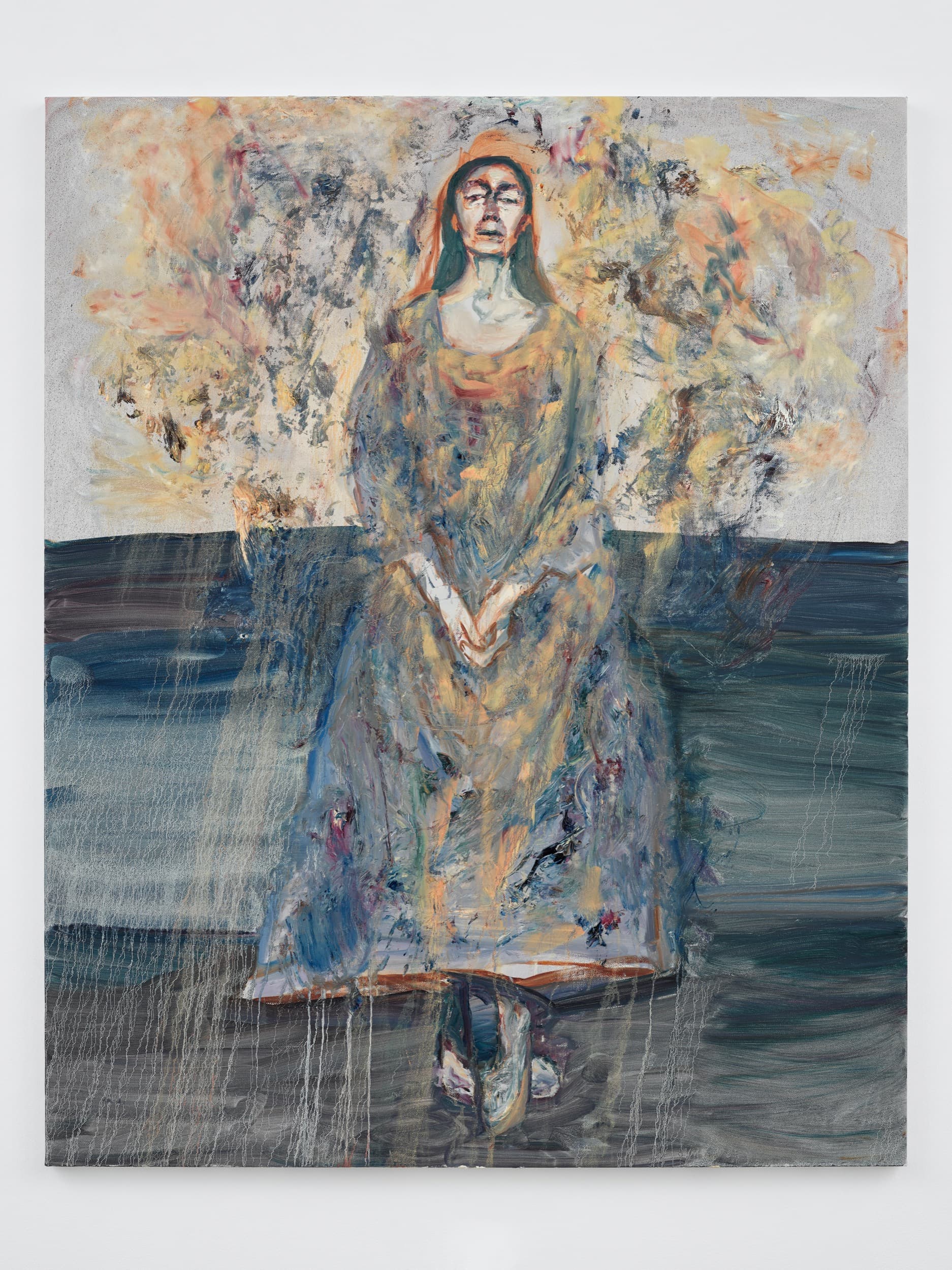
Celia Paul, Burning Painter, 2025. Oil on canvas, 72 × 58 inches. © Celia Paul. Courtesy the artist, Gladstone, and Victoria Miro.
Dian Parker (Rail): Albert Camus wrote that an artist is working to be free from the self, rather than freedom of the self. We have to get out of our own way so that we can be free to express truly, honestly, nakedly, the moment at hand: the sitter you are painting, the tree, your chair, a building, the flower, the light, a memory. I feel that’s what you do. You work to be free from yourself, rather than paint yourself in your self-portraits, or your sitters, everything you do.
Celia Paul: I think if you become self-conscious, you can’t do anything. It’s the most inhibiting thing to be aware of what one’s doing. The ideal thing is to be transported in the moment of painting so that you really do lose yourself, as you so beautifully put it, be free from oneself, and to achieve that is tremendously difficult. To have a sense of purpose about what one is doing without it being to do with one’s own purpose. It’s kind of taken out of one’s hands.
Rail: Yes, transported—that’s the operative word. I’d like to quote from your Letters to Gwen John book. Writing to her, you wrote:
What interests us is the spirit world: our inner world. Our instincts may be maternal or daughterly, but our deepest desire is for our art. Your aim, always, was to lead a more and more interior life. We remain remote. You have spoken about how you prefer to live your life in the shadows. We have lived our lives overshadowed by our own choosing. We can be free if we are unseen. We are like nocturnal animals.
Wonderful, because women are nocturnal animals.
Paul: I think what I fear most about recognition for my art, which I deeply want, is the exposure that comes with it; that exposure does make one self-conscious, which is the thing to be avoided. If you’re in the shadows, you’re free to commit any kind of art crime that you want. It does feel to me like painting is almost a crime.
Rail: Why?
Paul: I think it’s to do with paint itself. I mean people are really quite shocked by my studio; the paint is everywhere. Oil paint gets everywhere and leaves behind these traces, almost like traces of a battle. So to create this kind of havoc does feel like a crime, because there’s a sense of urgently trying to create something new, for oneself, privately, while all the time knowing that you’re doing it to be seen as well. So in that moment the exposure actually shines on what you’ve created. When it becomes something public, it is traumatic.
Rail: That’s well said: the dichotomy of the joy of creation and then having the creation being seen. But then why create? Why exhibit if it’s not going to be seen? On and on it goes, ad infinitum, barreling along. An emotional whirlwind. And to know that we always go through that and we never come to the end of it. It never goes away.
Paul: No, no, exactly. And to be true to yourself, you also have to be true to your private self, your most intimate self, because otherwise it’s just conventional. You just have to be open about it and not fear any kind of either disapproval or even rejection or misunderstanding. You just have to follow that intimate truth.
Rail: Do you feel that as you’ve gotten older, that boundary has become clearer for you—if we want to call it a boundary—that line of protecting yourself?
Paul: I’m getting more recognition now than I did when I was younger, although when I was a very young woman, I got a lot of recognition. But then there were some long dark years where I didn’t, so I didn’t have to feel so guarded from the public point of view. It’s tremendously exciting, actually, getting recognition. It’s like being cheered on by the crowd, and at the moment it’s having a really good effect. I’m blossoming. It’s tremendously rewarding and exciting that people can relate to what I’m doing. Because if you’ve been working privately on something there’s always the danger that it just won’t communicate. But it’s exciting that people do see what I’m doing, and I’m getting more and more used to paint and my own language with paint, so I’m getting freer and freer with it. At the moment, the challenge is between being very public and being extremely private, because when both my mother and my husband were alive, they were my main sitters and dependable. It cushioned the shock of either public or private life. But now I’m completely alone or else I’m having an exhibition opening, so there’s no in between. I find that quite difficult.

Celia Paul, My Mother, Myself and I, 2025. Oil on canvas, 72 × 60 inches. © Celia Paul. Courtesy the artist, Gladstone, and Victoria Miro.
Rail: Do you have someone looking at your work before you exhibit? Do you show Victoria Miro your work? Do you have one person that you talk to about your work before you present it?
Paul: There’s a very wonderful woman who works at Victoria Miro, Clare Coombes, and I do show her my work. She’s very astute and good. But it’s not the same as having someone I know. I used to love showing both my mother and my husband my paintings, because they knew me so well and intimately. They saw things in a very deep way, and I could talk to them at length about it. I miss that kind of personal help with viewing my paintings.
Rail: I can imagine there’s a void in that loss, not only for you personally but for your work. Let’s talk about your paintings. Through the years, you’ve spoken so much about stillness. Correct me if I’m wrong—isn’t that what you’re going for in the work? And you yourself have a gift for stillness that you had even as a young child in India. Up to the age of five, you would sit in the garden absolutely still and butterflies would land on you. Also, I can see that whatever it is you’re going to say, you’re very purposeful, you take your time. You get stillness into your work because you are still in yourself. That is your essence. So, of course, that would be in the work. Do you consciously try to put that into the work?
Paul: No, I don’t consciously try to put it into the work. I am still, and I cultivate that stillness in myself. I can’t go to too many events or anything; I feel dispersed, and recently I’ve realized that I can’t even attempt to paint. I’m feeling distracted at the moment because of the backwards shadow of my journey to New York. I bought a flower today to paint, and I just knew I wasn’t still enough in myself to paint. I absolutely need that discipline of having a stretch of time without distractions, because I know from experience that if I’m distracted, my work won’t be intense, and I need my paintings to be intense.
Rail: Why do you need them to be intense?
Paul: Because stillness is intensity. You can’t have something still, flopping in all directions, or moving in all directions. There are wildly painted artworks that have a still center. I’m thinking of Vincent van Gogh, for example, and Rembrandt, late Rembrandt, the paint is incredibly wild. Titian as well, late Titian particularly. They have this extraordinary stillness. If I’m still in myself and not distracted by social stuff, then when I want to paint, the stillness will come quite naturally. If I tried to meditate in a conscious way, or something like that, then they might become strained. I need to feel peaceful in myself.
Rail: Can you say more about how you cultivate stillness?
Paul: I don’t surround myself with lots of objects. In my studio, I have the very basic things: a bed, a chair, and an easel. I don’t even hang paintings on the wall. I don’t do anything apart from thinking about my paintings and reading, and I walk a bit. London is a beautiful place to walk, especially at this time of year, all the parks. Obviously, I keep in touch with my family, my son Frank, and my three grandchildren. I turn down a lot. People ask if I’d like to eat or have coffee or anything like that; I very often say no. I’ve cut down on the events I go to, and I try to be completely disciplined about my energy, which, as I get older, I need to really preserve.
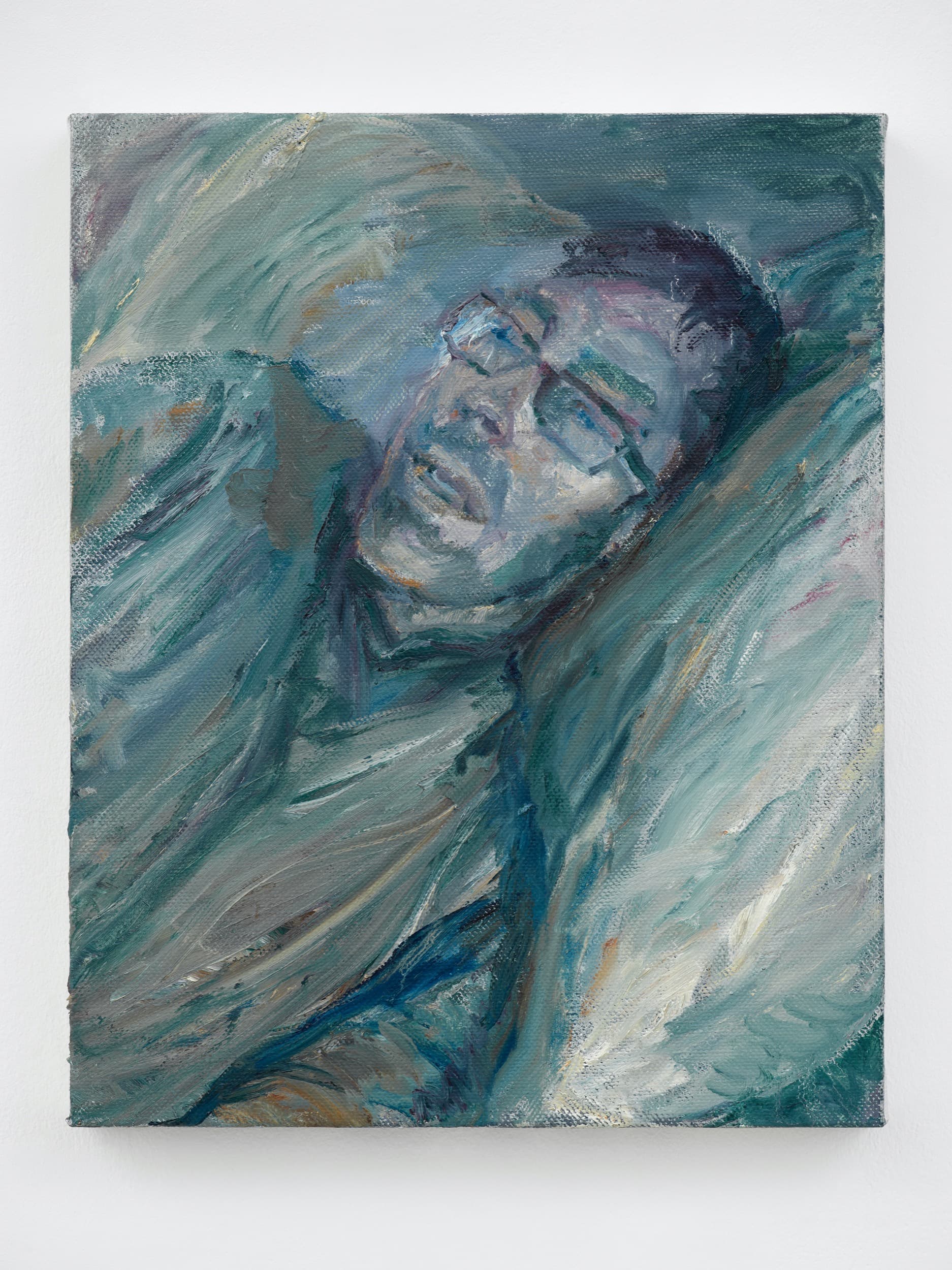
Celia Paul, Frank on a Green/Grey Pillow, 2025. Oil on canvas, 20 × 16 inches. © Celia Paul. Courtesy the artist, Gladstone, and Victoria Miro.
Rail: Do you go see exhibits?
Paul: I do, but then again, not as much as I want to. I want to set aside a length of time to be able to go. I’ve booked tickets to go and see the Gwen John show in Cardiff. I’m actually going with all my sisters. After Gwen, I’ll not see anybody. I think she might help me to still myself, after what will be a whirlwind time.
Rail: There is so much stillness in Gwen John’s paintings. You said once that painting is an act of prayer. “It depends on grace … religion is in my blood … prayer is the discipline.” In prayer, you are focusing on something outside of yourself. You mentioned selflessness and used the word goodness. Your mother, who was deeply religious, when she sat for portraits by you, she used the time of silence for prayer. “What a gift for a Christian,” she said. Goodness is such a loaded word, and difficult to define. What does goodness mean to you?
Paul: I’m going to say something so obvious. I feel that goodness and rightness go hand in hand. I think it’s embedded in us, this knowledge of rightness. It’s in the body healing itself. This force for goodness is built into the universe, in our world. Everything aims to right itself. After the worst catastrophe, there’s a force for good, for healing, for making it better, whether it wins or not. There’s such a lot against it, but there’s this force for goodness. There are qualities that one associates with goodness—kindness, selflessness. But there are also times when you actually need to go against the grain. You need to be angry and to do something. I think there’s also a point when you have to use your judgment about whether you’re actually being made to do something you don’t want to do or should not do. And I think for me, the discipline of painting is like prayer in a way, because it’s a duty. Something I should be doing. It structures my day. I hope to make something beautiful as well. I do think there’s a link between beauty and goodness.
Rail: What is beautiful to you?
Paul: I think it’s not in a superficial sense at all. Beauty has to do with balance, to do with the Paul Cezanne thing of creating harmony, that he couldn’t put one brushstroke wrong or he’d have to repaint the whole painting. It’s to keep the whole. I remember Frank Auerbach quoting Robert Frost, “A poem should be like ice on a stove—riding on its own melting.” This is a quality of stillness that you have with the ice, the still ice, which is being warmed and moved about. So there’s stillness and movement, which are held together by harmony. Because I think if there’s stillness, if it’s without movement, then it’s just stuck. But stillness with movement, then there’s beauty.
Rail: That’s an excellent definition. Do you step back from your paintings at any point and ever think, “Oh, this is beautiful.” Have you ever had that feeling?
Paul: I don’t because I’m just too anxious about it. You do need to step back. Step back, step back, leave some time or distance, real distance, and then it can be so gratifying.
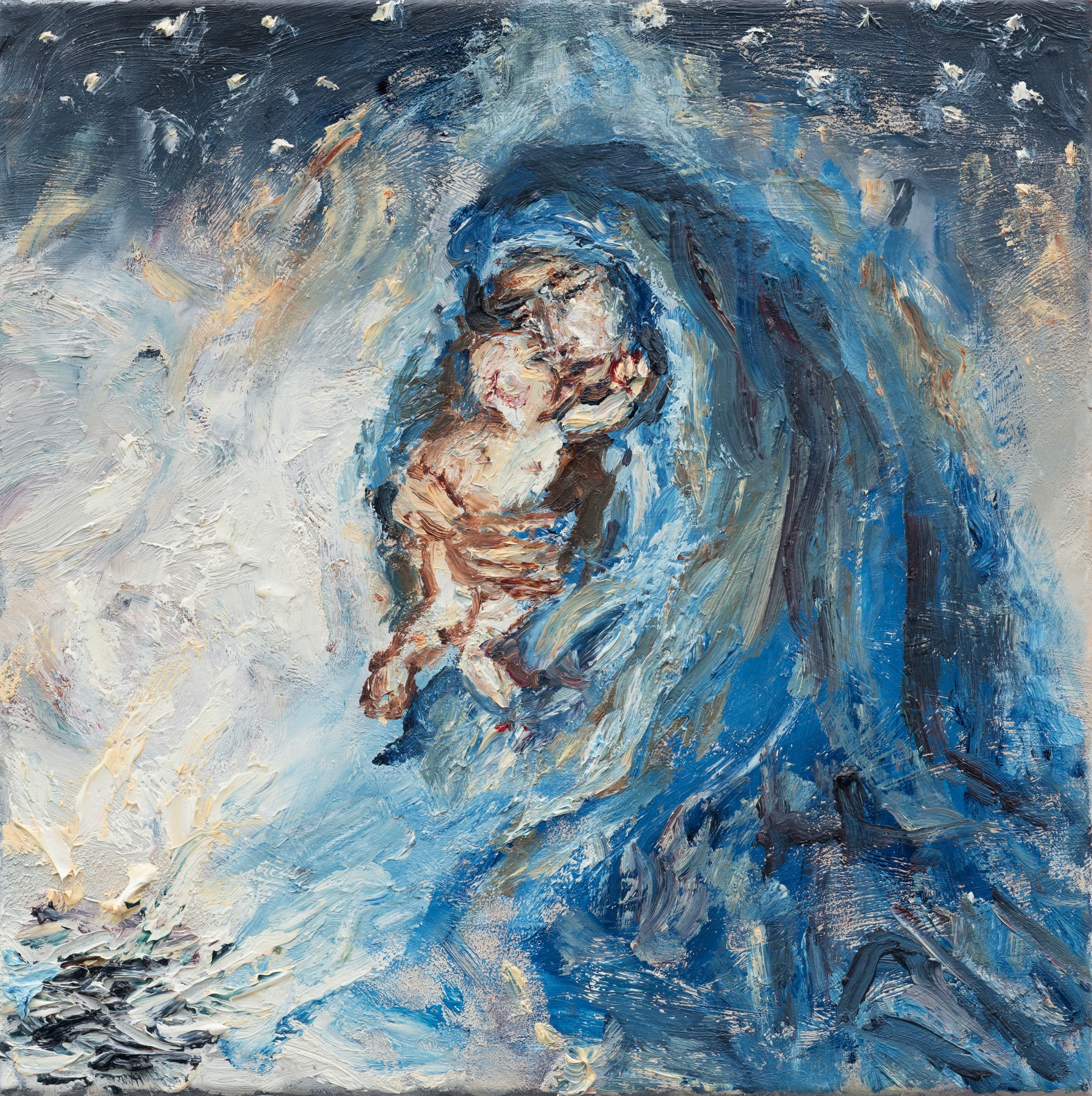
Celia Paul, Madonna and Child with a Fire and Stars, 2025. Oil on canvas, 10 × 10 inches. © Celia Paul. Courtesy the artist, Gladstone, and Victoria Miro.
Rail: You have an installation, Water Divining, at Sant’Andrea De Scaphis in Rome. The church dates back to 820 CE, with its crumbling walls, the dampness, the ancient stone; it is an incredible place. You said that you had “a vision of water flowing under the stone slabs of the floor.” Your three paintings there—The Source of Tiber, The Sea and The Mirror, and Madonna and Child with a Fire and Stars (all 2025) are streaming with thick paint. They feel submerged in water. I found the whole setting and your paintings deeply moving.
Paul: The context of the church, my God, when I saw it, I thought, How on earth can I do a painting that will work here? because the church is just so much a work of art in itself. It’s extraordinary.
Rail: In the work is this stillness, this goodness, and then there’s pain. You wrote about Colette and what advice she would give to someone who wants to begin to write. “Look at what gives you pleasure,” she said, “and what gives you pain; but look longest at what gives you pain.” Quite chilling to create from that place. How is that for you with your paintings?
Paul: I think you have to be courageous. You have to look at what hurts you because it’s an indication of truth. You have to go for what’s below the belt, an indicator of truth. Because not all people are hurt by the same things. There are different areas of pain, and in my life I’ve suffered grief. I’ve also suffered tremendously from jealousy. With my four sisters, being one of five girls, there’s a large scope for jealousy. And then, of course, being with Lucian, who had mainly daughters as well as lots of girlfriends. It felt like a familiar kind of hurt going from a family of my own, family of sisters, to Lucian’s family of women, and that’s something I want to explore more, the hurt of jealousy. I’ve been thinking about it a lot. In fact, the Venice book that comes out this November, the central theme is jealousy. I was thinking about Othello and Desdemona to begin with. And then, of course, the erotic power of jealousy, which Lucian used a lot in our relationship, which is a hard, hard thing to not think about in other relationships that I’ve had. I’ve been exploring looking and being looked at, and all that involves: the trust that a sitter gives to the artist to see and be seen by them. It’s been said that attention is the same as love, but I think they’re actually quite different. I think you can be given attention. That is not necessarily about love without control. So I’ve been thinking about control in relation to jealousy as well. It’s bound up with shame, isn’t it? It has to be explored more openly than it has been in art, in paintings. I can think about the Edvard Munch paintings, his great jealousy series, but I’d be excited to explore it more from my own personal experience.
Rail: I also think about Pablo Picasso’s Dora Maar paintings. He got her jealousy into those paintings.
Paul: Yes, he absolutely did. She has quite a different, sharp-edged quality compared to his other portraits of the women. I think Picasso has his own jealousy. Whereas you feel with Marie-Thérèse Walter this gentleness and acceptance. He doesn’t feel threatened by her in the same way. Jealousy involves competition. It’s a very complicated emotion. But you want to be the best. You want to be the most desired. In a way, it’s the most childish, babyish emotion. It’s just a deep need, to be the only one.
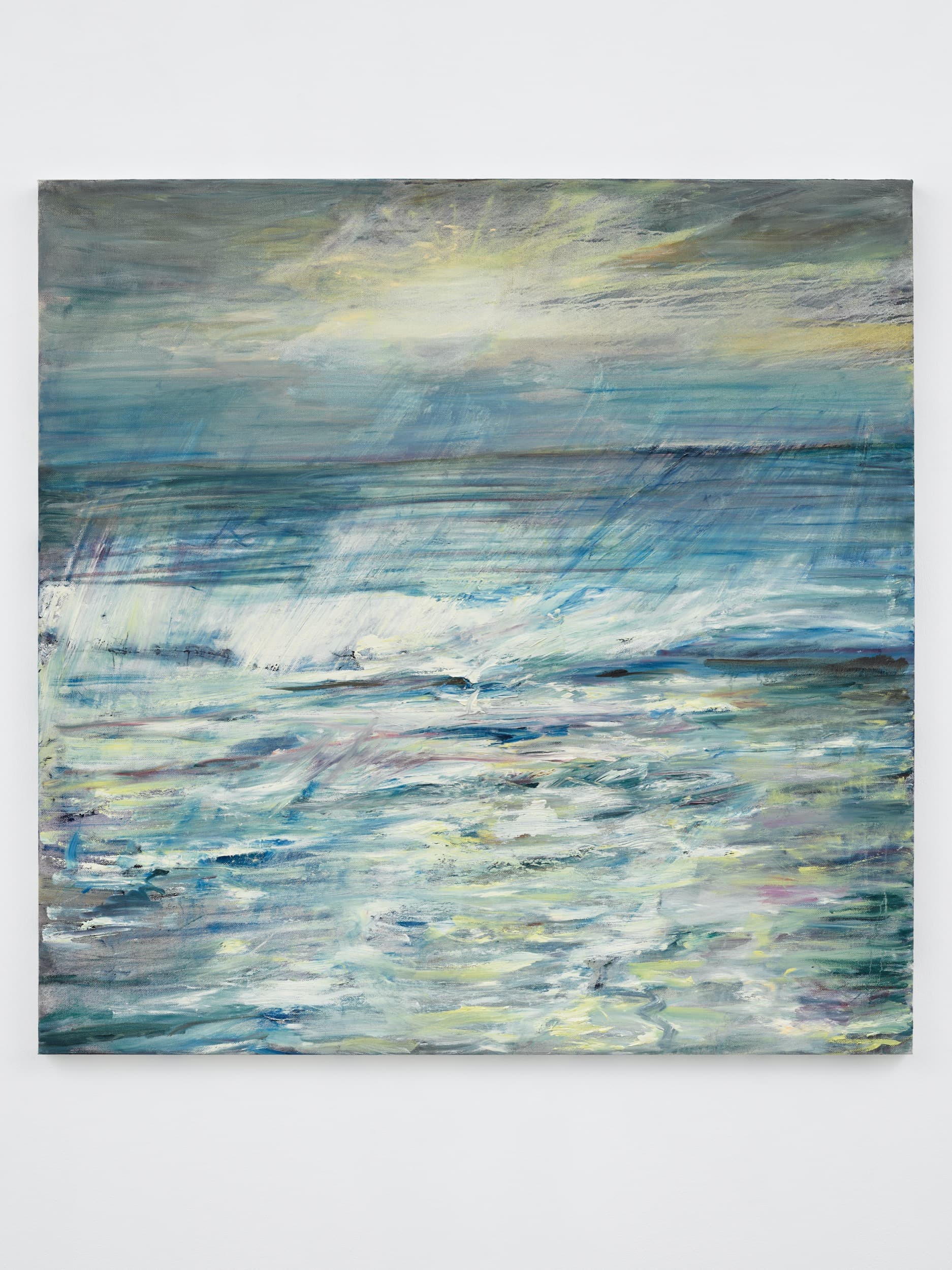
Celia Paul, Advancing Tide, 2025. Oil on canvas 58 × 58 inches. © Celia Paul. Courtesy the artist, Gladstone, and Victoria Miro.
Rail: What is the difference between envy and jealousy? They’re very different things, because jealousy is that childish agitation. Envy can be something much subtler and devious. It’s cleaner, sharper, whereas jealousy is messy and a reaction. Envy isn’t. It’s more cerebral. Jealousy is primitive; it’s so ugly in yourself, and in other people.
Paul: That’s right. Envy feels much more cultivated somehow, grown-up, whereas jealousy is really childish and feels animal. I’m excited to explore more about jealousy in my work. And talking about pain, I am very much exploring loss at the moment. My early past is really surfacing, because since the death of my husband, and because I’m still in the studio that Lucian bought me in 1982 when I was twenty-two, and my son by him, who’s now forty-one; Lucian is still very much part of my life and my history. I’ve just finished a big portrait of Frank, which will be in the group show that comes after my solo show at Gladstone.
Rail: You’ve said that you’re not a portrait painter but an autobiographer.
Paul: I think the whole notion of portrait painting involves something quite artificial, involves flattery and patrons. I can only really paint people I know very well, because if I paint someone I don’t know so well, then I have to be more literal about how I portray them. I have to measure the distance between their eyes, how wide their face is, that kind of thing. Whereas if I know somebody intimately, then I can just be free with what I produce. I can be wildly unrepresentational and yet capture something about them. I want to be free with proportion and yet create a presence. You have to be quite adventurous.
Rail: It takes more courage to do that. You don’t work from photographs but from what’s in front of you. But you said about your seascapes that you dream them. You don’t have to be in front of the ocean to paint them.
Paul: For a long time I lived right by the sea, when I was between eleven and seventeen in North Devon. My father was head of an evangelical Christian community on the North Devon coast. Lee Bay is the sea I always think of, and I paint these seascapes in my Central London studio. They don’t come from studies I’ve made. Very often they come about by the paint marks I make, initially to make the ground on the canvas. I make sweeping marks from the ground onto the blank canvas, and these suggest the movement of the sea. And then it’s almost as if it’s been laid out for me. I very often paint a self-portrait and a seascape at the same time, one after the other. If I’m painting a self-portrait with warm yellow ochre tones, the sea will echo that. If it’s more green or gray in the self-portrait, then the sea will echo that.
Rail: What kind of oils do you use, what medium, brushes? You work on canvas and not linen.
Paul: I use Old Holland oil paint. I don’t like to use too many colors, because it’s a distraction. If I make a slight change to the color, it feels like the most radical decision, and it changes the whole painting. About four years ago, I saw a Pierre Bonnard at the Musée d’Orsay and loved the green he was using. I’ve always had such a problem with green, it seemed too acidic, but that warm turquoise is the green that Bonnard uses. I think viridian is the nearest. I mix viridian with alizarin crimson, and then with flake white to make gray. In Florence, I saw the blue that Fra Angelico uses, so I bought myself this tiny tube of lapis lazuli, which cost 120 pounds. It’s only two inches long, and I use that quite sparingly. The very fact that I’m using just a touch of lapis lazuli seems to give my paintings this quality of reverence. Maybe it’s my reverence for Fra Angelico coming through. I use hog hair brushes, rounded filbert brushes. I only actually use brushes when I’m painting from life, when I’m working from a person. When I’m working by myself, I use anything that comes to hand, bath towels, sponges. I want to avoid that control element as much as possible. Small bath sponges are just wonderful for painting with. If you’ve dipped it in the turpentine, the drips can be extraordinarily beautiful.
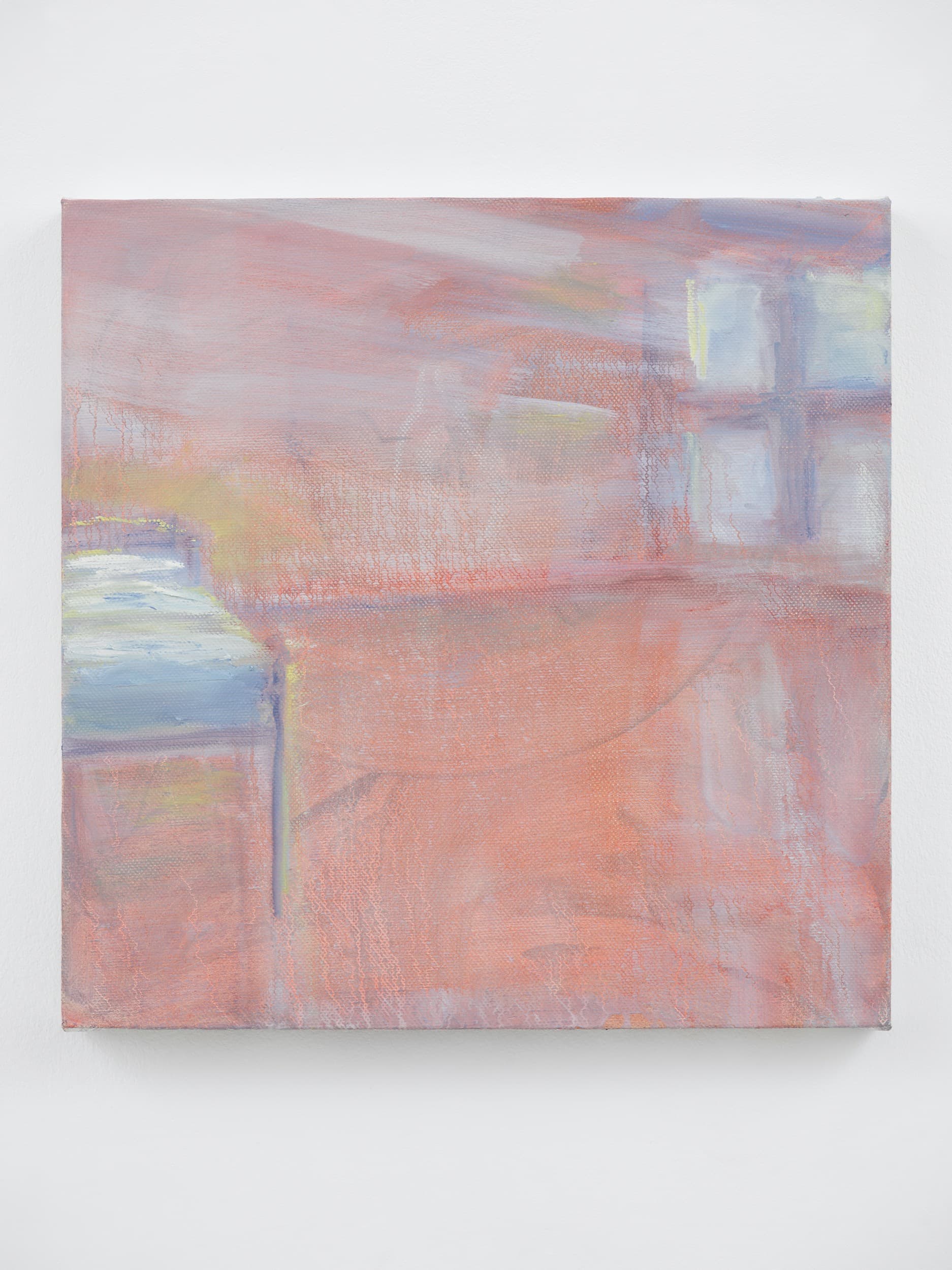
Celia Paul, Room in Bloomsbury, 2026. Oil on canvas, 20 × 20 inches. © Celia Paul. Courtesy the artist, Gladstone, and Victoria Miro.
Rail: Who and what are your favorite painters and paintings?
Paul: I love van Gogh. Rembrandt and Gwen John. There’s so many Italians—Giorgione and Masaccio. Fra Angelico is just a revelation to me. More contemporary artists… I do really think Lucian Freud is a great painter. I think he’s had quite a bad effect on figurative art because the paintings are more accessible than Frank Auerbach or Francis Bacon. I think there are a lot of artists that do a pseudo Lucian Freud that has given him a bad reputation. But that intensity, the early Lucian Freud, all the ones of his first wife, Kitty [Kathleen Garman], are just astounding. Throughout his career, he was painting autobiographically in a very uncompromising way. I don’t like a lot of his later work—he became a bit conscious of the celebrity stuff—but I still think there are some extraordinary masterpieces in his later years as well. And I love Frank Auerbach. I think they’re extremely beautiful when you talk about harmony. He never loses that balance in his work.
Rail: You were very close to him too.
Paul: Yes, I was very close to him and really devastated by his death. I felt he would never die. There was something so strong and life-affirming about him. And I think Francis Bacon is one of the great visionary painters of recent times. I’ve got to know the work of Cecily Brown and admire her work. She and Auerbach have something in common, that energy and drive. The balance is somehow always kept in the extraordinary darkness, the theatricality. And I love the work of Peter Doig. I think he’s another dreamer.
Rail: Books and authors? I know you love Marcel Proust.
Paul: Yes. That opening sentence, “For a long time I used to go to bed early.” I mean, what a revolutionary way to start a book. Just immediately you’re in somebody’s life, you’re engaged with that human being. I love Yiyun Li, Miriam Toews, Jean Rhys who I feel deeply connected to. Hilton Als curated a show about her and included a couple of my paintings. And I love the Brontës.
Rail: You are being represented now by Gladstone in partnership with Victoria Miro in London, your gallerist since 2014. The show at Gladstone is called Innervisions. Is there a theme, new paintings?
Paul: The title is a Stevie Wonder album. Most of the paintings in the exhibition are not done from life. They’re from dreams, memories. They’re kind of dreamed up memories. There are two portraits of my son, Frank, and one portrait of my sister, Kate, but otherwise they’re memories. My mother appears in the exhibition. It was very moving to resurrect her. I also resurrected my own self as a younger woman, as well as a big painting of a pregnant girl, echoing the position I take in Lucian’s portrait of me, Naked Girl with Egg (1980–81). The whole thing of being pregnant is to do with Fra Angelico’s The Annunciation (1425–26), so I used a bit of the lapis lazuli in the background surrounding the pregnant girl. It’s a big nude, a self-portrait of me when I was a pregnant girl. The painting, My Mother, Myself and I (2025), is a more elaborate composition, using three figures. I felt that my mother was looking at me with concern in some way, and was moved to see that it had happened. I think she is worried about me because I’m a widow. I’m only sixty-six but I’m entering into older age, and the body becomes frailer. I think she always thought of me as being so tremendously strong, and she was always the child. My nickname for her was Polly. There was something childlike about her, vulnerable, and I think it would be a worry for her to see me becoming more vulnerable and extremely tough as I get older.
Rail: That’s what I see in your self-portraits. That dichotomy, the ghost lurking, the stillness, the vulnerability, but at the same time you steel yourself to be vulnerable.
Paul: Yes, yes. Beautifully put. The painting of a head is based on a photograph I saw of Gwen John. It is about the strength of vulnerability. All the paintings in the show are dated 2025, apart from one which I finished in January of 2026, Room in Bloomsbury. It has an echo of the Fra Angelico with the lapis lazuli in the window and on the bedspread. I wanted a quietness in it, because some of the paintings, although they have a still quality, they’re quite wildly painted, like Two Trees After the Storm (2025). Almost every painting has failed paintings underneath. I don’t start off to fail, obviously, but somehow my best works come about through repeated failures, until I find the successful image. It’s been quite inspiring to work on a bigger scale as well. With a sitter, I have to fasten the canvas on an easel, whereas with these big paintings I paint them vertically but against the wall, and I can’t move them, they’re too heavy. Six feet tall by five feet, mostly.
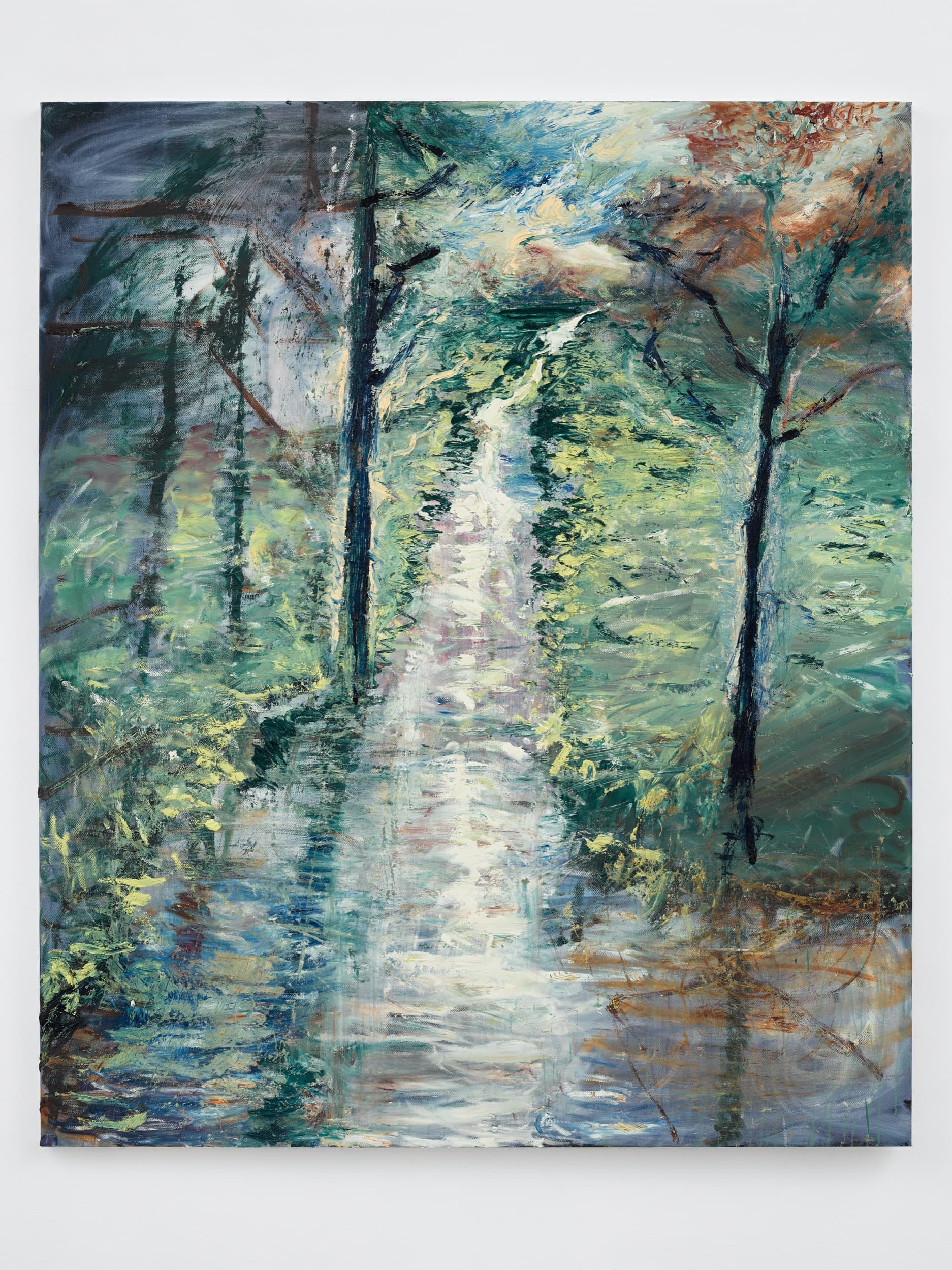
Celia Paul, Two Trees After the Storm, 2025. Oil on canvas, 72 × 60 inches. © Celia Paul. Courtesy the artist, Gladstone, and Victoria Miro.
Rail: What changed for you to go bigger?
Paul: I think it’s to do with the freedom of being by myself. I think it’s freed me. I’ve become more adventurous through being alone. I’m liberated by grief, really. It means that I can do what I want. After I come back from New York, I’m going to have to downscale again, because the next body of work I do is for the Venice show, which will come at the same time as my book comes out. That’ll be November. The gallery, Victoria Miro Venice, is a very tiny space, and you can’t put really big paintings in it. I’m quite excited to go smaller again, because there’s really not that much difference. My Mother, Myself and I is 72 by 60 inches and took me three days to paint, whereas the small painting, Room in Bloomsbury, is 20 by 20 inches and took a month.
Rail: There’s a different pace with each painting. How does that reflect your pace as you go through your days?
Paul: I really love getting up very early and starting painting. In the winter months, painting by electric light, I often start by five in the morning. If I do that, I’m usually finished by 1 p.m., then I rest and read and go to bed very early. It’s so exciting starting early in Central London because it’s so quiet. If I’ve got a sitter, I need to prepare myself in a different way. I need to prepare myself to be receptive to whoever it is. Recently, it’s been Frank who lives in Cambridge. And my sister Kate, who lives in South London. It’s very freeing to be working by myself because I can just spring out of bed and start painting.
Rail: Like with your self-portraits.
Paul: Yes. I have a kind of motif of the self-portrait of myself sitting on the bed. It means that I can do a whole series with this very simple composition. And it’s a way of gauging where I am in myself, the emotional state. The one that’s on the cover of the monograph is the most fierce of them all. Another looks almost joyful. Another is called Burning Painter (2025). I wanted it in the Innervisions show because my sitting body on the bed is covered with flames. It’s partly because I wanted to emphasize the sacrifice that artists make to produce art. It’s almost like I’m a sacrificial victim being burnt at the stake or something. It’s also being so physical with the paint. It’s tremendously physically demanding. It can make the body hurt if you’ve worked too long, so it was a way of showing the inner suffering, the toll it takes on one’s body.
Rail: I appreciate that you talk about that because it addresses the romance out of making art, the image of the tortured artist, suffering for their art. This is a different thing. It’s the work itself that is so important.
Dian Parker is an arts writer for the Observer, Art & Object, and other arts publications. She trained at the Royal Academy of Dramatic Art in London, and now lives in the hills of Vermont, working on a novel.