Word count: 1400
Paragraphs: 27
Created by Rebecca Martínez, Julián Mesri, Beto O’Byrne, Sara Ornelas, and Meropi Peponides
May 2–May 24, 2026
Brooklyn
“Come for the tamales—stay for the chisme!” That’s the tagline of Canciones, an immersive, site-specific theatrical experience coming to a private home in Flatbush in May. Created by Rebecca Martínez, Julián Mesri, Beto O’Byrne, Sara Ornelas, and Meropi Peponides, the show unfolds around multiple generations of a Mexican American family. And what fills up any good home? Food, music, and the chaotic affairs of the relatives we can’t escape.
Canciones promises audiences all three. Those aforementioned tamales will be passed around the table, cast members will pick up instruments and evoke the ancestral timbre of cantantes, and the culturally-renowned Guerrero family at the heart of this story will reunite under one roof—bringing old songs, secrets, and stories with them.
The Brooklyn Rail sat down with two of the five collaborators over Zoom to learn more about the show, created in association with Radical Evolution, Latinx Playwrights Circle, Boundless Theatre Company, and Sol Project. This interview has been edited for length and clarity.
Brittani Samuel (Rail): How are you describing Canciones to people who ask what you’re working on?
Beto O’Byrne: It’s an immersive reunion of Mexican Americans, and you’re going to become a member of the family. You’re going to eat some food, listen to some music, and get involved in some family drama.
Rail: So, like, if Sunday dinner at grandma’s house was staged. Who planted the initial seed?
O’Byrne: The show is partly inspired by a Linda Ronstadt album. I’ve had the idea to do something inspired by this music since I was maybe twenty-five or twenty-six years old. It’s lived with me for a really long time—much like this album has lived with so many of us.
Rail: Canciones de Mi Padre?
O’Byrne: Yes. It is a pivotal album for the Mexican American community. My mom would wear out the record on our old player, and other people would always tell me their moms did the same thing. Over the years it was an idea that I knew I’d want to play with. As our theater company Radical Evolution began to develop the show, we understood that it wanted to be something more than another family drama on stage. It wanted to feel more lived-in, because this music is so lived-in. The moment it really clicked for me was when we were reading liner notes from the album. Linda says the album is called “Songs of My Father” because she used to sit on the porch with her family and sing these songs. That’s the feeling we want to invoke. Especially right now. One of the things we keep talking about is the resilience of our families, and the Mexican American community at large. It’s a particularly egregious moment in a long history of deportation.
Rail: How did you settle on this setting?
Meropi Peponides: We went on a whole journey of potentially premiering the show in a different city outside of New York where space was maybe easier to work with, and where mariachi music was more part of the cultural fabric, like the southwestern United States or California. We explored a bunch of different permutations and possibilities. And then it really came down to: we have to do this at home. We have to do this where we live and can make a direct impact.
Rail: Flatbush, while it may not be as heavily populated with Mexican Americans, is obviously a huge immigrant community. There’s a natural bridge there. And it’s exciting to dream up this kind of theater, outside of a proscenium, outside of what’s traditional.

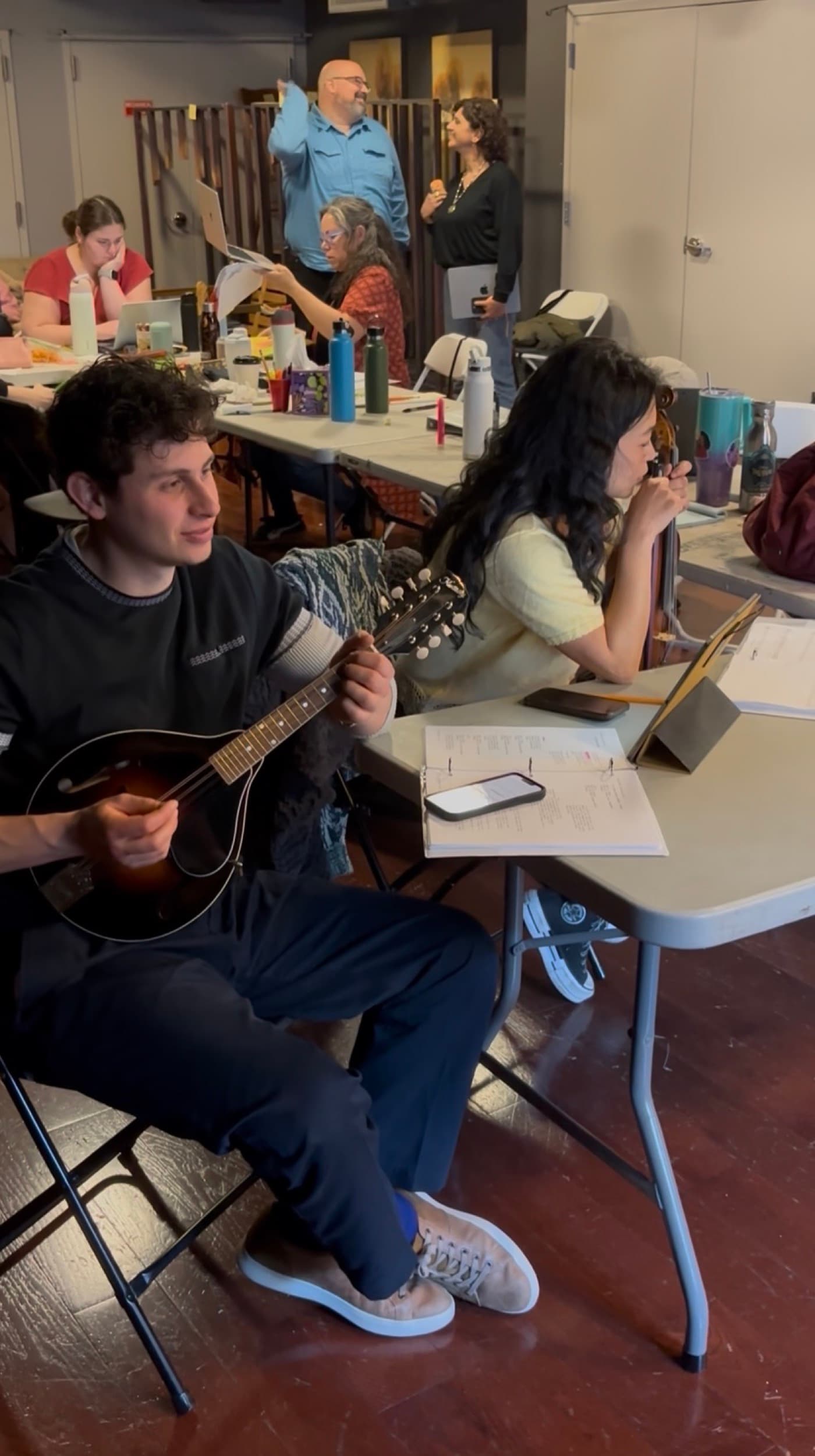
Rehearsal for Canciones. Photo: Danny Borba.
Peponides: So many organizations have struggled to bring audiences back into their theater spaces—we’re no exception. But there’s a freedom here: not only can you have food while you’re watching the show, it is part of the show for you to share a meal. It’s part of the show for people to talk to one another. We’re freeing ourselves and our audiences from this typical idea of theater etiquette, which I think is loaded with problems that are rooted in the -isms of the world. Julián would tell us that, in Argentina, the idea that you show up “on time” to the theater there before the play even starts is insane. That’s a completely unrealistic and artificial expectation. So this idea that you put your drink away, file into a row, sit in a fixed position and don’t move—that’s not the spirit of our show.
Rail: There are challenges to this way of making theater too, though.
Peponides: Sure. I mean fitting an audience into someone’s personal row house is going to be a thing. Just think of the traffic patterns. And design-wise, a theater is normally more of a blank slate. This space already has furniture, already has its own design concept, already has things on the walls. We’re meeting the venue where it already exists.
Rail: I was lucky enough to preview the script, and from the jump there is a lot of movement. Audiences will be passing through as characters are passing down their legacy via music and stories. I mean, that’s what theater essentially is, right? Zooming out a bit, why does this work feel important to you right now?
O’Byrne: One of the first things I ask my playwriting students is, “When do you think the first moment of storytelling ever happened?” And they often answer, probably some caveman saying, “Don’t go over there in the woods. There’s a sabertooth tiger with big teeth.” The way we’ve always learned, found our way, and understood who we are has been through collective storytelling. I just don’t see a world where that stops being true.
Peponides: Before any of us were going to major theater productions, we first encountered performance in these sorts of home environments. Radical Evolution is interested in placing folk forms right alongside professionalized work. In this instance, mariachi is an equally worthy, interesting, and juicy art form to experimental theater. By putting these two things together, we can also bring our own sensibility to evolve that form. The music in the show won’t necessarily be traditional arrangements. It’s going to be these almost idiosyncratic, personalized takes on each song from different characters—a “here’s an instrument I brought, and I think the song sounds cool on it” kind of thing. It’s about uplifting traditional forms, but disrupting the fixed notions around them.
Rail: The older I get, the louder that craving for the music and art and culture of home becomes. Can we talk a little more about the sounds of home, and mariachi specifically? What do you hope audiences feel when treated to this music?
O’Byrne: I’d preface that by saying we use “mariachi” as a bit of a catch-all, because the album contains a lot of different genres—it’s definitely performed by mariachis, but there’s son jarocho in there, ranchera, all sorts of things living inside of it. The experience you’ll have in this show is more like a family band sitting around and playing.
Rail: That’s all I ever want.
O’Byrne: They’re very nostalgic songs for us—songs we know, but maybe haven’t heard or thought about in a while. They’re so romantic. All about love and longing and feeling good around the people that you want to be around. So I hope this propels audiences and reminds us of that kind of passion, which I think is lost a bit these days. It’s okay to have overt feelings. Those get buried a lot, particularly in theater. If you go too far, you get called overly sentimental. Blah blah blah. But that’s human beings! We are overly sentimental and romantic and that’s not a flaw.
Peponides: Mariachi is not a part of my family’s culture, but growing up in Southern California, if you heard mariachi, you knew there was a party happening. There’s this sense of gathering and celebration, of lifting the mood of a place into something special—“let’s all sing these songs.” I lived in an apartment in Los Angeles where I could open my window on any given Sunday and just hear that sound floating up.
Rail: It’s like a flare signaling that joy is happening somewhere. There’s a place not too far where people are eating and laughing and loving.
O’Byrne: Exactly. A flare.
Brittani Samuel is a culture reporter, editor, and Rihanna enthusiast based in New York.