Word count: 1987
Paragraphs: 44
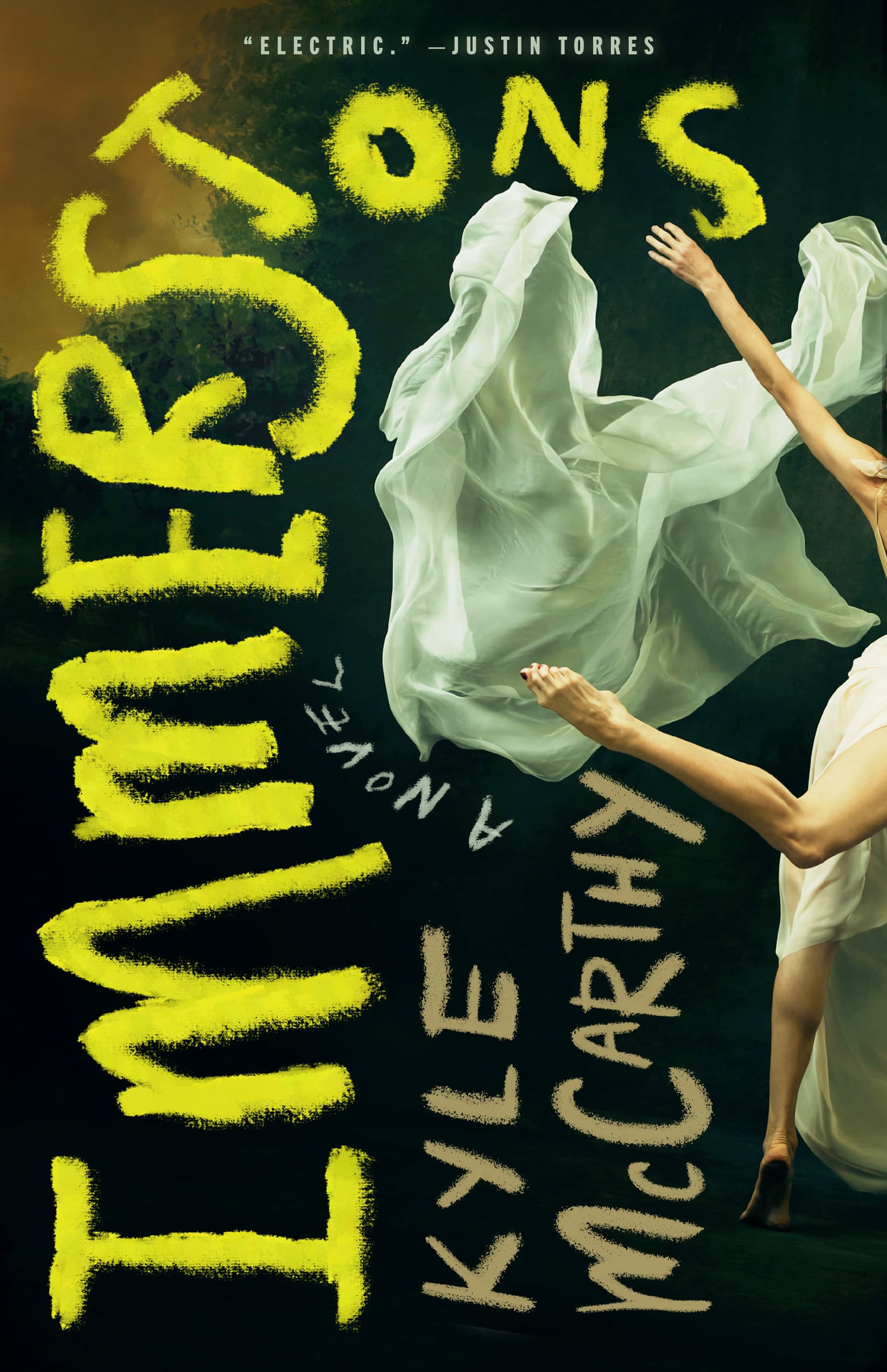
Immersions
Penguin Random House, 2026
Girl Through Glass
HarperCollins, 2016
I’ve long been a fan of Sari Wilson’s 2016 novel Girl Through Glass, so when it came time to publish my own dance novel, Immersions—out this May from Tin House—I wanted to call Sari up to discuss bringing dance to the page. We met over Zoom in late March to talk ballet training, the Gothic, and making space in our inherited literary traditions.
—Kyle McCarthy
Sari Wilson: Were the characters in Immersions always dancers?
Kyle McCarthy: Yes. Part of Immersions came out of feeling haunted by ballet, even though I haven’t studied seriously in a long time. So these characters were always going to be preoccupied by dance the way I am.
Wilson: Tell me about your own dance experience.
McCarthy: Like a lot of kids, I started out at a suburban dance studio studying ballet, and then when I was ten or eleven, I began attending the School of the Pennsylvania Ballet, now known as the Rock School for Dance. It was a pre-professional school, and after about two years the competition started getting to me. Ballet stopped feeling joyful, and it was really taking a lot out of my family to drive me in and out of the city four or five times a week. So I made the very painful decision to quit. I count it as the first adult decision of my life.
Wilson: I’m relating a lot to your story. I also fell in love with ballet as a child, and then found myself on a pre-professional track. It became an all-consuming part of my young life, and I reached a point where it was impossible for me to continue integrating. As you’re saying, the love of dance had gotten corrupted with so many things that I couldn’t even name. And hence, the haunting.
McCarthy: Yes, exactly. That pure love of dance, that joy in going across the floor doing grand allegro was just—it wasn’t gone, but corrupted is the perfect word for it. Too many things were mixed up in it. And yet sometimes when I go to New York City Ballet, I think: I would give up my current life to be one of those twenty-one-year-olds on stage.
Wilson: Wow. You can still access that!
McCarthy: It’s crazy, because mostly I’m very happy to be a writer. And yet there’s some part of me that hungers for that kind of embodied physical life. So, Immersions grew out of wanting to explore that feeling. That’s why both sisters in the novel have stepped away from the dance world, and yet one has poured that desire for immersive single-minded life into a religious calling, and the other sister is still longing for it.
Wilson: Frances’s journey, I think, is really interesting in Immersions. I was fascinated by it, and by the complexity of how dance weaves in and out for her. There’s a haunting. Hence the Gothic tone, right? Which cannot be avoided, apparently, in ballet.
McCarthy: Yeah, something about ballet and the Gothic attract each other.
Wilson: I know. Believe me, I tried to write Girl Through Glass straight. I tried it as realistic fiction. I tried it a lot of ways, but the Gothic just inserts itself.
Your character Frances has this complex reawakening through her relationship with Johnny, who is a monster, but he’s not just a monster. He also reads something in her, which is expressed both physically and through a sexual awakening.
McCarthy: I was very interested in this idea of a male gaze or a romantic interest whose perception of you can be both confining and liberating. When you’re idealized, there’s something wonderful and intoxicating about it, and it can help you grow into the person you want to be. But it can very quickly turn into pressure. Obviously, there’s much about Frances’s relationship to Johnny that’s toxic, but he also does see something in her that she can’t see. He sees her gifts.
Wilson: How much of the Gothic romance genre plays into this book?
McCarthy: When I was writing this book, I became completely preoccupied with the fairy tale “Bluebeard,” and obsessed with how so many books and movies are essentially retellings of this story. This trope of the older rich man, the big house, the locked room—it shows up again and again in our culture. There’s always a dark romantic past that’s being withheld from the young naïve girl. Her journey is always about seeking the truth, and opening that door.
Wilson: That is interesting. “Bluebeard” was not on my radar with Girl Through Glass. I went to The Red Shoes, The Nutcracker, Giselle, or La Sylphide, all these stories of the sylphs and these idealized, feminized spirits, and that took me to the Gothic European fairy tales, and Hans Christian Andersen, and this really dark thread.

McCarthy: Do you feel like in Girl Through Glass, Maurice pushes Mira into this fairy tale, or that she wants to be in this Gothic realm?
Wilson: Oh yeah, she wants to be there, for sure. It’s an escape, you know, and as dark as it is, it’s powerful. She’s a heroine, she has this complex power. There’s a lot of danger in that. It’s intoxicating, especially when you’re so young. One of the things about ballet, and going on a pre-professional track where it becomes all consuming, is that the rules of that world are different than the rules of the normal world. It took me a long time to come to terms with that, because in some ways those rules made more sense. As you also said, those rules are about love. They’re about a pursuit, a single-minded pursuit of beauty or truth, or transcendence or art, or God. There are so many different words that we have for it. But there’s a beauty to that calling. It’s a space that’s similar to a spiritual pursuit. In your novel, the older sister, Charley, is a nun. Can you talk about how those themes factored into your novel?
McCarthy: I do think ballet is a calling toward seeking beauty or transcendence or truth, and I think the life of a nun or monk is very similar. It’s also about dedicating your life to pursuing this unnamable thing. It was important to me that Charley’s decision to become a nun was not portrayed as a straightforwardly bad thing. She is replacing dance with religion, and I think that’s a fair exchange.
Wilson: Frances has this idea of Charley in her abbey, behind this iron grille, trapped, caged, like a prisoner. It’s a terrifying image. And so to see Charley at the end was so surprising, because I felt like we were being offered, psychically, a way out of the Gothic universe. Which, for all its power, is a trap. So to see Frances see her sister anew, and say that she had to consider the possibility that this was actually her sister’s choice, was very powerful. And unexpected.
McCarthy: Oh, good, thank you. Yeah, I think the Gothic, both as a literary genre and as a mode of interpretation, is so powerful and enthralling, and then there’s always that turn when it suddenly feels claustrophobic. So at the end I’m wanting to assert that there’s more to life. That there’s the warmth of family, that love can be a bright thing.
Wilson: I really appreciated that as a reader. And I tried to do that in Girl Through Glass. It’s been many years since it was published, but it felt to me at the time like a bold and surprising decision that I was going to give my book a happy ending. It wasn’t going to be a tragedy, like all of those fairy tales essentially are.
McCarthy: I love that it’s not a tragedy. She’s okay at the end of the book.
Wilson: It was really important to me that she came through this, and that there be another way of being, you know. A way of being on the other side.
McCarthy: The fact that so many of the stories about ballet dancers are tragedies, and that the narrative we’re given always ends in self-destruction, or the afterworld, you know—
Wilson: Exactly. Death is very beautiful.
McCarthy: It’s this total nineteenth-century romantic male fantasy of ethereal, otherworldly women. And if you’re going to write about dance, you need to engage with these narratives, because that’s the tradition we’ve inherited. But I think it’s also really important to write our way out of them.
Wilson: Yeah, I agree with you 100 percent. And just personally, psychologically, I needed to do that.
McCarthy: Do you think it helped heal some of your wounds from leaving dance and building another life?
Wilson: Absolutely! I think this is why I was obsessed and haunted by this material. I did not really even want to write this book about ballet. At the time, all the years I was working on it, it didn’t seem to warrant literary treatment.
McCarthy: How come?
Wilson: I was studying literary fiction at a time when it was very codified. The tradition that I inherited is a very masculine tradition, a way of working with language that wasn’t organic to me. My earliest desires to be a storyteller and an artist happened at a young, almost pre-verbal age. It was this romantic, Gothic, fairy-tale language, the language of dance. The storytelling idioms that were passed down in that world didn’t have a place in the literary tradition I later learned. So I kept trying to dismiss it, but it wouldn’t let me. It haunted me! That’s why your word of haunting is just perfect.
McCarthy: There can be something that feels so gushy about ballet and the Gothic. It feels like there’s not really a space for it in that masculine literary tradition.
Wilson: When I finally agreed with myself that I was going to give the material my all, I decided I was going to treat ballet the way Ernest Hemingway treated bullfighting or Herman Melville treated whaling. I wanted to bring it into the literary realm. Then I also wanted to bring in the feminist lens. That’s why I brought in the character of the dance historian. She’s able to apply a critical lens.
McCarthy: I wonder if my desire to write about modern dance was also a desire to introduce a more critical lens, because the history of modern dance is much more inclusive of women choreographers, and much more feminist. I think for a lot of ballet dancers, when they move into a modern space, they discover a way of being inside their bodies that is not so much about constructing an image, turning out their bodies for the male gaze. And I was really interested in that, which is why Charley is a modern dancer. But it only goes so far. The cult of personality that can emerge in some modern dance troupes is not so different from ballet’s cults. Either way, you’re giving your body to a choreographer, and embodying or enacting their ideas on stage.
Wilson: To be a dancer is to be both an artist and a tool.
McCarthy: It’s so complicated. Do you feel like your move toward writing was motivated in part by the desire to let go of the “tool” aspect of the dancer’s job?
Wilson: Well, I don’t think I had as much awareness as you did. I got injured a number of times, so that ended that possible trajectory. And as in your novel, you can leave, and then be drawn back in. Because the life of the body has its own life. There’s a great line in Immersions about the body wanting what it wants, and will do anything to get that feeling back.
McCarthy: Yeah, do you feel that way?
Wilson: I think every dancer does.
Kyle McCarthy is the author of the novels Immersions (a Lit Hub Most Anticipated Book of 2026) and Everyone Knows How Much I Love You (an Amazon Book of the Month and one of Publishers Weekly’s Best Books of Summer). Her work has appeared in Best American Short Stories, n+1, on NPR’s Selected Shorts, and elsewhere. She lives in Brooklyn, New York.
Sari Wilson is author of the novel Girl Through Glass, which was a The Millions Bestseller, an Amazon Book of the Month, and long-listed for the Center for Fiction debut novel prize. Her writing has appeared in The New York Times, New York Magazine, AGNI, and other publications. She is the recipient of a Wallace Stegner Fellowship, a Provincetown Fine Arts Work Center Fellowship, and a residency from Yaddo. She lives in Brooklyn, New York, with her husband, cartoonist Josh Neufeld.