Ayano Elson’s Control
Ayano Elson’s Control tunes the edges of tension in her time-bending premiere at the Chocolate Factory.
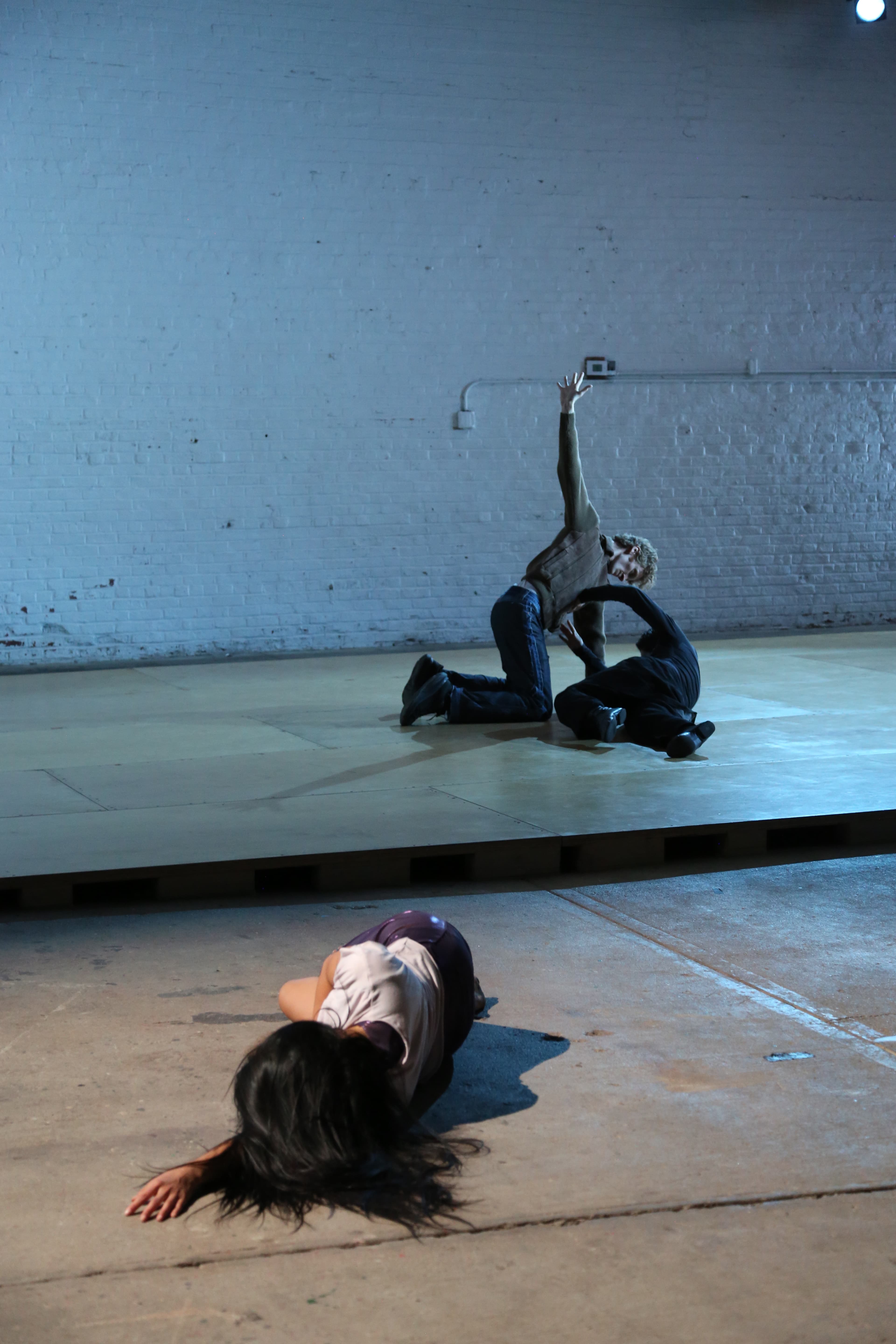
Ayano Elson’s Control, Chocolate Factory Theater, New York, 2026. Photo: Brian Rogers.
Word count: 1061
Paragraphs: 15
Control
Chocolate Factory Theater
April 23–25, 2026
New York
Tension is timing. As the doors to the Chocolate Factory opened just past the hour—3 p.m. and raining—wordlessly and more swiftly than most beginnings I’ve experienced lately, Ayano Elson’s Control began—began in that time lengthened upon the lone Amelia Heintzelman, and the air was cleared of something unnecessary and uncertain, and attention narrowed into her form. She sat turned away from us at the back wall, seated with her hips bent in two triangles, dressed in full pink velvet.
The large space is cut in two: halved by the wooden stage to the right, at the top of which the audience sits in three rows, and the more barren, concrete-floored space to the left. The space feels especially large as it expands the usually narrow stage at the Chocolate Factory into a more open playing field.
The delay becomes palpable as Heintzelman bores into her form. Waiting evolves into something sensuous. Tension accumulates this way, as attention tuned into Heintzelman’s rhythms: her slow, masturbatory rock that propels her up, brings her to the fore, where she faces us with deadened lust in her gaze, peering as if through us, rounding imperceptible bends that were seemingly laced between our bodies. The sheer viscerality of her presence, which seems to have mounted from her very depths, is commanding. She appears completely self-possessed and yet ravaged by an internal grip that cuts its way through her sex. She turns to another wall now, holding her hair in a fist above her, and throbs against it.

Ayano Elson’s Control, Chocolate Factory Theater, New York, 2026. Photo: Brian Rogers.
Another dancer, evan ray suzuki, enters and walks on light feet to the back wall on the concrete side of things and quietly looms at the edge of a shadow as if it were the gate to another realm. He, like Heintzelman and the two dancers—Owen Prum and Cayleen Del Rosario—who follow in their time, appears to be a world unto himself. That is, the very specificity of suzuki’s gestures implies a complete narrative universe that seems to warp time in its direction. When suzuki, like Heintzelman before him, surfaces to the foreground, he falls suddenly onto his back with hands outstretched as if to fend off some towering beast.
When Heintzelman returns, and falls as suzuki did, time, we realize, has already entered a kind of Lynchian regression, where echoes of previousness loop and contort. As Control continues, Elson masterfully excavates a psycho-sexual landscape that recalls Carl Jung’s notion of synchronicity, which describes the meaningful—and not causal—relationship between physical and psychic events.
Now Prum strides in. He draws a perimeter along the back wall, crosses onto the wooden stage, then swings an unseen door open, and enters. He turns to us and stares out from the long well of his face. If suzuki is the sly and nimble attendant, Prum is like a cowboy, whose endless gaze and stark stride seem to be elongated with history.
Del Rosario is the last of the four to appear. She has an air of freedom as if she were just now returning from an affair with the wind that still blows about inside her. She swings—in her own time. Rising up the length of one leg then the other.
These world-instilling characters cross-pollinate, and throughout Control, continue to finely tune an erotic topography of desires that teeter at once between violence and love, reality and its reversal. At some points, time hangs on a thread, made acutely present in the precision of proportions between gestures and their weight. And yet, sometimes, time widens into something of a landscape, spacious and open. And then, without notice, slams shut—by the single clap of Prum’s hands, for example.
Around them, the early clatterings of instruments, as composed by Elson’s longtime collaborator, Matt Evans, tumble in. Their sounds, which in their plurality and openness resist the oneness of music per se, are instead like discrete accidents that by some unlikely magic begin to hang together. In time, they grow into a voluminous and propulsive whole that swells with charge and ominous expectation.

Ayano Elson’s Control, Chocolate Factory Theater, New York, 2026. Photo: Ayano Elson.
In a particularly striking moment before Control breaks, all four dancers join in a spacious diagonal line that extends across the space. Each appears beholden to their world. The scene is like a painting, wet with detail and implication as Elson demonstrates her striking ability to move this work between visual landscape and durational event at will.
Control culminates in Del Rosario’s solo. Her vitality and self-possession, as she takes center stage, swinging, lengthening, and rounding, build into the eye of an unyielding, feminine storm. The lights now dimmed, suzuki swiftly emerges from his shadow and begins again in his sharp and methodical movements some distance from Del Rosario’s turbulence. He loads a high step and when his foot crashes down, the lights blink shut.
Perhaps what I most appreciate about this piece is its commitment to building charge—and breaking it—from the ground up. Many dances I’ve seen over the last several years seem to skip these early stages and instead begin at the part where tension is meant to be at its most vivid. As a consequence to this flinching in the foundation, however, drama often feels hollow, imposed instead of enlivened. Here, Elson takes her time undressing. While some moments are brazen in their explicitness, sex is not taken for granted or used as a decoy. The work employs a steady gaze that does not shy when things become unsteady, but holds it there, dead-center, until a new energy breaches the scene, thus allowing for the possibility of satisfaction, too often assumed.
In fact, Control left hardly any room for a breath of boredom. It seared. Gyrated slowly, body upon body, world upon world. Elson, whose most recent work includes Distances (The Kitchen, 2025) and Part Song/Immortal Life (Danspace Project, 2024), has long demonstrated an interest in building tension-fueled dance works that tease out the edges of silence and duration. Here, she furthers that interest into an almost excruciatingly precise, pristine, and beautiful work as she manipulates the proportions of tension with an exacting, obsessive hand that evokes equal parts aggression and tenderness. In so doing, Elson showcases gripping dexterity in negative physical and psychic space, a finely tuned and deeply sensuous understanding of the polymorphic rhythms of reality as such.
Through Tess Michaelson’s work, she has become well acquainted with members of Control’s cast.
Tess Michaelson is a writer, dramaturg, and psychotherapist in training. Her work investigates
performance, relationality, and language. Tess holds a BA in English from Stanford University, an MFA in nonfiction writing from Columbia University, and is currently a Master of Social Work candidate
at Smith College.