Jack Flam
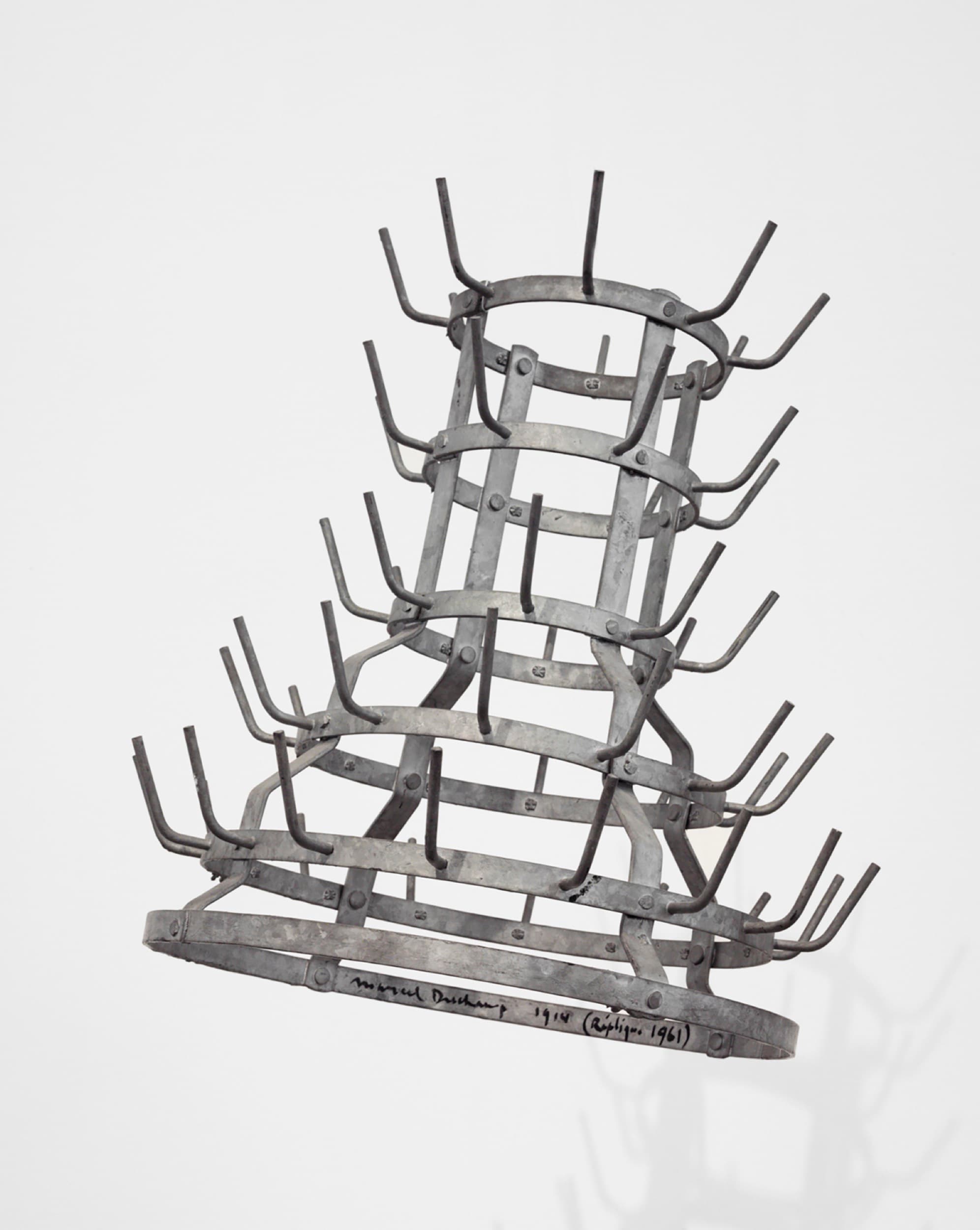
Marcel Duchamp, Bottlerack, 1961 (replica of 1914 original). Galvanized iron, 23 ⅜ × 21 ¼ inches. Philadelphia Art Museum: Gift of Jacqueline, Paul, and Peter Matisse in memory of their mother, Alexina Duchamp, 1998-4-23. Courtesy MoMA.
Word count: 672
Paragraphs: 6
Speaking of the readymades, Marcel Duchamp said in a 1961 talk at MoMA that his choice of the objects “was based on a reaction of visual indifference with at the same time a total absence of good or bad taste … in fact a complete anesthesia.” But I think this is a rather disingenuous statement, or in any case an intentionally misleading one. The 1913 Bicycle Wheel seems to have been fabricated as an object of delight, as is evident in his description of it: “In 1913 I had the happy idea to fasten a bicycle wheel to a kitchen stool and watch it turn.” And the 1914 Bottle Rack is something like the opposite of “visually indifferent.” Rather, it seems to have been chosen by Duchamp precisely because it is in fact a very assertive (one might even say, “beautiful”) object—in terms of both form and material. The hierarchical layers of the radiating spiky forms of the Bottle Rack give it great presence. (I lived with a bottle rack for several years, and can attest from firsthand experience to the persistent effect of its austere beauty.)
The readymades are also generically very different from what we see in other modernist sculpture of the time, such as Constantin Brancusi’s suavely modeled, carved figures. In fact, I believe that the Bottle Rack should be seen as one of the earliest-constructed steel sculptures, a landmark in the history of modern sculpture, contemporaneous with the early Constructivist works of Vladimir Tatlin, and decades ahead of Julio González. But, it might be objected, Duchamp did not make this object, he only “found” it. To which I would respond that it doesn’t matter whether or not he actually fabricated the object with his own two hands; what is essential here is the way he recontextualized it—initiating a dynamic that would become characteristic of so much art created after World War II.
As I write this, I am reminded of the kinds of objections to the readymades that were often raised years ago by my students. When I showed slides of the Bicycle Wheel and the Bottle Rack, many of the art history students were offended by the idea of an artist presenting “common objects” as art; and several of the fine art students were especially offended by the idea of an artist presenting things as art that he had not made with his own hands. And the level of offense increased considerably when I showed a slide of Duchamp's 1917 Fountain. To many students, Fountain seemed like an insult, a slap in the face—and it was not unusual for someone to say that by exhibiting it Duchamp was in effect trying to bring an end to art.
In fact, although the Fountain was not meant to bring on the end of art, it was of a different order from the earlier readymades, and seems to have had a different motivation behind it. In contrast to the formal elegance of Bottle Rack and the whimsical nature of Bicycle Wheel, the Fountain is charged with taboo-breaking evocations of bodily functions, sexuality, and something like a violation of privacy. Putting a urinal in an exhibition and calling it a work of art was clearly meant to go against the grain. It was, in a sense, what the French call an acte gratuit, or gratuitous act.
In fact, I think Fountain can be seen within the context of the contemporaneous emergence in French literature of the acte gratuit, the most influential instance of which occurs in André Gide’s 1914 novel Les Caves du Vatican (which Duchamp almost certainly read), in which the protagonist, Lafcadio Wluiki, kills a complete stranger for no apparent reason by throwing him off a train. In effect, Lafcadio self-consciously acts to prove his freedom from societal, moral, or rational constraints. And one can see Duchamp’s Fountain as an extreme declaration of a similar kind of freedom—one which would exert an enormous influence over countless later artists, including Robert Rauschenberg and Jasper Johns, and even Maurizio Cattelan.
Jack Flam is Distinguished Professor Emeritus of Art and Art History at the City University of New York, and former President and CEO of the Dedalus Foundation.