Word count: 3270
Paragraphs: 36
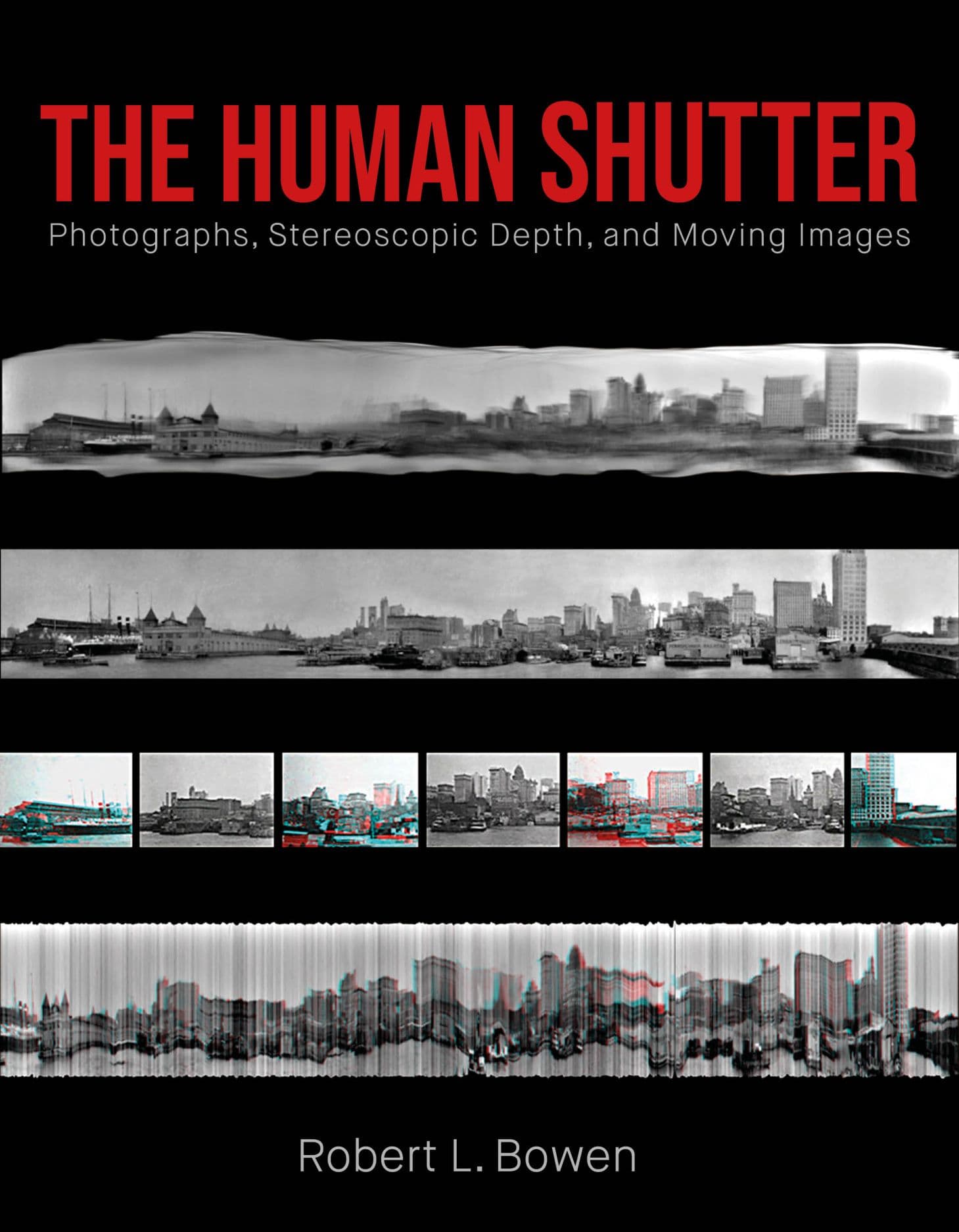
The Human Shutter: Photographs, Stereoscopic Depth, and Moving Images
Intellect, 2024
Bob Bowen and Tom Huhn discuss Bowen’s new book, which offers a radical departure from standard histories of photography and cinema. The work recounts the modern history of ideas of vision, especially in the development by artists, and scientists, of the peculiarities of stereoscopic perception, and continues to a consideration of contemporary Generative AI. The discussion centers on key works by Marcel Duchamp and Ken Jacobs, two of Bowen’s primary figures in his alternative account of the emergence of photography and cinema. The conversation reflects the book’s compelling narrative as both rich in historical scholarship and rife with insights for a general art audience. The dialogue explores how Bowen’s thesis redefines our understanding of the history of sight and the technological evolution of the image.
Tom Huhn (Rail): Let’s talk about The Human Shutter: Photographs, Stereoscopic Depth, and Moving Images, and especially its relevance for people who are interested in the history of cinema and so too the history of theories of vision. This book also discusses how early experiments in vision and stereoscopy express an abiding interest in space, time, and motion. But we should begin with how the book is immediately relevant for a couple of exhibits that recently opened in New York.
Robert L. Bowen: First, rarely, if ever, has stereoscopic visualization been addressed from an artist’s perspective in terms of how it informs the way artists see. In other words, looking very carefully. Two of the most important figures appearing in this book are Marcel Duchamp and experimental filmmaker Ken Jacobs. A Duchamp retrospective opened this April at the Museum of Modern Art. And The Whole Shebang is a current series of screenings in different venues celebrating Ken and Flo Jacobs, both of whom died last year. Ken Jacobs was one of the most important and prolific experimental filmmakers of his generation, and a pioneer in pushing avant-garde stereoscopic seeing to its limits and beyond. Duchamp and Jacobs demand a great deal from their viewers and reward the efforts. It’s a unique opportunity to see such large samplings of their work.
Rail: Let’s talk about how your early interest in one particular work of Duchamp’s actually sparked your curiosity and became the motivation for this extended study. What happened?
Bowen: As an undergrad, I took an art history class on modern art. Toward the end of the semester, the professor showed us several works by Marcel Duchamp, including one with three names: Handmade Stereopticon Slide, Hand Stereoscopy, and Stéréoscopie à la main, 1918. Typically, stereographs are composed of two photos pasted side by side onto a card. Each of the paired photos roughly represents a scene as photographed from the unique position of each eye. Using a stereoscope, most of us can see a 3D depth illusion. When the professor projected the image, he said he didn’t understand it, but he sensed its significance. I still remember seeing the image for the first time, and it struck me that I was looking at a puzzle. How different it was from the paintings and sculptures I had been looking at all semester. This kind of art was something else entirely. It seemed to me that if I thought about it over time, I might be able to understand it in a way that the professor didn’t, and maybe I could also learn something significant about art.
Rail: And what did you come to understand about this piece, which many consider a minor work of Duchamp’s? You pointed out that Duchamp included a version of it in The Box in a Valise (Boîte-en-valise) (1941), his mini-retrospective of representative works, right?
Bowen: A version of the stereo card does appear in the Boît, which is based on the idea of a salesman’s briefcase, and a great deal of irony. A traveling salesman would peddle his wares out of something similar. For this, Duchamp created miniature versions of his iconic works, including the readymades. The stereo card was one of these. The image shows a hand-drawn, geometric, crystal-like structure drawn on top of a horizontally bisected seascape photograph, with the sea below and the sky above. It's classified as a rectified readymade. Its French title, Stéréoscopie à la main, translates as “Hand Stereoscopy,” but in English, main also suggests sea, as in “Spanish Main,” and that sounds like seeing, so suddenly one is trapped in a series of interlocking bilingual puns. Then, in its other English title, there is stereopticon. Though it suggests a stereoscope, it turns out that stereopticons were not stereoscopic. A stereopticon was a brand of magic lantern slide projector allowing its operator to dissolve between the slides they were projecting. It was never stereoscopic, as I’m sure Duchamp knew. Most likely, the ocean background came from a magic lantern slide that was photographed twice with slightly different lighting. And so stereopticon is a very precise name for it. The two hand-drawn crystals appear to float above the ocean background.
Rail: But when one looks at Duchamp’s Handmade Stereopticon Slide, can one see it stereoptically? Does it work as a stereograph?
Bowen: It does. I went to the Museum of Modern Art research library to take a close look. When the work was acquired, Duchamp was asked to fill out a questionnaire. In it, he wrote about “the effect,” which I read as both verbal and visual. Visually, the crystal structure is a reversible figure, a 2D/ 3D hinge figure. More specifically, in 2D, it is bistable like Wittgenstein’s duckrabbit or the Necker cube. One sees the duck, or the rabbit, but never both at the same time.
Rail: You can’t see a duckrabbit, right?
Bowen: I’ve tried and no. When the crystal drawings flip, the effect is that you either look down on it or look up at it, but not both together. And so far, I’ve only described the 2D effect, but it also flips in 3D. Since our eyes are approximately 2.5 inches apart, each sees a slightly different view of the scene, and the brain processes them as a 3D stereoscopic scene. If our eyes were to exchange positions, for example, by crossing our eyes, then the world would look like a mold turned inside-out. So Duchamp’s stereograph is both a 2D bistable image and a 3D stereoscopic/pseudoscopic image. It flips, both verbally and visually, in 2D and 3D.
It is also an acknowledged prototype for the Large Glass. That’s the main reason it’s important. According to artist Jeff Wall, who began his career as an art historian, Duchamp’s notes collected in the Green Box and the White Box apply to both the Large Glass and Étant donnés, which is a three-dimensional peepshow-based diagram of a stereograph that happens to be pornographic. Pornographic stereographs were popular in the 19th and early 20th century. Also, as an aside, one of the best known series of photographs by Sugimoto is the seascapes. And similar to Handmade Stereopticon Slide, they are bisected with the sky above and the sea below. Sugimoto is a self-proclaimed Duchampian, so it’s rather likely that Duchamp’s stereo card inspired him.
Rail: Interesting parallel here, because what you’re suggesting is that for Duchamp, the Handmade Stereopticon Slide was generative for a couple of his most important works. And the parallel is that the same stereopticon slide turned out to be incredibly generative for you and probably for Sugimoto and maybe others. Can you say something more about what sparked your young and very strong sense of curiosity?
Bowen: As I mentioned, I had no idea what it was, but first, it drew my attention to stereographs and then to photography in general. And that led directly to experimental cinema. So my interest in Handmade Stereopticon Slide led me to Ken Jacobs.
Rail: Should we go back to the specifics of the book and the various practitioners and artists that you treat in such a rich array, beginning early on with Claudet?
Bowen: Antoine Claudet is a figure from the early history of photography that we don’t think about very much anymore. Yet he is everywhere in the early sources. He learned photography directly from Daguerre and also from William Henry Fox Talbot. He attempted to speed up exposure times for both processes, though he was ultimately unsuccessful with Talbot’s process. He was a chemical engineer, a mechanical engineer, and an optical engineer. In the history of the Royal Society, which was founded by Sir Isaac Newton, he is the only member ever elected as a photographer. Claudet’s election certificate was authored by Michael Faraday, the scientist who brought us from the age of steam into the electrical age. The certificate is cosigned by several other key individuals. Name-checking just a few, there is Talbot, the British inventor of photography, and Charles Babbage, who, working with Ada Lovelace, essentially invented computing, Charles Wheatstone, who explained stereoscopic vision, and Astronomer John Herschel, who, among many things, invented photographic hypo.
These individuals tell us that Claudet invented portrait photography, which seems absurd because how could one person be credited for doing that? Yet Talbot and the others sign his certificate. It means that Claudet made the exposure process for the daguerreotype fast enough to capture a photographic portrait reliably. Then he focused on stereoscopic portraiture. And along the way, he invented many things. By inventing the safe light, he essentially invented the darkroom and made the complex manipulations that photographers performed there possible, because they could see what they were doing. And he was the first to introduce color to photography through hand-tinting. I don’t think we can appreciate how strange it must have been to see black and white photographs in the beginning. It was like seeing into a shadow world.
In addition, Claudet was the first to use painted backdrops in his photographs. And he’s the first to create a photo panorama. He invented the light meter. He pioneered multi-exposure photographs for astronomy. Working with the physicist David Brewster, he pursued photo sculpture, a process that anticipated digital photogrammetry, the concept of taking many photographs of something and creating a 3d model from them. He also wrote 300 articles, and in some of them he argued that photography was a fine art.
And then, within a few weeks of his death, a fire destroyed his entire archive of 20,000 photographs. We lost the urtext of photographic history. He was there at the very beginning, and he knew everyone. That archive would have been unimaginably illuminating.
But most importantly for me, and what I still haven’t mentioned, is that Claudet pioneered photographic motion. He used the medium of the stereograph to create two-frame photographic motion, a microcinema. The central example we have is a moving stereograph of Claudet smoking.
Rail: In the book you make this really interesting connection between Claudet and Duchamp.
Bowen: To me, Marcel Duchamp and Antoine Claudet are not just similar, but uncannily so. It’s almost like they’re the same person living in two different time frames. In the book, I wanted to remain academic, citing sources for all my assertions. So I never explicitly say it, and I’m not arguing for reincarnation or anything like that, but I think this is a good moment to talk a little more about this.
Both were French expats living in English-speaking countries—Claudet went to Britain, and Duchamp to the US. One French art historian even told me that he thinks of Duchamp as American. Also, both were fascinated by perceptual illusions, especially of stereoscopic depth. And they both worked with glass. Everyone knows about Duchamp’s Large Glass and his similar works, but Claudet, before photography, invented a device to cut curved glass. He was an expert on plate glass, which England did not have at the time. He went to England as a French glass importer. Of course, daguerreotypes are encased in glass, and lenses are made of glass. It was Claudet’s plate glass in the upper transepts of the Great Exhibition at the Crystal Palace that illuminated Claudet’s stereographs, where they were seen by Queen Victoria and quickly became a mass medium. So both individuals were obsessed with glass.
And they were obsessed with chess. We know about Duchamp’s involvement with chess. But Claudet also took several photographs of himself playing chess with Talbot. Looking at these images, I read the chess game is a metaphor for the new medium they are inventing together.
Duchamp and Claudet also both invented a range of curious, circular optical devices. That bit is the most uncanny. Both of them also took a large number of self-portrait photographs, including ones when they are smoking. And both wrote about art.
I think I mentioned that Claudet was the first to use backdrops in his photographic portraits. The one he used most was a French window scene. Similarly, Duchamp has a work titled Fresh Widow (1920), a pun on French window. But in Duchamp’s case, the panes are blocked with black leather and therefore opaque. You can’t see anything through them, at least nothing visual.
Rail: And how should we think about the connection between Ken Jacobs and Giorgio Sommer that you discuss in the book?
Bowen: Giorgio Sommer was a nineteenth-century photographer working in Naples. He made his living photographing Roman sites for an archaeologist at Pompeii and also making picturesque views for the tourist trade. For the archaeological work, Sommer conceived a new and proto-modern way to photograph the sites, based on the way excavations proceed top to bottom through historical and geological layers. It was a radically different from the picturesque, which involved leading the eye through a scene from front to back. And I think the archeological photographs led him directly to his experimental stereoscopic work based on two-frame motion within the stereograph format.
Sommer did crazy things with stereoscopic space, like plucking a boat out of Naples harbor and floating it in the air somewhere between the camera position and a figure carefully placed along the shoreline. Going far beyond Claudet’s basic experiments with photographic motion, Sommer is like a flaneur, not only observing but likely even controlling the motion of crowds and traffic on Neapolitan boulevards. It can’t be accidental because he does it over and over in so many of his images. It is crazy stuff that I would argue anticipates the work of Ken Jacobs. In this link, you can see some simulations of how Sommer explores the human shutter effect:
Beyond any other filmmaker, Ken Jacobs pushed the limits of cinema’s perceptual dimensionality. He called his approach eternalism, a machine-to-brain technology that he and Flo manipulated first using a pair of analog projectors and a rotating shutter, and later in software. He referred to this technology as the nervous system. I love that, a model of the human nervous system. And curiously, unbeknownst to Jacobs, eternalism is also a philosophical concept. It’s the idea that the past, present, and future can be treated simultaneously. Einstein and Minkowski proposed something similar in physics. But it is so interesting that Jacobs uses the exact same term for an approach that slurs together past, present, and an ever-evolving future in cinema, the same name as a philosophical concept with a similar purview. So both Giorgio Sommer and Ken Jacobs pursued uncompromising stereoscopic photography as optical and cinematic revelation that Jacobs described as “bizarre depth worlds.” Jacobs also says that he was not drawn to nature but to “unnatural depth phenomena,” a neurobiologic predicated on the cinematic flicker. As I mentioned in the book, the human shutter refers to the visual alternations in the brain known as binocular rivalry, and this concept directly links to how the flicker interfaces with the brain, whether via a digital or mechanical shutter.
Rail: A way to look at Duchamp and Jacobs’s work is not just as things to see but as interventions in and reflections on the way the mind works. I think this is one of the real insights of your book, that we see Duchamp, Ken Jacobs, Claudet, Robert Smithson, Lucy Raven, so many other artists whom we meet, contributing to these artistic histories of making, but more importantly, we come to understand and appreciate their continuity and kinship with this whole other scientific and philosophical exploration of the mind’s relationship to nature and the way in which the brain translates experiences that we have. For me, this deep philosophical continuity throughout the work is manifest in the book’s title, The Human Shutter. That is the point of view from which so much of this work happens: to see that a central part of being human is not just vision or the mind, and that sometimes our minds function like a photographic shutter.
Bowen: It was a great moment in researching the book when I began to discover current work in neuroscience on binocular rivalry. In the published papers, they always say they’re doing it to better understand consciousness. Jacobs and Duchamp are doing it from an artist’s perspective. But consciousness is an elusive thing that, on one hand, is simply the awareness of a sensation, but then it moves into an array of concerns in so many disciplines.
Rail: All of this inquiry and experimentation is also acknowledgement that consciousness is not just an instrument that we deploy to evolve and survive. Consciousness also, I’m thinking of Duchamp here, conjures up a world of its own. There is a world within consciousness, or many worlds within consciousness, and so it’s both this instrument as well as a world-making thing, not unlike photography and cinema. How do you think about Gen AI in this context?
Bowen: It took me five years to write the book. And, along the way, things happened. We had COVID at the beginning, and towards the end of the writing, Gen AI emerged. Since time perception in film and photography is obviously central to the book, it was interesting to think about how Gen AI relates to that. I would say that traditional photographs record a scene, and stereographs offer a kind of simulation, whereas gen AI is synthetic. It uses statistical induction, a form of reasoning that draws general weighted probabilistic conclusions derived from the data population in its training set. Unlike the move from analog to digital, I believe Gen AI has caused a kind of rupture in the technical evolution of film, photography, and video media. It’s really not about the question of truth and indexicality. That was lost long ago, although it’s reached new heights recently to the point that there’s no way to tell which image is true and which isn't. What’s happened is that photographs are no longer clocks that tell time. What changed is that a synthetic photo no longer syncs to a particular moment. It obliterates time. In one sense, AI images may seem timeless, but that is misleading. Time perception as an activity in current photo-based media has become all but impossible. Speaking metaphorically, death is not present in an AI-generated picture. Think of a classic family photograph, the young child, now grown, or a grandparent who is no longer around. That manner of perceiving time is no longer possible. Conjuring Panofsky’s famous essay on Nicolas Poussin, death is not present in this Arcadia. The death of time perception is a new form of death that we don’t yet comprehend.
Tom Huhn is Chair of the Art History and BFA Visual and Critical Studies departments at the School of Visual Arts. He is a philosopher and an author of numerous books.