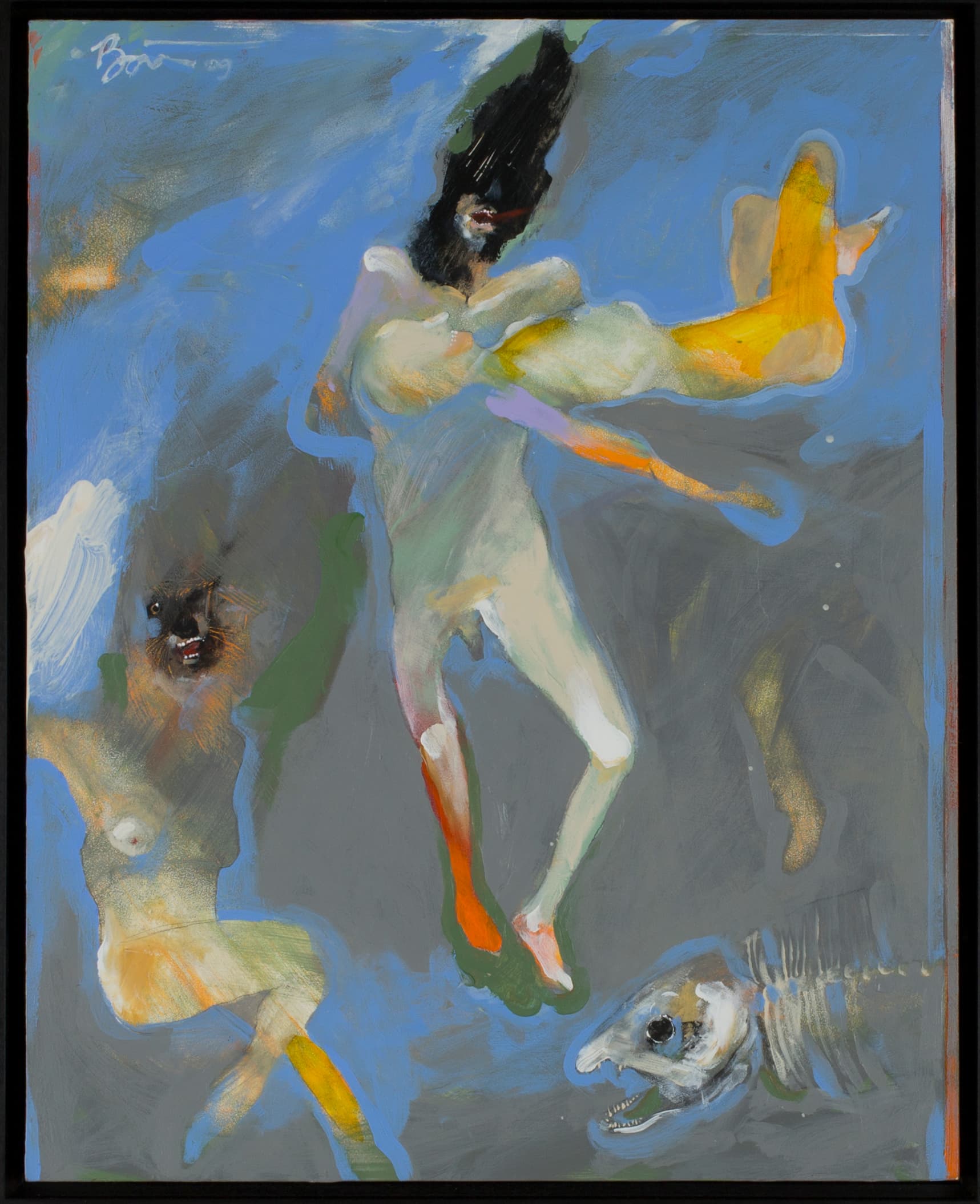
Rick Bartow, Give Me Back My Father, 2009. Acrylic on panel, 20 × 16 inches. Courtesy Portland Art Museum.
Word count: 1493
Paragraphs: 11
Portland Art Museum
November 20, 2025–May 23, 2027
Portland, OR
On view through May 23 of next year, Rick Bartow: Storyteller fills five compact gallery spaces at the Portland Art Museum with the late Oregon artist’s complex, searingly vibrant pastel and graphite drawings, acrylic paintings, and sculptures. Bartow was a member of the Mad River band of the Wiyot Tribe; a talented blues-rock musician and songwriter; a Vietnam vet; a life-long resident of Newport, Oregon; and is now much-missed in his home state. In 2016 he died at age sixty-nine of congestive heart failure, still at the height of his creative powers.
The exhibition contains superb examples of Bartow at his strongest, drawn from across his career. It includes powerful work on paper and canvas and in wood, but none of Bartow’s exquisite prints. You can see his gift for mark-making and his fearless love of color on full display in drawings such as Coyote & the Myth (1991), Surprise (1995), and To Everything a Season (2002). Working on thick paper allowed Bartow to attack the page physically, smearing graphite with his fingers and layering areas of intense color in pastel. The speed of his hand comes through in these pieces, along with a confidence that allowed him to try anything and then erase it or simply cross it out if he didn’t like what he saw. In a 2025 Oregon Public Broadcasting (OPB) episode about Bartow, in footage shot in his studio in the early 2000s, he commented, “I can do anything I want, because it’s my drawing.”

Installation view: Rick Bartow: Storyteller, Portland Art Museum, Portland, OR, 2025–27. Courtesy Portland Art Museum.
Coyote & the Myth shows Bartow at his best, deploying agitated, slashing marks of saturated pastel color, areas of erasure, and a skittery dotted line he often employed. Together they conjure a spooky half-animal, half-human, androgynous spirit figure. His title identifies the subject as “Coyote,” the Native American trickster and creator that Bartow identified with. A substantial portion of Bartow’s work takes the form of portraits and implicit self-portraits, including Coyote & the Myth. Much of the paper remains untouched, a common practice in Bartow’s drawings. The empty expanses of white amplify the intensity of his marks and bright color, making them stand out as dramatic actions enacted on the blank page. In stark contrast, a deep black void fills the right side of the drawing. It also reveals a ghostly outlined head that might be either a human or a bear or both, with teeth and a muzzle signaled by faint lines created through erasure. For Bartow, erasure was not just a way to correct something he didn’t like or make a mark in a different way; it had a personal, philosophical weight. “I use erasure because my life has been shaped as much by what I have lost as by what I have gained,” he said in 1988, a remark that appears in a number of sources on Bartow.
Bears, birds, coyotes, deer, fish, and dogs populate Bartow’s world, teeth often bared, staring out at the viewer. Animal and human head and limbs overlap, intimating that the borderline between humans and animals is indeterminate and ultimately meaningless, as in Crow, Song, Bear (2014). That’s Bartow’s point. “I’m just an artist who thinks that people and animals share the same bed,” Bartow commented in footage included in the 2025 OPB episode. “And if the bed isn’t comfortable for them, it’s not going to be comfortable for us very long.” Another excellent documentary video, this one on view in the exhibition and titled Rick Bartow: The Man Who Made Marks (2022), by Nanette Kelley (Osage/Cherokee), includes reminiscences by a number of the artist’s friends, including Ted Hernandez, a former Wiyot Tribe chair and current Tribal Historic Preservation Office director. He recalls how Bartow’s art echoes relationships and connections between humans and animals in Wiyot culture and stories, and how important those were to the artist.

Rick Bartow, “Dog Pack Series,” 2003. Mixed media containing wood, nails and screws, 17 ¼ × 24 × 7 inches. Courtesy Portland Art Museum.
As with Bartow’s drawings, there’s a pronounced physicality and economy of gesture to his work in wood. His carving, use of color, and additions of found metal and things like plastic teeth feel both raw and effortlessly, intuitively right. Entering the gallery, a pack of three dogs confront you, snarling ferally. Two of them sport fur made from hammered nails that evoke nkisi nkondi power figures made by the Kongo people. They’re amazingly realized, scary, and also beleaguered and sad. I wish they’d been displayed on a low plinth, on the ground, like dogs in the wild or on the street, and not behind glass in a case.
Another sculpture, Anxiety (2014), draws explicitly on the transformation masks of the Kwakwaka'wakw people of the Pacific Northwest Coast. As the museum’s excellent gallery labels point out, the theme of transformation runs throughout Bartow’s work. It is “something that I kind of borrowed from the North Coast guys, because they had faces within faces within spaces, spirits,” he said in a 2015 interview at the University of Oregon’s Jordan Schnitzer Museum of Art for his retrospective there. “If you put on a mask, you will hear the truth, it will tell the truth. If you leave it off, it will lie to you.” Anxiety includes an outer mask that opens up to an inner face and head, a traditional form (that often featured an animal outer head with a human inner head) used in masks danced during Kwakwaka'wakw potlatch ceremonies. In Bartow’s sculpture, the inner figure’s head is also exploding vertically, revealing a third head, mouth frozen open in fear, teeth visible, eyes wide in shock. Wearing a mask or not, hearing the truth is not always easy to bear.

Installation view: Rick Bartow: Storyteller, Portland Art Museum, Portland, OR, 2025–27. Courtesy Portland Art Museum.
Together with the teeth that show up so often in Bartow’s work, eyes are also omnipresent, anchoring the psychological impact of his imagery. “There’s always an eye in there, looking back at you,” as fellow artist James Lavadour (Walla Walla, and cofounder of Crow’s Shadow Institute of the Arts, where Bartow did a number of residencies) said to me in a recent phone conversation about Bartow’s work. In Surprise, a white, hollow-eyed skull attacks a figure with a dark head from behind, using a gray-white hand to muffle its mouth. A slash of red runs across the forehead like a wound. Along with terrified shock, the foreground figure’s eyes seem to express a mix of desperation and abject despair. It’s a nightmare image done just weeks after the AIDs-related death of Bartow’s dear friend, the Portland art dealer William Jamison, who played a crucial role in launching his career. It might also recall the barbaric, brutal 1860 massacre of Wiyot people in Humboldt County, in which as many as 250 women, children, and elderly men were murdered by white settlers encroaching on Wiyot land. Bartow was still a member of the nearby Yurok tribe at the time he drew Surprise; based on an aunt’s research he enrolled in the Wiyot tribe some years later. But in 1995 he would surely have known of the Wiyot massacre: his own Wiyot grandfather, Mad River Johnny, as the family called him, was a survivor of it. He left California in the early twentieth century, walked up the coast, and homesteaded alongside Oregon tribes near Newport, where Bartow lived his whole life.
The genocidal 1860 massacre interrupted the Wiyot tribe’s World Renewal Ceremony. In 2014, Bartow was on hand when people from the Wiyot, Yurok, Hupa, and Karuk tribes gathered on Tuluwat Island to finally complete the ceremony after the island was returned to the Wiyot tribe. The curators’ label for Crow, Song, Bear notes that the painting of the same year may commemorate that ceremony. The word “harmony” scrawled on the left of the canvas lends weight to their speculation. The painting is another image of transformation. One of Bartow’s bear heads morphs into a human one, with another head peeking from behind the dancing, animated body. A saturated orange background dominates the painting, making the largely black-and-white figure pop out. Bartow’s paint handling of the dancer is unsettled, agitated, and anything but harmonious. The overall mood strikes me as haunted, an entirely understandable response to an event—however celebratory and renewing—that would inevitably have also evoked Bartow’s thoughts of what happened in 1860.
Rick Bartow: Storyteller was organized by the Portland Art Museum’s Senior Curator of Native American Art, Kathleen Ash-Milby (Navajo Nation), a commissioner and curator of Jeffrey Gibson’s US Pavilion for the Venice Biennale, and Erin Grant (Colorado River Indian Tribe), Assistant Curator of Native American Art. It opened last November when the Portland Art Museum unveiled its new Mark Rothko Pavilion, adding over one hundred thousand square feet of public space, new galleries, a dramatically restructured and improved circulation scheme, and more. Rick Bartow’s show is one of the best reasons to visit soon. For anyone who loved his work, the exhibition is a pilgrimage site. For anyone who hasn’t seen his work yet, it will be a revelation.
John Weber began his career as an artist and art writer and has served as the executive director of the University of Oregon’s Jordan Schnitzer Museum of Art, as founding director of the Institute of the Arts and Sciences at UC Santa Cruz, as executive director of the Tang Museum at Skidmore College, as the curator of education and public programs at SFMOMA, and as curator of contemporary art at the Portland Art Museum.