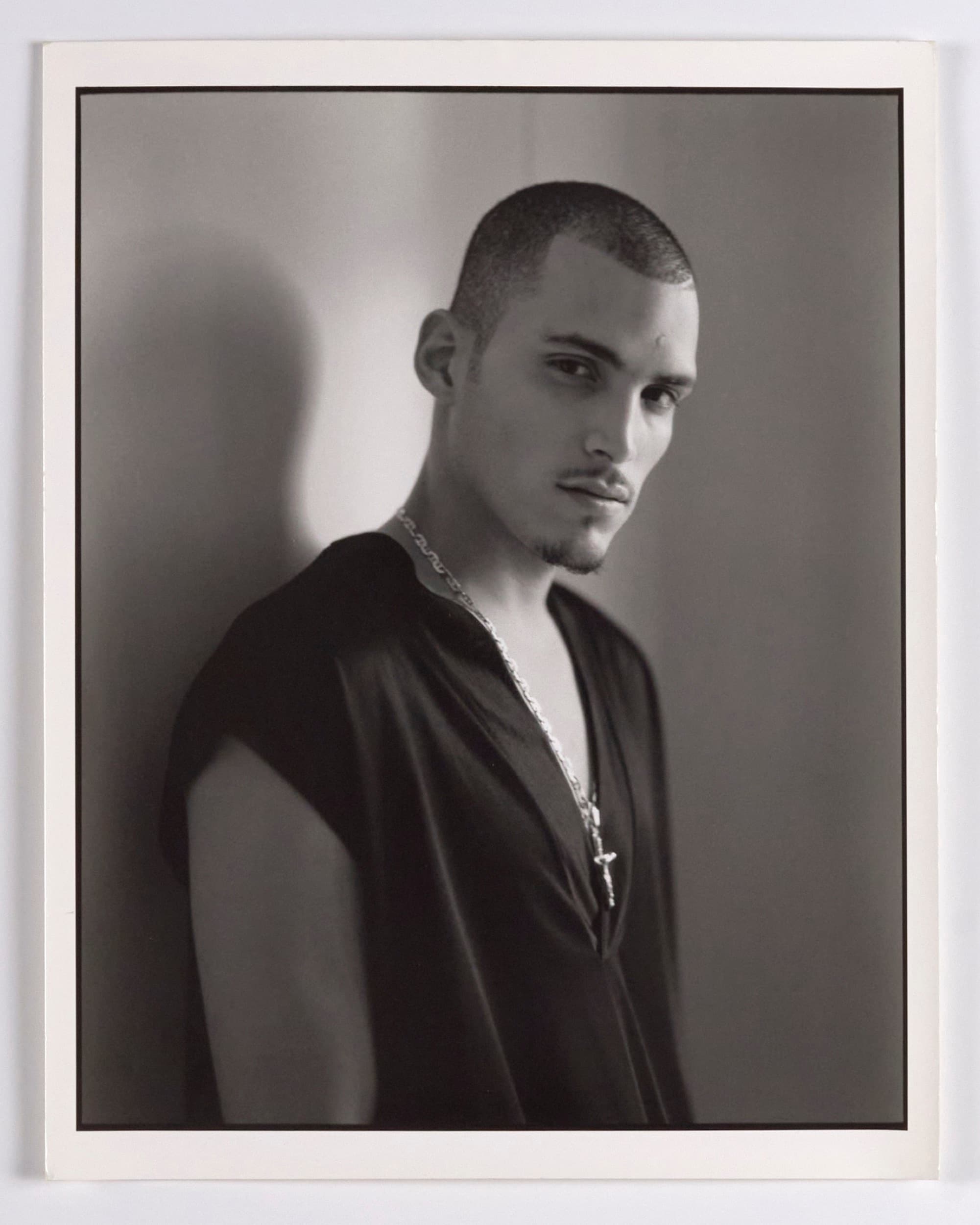
David Armstrong, Eddie, Jefferson Avenue, Brooklyn, 2001. Gelatin silver print, 14 × 11 inches. © David Armstrong. Courtesy the Estate of David Armstrong.
Word count: 590
Paragraphs: 5
Artists Space
March 10–May 23, 2026
New York
A visually enthralling and emotionally stirring career survey, David Armstrong: Portraits contains some ninety works by the Massachusetts-born, Brooklyn-based photographer who died of cancer in 2014 at age sixty. His first US retrospective, the exhibition features portraits of friends, family, and acquaintances, plus a selection of landscapes, still lifes, and interior scenes that are deliberately out of focus. Also on view are vitrines filled with diaristic workbooks, notes, studies, and other documentary material. The photos range from 1992 to 2012, when Armstrong’s career as a fine-art photographer was well-established and he was a much sought-after fashion photographer. Although he disliked the categorization, Armstrong is often associated with the so-called “Boston School” of photographers, many of whom attended Boston’s School of the Museum of Fine Arts. Among his illustrious peers were Nan Goldin, Philip-Lorca diCorcia, Mark Morrisroe, and Jack Pierson. Goldin became a particularly close, lifelong friend, and he was a favorite subject in her early works. Like other artists of the Boston School, Armstrong was fascinated by the genderfluid denizens of the underground art and music scenes in Boston; and he later immersed himself in the gay scene in New York City, where he relocated in the late seventies. There, he befriended like-minded art-world figures such as Cookie Mueller, Rene Ricard, Patti Astor, and New York Dolls guitarist Johnny Thunders.

David Armstrong, Ethan, Jefferson Avenue, Brooklyn, 2009. Pigment print, 11 × 8 ½ inches. © David Armstrong. Courtesy the Estate of David Armstrong.
Armstrong explored the often-sordid New York underground milieu of hardcore sex and drugs in the seventies and early eighties, but unlike those of some of his colleagues, his images are typically romantic in temperament. The young men he photographed in his home studio in a brownstone on Jefferson Avenue in Brooklyn, such as the black-and-white portrait Eddie, Jefferson Avenue, Brooklyn (2001), convey a certain unapologetic homoerotic tension. Yet the seductive gaze of the handsome model, wearing a tank top and buzzcut, is that of a self-possessed personality rather than of a lurid one-night stand. In his commissions for fashion companies, by many accounts, Armstrong liked to work with limited assistance and sought to know his models on a personal level, photographing them as unique individuals rather than mere live-mannequins peddling designer clothes. In another wonderful and more playful portrait, the color print Ethan, Jefferson Avenue, Brooklyn (2009), a youth with wild black hair turns toward the viewer with naked back exposed, as he is either taking off or trying on a beige sweater. The cold, intense gaze of the lithesome young man toward his photographer, and thus the viewer, thwarts any suggestion of an easy pickup or a casual affair.

David Armstrong, Charlottenburg, Berlin, 2000. Cibachrome, 37 × 27 inches. © David Armstrong. Courtesy the Estate of David Armstrong.
Organized by Artists Space executive director and chief curator Jay Sanders and deputy director Kelly Taxter, the exhibition opens with a series of blurry color photos of landscapes—mainly trees and shrubs in formal gardens in Vienna, Berlin, and Provincetown in Cape Cod, which Armstrong often visited for extended stays. Armstong’s attraction to blurred imagery, with its dreamlike atmospheric effects, contributes to the romantic spirit of his work, and corresponds to a range of photographic precedents, from Julia Margaret Cameron’s hazy portraits from the nineteenth century to Barbara Ess’s pinhole camera works of the 1980s. The show’s arresting conclusion features Your Picture on My Wall, an expansive installation filling one large wall of a rear gallery. Here, dozens of abutting photographs of people, places, and things that Armstrong took between 1977 and 2003, which was first shown at Matthew Marks Gallery in New York in 2004, is an encapsulated David Armstrong retrospective unto itself.
David Ebony is a contributing editor of Art in America. He is also the author of monthly columns for Yale University Press online, and Artnet News.