Word count: 723
Paragraphs: 7
Satchel Projects
April 30–May 30, 2026
New York
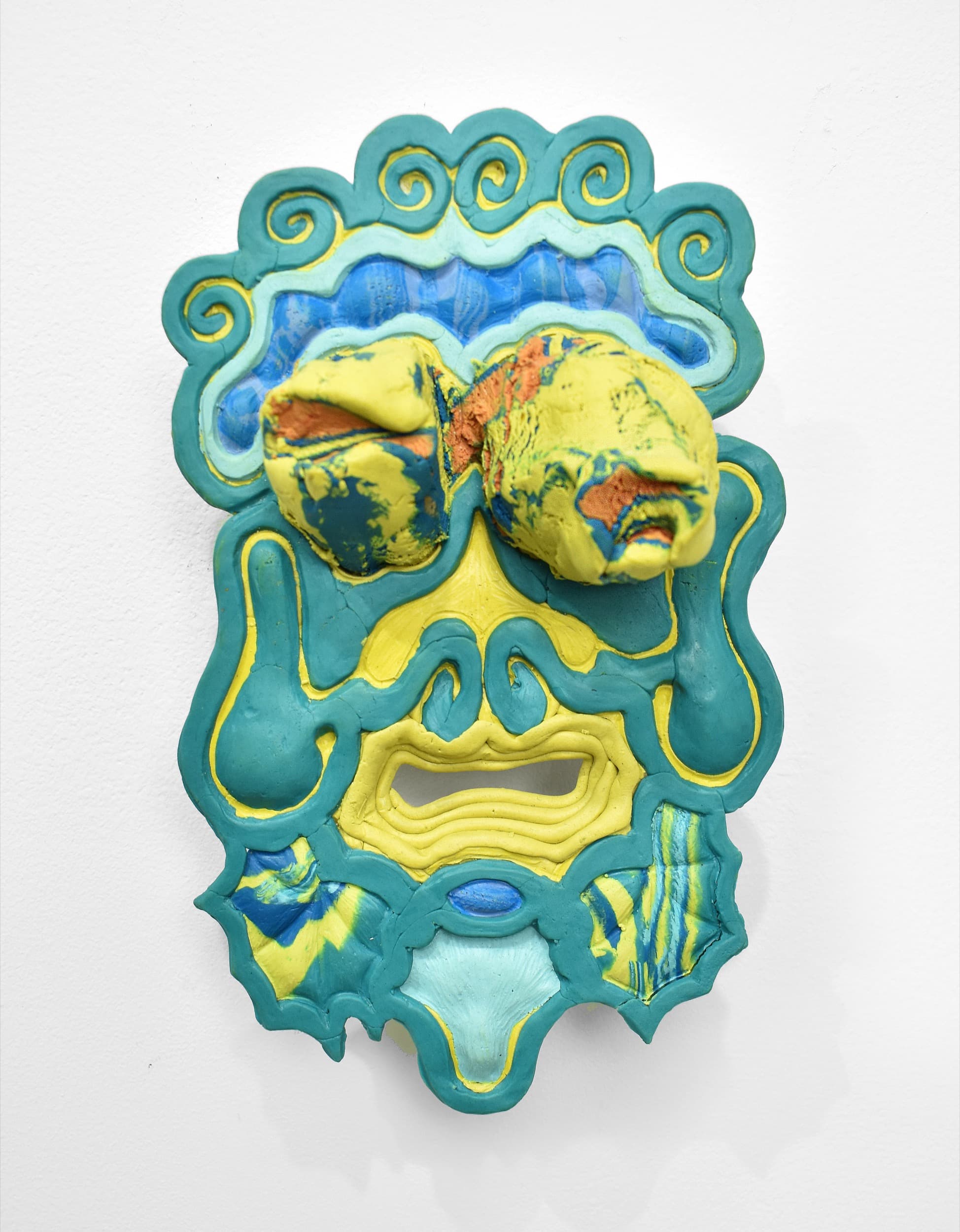
While viewing Out in Front of the Back of Beyond at Satchel Projects, I found many of Daniel Wiener’s pieces viewing me back. From the writhing masses of clay, some faces returned my stare with smiles, while others seemed to look pained. A few have been contorted into odd shapes of uncertain emotion. I wonder if the emotions are really there, or if I project them upon the pieces. Out in Front of the Back of Beyond demonstrates a subtle but strong connection to psychology, a deep interest in how we perceive ourselves and each other. Does the art resemble us, or do I place that resemblance upon it in an act of pareidolia?

Installation view: Daniel Wiener: Out in Front of the Back of Beyond, Satchel Projects, New York, 2026. Courtesy Satchel Projects.
Doubling Back (2026) resembles a plastic model of an organ found in a high school science lab. The surface is flat with a light luster, and the almost amoeba-like shape is vibrantly layered, recalling a cell or an organ banking layers of fat. It’s familiar and unfamiliar; I know the shape yet I can’t place any specific meaning on it. Moving behind it, I find that a lot is hidden. Spilling from the back are waves of overlapping color, twisted together and radiating out in shell-like shelves of clay. The texture is rough and dimpled—two crude floral shapes jut out and bloom. Crowning the colorful maelstrom is a small, almost skull-like face. The emotions of this visage remain enigmatic, but I nonetheless detect nervousness. Is this nervousness somehow encoded in the work, or am I nervous, casting my emotional state on the sculpture?
Doubling Back, like many of Wiener’s larger pieces, sits in the round. Classically, sculptures in the round should be considered from 360 degrees. There’s some of that in Doubling Back, but there’s also a clear front and back. The front is flat, organic, and familiar. The back has dimension, swirling color, and hidden, ambiguous shapes—a brief burst of unfiltered expression. From the front, Wiener’s sculptures capture the public, formal faces we transmit to the world, and in the back there is the repressed internal life that we tuck away. I think about my arrival to Satchel Projects. I met the woman sitting at the desk and I smiled. I believe I came across as amiable. I don’t think she noticed that I was sweating, a bit nervous, my fears and ambitions bucking beneath the saddle of my carefully curated outward expression. That’s why Doubling Back is so familiar. And that’s why there is a front and a back rather than a full articulation in the round: because we choose to show the world a familiar and comfortable face, hoping our complicated, grotesque interior slips silently past.

Installation view: Daniel Wiener: Out in Front of the Back of Beyond, Satchel Projects, New York, 2026. Courtesy Satchel Projects.
Polyphony Beyond the Baton’s Thrust (2025) was meticulously molded by hand. The epoxy tendrils that keep it standing are rough, splitting to show small caverns of color within. On the front, a warped smile of chipped teeth looks back. There are tumor-like growths of additional teeth near the bottom and top. And between stacked layers of clay I notice loose hairs sealed into the sculpture. The piece is a feat of craftsmanship. Yet within the splitting clay and loose hairs, I wonder what was a happy accident, and what was intended to look broken or out of place. What do we create of ourselves, and what is wrought against our will? Polyphony Beyond the Baton’s Thrust has an intense individuality, so much so that it simply exists as itself, without clear adherence to any known form. I don’t ask people why they are the way they are, I just accept. With its ruptured clay and rough, almost incomplete edges, Polyphony Beyond the Baton’s Thrust doesn’t suggest that we are complex. It shows it. More than inconsistent or “imperfect,” it’s wrought in a singular way—we all are, as we endure and are formed by our own experiences, cracks, and imperfections.
A relief on the wall, Half Dissolving (2020), catches me as I leave. A face presses through—or maybe disappears into—a blend of dragon fruit white and red. Is this presence mad? Malevolent? Or do the neon blue lips curl in happiness? Or is that me, again, seeing myself, a smile pressing through a blurring swirl of color?
Nic Rago is a contributor to the Brooklyn Rail.