Daniel Spaulding’s Joseph Beuys and History
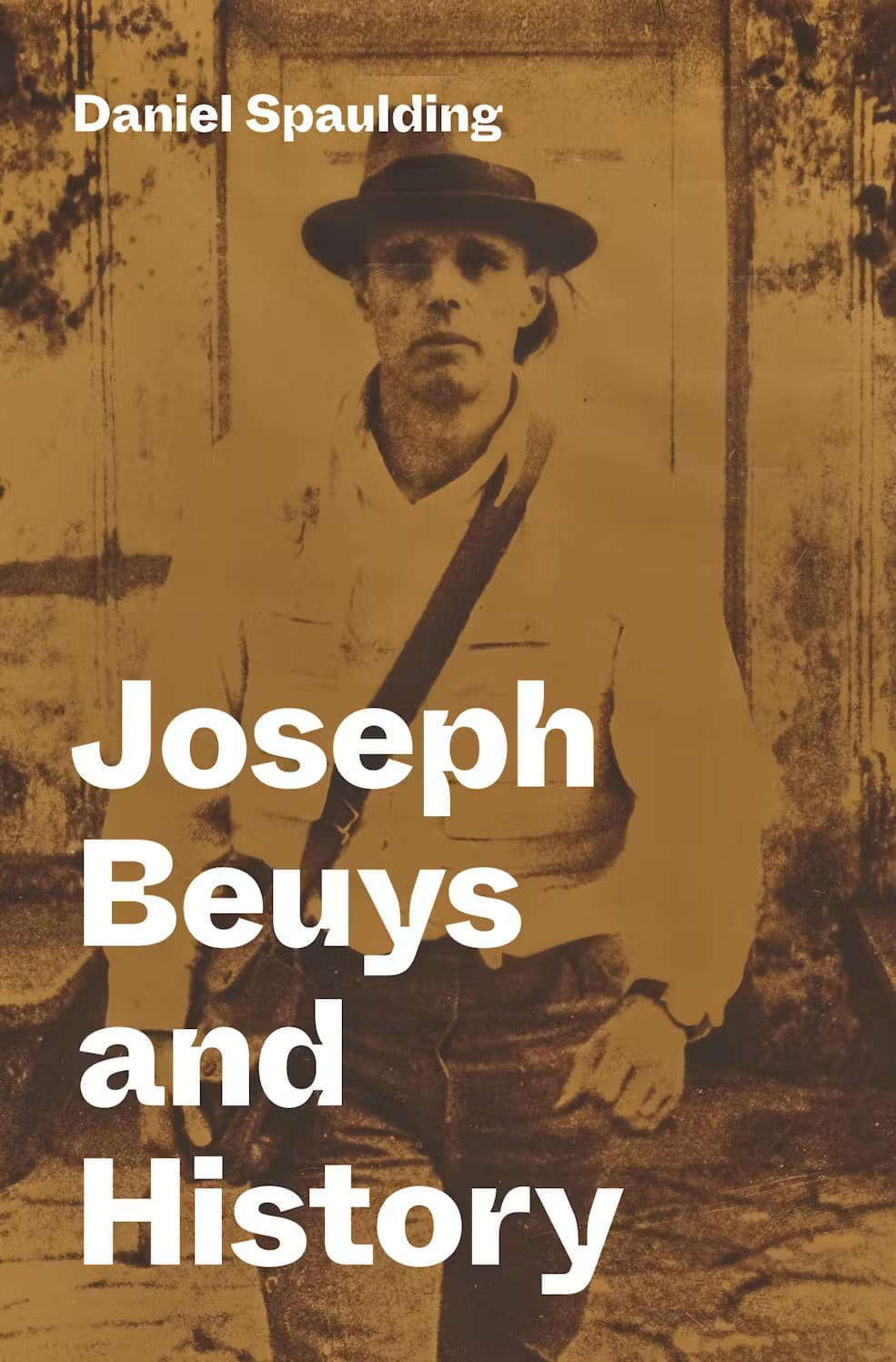
This densely theoretical rereading of the artist through the lens of Marxist social art history is, above all, an attempt to take Beuys seriously.
Word count: 1158
Paragraphs: 12
Daniel Spaulding
Princeton University Press, 2026
In 1977, artist Joseph Beuys installed a massive apparatus at Documenta 6 in Kassel, Germany, consisting of a motorized pump circulating two tons of honey through transparent plastic tubing that snaked through the exhibition’s main venue in a closed loop. Titled Honigpumpe am Arbeitsplatz [honey pump at the workplace], the installation was meant to complement—and metaphorically exchange energy with—robust economic, social, and political discussions hosted in the galleries by Beuys’s Free International University (FIU), an itinerant academy the artist had co-founded several years earlier.
Honigpumpe’s intersecting associations—circulation, accumulation, and sociality in relation to the body, the economy, and the exchange of ideas—lie at the heart of Daniel Spaulding’s ambitious new monograph, Joseph Beuys and History, a densely theoretical rereading of the artist through the lens of Marxist social art history. (Be warned: if you are not versed in the vast Beuys literature nor particularly comfortable with critical theory, your entrée lies elsewhere.) Spaulding’s book is, above all, an attempt to take Beuys seriously. Many others, especially in the American academic context, have dismissed the artist as a charismatic mythmaker (or worse) and refused to analyze any aspect of his production beyond his persona. By sharp contrast, Spaulding amply demonstrates that much is to be learned by confronting Beuys’s works in all their unruly materiality and metaphoricity, in full view of the complex histories in which the artist was embedded.
Born in 1921 in Krefeld, Germany, Beuys served in the Luftwaffe during World War II. He later developed a partially fictionalized personal mythology around his wartime experiences, claiming to have been healed from a plane crash by nomadic Tatars who wrapped him in fat and felt. By the 1960s and ’70s, he had become a central figure in the European avant-garde, known for his use of nontraditional materials, as well as for a public persona developed through performances and expansive pedagogical and political commitments. At the height of his career, Beuys was nothing short of a household name in Germany, equally mocked and adored.
Over the course of the 1960s, Beuys elaborated two key propositions: first, what he called the “expanded concept of art,” exemplified by his catchphrase “everyone is an artist,” meaning that human creativity of all kinds (whether painting or potato peeling) should be equally valued; and second, the idea of “social sculpture,” which proffers a utopian vision in which society itself is constantly shaped and reshaped through the exercise of human creativity. Neither idea is fully original; both can be traced to nineteenth-century German Romanticism, Rudolf Steiner’s anthroposophical writings, and, rather unfortunately, to Nazi rhetoric under the Third Reich. Aware of their origins, Beuys turned these propositions—which continue to be widely influential today—into the basis of his artistic practice.
Through close examination of a number of Beuys’s large-scale sculptural installations of the 1960s and ’70s, Spaulding argues that Beuys advanced a conception of art as a totalizing social, political, and economic mediator, one that has its mirror in the only other totalizing concept experienced by the modern subject: capital. Per Karl Marx, capital flattens particularity into abstract value that can be measured in dollars, cents, and bitcoins, and does so with a naturalized violence.
Beuys himself, against the backdrop of Germany’s postwar economic and political developments and moments of crisis, offers a solution, summed up in an equation he oft repeated: “Kunst = Kapital,” or Art = Capital. Spaulding casts this as Beuys’s core paradox: art could function as expansively as capital, supplanting it as the organizing principle of society, but the way to this anticapitalist future is by modeling art after capital. Spaulding takes Beuys’s metaphor literally, testing it against his artworks—beginning with Honigpumpe, whose circulating honey he reads as a figure for the circulation of capital—to understand how such an operation would work, if it would work at all, and also to sketch more broadly how and to what end Beuys relies on metaphor and myth for meaning.
The ensuing 200-plus pages involve a series of intricate theoretical maneuvers that attempt to make sense of the most confounding aspects of Beuys’s practice. One of Spaulding’s great strengths is his ability to estrange Beuys, to de-naturalize the artist’s own interpretive matrix and articulate the oddness of what the work asks us to accept or hold true. In discussing the monumental 1977 sculpture Unschlitt/Tallow, for example, Spaulding initially unpacks the work according to Beuys’s association of fat (in this case beef tallow) with healing, but then asks whether that linkage is even remotely suggested by the bare material form of the work. (Elsewhere, in relation to the 1976 installation zeige deine Wunde [show your wound], Spaulding bluntly notes, “We are told ‘healing’; we see death.”) “The presence of the work’s intended meaning,” he writes, “cannot be in the phenomenological encounter; it cannot be assumed to emerge in the spectator without a kind of nudging. That nudging is myth.” In other scholarly hands, that pronouncement would be a condemnation. Spaulding, however, sees myth serving a crucial function: it’s the vehicle by which Beuys analogizes art to capital, since art, like capital, is able to convince us of equivalencies that are quite apparently fantastical.
Spaulding’s goal is not to debunk or defame the artist. Rather, he exposes Beuys’s hermeneutic maneuvers and situates them in historical context, a process that ultimately leads to the conclusion that “utopia is in the work’s unplaceable queasiness, not in its manifest ideology.” It lies, in other words, in whatever remainder cannot be subsumed by any totalizing idea, including the scholar’s own.
While this text is compelling, more hagiographic—and frankly easier to understand—readings supported by Beuys’s self-narrations will inevitably continue to dominate. That doesn’t mean this book won’t have its reverberations within the academy and eventually beyond. For one, it stages a recuperation of Beuys with the same language—Marxist theory and its many derivatives—that has long been used, especially in an American context defined by the journal October, to disavow him. Doing so hopefully gives an emerging generation of scholars permission to investigate him more deeply. Second, in what amounts to an aside at the book’s conclusion, Spaulding argues that Beuys’s work cannot be understood “if assimilated to the genealogy of social practice art, relational aesthetics, or the ‘material turn’,” as much contemporary scholarship has performed. Without dismissing such comparisons entirely, I agree with Spaulding that we have not yet properly worked through the meaning and import of Beuys’s project and that we risk foreclosing its possible legacies if we alight on too simple an account of its aftermath.
Who, then, are Beuys’s rightful inheritors? Is a Beuysian level of artistic ambition and utopian vision still possible? Writing, as he puts it, in a time of “catastrophic anthropogenic climate change and a global resurgence of the far right,” Spaulding suggests that collective action on an unprecedented scale is necessary, whether or not we—like Beuys—are ready and able to meet the moment.
Andrea Gyorody is a curator, art historian, and critic based in Los Angeles.