Greetings from New York
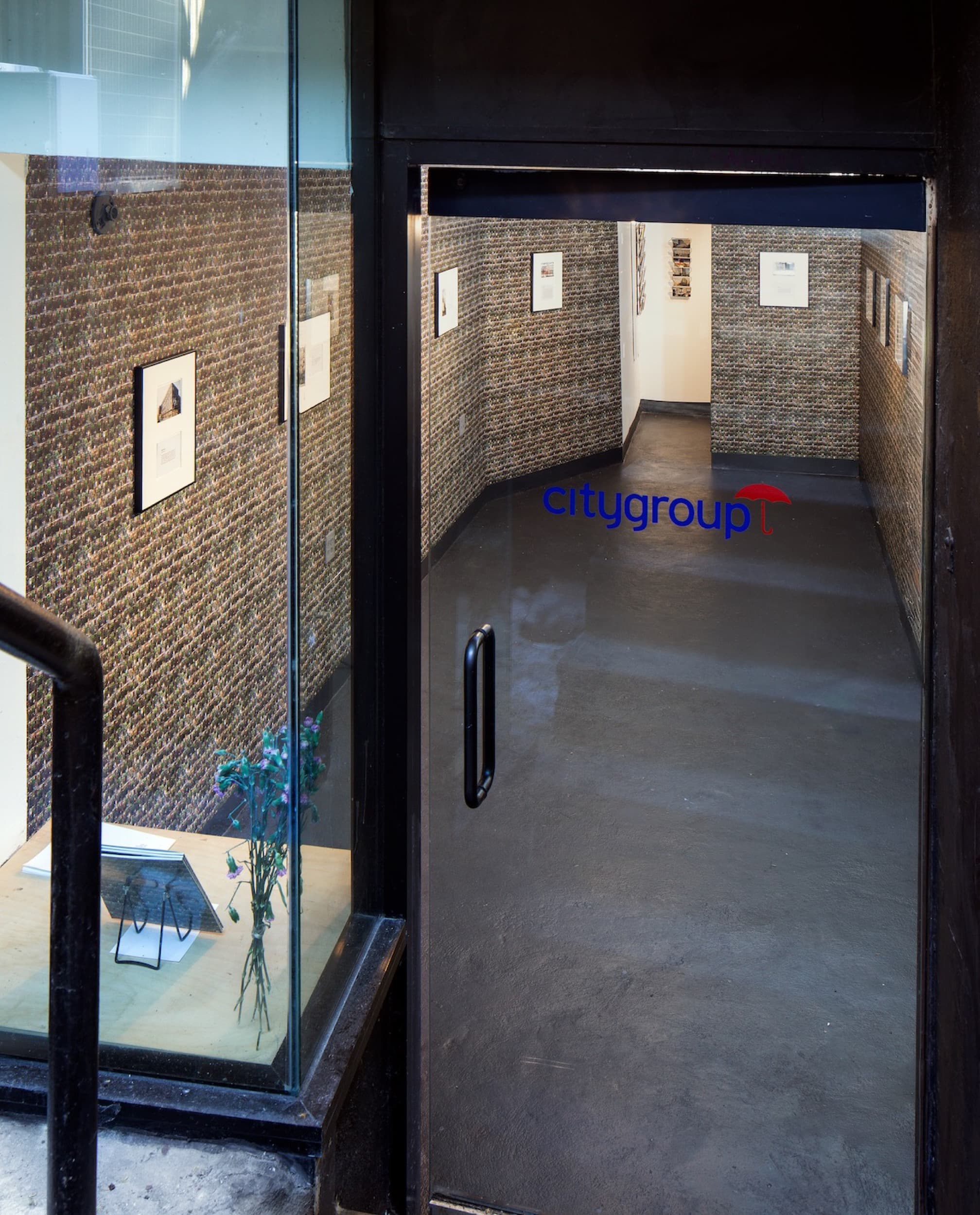
Installation view: Peter Scott: Public Sentiment, Postcards from New York, Citygroup, New York, 2026. Photo: Nicholas Knight.
Word count: 872
Paragraphs: 8
Citygroup
January 15-March 15, 2026
New York
People get displaced. Memories get lost. Identities get defused. Communities disappear. It all starts behind a green plywood fence.
A green plywood fence along the sidewalk in New York City indicates and separates a construction site from the street, the public realm. All required construction permits are on display. Alongside these are encouraging, smooth renderings of the new building. It’s another luxury condo for the few who can afford it; they are not locals. The locals have been priced out. Something is handwritten on the render of the new building: COLONIAL SCUM. On another street: HOUSE THE HOMELESS HERE. Another: NO ONE CAN AFFORD THIS. Again: PLEASE REVISE TOO BORING. Vandalism? No, it is reasons and sentiments.

Peter Scott, Nolita, Mulberry Street, 2023. 16 × 14 inches. Courtesy the artist and Citygroup. Photo: Nicholas Knight.
Public Sentiment, curated by artist Peter Scott, is an exhibition at Citygroup exploring how New York’s built environment and inhabitants are changing. It’s a collection of postcards featuring renderings of new developments across Lower Manhattan and Brooklyn, overlaid with graffiti critiques and exhaustion at the rise of yet another expensive new condo. These postcards, along with short texts collected from the comment sections of local newspapers, represent what is not happening enough in the public space: protest, speaking out loud, opposition to what should be opposed and resisted—a change that is not sustainable for all. It’s the voices of the last that will soon be displaced, or perhaps those that are already gone. They speak for the communities, the same communities that have shaped the city for generations. Public Sentiment is not just a collection of Scott’s, but a living memory and archive of the very many people who have called New York home.
Visiting New York as a European teenager in the eighties and nineties, it would have been about searching for all those things that were uniquely here. Going from one museum to another in the glossy Midtown and Uptown neighborhoods. Looking up at the skyscrapers seen only in movies or on “Greetings from New York” postcards. Searching downtown for the blooming hardcore punk scene—even though Bowery Street resembled a warzone, the sidewalk in front of CBGB during Sunday matinees was an explosion of vitality. Admiring the eye-catching graffiti on the subway cars and around the five boroughs—spontaneous and ticketless museums. Cooling down on hot days under the spurting hydrants or in the community gardens flourishing between the cracks in the city. Following the rhythm of the loud boomboxes, rapping the voices of the Black community in the street. Finding out that, like in Europe, in the neighborhoods where the City has been missing for too long, squats like ABC No Rio, C-Squat, and several more, have been—and some still are—crucial organizations and meeting points for communities, artists, and activists. They guarantee spaces for the public discourse and participatory modes of claiming space and decision-making in the city.

Installation view: Peter Scott: Public Sentiment: Postcards from New York, Citygroup, New York, 2026. Photo: Nicholas Knight.
That New York was sometimes posh, sometimes gritty, sometimes frightening, sometimes familiar, and sometimes new, but always energetic and vibrant. It was the place where citizens constantly organized themselves in myriad ways to claim their existence. It was the New York of conflict and fear, but also of possibilities and perpetual hope for everyone. In this aliveness, the street was a vital place—a public stage that represented different people, their relationships, struggles, and ambitions. It was a city unpredictable by nature, hosting fights and love stories. Still, little by little, many of those unique pieces, along with the lives behind them, were cleaned up by a sanitizing force and replaced by indistinct condos, restaurants, shops, and maybe even existences. It’s the same force that left CHARAS/El Bohío Cultural and Community Center without a home. In 1979, CHARAS, Inc., a prominent Lower East Side cultural and political citizens’ organization, squatted the former Public School 64 on Ninth St. In a few months, this illegal action became a lease from the City, and the availability of a large space permitted the offering of many social and cultural activities for almost twenty years. In 1998, a few months before the lease was up, the city sold the former P.S. 64 to investor Gregg Singer, who wanted to demolish the building and replace it with a student dormitory for New York University. After a legal battle in 2001, CHARAS/El Bohío was evicted, but thanks to its members and the Greenwich Village Society for Historic Preservation, P.S. 64 was landmarked in 2006, guaranteeing it wouldn’t be demolished. Many other buildings haven't been so lucky. Still, since the eviction, it has remained empty; its future is uncertain, and the neighborhood has lost a house for its community. There’s no nostalgia, but far more precarity. New York was not easy for everyone, but it was home for many. Someone might say that New York is now safer and more livable. But for whom?
The construction fence and its renderings are the boundary between those who were there and those who will be, between a public and a private sentiment. Hidden behind the fence is a graveyard of history and communities. The graffiti is the only visible pain of the absences and disappearances, voices of those who don’t want to be displaced.
Valerio Franzone is an architect. The director of OCHAP | Office for Cohabitation Processes, he works on design and research projects, teaching, and publications on how architecture addresses current societal and environmental urgencies.