Visible Read
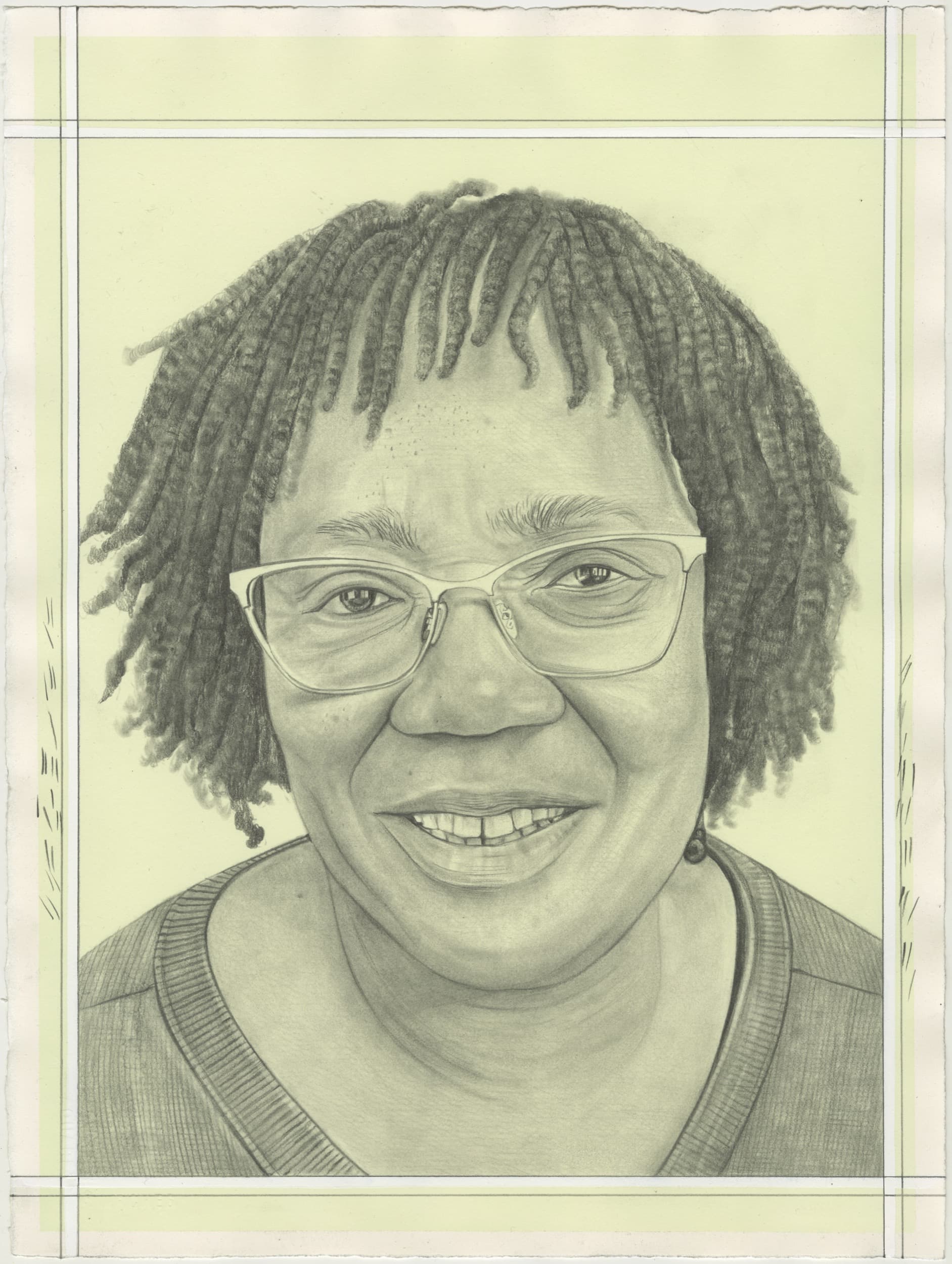
Portrait of Erica Hunt, pencil on paper by Phong H. Bui.
Word count: 550
Paragraphs: 9
This month’s Critics Page features eighteen poets and visual artists responding to a call for hybrid poems that place poetry and image in generative encounters. The strategies of each poem vary, recalling graphic literature, rune, collage, and concrete typographic art. But each poem-image creates visual poetry sampling from the techniques of the visual and poetic domains, and mines the vocabulary and allusions into compositions inviting eye and mind. Together, they blur the boundary between the read and the seen, joining each—text and image—into a sum greater than their individual parts.
My fascination for this valence of poetry and image stems from considering the broad and deep traditions of the hybrid. Mergers between multiple domains—the image, the symbolic, and the text—have occurred across time and in many guises. These hybrid text/images summon the symbolic; that is, a figural correspondence—similarity or dissimilarity and tension.
The concatenation of a visual image and association can be read in culturally diverse sources reaching as far back as the paleolithic period—think Kalahari rock painting, caves of Lascaux, and other rock paintings tens of thousands of years old (100,000 BCE onward) found on virtually every continent.
Poetry/text, chant, and symbol meet in Egyptian hieroglyphs, in the lettrist magics of Jewish Kabbalah, Islamic sacred scrolls, and medieval illuminated manuscripts. Collaborations between writer/visual artists, as well as those who are both, proliferate (William Blake) in European culture and in the calligraphic, non-alphabet-based writing systems of Chinese, Japanese, and Southeast Asian art; innumerable, encyclopedic, examples among modernist writer/artists forming a long trajectory of collaborations: Edouard Manet/Stéphane Mallarmé, Pablo Picasso/Paul Eluard, Joan Miró/André Breton, Wifredo Lam/Aimé Césaire. And in America: Barbara Guest/Grace Hartigan, Robert Motherwell, Philip Guston/Clark Coolidge, Frank O’Hara/Larry Rivers, Langston Hughes/Aaron Douglas, Rita Dove/Glenn Ligon, John Yau/Richard Tuttle, and Jeffrey Gibson/Layli Long Soldier, etc.
The hybrid poem text invites us to decelerate and to gaze. To slow down and step on the brakes in the race to decode, process, and obey, and instead take time to recalibrate an alphabet that is more mnemonic and contextual, oddly personal yet outward facing—meditative and inviting the reader/viewer to intentionally participate in making meaning. A raft of oxymorons in crossway currents to spin us, the reader/viewer, in order to activate the text—flipping hierarchies of reason and intuition, upheaving preconceived boundaries.
The tacit shift created by hybrid visual poetry is that slowing down expands meaning and resists reduction and simplification. The curious are provoked to question the easy practices of simple literacy—whether visually or textually—and modes of interpretation are tested and revised.
The array of visual poetry presented here flirts with the permutations of words and images in space, scale, typography, symbol, and fragment. While most of these examples occupy the two dimensions of the page, there is more than one that maneuver words into a third dimension of depth or edge. More than one of the image-texts suggest a spell; all suggest that words and letters are material and tangible, and place images and words into your hand, unmediated and assertively dialogic with you—reader—and your/their surroundings.
The editor thanks the contributors to this Critics Page section:
Alison Saar, Johanna Drucker, Kamau Brathwaite, sadé powell, Renee Gladman, Douglas Kearney, Francie Shaw, Bob Perelman, Rae Armantrout, Marcella Durand, Suzan Frecon, Susan Bee, Charles Bernstein, Diana Khoi Nguyen, Kostas Anagnopoulos, Keiko Narahashi, and Rachel Blau DuPlessis.
Erica Hunt is the author of Jump the Clock (2020); Veronica: A Suite in X Parts (2019); Piece Logic (2002); Arcade (1996); and Local History (1993). Hunt is the co-editor with Dawn Lundy Martin of Letters to the Future, Black Women/Radical Writing (2018). Recent work includes collaborations with composers Marty Ehrlich, Ingrid Laubrock and Myra Melford. New work with composer John Aylward is forthcoming in 2026.