Kory Stamper’s True Color
Word count: 989
Paragraphs: 13
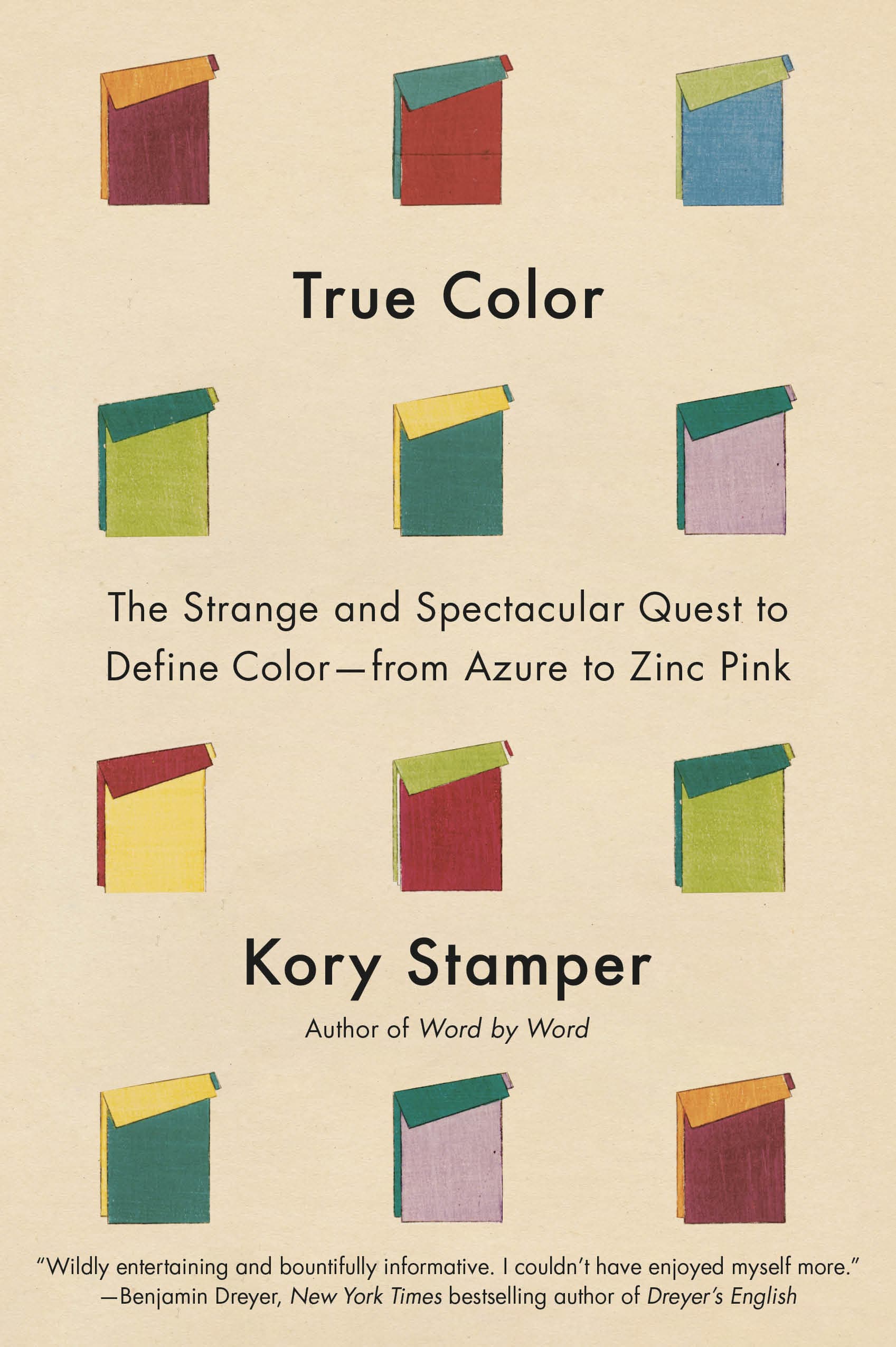
True Color: The Strange and Spectacular Quest to Define Color–from Azure to Zinc Pink
Knopf, 2026
In 1975, the uncategorizable writer William H. Gass published On Being Blue: A Philosophical Inquiry, a slim but dense volume dedicated to the color blue, the hue that perhaps more than any other has stained the language with longing, depth, and meaning. Attempting to reach an understanding with “blue”—and with the whole notion of words as signifiers for sensory perception—no single approach was enough; Gass had to employ philosophy, prose poetry, criticism, and catalog to even get close.
And his is hardly the only book about that one color. (Difficult to definitively count, there might be upwards of ten blue volumes.) There have also been literary explorations of white, red—a couple of those at least—and yellow. As well as titles aplenty on everything touching on the history, sociology, chemistry, and physiology of color, including in art, nature, and manufacture.
It seems there is no end to what we can say about color, just as there is no end to color’s variety, importance, and emotional resonance. But what do we talk about when we talk about color?
Outlandish as it may sound, Kory Stamper has now given us a spiritedly breathless account of the effort to define thousands of different colors—define, as in “dictionary entry.” It is a depiction rich enough in detail and, yes, suspense that it could be the basis for a binge-worthy television series. Who knew the offices of Merriam-Webster in Springfield, MA, could hold such intrigue, so many irascible personalities, disasters in the making, and arcane props in its mise-en-scène (aka “color”)? Imagine The Pitt set in a 1950s office, with paperclips instead of heart monitors, and where the insertion of an errant period at the end of a single definition, say, becomes a subplot concerning the firing of a young Smith grad so sleepy from the toil to get pages to the printer she let that fatal error get through.
In writing about the making of dictionaries, Stamper offers the kind of elemental story people crave: a privileged look inside a subculture whose multitudinous gears and levers have been hitherto hidden to outsiders. Whether depicting the world of a free soloist or that of an F1 driver, the inside dope on the specific languages and equipment and agendas that comprise any number of esoteric human pursuits are manna to readers.
In True Color, the minutiae of the lexicographer’s work becomes oddly thrilling: the millions of index cards, or “pinks,” on which editorial notes about definitions are collected, and the “buffs” on which the definitions themselves appear; the department whose sole job is to read widely to find the citations, or “cits,” that will best illuminate the meanings of words; the elaborate office hierarchy and the pace at which the worker bees must hum; the heated arguments about punctuation and prepositions.
Stamper, herself a lexicographer who worked at Merriam-Webster and the author of Word by Word: The Secret Life of Dictionaries, shows off her extraordinary chops as a researcher by plumbing the depths of the company’s archives to bring us a blow-by-blow narrative of the making of the second edition of Webster’s New International Dictionary (1934) followed by its all-new remake, Webster's Third New International Dictionary (1961). But like any great storyteller, she knows it is focus on granular particulars that propels a book, and so she tightens focus to the rare ferment in the science of color during the first half of the twentieth century. Rapid discoveries in the field, and the desire to establish authoritative color standards for use by the government and industry alike, paralleled an unprecedented rush of scientific advance at the time: in just the twenty-five years between the first and the second New International dictionaries, Stamper notes, “the blender, the traffic light, the polygraph, the garage door (and garage-door opener), the grocery store, the crystal oscillator, the iron lung, the electric guitar, the radio telescope, autopilot, Freon, tampons, the cyclotron, and toggle light switches were all invented.”
We had fully entered a bright new age of science, and the study of color—the language of poets and painters that is also the tint of human experience itself—came right along. The compendium that was meant to capture the entirety of a living language (Stamper refers to the finished product, which contained 2,726 pages, as a doorstop) had to account for modern redefinitions through the lens of new understanding of color. The special editor hired to oversee the subject proposed defining three thousand color names, out of 400,000 entries total. Arguments about classification and description immediately commenced, and continued for the better part of a decade.
To take one example from those thousands, consider amethyst: in the course of editing, its definition “blossomed from the short ‘dark purple’ to the fully fleshed out ‘a variable color averaging moderate purple (which is) redder and duller than heliotrope (sense 1) or manganese violet, bluer and duller than cobalt violet, darker and slightly stronger than average lilac (sense 1).’”
Stamper’s improbably entertaining chronicle of the struggle to authoritatively name the inherently unnameable is a nerd classic, and I mean that in the best way. Indeed, the growth of the public appetite for reading about scientific discovery during the first half of the last century caused the flowering of what we now call “pop sci”—the very genre of True Color. The period that Stamper writes about in effect made her book possible.
One of the signal qualities of the genre as practiced today is a foregrounding of individual character and narrative propulsion, two elements Stamper has conjured like a dove from a top hat. Or from the desiccated records of an old dictionary’s creation. In restoring color to the people and events of a past time, her book embodies the essence of its subject: life, like the making of a dictionary, is nothing if not colorful.