Rana Begum: Reflection
Installation view: Rana Begum: Reflection, the Gallery at Windsor, Vero Beach, Florida, 2026. Courtesy the Gallery at Windsor.
Word count: 903
Paragraphs: 12
The Gallery at Windsor
January 24–May 8, 2026
Vero Beach, Florida
These days, I’m sadly able to glide through most exhibitions without a scratch. Skimming wall text, glancing from piece to piece—I’m rarely arrested by art. But Rana Begum’s Reflection shattered every one of these bad habits. I found myself circling back to certain pieces again and again, obsessing over the ways they shapeshifted before my eyes. Begum’s artworks are dazzling displays of technical skill and conceptual originality, but what is most impressive about them has less to do with the pieces themselves and more to do with the experience of standing before them.
Begum is fascinated by the viewer’s experience: perception is as much a tool for her as aluminum, paint, watercolor, and glass. Begum is an alchemist of color, manipulating shadows and light to concoct mesmerizing effects that change throughout the day. At the same time, she is a mathematician of form, using abstracted shapes and patterns to guide a viewer’s focus inward, toward awareness of the multitudes within the self.
Begum’s first museum survey in the United States, Reflection unites several series of works made over the course of her career, foregrounding the artist’s fascination with light and color, her mastery of minimalist sculpture, and her thoughtful reimagination of industrial materials like light reflectors, safety tape, and glass panels. The exhibition was produced collaboratively by the Savannah College of Art and Design and Windsor—a New Urbanist residential community in Vero Beach, Florida—and its title, Reflection, offers a window into the contemplative heart of the show.

Installation view: Rana Begum: Reflection, the Gallery at Windsor, Vero Beach, Florida, 2026. Courtesy the Gallery at Windsor.
We can see this, for example, in the straightforwardly reflective conceit of No. 744 L Fold (2017). Stainless steel, painted cherry red, is contorted with origami-like precision and mounted at eye level so that each face of the sculpture reflects light and casts shadows in every direction. Walking around the piece, shadows shift and hues of red intensify and soften, creating an effect that is simultaneously monochrome and kaleidoscopic. As with many other works in the show, Begum rewards her viewers’ curiosity: the more time you spend shifting back and forth, tilting your head, the more the work transforms itself before you.
No. 827 (2018) produces a similar effect. Because the face of each of its vertically-mounted aluminum bars is white, standing directly before the work, or viewing a photo of it, is a rather bland experience. Walking slowly past No. 827, however, reveals the magic at work. Because the sides of each powder-coated bar are painted with different colors, the light reflecting between them causes the whole installation to glow various combinations of colors depending on where you stand, creating the illusion of movement. It’s a trick of the eye, yes, but it’s also a critique of myopic oversimplification. The moment you decide what colors you see, you take a step, and those colors change.
While Begum’s watercolor pieces scattered throughout the show continue to toy with bleeding and shifting colors, No.1272 Chainlink (2023)—composed of massive sheets of hand-woven chain-link fence hanging in the center of the gallery—represents the artist’s most direct engagement with industrial material. Some of the sheets are blue and others are red, so the spaces where they overlap read as a cluttered and chaotic purple. While chain-link’s associations, such as separation and even imprisonment, are palpable within the room, the piece doesn’t engage with any of these ideas directly. It is left up to the viewer to parse out how these connotations affect their experience.

Installation view: Rana Begum: Reflection, the Gallery at Windsor, Vero Beach, Florida, 2026. Courtesy the Gallery at Windsor.
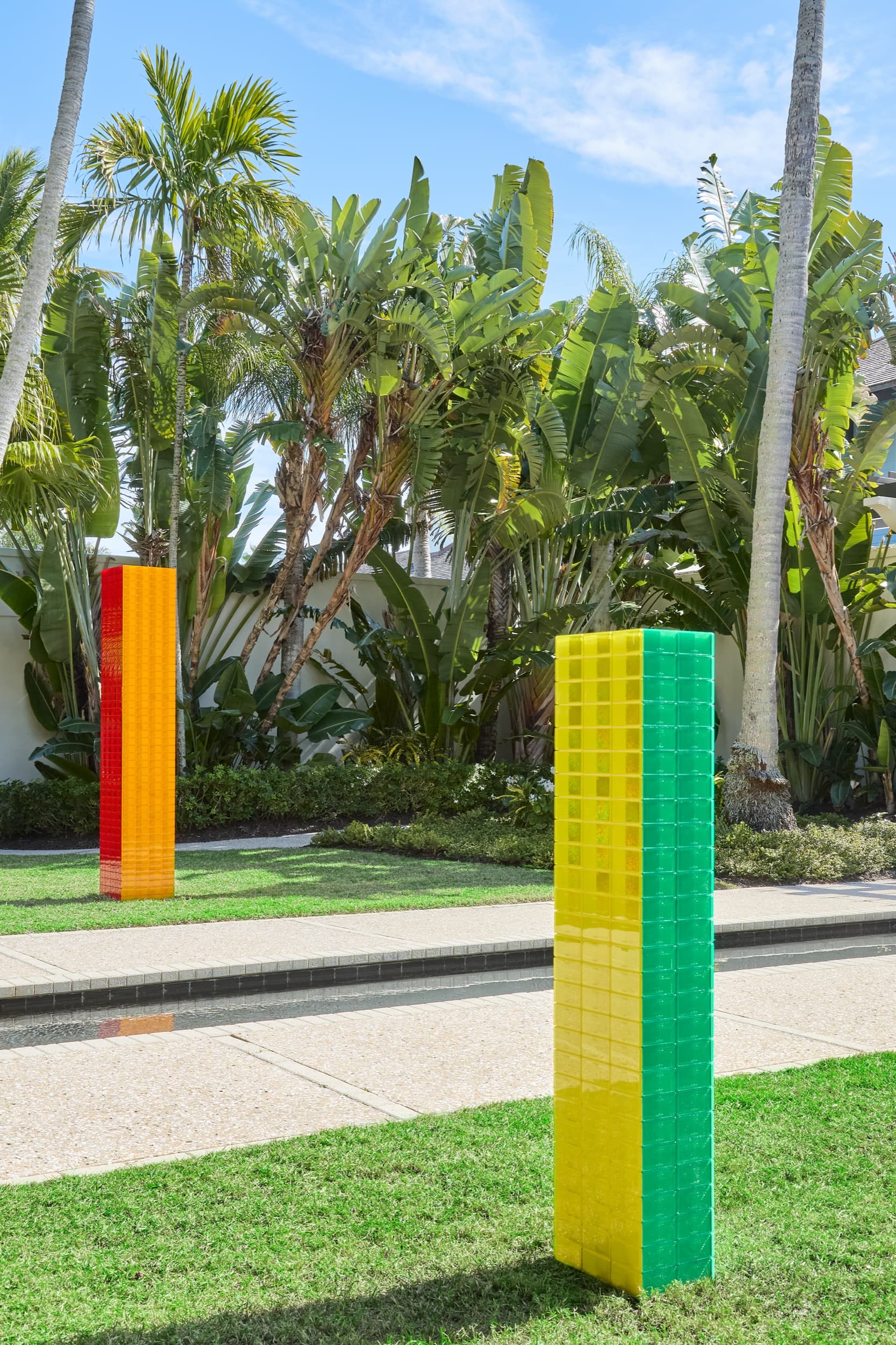
Though most directly linked to the show’s title, Begum’s reflector series was, for me, perhaps the least arresting installation included here. It was a smart curatorial decision to install the rectangular pier of No.1261 T Reflector (2023) outdoors alongside several other aluminum towers decorated with alternating sheets of colored reflectors, so that each sculpture sparkled in the bright Floridian sun. But ultimately the simple geometry of these works left me uninspired.
To my mind, Begum’s empyrean “Louvre” series restores the sense of awe and wonder her reflectors lost. Each hanging stack of painted glass, finished with progressively diminishing opacity, leads the eye skyward. Though there is no actual sun shining behind them, each of these works recreates the warmth of sunlight escaping through clouds, making the room feel lighter. As many of the windows of the surrounding Windsor houses use plantation shades, the “Louvre” series, which mimics their form, felt right at home.
It’s crucial to note that nothing about Begum’s work is pointed. While the gallery’s description of the exhibition draws connections between ideas like the artist’s “childhood memories of the rhythmic, daily recitals of the Qur’an” and her interest in meditative artmaking practices (e.g., the manual weaving of chainlink material and the repetitive painting of blocks of watercolor), the works on view here make it abundantly clear that Begum doesn’t want to pigeonhole herself. Though her experimentation with color, light, and sculptural space suggests a dialogue with artists like Dan Flavin and Robert Irwin, for example, Begum has made it clear that none of these comparisons interest her. While her work seems to interact with the legacies of abstraction, Minimalism, and Op art, Begum’s focus is never on art historical parallels or genealogies, and instead always returns to her viewer.
Conceptually, Begum’s work is unencumbered. What matters most is what the viewer brings to the encounter; what they take home is up to them.
Justin Duyao is a writer and editor based in San Diego, CA.