Qiu Xiaofei: The Theater of Wither and Thrive
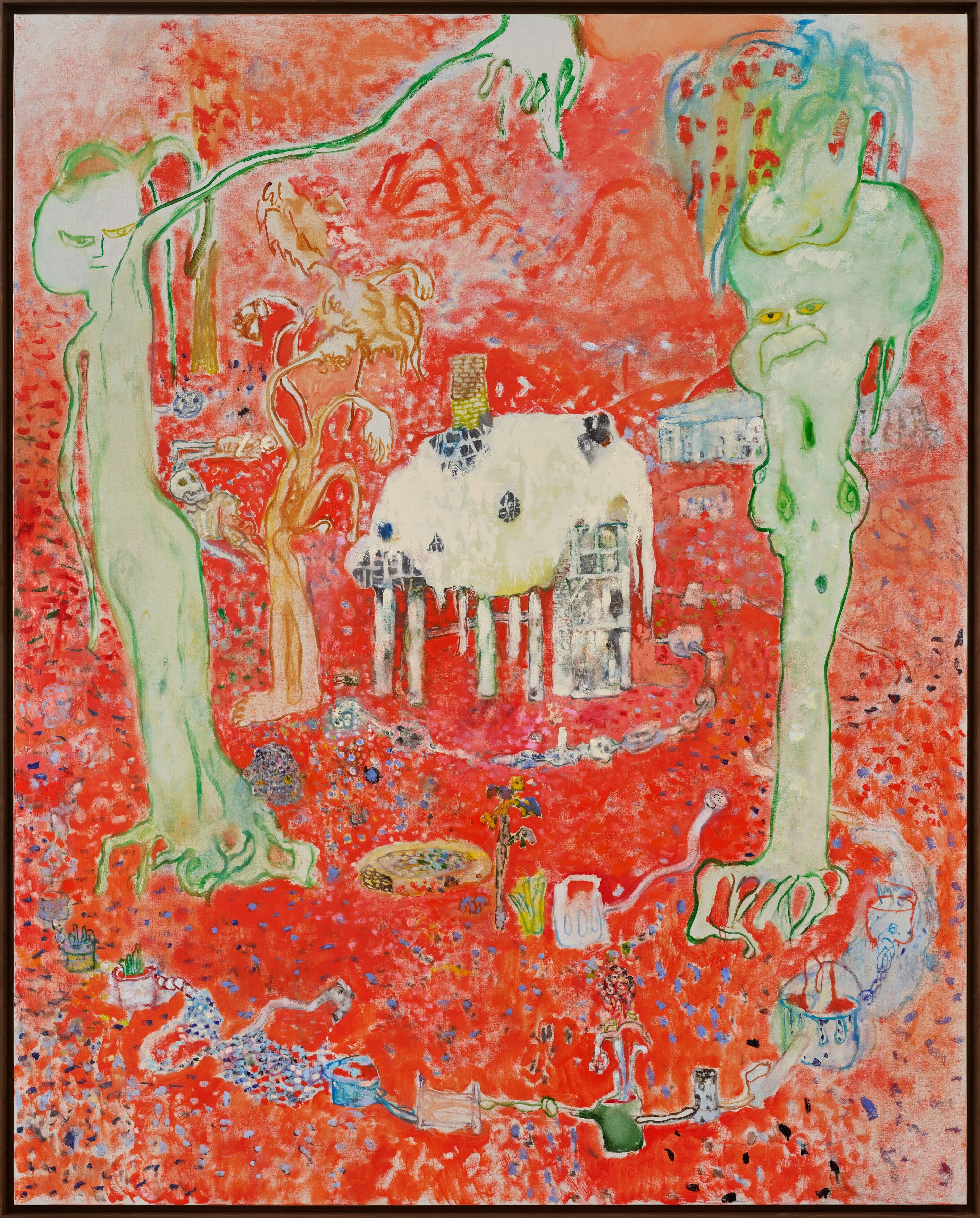
Qiu Xiaofei, Garden, 2025. Oil on linen, 98 ⅜ × 78 ¾ inches. © Qiu Xiaofei. Courtesy the artist and Hauser & Wirth.
Word count: 927
Paragraphs: 9
Hauser & Wirth
February 12–April 18, 2026
New York
A condition of our contemporary experience of artworks and exhibitions, photography remains the main point of entry before we get a chance to see anything in person, if ever. It plays a fraught role within the artist’s studio where painting’s nostalgic return to realism can—in certain cases—conceal it. Qiu Xiaofei becomes one of the few painters who publicly acknowledges photography’s role in his new body of work at Hauser & Wirth, New York, though to surprising ends. The inception of The Theater of Wither and Thrive lies in a box of undeveloped film left by the painter’s late father, who was the set designer at the Yong Feng Society in Beijing, China. The developed photographs are on display in the back room of the gallery, so I started my visit there.
Black-and-white photos of the artist as a child yellow his juvenile smiles. Scenes of familial gathering are sprinkled amongst those of nature and history: a rippling lake framed with foliage, a frozen lake under withering trees, the Colosseum, a picture of Paul Klee’s Angelus Novus next to a portrait of Walter Benjamin, a postcard picture of the Hagia Sophia, and studio images of still life flowers. One of the most striking photos depicts a gateway to a world in ice—likely in the artist’s native Harbin—tightly lined with sharp icicles suspended midair. Such crystallization lends itself to an important formal language in Qiu’s dreamscapes. Cosmopolitan(2025) ink study inhabits a flattened perspective, conjuring a vertical landscape shaped by pen drawings captured in various states of dissolution. The composition is fixed with a man’s head at its center, whose wounds open windows and expose fences that are already rotting in rusty tears.

Installation view: Qiu Xiaofei: The Theater of Wither and Thrive, Hauser & Wirth, New York, 2026. © Qiu Xiaofei. Courtesy the artist and Hauser & Wirth. Photo: Thomas Barratt.
The unnerving stillness extends to a strange sense of deprivation despite the vibrant range of Qiu’s palette. The dispersive landscapes grapple with no single frozen moment but unfold a multitude of times. Every site of sprouting is accompanied with residues of decay. In Garden (2025), roots turn into the toes of humanoid trees, extending their arms over a snowy cabin, resting amidst a red field of scattered skeletons, potted plants, and watering cans. The titular piece sees a central figure in repose, with a shaggy hand gripping his own head, as if pointing to neurosis. His chunky, crossed legs appear to form a mountain range. Near his giant feet stands a residential building, alone in a forest of animated branches like dancing arms, leaves like theatre masks. The sense of malaise is further accentuated in The Shelter with a Thousand Rooms and Joyce’s Snow (both 2025), where dark crimson is deployed in scenes of hospital beds and wreckages.
Qiu Xiaofei is known for his philosophical contemplation on time, encompassing its inherent spirality through mental representation to the topical population on his canvas. If his past paintings were ethereal gesticulations towards time as an abstract matter, this new body of work meanders through time’s symbols in history and personal memory. How does time survive? Imagination is staged on anachronistic fragments forming familiar phantasms, trails of glistening remnants in cavernous spirals—while rotting in the depthless field of what seem to be endless, painterly ruminations, surfacing the incongruity of time. On the propped-up stage in Fault Line (2024), pastel vapors redolent of Socialist realist dreams form an idyllic village above the reclining body in the middle ground stationed like a brutalist building. On the bottom, reflections scatter like holes in the ground. The base color in Fault Line is foregrounded in Dandelions of Jade Spring Hill (2025) and colors the faces and building walls in the picture with a monochromatic redaction.

Qiu Xiaofei, The Shelter with a Thousand Rooms, 2025. Oil on linen, 94 ½ x 78 ¾ inches. © Qiu Xiaofei. Courtesy the artist and Hauser & Wirth.
For a body of work that probes the personal, these paintings seem to slip into the liminal and the lethargic. Qiu’s paintings depict egalitarian germinations of houses and trees, interspersed with household items, elongated arms like pipelines, not unlike the socialist urban development in 1980s and 90s China, a now-dematerialized vision that only resides in distant memory as the country takes on a new direction. Qiu’s mark-making here excels in both its obscurity and clarity—carving an indeterminate space out of aesthetic detritus left behind in history by progress—the accumulative effects of which seem to unironically amount to a deep loss. This could explain the dissatisfaction with reality when compared to the works’ photographic reproductions, but this deduction alone feels amiss.
Angelus Novus (2025) hosts the most brilliant spectres of the show in terms of intensity. The colorful strokes fill in the cobalt void like swarming fireflies or a forceful blizzard, storming passages into crystalline refractions. Yet upon closer look, what shimmers from afar dims in dissipating impermanence up close. A ghostlike figure cloaked in darkness and bandages gazes up in agony. He wears a red symbol of hammer and sickle on his head, his hand held high holding a golden chip as if reaching from beneath the theatre stage. Could this be the Angel of History in distress? We might recall Benjamin’s “Theses on the Philosophy of History”:
His eyes are staring, his mouth is open, his wings are spread. This is how one pictures the angel of history. His face is turned toward the past. Where we perceive a chain of events, he sees one single catastrophe which keeps piling wreckage upon wreckage and hurls it in front of his feet. The angel would like to stay, awaken the dead, and make whole what has been smashed. But a storm is blowing from Paradise.