Penumbra: Beyond the Uncanny Valley
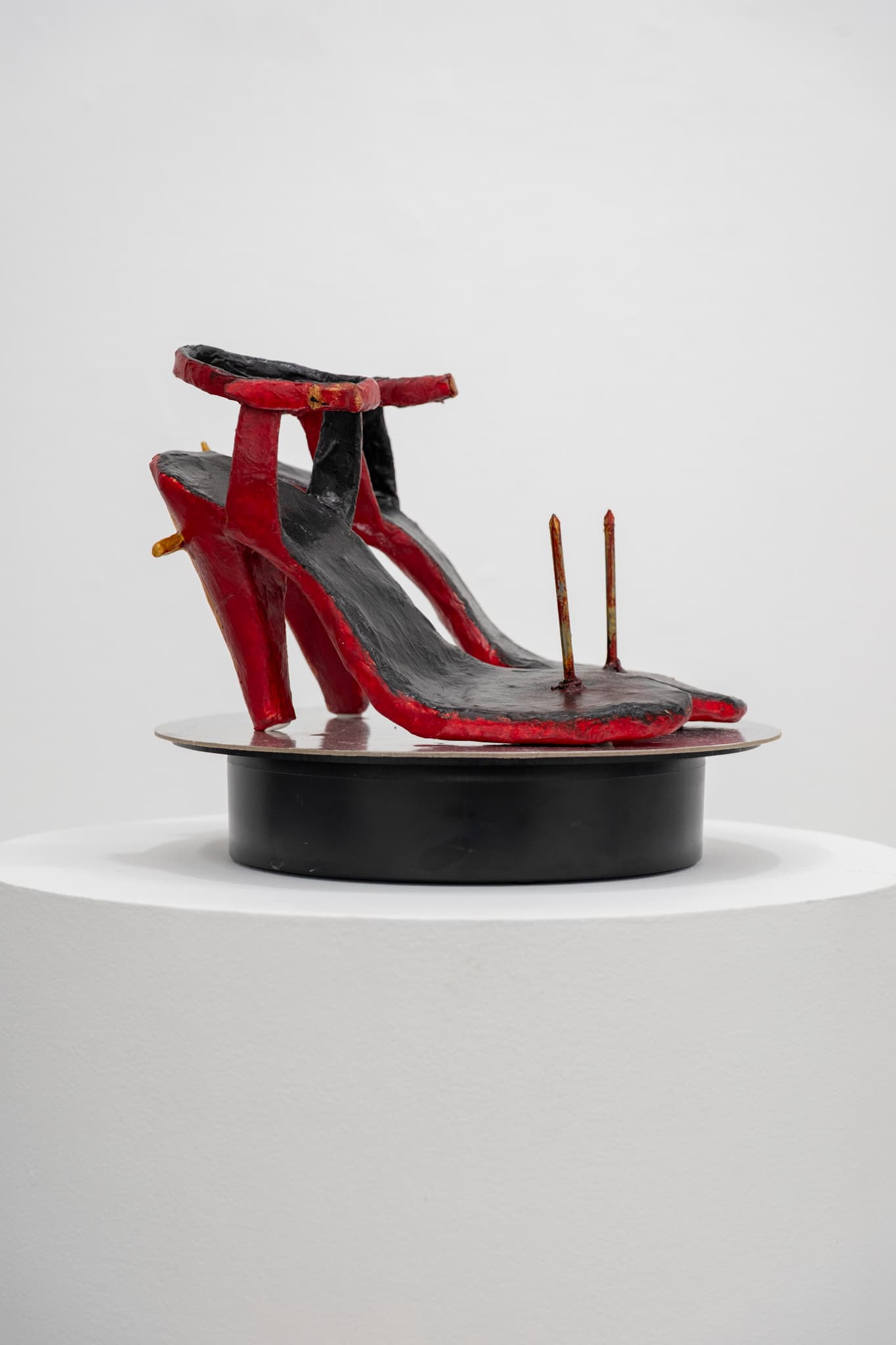
Greer Lankton, Jesus's Cha Cha Heels, 1986. Acrylic paint, papier-mâché, metal, wood, 7 × 7 × 4 inches. Courtesy Ortega y Gasset Projects. Photo: Chanel Matsunami.
Word count: 835
Paragraphs: 9
Ortega y Gasset Projects
March 7–April 26, 2026
Brooklyn
Penumbra: Beyond the Uncanny Valley brings together ten works spanning over four decades, plumbing the iconic oeuvres of seminal artists like Beverly Buchanan, Robert Gober, and Greer Lankton. Newer works on view by Christopher Gambino and Alec Snow recall human shapes, though barely. Fetching a harmony across time, this presentation gives voice to formless silhouettes of absent and unknown bodies.
To open, Greer Lankton’s Jesus’s Cha Cha Heels (1986) turns slowly on a rotating mirror display, resembling those in a storefront window. The strappy papier-mâché shoe is painted in blood-red acrylic with a golden cross embellishment along the spine of the heel. Stained crimson, two upright nails puncture each sole. Lankton’s tongue-in-cheek sculpture pictures a scene of Jesus pulling himself off his high heels, letting out a sigh of relief after three long hours of dancing.
The single-room gallery is full of strange wares. For example, Juju Bag for a White Protestant Male (WPM) (1979–80), Janet Olivia Henry’s clear vinyl tote bag, contains a curated assortment of plastic toys, dolls, and short texts. One reads: “White Protestant Males are born adventurers, explorers of the wild, seekers of the unknown (to western man), path finders, trailblazing, unbeaten track-treading pioneers (and stuff like that).” Henry’s juju bags are transparently biting, enlisting dolls to parodize social and political identities. Nearby, Charles LeDray’s Doggie DINER (2018) shrinks a shirt to the size of a large doll. The T-shirt’s scale, along with the detailed hand-painted marks and threadwork, affords the soiled shirt a delicate quality. Miniaturization formalizes acts of apprehension, pacification, and derision. In this case, the artists take up particular strains of evangelical and blue-collar masculinities.

Installation view: Penumbra: Beyond the Uncanny Valley, Ortega y Gasset Projects, Brooklyn, 2026. Courtesy Ortega y Gasset Projects. Photo: Chanel Matsunami.
Accompanying the exhibition and inadvertently scheduled for the afternoon of Easter Sunday (to Lankton’s amusement, I imagine), Ortega y Gasset Projects hosted a series of performances by sound artists Allium, wei, and Mason Youngblood. In Alaka'i 1777 (2026), Youngblood extrapolates the birdsong of the Kauaʻi ʻōʻō, a now-extinct honeyeater, invoking a time before European colonial encounters reduced variation in the species’ vocalizations. Youngblood’s manipulation of recorded ʻōʻōs mirrors the use of field recordings and reclaimed material by Allium and wei to produce sound. At one point during Allium’s performance, she turned the speaker back toward the source. The sonic output folded back onto itself, resulting in disorienting ringing and sharp crepitation. Using feedback as material teases the psychological effect that uncanniness prompts.
If it were enough to make out the known from the unknown, uncanniness would be aesthetically toothless—the artists here insist on something more. Many of the works’ identifiable doors entice visitors throughout the exhibition. Greg Caridero’s TSD (2022) stretches a sheer fabric across a steel domed awning. Guiding lines draw toward the heel of an inlaid shoe sole. I craned around the four sides of Beverly Buchanan’s Wooden Shack (2011), finding that the little balsam house’s stoop faced the gallery wall. A wooden bulkhead door opens to downward steps leading to a fake entry in Robert Gober’s untitled silver box (2001–23). Small-scale interiors are suggested, as they might appear in faith****’s mosaic wall sculpture and Laurie Simmons’s image of a TV room full of pocket-sized furniture, and still, admittance is a fanciful prospect. Entryways become as functionless as they are in dollhouses, and unlike with dollhouses, we don’t have the luxury of being able to pull these artworks apart at their hinges. But it’s for this reason that they so trenchantly arrest the uncanny. Teetering between acquainted and alien, they not only destabilize our sense of the (un)familiar, but they gesture toward a persistent impenetrability on either side of the parentheses.

Christopher Gambino, Dreaming Augusta, 2026. Banisters, duct tape, stockings, resin, shoes. 5 ½ × 10 × 64 inches. Courtesy the artist and Ortega y Gasset Projects. Photo: Charles Benton.
Two sculptures by Christopher Gambino and Alec Snow rest on the floor of the gallery. Together, they complicate this idea of opacity. Snow’s Farewell Tour (Systole) (2025) stands precariously on irregular ceramic spires. Glazed in a gradient of cobalt blue, they neatly pierce through a clear acrylic box hugged by a poplar grid. Inside, a pillow, compressed between the lancing pieces, contorts into an organic form. Meanwhile, Gambino uses old banisters to approximate a set of legs. Stockings treated with resin stretch over the wooden appendages to create a glassine effect. At their feet, two croc-effect heels lean face down, indicating we’re viewing the backside of the half-body. Jutting nails haunt as allusions to once-joined structures and acts of dismemberment.
While the familiar charm of recycled clothes, buttons, and found objects is spent by the time they appear in the gallery, these collectibles resurface as vestiges, or shadows, of their former uses. As much as our viewing constitutes an attempt to know these objects, it is the even counter of their refusal to settle comfortably into understanding that paradoxically allows for any insight. Uncanniness derives from uncertainty—the potential present in seeing something that could be living or pulseless. These artists don’t bank on uncertainty; they assuredly move beyond it toward sounds, forms, and worlds that are impossibly human.
Joshua Chee Sanford is a writer based in New York.