Henri Rousseau: A Painter’s Secrets
Word count: 1016
Paragraphs: 11
The Barnes Foundation
October 19, 2025–February 22, 2026
Philadelphia
Amid the Impressionist and modern luminaries collected by Dr. Albert C. Barnes of Philadelphia, an exhibition of paintings by Henri Rousseau (1844–1910) seemed implicitly to make the case for his excellence as a painter—an idiosyncratic master with the chops to go toe to toe with anyone from Édouard Manet to Pablo Picasso.
No need for such a case, for two reasons. First, in this riveting selection of nearly sixty paintings, including iconic works from the Barnes collection and the Musée d’Orsay, Rousseau’s strengths and weaknesses were there for all to see, by turns transcendent and laughable. Any arguments for his aesthetic and technical accomplishments—the sort of discussion that went on around the exhibitions he entered in the 1890s—or for his influence on modern art seem like special pleading.
Second, Rousseau’s true importance lies both within his paintings and far beyond them. The ascendency of modern art in Europe in the nineteenth century and its break with tradition cannot be understood without reference to him. His work is the shadow of all that was produced around him, a shadow whose darkness the sun of modernism and revolutionary progress could not dispel. Getting his terms inverted, Rousseau put it this way to Picasso: “You and I are the two most important artists of the age—you in the Egyptian style, and I in the modern one.”
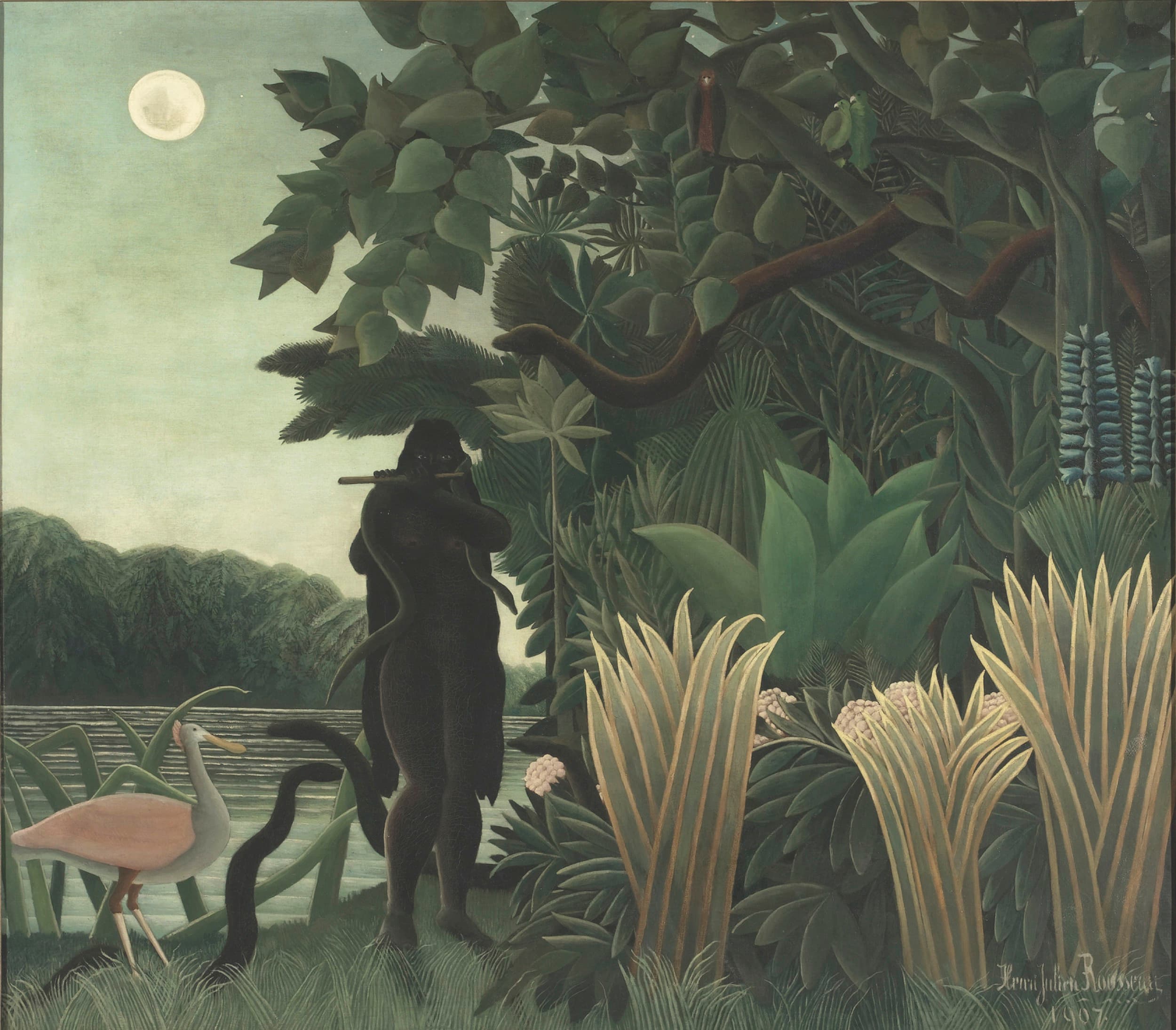
Henri Rousseau, The Snake Charmer, 1907. Oil on canvas, 65 ¾ × 74 ⅝ inches. Courtesy the Musée d’Orsay.
Rousseau was born to a working-class family in Laval. Working class is optimistic: his father was a tinsmith. Rousseau himself found work as a minor excise officer for the city of Paris. Later among the art crowd this would earn him the patronizing sobriquet “Douanier” (customs agent). Patronizing because Rousseau was self-taught. He spent his limited spare time haunting the Louvre, the salons, and the exhibitions. They were his only school. He pursued conventional achievement with doggedness and ambition—and got it exactly wrong. As art historians Carolyn Lanchner and William Rubin put it, “It is likely that he tried in his earliest paintings to emulate the achievements of [art’s] high priests, and, in working toward that ideal, rather than away from it as his contemporaries were doing, effected an unpremeditated reversal of its terms.” In every way he was the shadow, the distorting glass of the avant-garde: in his ambition, his desire for popular success and his need for money, in his pursuit of critical recognition and a place in the community of painters (whose work he often did not understand), and above all in his inability to follow the very conventions he valued so highly.
He couldn’t paint faces, except in larger, possibly commissioned portraits, where he really had to. His sense of perspective was medieval, and the proportions of his figural elements usually made no sense. His scenes were flat and ornamentally elaborate, with no interest in the temporality that obsessed the Impressionists. One critic of the time described him as “a completely worthless but extraordinarily determined painter.” Yet precisely in his undermining the rules, the avant-garde saw a fellow traveler. His paintings were praised by a wide range of artists, including many of those in the Barnes collection itself: poets Alfred Jarry and Guillaume Apollinaire, painters Paul Gauguin, Odilon Redon, Robert Delaunay, and most important, Pablo Picasso, who bought Rousseau’s arresting full-length portrait of a woman (1895) for five francs and later bequeathed it to the Louvre.
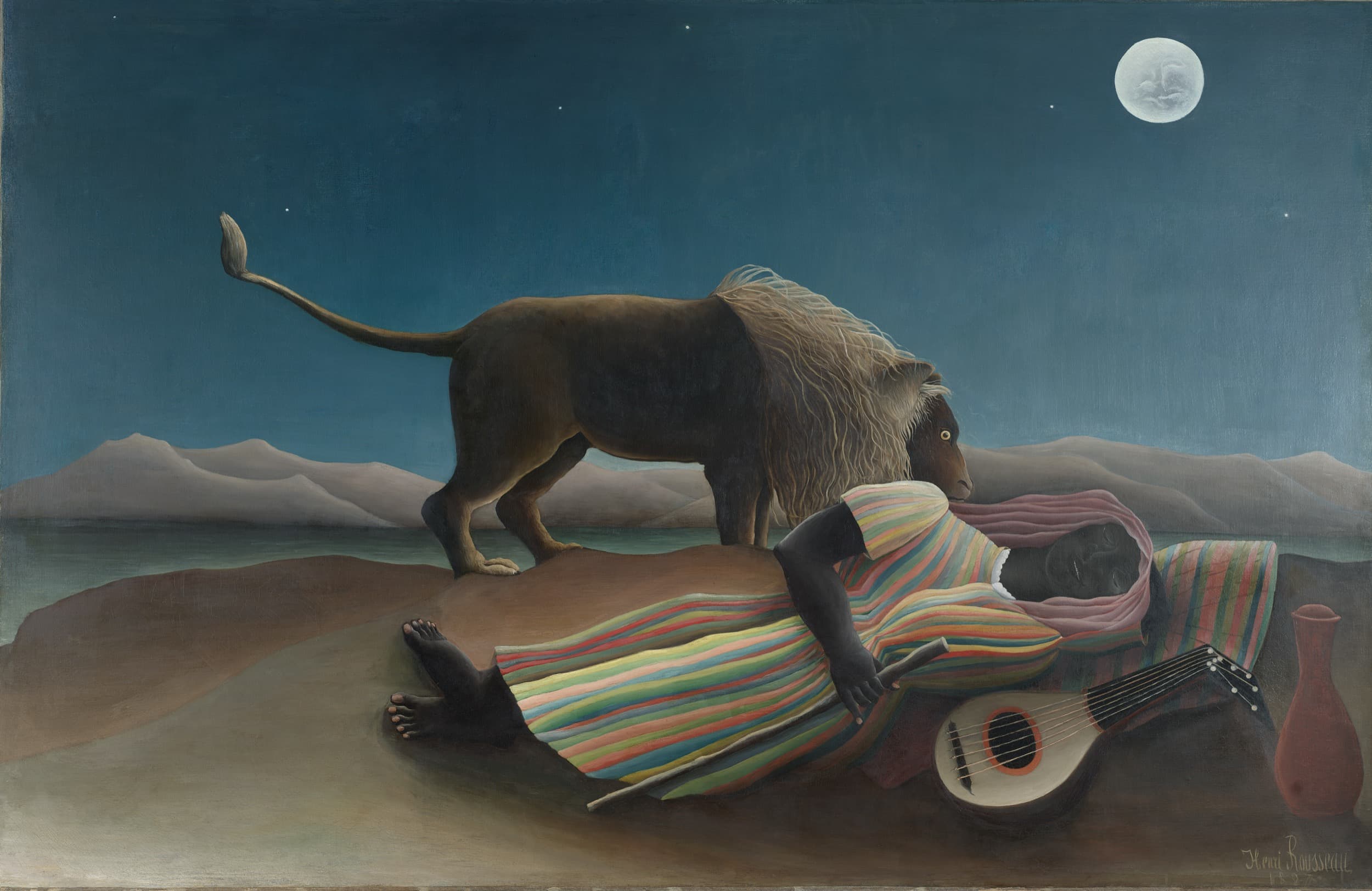
Henri Rousseau, The Sleeping Gypsy, 1897. Oil on canvas, 51 × 79 inches. Courtesy the Museum of Modern Art.
Rousseau became the most celebrated example of what philosopher Arthur Danto called the selective enfranchising of the other that underpinned so much of modern art. In their quest to forge more authentic languages of expression, outside of social, academic, and aesthetic norms, artists sought confirmation and inspiration in the productions of self-taught and “Sunday” painters, of the institutionalized mentally ill, and of so-called primitive cultures (anything not Greek or Roman), none of whom, it is safe to say, shared the goal of formal innovation.
Those battles are over. Standards of bourgeois taste have long since fallen to pieces like the shackles of Saint Peter, leaving us free to regard any form of expression, however odd or extreme, with tolerance and appreciation. Is that all the Douanier deserves? The Barnes exhibition showed, instead, that Félix Vallotton hit the mark when he complained of having his work hung next to one of Rousseau’s jungle paintings in the 1891 Salon des Indépendants: “He is a terrible neighbor, since he crushes everything else.”
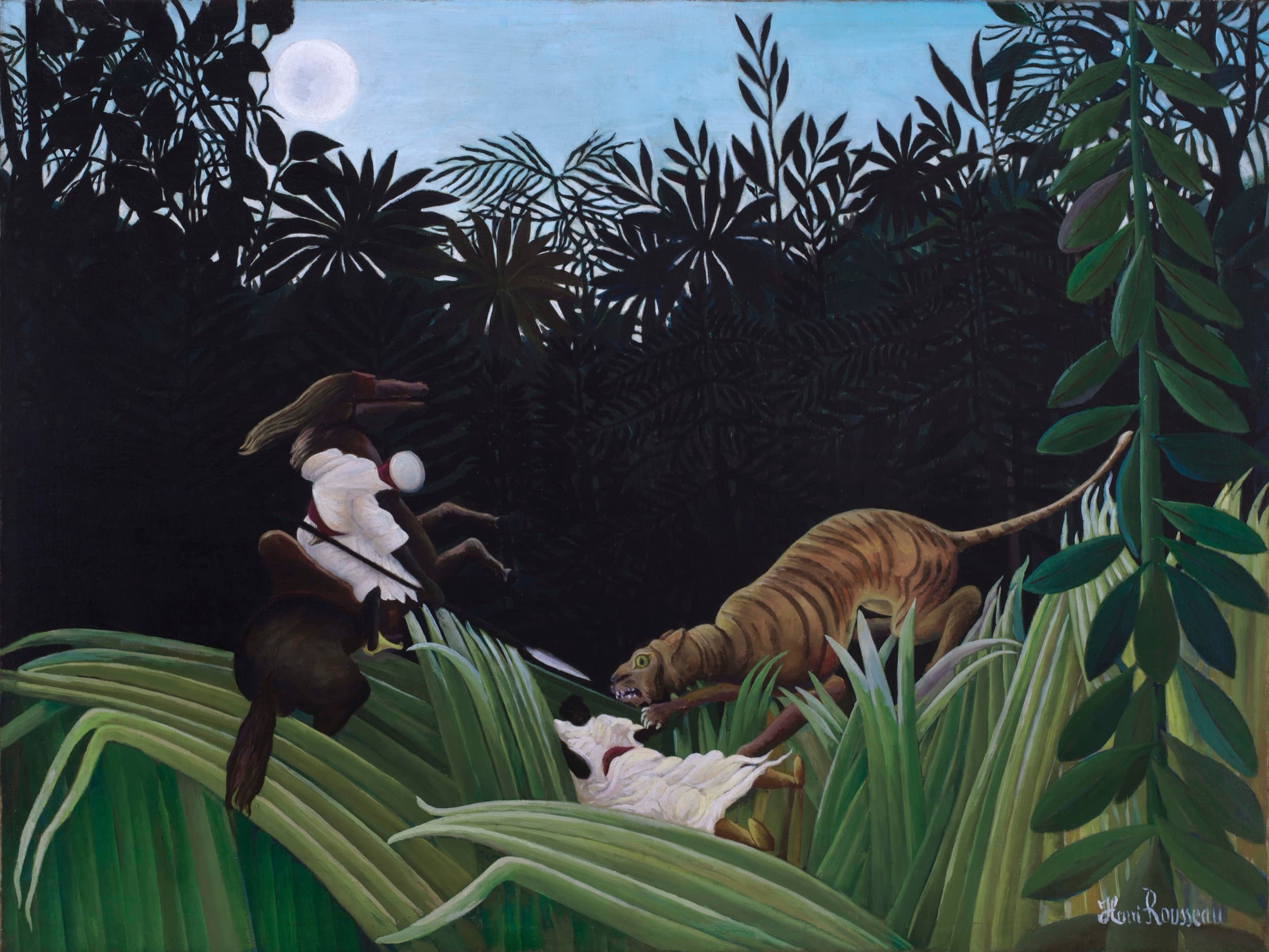
To visit a room in the Barnes exhibition that contained a suite of jungle paintings, including the apparitional Scouts Attacked by a Tiger (1904), was to be crushed like Félix Vallotton—by the transvaluation of all values taking place in a profound imagination that, despite its intentions, couldn’t do otherwise. The sources for many of Rousseau’s most captivating paintings were kitsch. The Snake Charmer (1907) probably owed its inspiration to popular stories and illustrations of Orientalist mythmaking. Carnival Evening (1886), depicting two costumed celebrants in a moonlit and leafless forest, should have been nothing more than a charming, exotic (read: colonialist) diversion. Instead, its moodiness and the spectral quality of its spindly trees leave naturalism behind for the realm of allegory or dream. Which was the takeaway for later artists, especially the Surrealists, who saw it in The Sleeping Gypsy (1897), by now his best-known painting because of its permanent residence at the Museum of Modern Art. Again, following Orientalist models, possibly the paintings of Jean-Leon Gérôme, Rousseau created the very archetype of a subconscious event. In a featureless, timeless desert, under a full moon, a lion nuzzles the sleeping form of a caftaned desert dweller, who lies next to her oud. Rousseau described it, benignly, as “very poetic.” Thirty years later, Jean Cocteau had a different take: “She is there. She is not there. She occupies no human site. She lives in mirrors.”
This was Rousseau’s gift to modern art. Thinking he was giving the people what they wanted, over and over again he gave them something they had never seen before, perhaps never even imagined.
Lyle Rexer is the author of many books on art and photography. He is on the faculty of the School of Visual Arts.