ArtApril 2026In Conversation
VÁCLAV POŽÁREK with David Rhodes
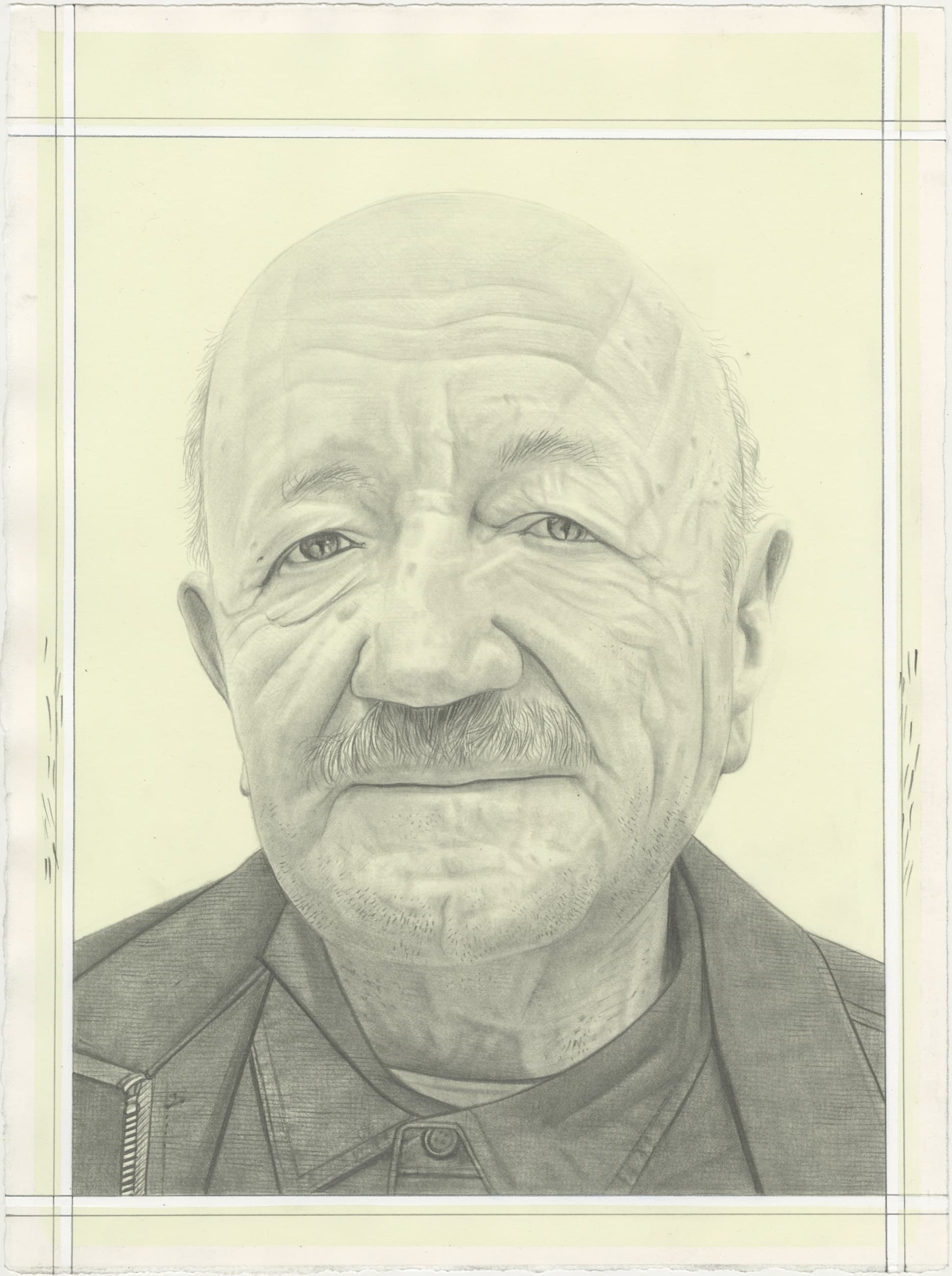
Portrait of Václav Požárek, pencil on paper by Phong H. Bui.
Word count: 3186
Paragraphs: 83
15 Orient
March 20–May 2, 2026
New York
Václav Požárek was born in 1940 in Czechoslovakia. His family was not in favor with the Soviets who occupied the country during his youth. Consequently, Požárek’s path to become an artist was made with great determination and cunning. He was in opposition to the politically motivated social realism sanctioned by the state, and after traveling in Europe, he received an opportunity to study in London at Central Saint Martins. He now lives and works in Bern, Switzerland. On the occasion of his exhibition at 15 Orient, David Rhodes met with Požárek to discuss the evolution of his artistic practice, the importance of material to his works, and his insistence that the work speak for itself. Susanne Bieri provided interpretation during the conversation.

Václav Požárek, American, 1980. Found wood, aluminum, 21 x 16 x 4 inches. Courtesy the artist and 15 Orient. Photo: Sebastian Bach.
David Rhodes (Rail): Václav, how did this exhibition at 15 Orient come about, and has it been some time in the planning?
Václav Požárek: I had a gallery in Zurich, Switzerland—Francesca Pia Gallery. Francesca is good friends with Ben Morgan-Cleveland and Shelby Jackson from 15 Orient. I had two shows at Francesca’s gallery, and after one of them, Francesca told me that Ben and Shelby were interested in my work. This is about three or four years ago, back when 15 Orient was still in Brooklyn. So when I met Ben and Shelby, we started with the idea that I would not ship works from Switzerland to New York, but instead make work onsite.
Rail: I see—so working onsite is not your usual approach in making an exhibition?
Požárek: It’s not really in my habit to work onsite, but for this occasion, I thought it would be interesting to send plans and designs and to have it done here.
Rail: Right. It’s normal for you to be aware of the space of the gallery when planning an exhibition, and also to use reclaimed objects, found objects.
Požárek: So normally, I don’t consider the room as something important for my work. The room doesn’t play a role in establishing a subject or theme. The works are speaking for themselves. But that doesn’t mean I don’t consider the room. When I am placing works in a gallery, I am very precise. It’s always a reaction to the room. So I do work onsite, but I do not want the room taking up too much intellectual space. I don’t work for the room; I put something inside it. So the room does play an important role in how it contains the works, but I don’t want the room itself to be overly considered or intellectualized.
Rail: So the room is a location or a context, but it’s not thematically important.
Požárek: Exactly.
Rail: But it’s necessary in terms of placement—
Požárek: Correct. It’s necessary in the context of showing my works; that is all.
Rail: The exhibition at 15 Orient is taken as a proposal—an opportunity for you to see your works in relation to each other in a new environment?
Požárek: It’s an opportunity to play with my works in different rooms. My works are family, so I can play with them. For example, I can place them in a way to frighten people or make them laugh!
Rail: In a new space, different aspects of particular work are encountered. This can change the perception of the works—by where they’re placed, their relationship to the space, and how they then engage with the viewer.
Požárek: I like using different on-site situations so that the public, after having a walk around, can start to work it out. It’s kind of like scenery with a puzzle that has no answer. It’s hard to explain, but maybe you understand this kind of journey in which things are put together in different rooms, and if you go through the rooms multiple times, then you get multiple ways to think about it. It’s like you have some kind of new world each time.
Rail: The sequence of works can alter the viewer’s experience of them during a passage through the exhibition?
Požárek: Well, each specific work speaks for itself. They do not have to be put together in any kind of bigger sense.
Rail: It activates another dimension of the work. The works are singular, but if you see more than one, then there’s a process of seeing them in relation to each other—which is in addition to the individual work?
Požárek: I like to have different rooms, because one work can have different signification as an individual, and when put together, they tell another story.

Václav Požárek, Offen mit Neon, 1995. Painted wood, 23 ¼ x 19 ⅝ x 11 inches. Courtesy the artist and 15 Orient. Photo: Sebastian Bach.
Rail: Yes, I can understand that. I want to back up a little and talk about your biography. I’ve read that your father was a hat manufacturer, but his business was expropriated, and because of the Soviet presence, the opportunities open to you were limited. You were apprenticed to a toolmaker in Pilsen. But then you became interested in typography and film, which you studied in Prague—Kafka’s city. Was this turn of events where life was refracted through the Soviet presence something unavoidable, and these interests came because of these events? Did you see a trajectory where you would become an artist of some kind at each stage—or could you have remained a toolmaker or a typographer or a filmmaker?
Požárek: For parents who have been persecuted by the Soviets—of course, they were not friends with the system. In 1948, this was the situation: the factory was taken away from my family, and so as a child of a family against the system, it was very clear that I wouldn’t serve the system. I stayed in this kind of situation against the system, because my father was made to work as a logger in Slovakia.
Rail: Forced to work as a logger?
Požárek: They had a system at that time that the family was fed by the state, but kept on a strict minimum. My father was working for free as a logger. It was quite impossible to plan any kind of education, because the system would dictate what you could do or not. So there was not a free choice for me. I never thought, “I would like to be a toolmaker,” for example.
Rail: You went to school?
Požárek: I wasn’t respected in school. I was behind. I did feel fortunate to do this toolmaker apprenticeship.
Rail: Where did you do the apprenticeship?
Požárek: The apprenticeship was in Pilsen, where my family wasn’t known, which was fortunate for me. I had a quite neutral situation for the first time. At that time, the state wasn’t quite so fit for surveilling everybody, so I got to be a little bit freer.
Rail: This had to have made a big difference for you.
Požárek: After the apprenticeship as a toolmaker, I was interested in going into the airplane industry—which would have been possible, because I was able and intelligent enough—but the political system was against it, because they were frightened I would construct a plane and go away from Czechoslovakia. There were such cases.
Rail: Now, I read that you had an interest in typography; you were particularly interested in Jan Tschichold? He was a radical modernist typographer, who I think had been influenced after a visit to the Bauhaus in Weimar.
Požárek: He wasn’t as radical as Bauhaus typographers. He was interested in folklore. He was rather parallel to the Bauhaus typographers—kind of a different lineage. El Lissitzky and Alexander Rodchenko: those typographers were very, in a way, famous and were taught at the schools, but in fact, they were against the system.
Rail: That’s interesting.
Požárek: At home in Russia, they were persecuted, but exported to Czechoslovakia as role models.

Václav Požárek, Zwei mal offen mit Neon, 2017. Painted wood, 27 x 15 x 18 inches. Courtesy the artist and 15 Orient. Photo: Sebastian Bach.
Rail: Right. So when you moved to Hamburg, what was your particular interest in film?
Požárek: So, I discovered my interest in typography during military service I had to do in Slovakia for two years. After a military service, I got back to Budweis and worked as a toolmaker, but at the same time started to work in an edition and print shop. The people inside this edition were, in fact, Soviets against my family. But as the political situation at that time already changed, they wanted to make something good for the family, so they took me in this print shop, and there I could develop typography and act as a kind of art director.
I could have stayed at this print and edition shop, but between the ages of twenty-one and twenty-three, I had the idea to go to the Film Academy in Prague. They took about three people per year, and I had to take an exam. At the first attempt it didn’t work out, but on the second attempt I was taken. And then I started, and I wanted to make films, but not in this positive way which was wished from the political system. I wanted to make artistic films with no content—that wasn’t wished for at all. But this was my fantasy.
Rail: How did this go?
Požárek: During this year at the academy, I discovered that I wasn’t able to direct people. I could not make actors act. So that was the end, in a way, because I wasn’t able to really direct people. But still, I left the the academy lighthearted, because I thought, “I’m doing typography now, I can earn my living with this.”
I became a freelance typographer, and I was engaged by a theater, because they wanted a different style. I didn’t know exactly why—maybe because I had a freer style of typography. But in the spring of 1968, the theater was invited to go to Paris, and they wanted me to travel with them. So I got a visa.
Rail: I see—and you went to Paris?
Požárek: I had already in mind to leave Czechoslovakia and not go back. So, I bought money on the black market. And I had my passport. I went in the direction of Paris, but I quit the train in Nuremberg, sold the tickets to get some money back, and from there it went.
Rail: And, was it from there that you went to London?
Požárek: In a way. I didn’t really quite know what to do, because I had a visa, a passport, and some money—not so much I could live on. At first I had the idea to go to Bern because it’s a small city; it’s Switzerland. And then I had the idea to go to Denmark, because I thought it would be an open-minded society. But then I met a Czech friend in Bern, and he told me, “No, don’t go. There is too much wind!” [Laughter] So I stayed in Bern. I worked at a design studio, and I designed watches.
Rail: And making sculpture—this began before your time in London, where you studied with Anthony Caro at Central Saint Martins?
Požárek: In London, I saw the new school of English sculpture: artists like Phillip King.
Rail: Yes. It was an exciting time for British sculpture in London during the late sixties and seventies.
Požárek: I thought, “I can do that as well.”
Rail: You can do that too?
Požárek: Yeah, I could. So I did that when I was in London. I learned everything, but before that I was in Hamburg. I decided in my first year in Bern to do real studies. So I went to Hamburg, and after two years in Hamburg it was clear to me that I would do sculpture.
Rail: And so it was with this realization that you then went to London?
Požárek: Yes, I decided to move to London because it seemed to me to have the best culture.

Václav Požárek, Silver Light, 2024. Painted wood, 16 ½ x 16 x 7 inches. Courtesy the artist and 15 Orient. Photo: Sebastian Bach.
Rail: How long were you in London?
Požárek: Two years. I was accepted to study at Saint Martins, but it was expensive. I had a grant from the city of Bern. At that time, in 1971 or ’72, I was rather interested in Robert Morris, Carl Andre, Donald Judd, of course, and also Robert Smithson and Tony Smith.
Rail: So, American Minimalist sculpture.
Požárek: Saint Martins school was a moment to inform myself on what was culture in London, but my interest was really because of American sculpture.
Rail: That’s an interesting point, because your work can be seen in dialogue with American Minimalism; you have a certain shared precision, but your sculpture is very different. It poeticizes material in a very different way to Judd or Morris, but the material is still as important. Going back to your training as a toolmaker: you’re expertly skilled at using metal, but you then choose to use wood, where you’re not an expert. That personal choice and the context of the art that you were interested in makes for this very singular kind of sculpture. I remember reading that Samuel Beckett decided to start writing in French because he knew too well how to use the English language. He went into another language to discover or to change something about his use of language.
Požárek: Yeah, so I choose wood because I’m not a carpenter.
Rail: Yes, exactly.
Požárek: I know too much in metalworks, like you said, and I don’t want too much control.
Rail: Yes.
Požárek: Wood, as a material, is easy to work on. You can work with a simple knife, for example. You don’t need big machines.
Rail: Or assistants, right? In respect to the traditions of modern sculpture, you are combining a very rigorous approach to Conceptual art with the desire for a very strong, formal, constructed approach. The two things come together very naturally, and sometimes with humor, which is a very interesting characteristic.
Požárek: For me, it’s quite normal to work both sides. I have no real method. But this is, of course, also a method. [Laughter] Okay, so my ideal situation would be to make a solo show, but the public would think they walked into a group show.
Rail: Right, I can easily imagine this.
Požárek: I don’t want to have a real style. I want to stay behind the work.
Rail: Anonymous—the work speaks for itself, and it’s not conveying a message.
Požárek: Yeah, no message.

Václav Požárek, Three of OOF (maquette), 2023. Wood, 12 ½ x 16 x 2 ⅝ inches. Courtesy the artist and 15 Orient. Photo: Sebastian Bach.
Rail: At this point, I would like to ask about one particular work of yours, Paradise Gate, which I think is from 1988, a truly fantastic piece. But it is typical in a way: it brings something from the everyday world, and it is presented as an art object, but without removing the everyday aspect. So, going back to what you were saying about working with a space and the objects you have: this piece, does it always go in a corner?
Because here again, we could mention Vladimir Tatlin’s Corner Counter-Relief—that’s 1914. Or Dan Flavin’s pink out of a corner (to Jasper Johns), from 1963, or even Fred Sandback’s corner pieces. So, there’s something very interesting about bringing something in from the everyday world into the art world, and putting it in a situation where there’s a potential. I think the gate is no longer opening.
You found the gate somewhere. It’s no longer functioning. It’s a non-functioning, practical object, but it’s functioning in another way, so it has a potential. You don’t have to reconstruct the object; you find its potential. Maybe this relates a little bit to Marcel Duchamp, but I really like the idea of a corner being a particular place that we all experience. I think I read somewhere that you mentioned your mother’s brooms being propped up in the corner, and you’ve propped up carbon rolls, and then we have Tatlin using a corner. And of course, Richard Serra’s “Prop Pieces” come to mind here too. This is so full of potential for a viewer—for somebody coming in and seeing these objects. The process it begins will always be different, because it’s not telling you what to think. It’s giving you an opportunity to participate.
Požárek: In fact, Paradise Gate is a centerpiece of my thinking—how to treat sculpture, in a way. But in fact, I was invited to a show in Paraguay—and here we come back to the start of our discussion—because I was told to make something onsite. I will work onsite, and I thought, “Within a week, I will be able to build something.” But I had no idea, and I was walking around, and I saw this unused gate, and one night, I stole it. It’s quite interesting because I could have easily bought something like this gate in a shop, but it was ideal to have something used. And then I restored this found gate—I restored it in my way, and the fact to put it in a corner is, of course, very practical, because it holds itself right. But of course, there is Duchamp behind it—you know, this famous door of his.
Rail: Maybe Richard Serra also?
Požárek: No, really it’s Duchamp. And for the humor of this work, the title—why Paradise Gate? Because of Lorenzo Ghiberti’s Gates of Paradise (1425–52) in Florence, at the Baptistery of San Giovanni. And, my gate was found: no real work, no metalwork, and no gold!
Now, if I don’t know what to do with a sculpture, I put a door in the corner. [Laughter] So, just to make the context, I had another invitation for a show in the Czech Republic, but years later. As with the Paradise Gate, I didn’t have an idea for this project, and in fact I went to an old castle, and I found an old door that was not in use. I put this door again in a corner. But the problem, the situation, was the skirting board at the base of the wall, so I used a small rock that I found to prop the door, a better solution to this problem as doors are always a slight distance anyway, from the floor. I’ve worked with various doors after this too.
The Paradise Gate was for a long time in my studio, until the Museum of Modern and Contemporary Art in Geneva bought it. This museum, by the way, has many works from Richard Nonas.
Rail: Oh, yeah?
Požárek: Yeah, yeah—many American sculptors.

Václav Požárek, Bodenarbeit, 1973. Wood, 2 x 25 ⅞ x 25 ⅞ inches. Courtesy the artist and 15 Orient. Photo: Sebastian Bach.
Rail: Václav, maybe we finish this conversation for now; it’s been great talking to you, and I can’t wait to see the exhibition at 15 Orient. Oh—just one last thing. What did you say earlier before we started recording about the last time you came to the United States? Was it in 1986?
Požárek: Yes.
Rail: So, then, welcome back!
Požárek: Thanks. And, if it doesn’t work out with the plan for the show at 15 Orient, I will look for doors. [Laughter] Thanks also for your questions. I never really thought so deeply about my own way of becoming a sculptor. Also, by now, I can reconstruct why I became, finally, an artist like a sculptor, because at that time, I didn’t really reflect so much on the situation.
David Rhodes is a New York-based artist and writer, originally from Manchester, UK.