BARBARA ZUCKER with Joan Simon
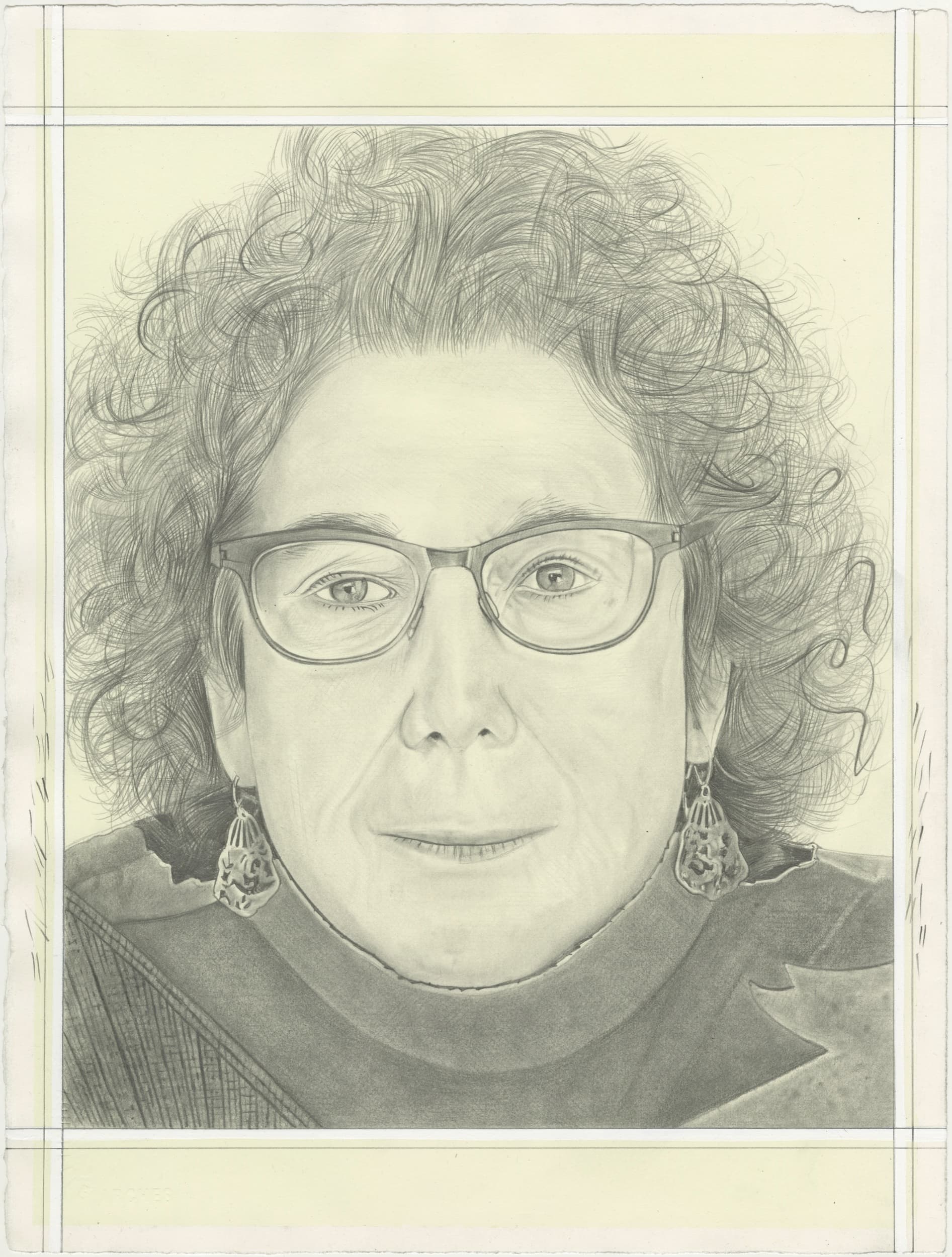
Portrait of Barbara Zucker, pencil on paper by Phong H. Bui, from a portrait by Grace Roselli, Pandora’s BoxX Project.
Word count: 8897
Paragraphs: 142
Barbara Zucker
Abbeville, 2026
This conversation with Barbara Zucker took place on January 20, 2026, in anticipation of the publication of her book The Second Oldest Profession: The Wet Nurse Revered and Reviled, in February 2026. Decades in the making, the work is a social history, economic case study, cross-cultural art-historical investigation, travelogue, memoir, and quest with a surprising twist at the end. It began with Zucker’s fascination with Berthe Morisot’s 1880 painting The Wet Nurse and Julie Manet.
Among the 112 plates in the book, Zucker includes images of paintings, sculptures, prints, drawings, photographs and newspaper articles that represent the work of wet nurses, the complexity of breastfeeding and its symbolic renderings in religious and mythological iconography, as well as the contradictory perceptions of the female breast itself. The myriad illustrations range from a Tanagra terra cotta figurine made 2000 years ago in Greece, to a fifteenth-century oil painting, sixteenth-century lactating fountains in Italy and Germany, a seventeenth-century illuminated prayer book, seventeenth-century paintings by Rubens and Tintoretto, nineteenth-century photographs, to contemporary works by, among others, Niki de Saint Phalle, Pat Lasch, Nancy Fried, and the artist herself.
She also includes newspaper accounts of the discovery of the tomb of King Tut’s wet nurse, a nineteenth-century print of a crowd of wet nurses and patrons outside a Parisian wet-nurse employment agency, and twentieth-century photographs of interspecies feedings reminiscent of but stranger than the iconic bronze figures of Romulus and Remus being suckled by a she-wolf.

Zucker has long deployed abstracted forms to investigate ideas about the body and the performative with wit and conceptual rigor. She repeatedly discovers her subjects by focusing on the overlooked or undervalued in the everyday and imbues her findings with an acute sense of worth. Her new book, The Second Oldest Profession (Abbeville, February 2026), as well as her bodies of work in many mediums—including sculpture, drawing, performance, installation, wallpaper, and a video—are discussed here.
Joan Simon (Rail): Let’s start with the title, The Second Oldest Profession: The Wet Nurse Revered and Reviled. Why?
Barbara Zucker: Which part? The second part?
Rail: Both. Or start with Revered and Reviled.
Zucker: Okay. Actually, it's more than fifty-fifty—I would say more reviled than revered. Once I started reading about the wet nurse, there was so much prejudice about her, about the profession. Occasionally someone would write about how marvelous she was and how she'd saved their child, and how she had done this for her whole life, and what a wonderful profession it was.
But generally, you know, she was considered not much better than a prostitute. She was really right down there, because she was selling her milk from her body, from her breast. And people had a hard time with it, or even if they didn't—they used her anyway. That's why.
Rail: What prompted you to begin this investigation in the first place? It's decades since you began the research.
Zucker: Yes, before I had gray hair. Well, I read this article, this essay, I think you know, by Linda Nochlin, in her book Women, Art and Power (1989), and essentially, it was about a painting, a Berthe Morisot painting. It was a painting of Morisot’s daughter, Julie, being wet-nursed.
Rail: Julie and Her Wet Nurse is one of the painting’s several variant titles. Nochlin cites La Nourrice Angele allaitant Julie Manet (The Wet Nurse Angele Feeding Julie Manet); others are The Wet Nurse and Julie and Nourrice et bébé. Julie was the child of Morisot and her husband, the artist Eugène Manet, brother of Edouard. Nochlin dated the painting to 1879, although more recent publications often assign it to the year 1880.
Zucker: When I first looked at it, I thought it must be Berthe Morisot, nursing her own child, and she's doing a painting, and I thought, no, that's not possible, so I kept looking at it. It's a brushy painting, as her paintings are, and it took me a while to see what was actually happening—that the child was being nourished by another woman whom Berthe Morisot had hired. And it got me going. I've been thinking about process and whether this was any different than anything else I've ever done as an artist, as a sculptor.
What is the process that gets you going? What gets you obsessed? Usually, it makes no sense. Sometimes there's an idea, you follow that out; sometimes someone says something, you follow that out. In this case, it was Linda Nochlin, whom I have followed for years anyway—whom I have respected and read, and who has influenced my life, really, as an artist, so that’s what got me started.
I don't know if you've seen this book or read this book, Joan, but if you've ever looked at that article, there are photographs of these charming-looking young women wearing unusual and intriguing outfits, holding up a baby. And they're holding them up with pride. They were wet nurses who were in Paris, who were in the Jardin des Tuileries, hanging out, and these photographs were taken of them. I thought, what an amazing thing. Who are these women? Where do they come from? What are they doing? And that's how I got going.
Their work kept being referred to as the second-oldest profession, and it took me a while to figure out what the first one was, but then I figured it out: prostitution. So there's that part, and the fact that she was either hated or loved, according to the century, the country. That's why.
Rail: The book doesn't strictly belong to any one genre. It's a case study, it's an economic case study, a social and cultural history, it's an art-historical search—with images of painting and sculpture dating back millennia, as well as photographs and drawings, and some of your own works; a sociological investigation, a cross-cultural comparative look, a study of costume and custom as well as of odd medical tests. It’s a quest, an obsession. It’s so many things. How did you go about beginning the research, and how did you interweave all these different aspects of the story?

Alonzo Cano, St. Bernard and the Virgin, circa 1650, oil on canvas, Museo del Prado, Madrid. Photo Bridgeman Images.
Zucker: I just want to say that your description is exactly why it was hard to get it published. Because it doesn't fit into any category. When I started this, I started making sculpture about it. I had no idea that any of what I was looking for—people I spoke to or archives I investigated— would end up as a book.
I started making the sculpture in the ’90s, and I kept making it and thinking, well, these are okay, but it doesn't make a show. It doesn't make an exhibition. It's insufficient. It isn't enough. I did other things in the meantime, other bodies of work. But I never stopped thinking about it, and so after years, actually, of research, thinking that the research just related to making things, I realized that like a lot of artmaking, it told me what to do. It said, you're a book.
Then my task became, how do I put this together? Was it a two-dimensional object that has writing in it? And although I have written over the years, never a text-heavy book.
Rail: You’ve written for art magazines and newspapers, including Art New England, the Art Journal, Art News, Art in America, Artforum, Arts, Heresies, Los Angeles Times, Ms. Magazine, New York Times, Village Voice, The Boston Globe, The Philadelphia Inquirer, Seven Days, Vermont Woman.
Zucker: Articles, essays, reviews, never a book in which the words were equal to the pictures. So, that's how it began. I just felt I had done so much research, I had so much information. It was so interesting to me. It was so unusual. It didn't seem that there was a book about her except some scholarly ones. And I wanted to do something that reflected my thoughts and feelings and my perceptions as an artist about this woman and her profession.
Rail: I think it’s important to note regarding your sculpture and drawings—for these wet-nurse inspired pieces and others—that your work is for the most part abstract. Yet in the titles they are very specific and there seems to be a tension between the two. How does that work? Why do you offer that?
Zucker: Whatever I'm making has to fit the idea. It could be abstract or not. When I started thinking about this, pardon me, body of work—unintended pun—it seemed clear to me that it could not be abstract. It had to be specific. So it is. I don't really make a distinction. But I’d like to address your observation about the tension between the titles and the work itself. I like it if people look at what appears to be an abstract sculpture and are initially comfortable with it, have pigeon-holed it, and then I hit them with some basic, ordinary title that brings the work to a literal, almost simple level—a standstill. This isn’t always true, of course, but is most blatant in my series For Beauty’s Sake. If I get an idea, whatever it is, the thing is supposed to try to look like the idea. And as we know, no one ever quite gets there, but I get as close as I can. And with the wet-nurse project I started with the sculpture.
I'm trying to remember the first one. I think the first one might have been sort of these milk sculptures—of running milk, that I didn't like, that I destroyed. Unfortunately. Then I did a bunch of works on paper. I went to Yaddo and I made a lot of works on paper about the tests that were implemented to assure mothers that their babies were getting the right kind of milk, and then I started making some sculptures.
Rail: Yaddo’s mission for its residencies since its founding in 1900 has been, as noted on its web site, “to give uninterrupted time and space to artists.” Please talk about the drawings you made there. The tests you refer to are bizarre, sometimes funny, strangely interesting. They're weird.
Zucker: Yes, yes, yes. There are doctors, venerable doctors: Avicenna [Avicenna of Persia, 980–1037 CE], I think, was the earliest one I heard about, with many doctors’ edicts in between, ending with Maimonides [1135–1204 CE]. They all devised tests that would indicate whether the milk of a particular woman was appropriate and viable and could be used to wet-nurse. And if it didn't meet the criteria then that woman could not have that profession. She could not be a wet nurse, and I think bizarre is putting it kind of nicely. Nuts would be more true. I mean, crazy.
So I, for whatever reasons, started focusing on that. One of them is the sword test. Then there’s the rock test. The plate test. I mean, nuts. And a drop of milk placed on an object, including in someone's eye—don't ask me what was supposed to happen there—all of these tests would determine whether someone could make money selling her milk or not. And, of course, it was all men, all physicians. One of those tests was still being used in the 1990s, if I remember correctly, by wet nurses I found in Italy. It was the thumb test. This one makes sense, actually. These women would put a little drop of milk, a little drop of milk on a thumb, and I think if it was the right temperature, they could then feed the child. The thumb test is one of the tests that has been used over time to determine whether the milk is okay or not.

Barbara Zucker, The Eye Test and The Plate Test, 1995. Courtesy the artist.
Rail: You found visual evidence of the practice of wet-nursing going back millennia. What's the earliest image you found?
Zucker: I think it is over two thousand years old. It is a Tanagra figure, and it looks like an older woman. I'd like to say something about that. As long as you are nursing, you can keep producing milk up to a pretty advanced age. As long as there's someone at your breast, you can keep producing milk. So this particular small Tanagra figure, small sculpture, is of an older woman with a baby in her arms. It's a sculpture. I'd say that was the earliest one. But, you know, there are frescoes from Egypt that show wet-nursing. So I don't know. I did a lot of research at the New York Public Library. At that time, it was a kind of wonderful, sloppy archive; you could just go sit down and go through it. This was prior to the internet, and I found a lot of amazing things there. One of which was a painting of a goddess nurturing a young god. Those are the earliest ones I know.
Rail: You go through centuries of religious paintings, of public sculptures. The range is tremendous, and the number of works is surprising.

Statuette of Isis with the infant Horus, Ptolemaic Period, 332–30 BCE, faience; Metropolitan Museum, New York.
Zucker: Isn't it? You know, once you get obsessed, you're obsessed. I just took it where it took me. I followed the trail, whatever that was. And also, I guess, as a visual artist, the fact that I could find all these images of wet-nursing was kind of a counterbalance to the few books I'd found so dry. There are always histories that exist that are layered on top of each other. And so, I just started, I just started looking, and there they were.
Rail: You present a number of images of the distinct clothing, and the elegant, beribboned headdresses that many wet nurses in Europe wore. How did you come across these, and what did they signify?

Jean Fouquet, Madonna Surrounded by Seraphim and Cherubim, circa 1450, oil on panel. Royal Museum of Fine Arts, Antwerp.
Zucker: I've used this analogy in the book. If a wet nurse worked for a Parisian family, you know, or worked in another big city, she was a status symbol for that family. And they dressed her. They would take her to a department store, like Bon Marché in Paris, and there were actual outfits specifically sewn for wet nurses, and they wore them, and there were winter ones and summer ones, and they were quite elegant. They would be riding in open carriages, you know, on special holidays, on weekends, and they would be in an open carriage with the family, with the baby.
Rail: This world is seen in Edgar Degas’s 1869 painting At the Races in the Countryside, in the collection of the MFA Boston, which is described on the museum’s website as an “intimate scene of modern life, leisure, and labor taking place in the foreground. In the driver’s seat of a horse-drawn carriage, Degas’s smartly-dressed friend Paul Valpinçon—echoed by his loyal canine companion—gazes down at his passengers: his wife, holding a parasol, and his infant son Henri, asleep in the arms of his working-class wet nurse, her breast still exposed.”
Zucker: Having a wet nurse was like having a Cadillac, I guess. A Cadillac with breasts; someone, a living being, who was this incredible status symbol for them. In other settings—when wet nurses worked in the countryside, or if a wet nurse was suckling a baby at her own home—this didn't happen, of course. Also, some wet nurses came with regional attire—traditional costumes that they just wore, that people had worn, I guess, for hundreds of years, and those were sometimes obligatory. They had to wear them, again, as a status symbol, so everyone would know who they were, and that that family had the money and the status and the power to hire someone to produce milk for their child, so that the birth mother didn't have to be tied to a feeding schedule, they could go out, they could be free. By comparison to the mothers’ motives, their husbands valued keeping their wives’ breasts as they had appeared before. In some cases, the birth mother really couldn't. She couldn't breastfeed.
Rail: Through many eras, as Lucy Lippard says in her comments about your book, racism, misogyny, antisemitism, and always class issues have figured in assessments of wet nurses and their milk.
Zucker: Well, there is a reference in the book to anti-Semitism. There was one hospital, in Vienna, where the wet nurses refused to breastfeed Jewish infants. This was like a people's hospital, like a government functioning hospital or regional hospital. But in Paris, if a family was affluent, and Jewish, they could hire a wet nurse. Money overcame anti-Semitism in this case.
I have a list of names—I don't know if you remember seeing them—this huge list of names of families who hired wet nurses in the nineteenth century, and I would say maybe six of those names are clearly Jewish names, Jewish families, but they're prominent families.
Rail: It's quite a long list, takes up half a page, actually, in the book.
Zucker: Someone tried to talk me out of doing that. They didn't think it was necessary for me to put that list in, but I like the list.
Rail: Though the volume includes beautiful color images of paintings, sculpture, and drawings from ancient times to the present as well as black-and-white historic photographs and newspaper clips, it feels like a different kind of art book. You can comfortably hold it, read it, and there are surprises to be found motoring the narrative and in the illustrations as the many different kinds of histories are woven together. The volume is bigger, say, than a handbook or guidebook, but, like them, it has the sense of being a compendium offering information in a conversational mode. The whole of it feels carefully thought out—the relation of text, image, and white space within its hand-span-sized square format—and there is a graceful modesty to it.

Wet Nurses in Jardin Luxubourug.
Zucker: Thank you. Well, actually, apropos of what you said, a handbook, I wanted this book—I say I wanted because it's a little more formal than what I had initially envisioned—I wanted this book to be really accessible. Above all, I did not want it to be a coffee-table book. I did not want it to be perceived as purely an art book. I wanted it to be small enough that you could hold it in your hands, that you would not be threatened by it, that the cost of it wouldn't be so outrageous that only a few people could buy it. I wanted it to be easy to see and easy to read, and hopefully easy to buy. And I wanted it to be something that you wouldn't want from afar, but you could want, and you could actually have. So, the book is something like, I think, $25.
Rail: I just checked. It’s listed at $24.95. It’s accessible in how it’s written, in its often subtle but acute, witty asides, and surprisingly, it is also a page-turner. It's a very compelling story, with many unexpected turns along the way. Why does the subject continue to be taboo?
Zucker: You tell me what you think. I just think it's because—I think you mentioned prejudice a couple minutes ago. And misogyny, I think you said. Didn't you?
Rail: I did. I also have some other thoughts about why.
Zucker: I think today—you know, it's like I said in the book, towards the end—you can show your breast if you're a sex object, if you're trying to attract people to your body, to your boobs, to how great you're looking, your makeup, your whole outfit, all of that. That's fine, that's fine. For guys. And for women, too. When the nipple gets involved, and when there's milk coming out of the nipple, that becomes something else, and I think that some people are disgusted by it, some people really don't want to even make the connection. There's tremendous prejudice about selling milk, you know, or donating milk, or even—
Rail: Nursing in public.
Zucker: I think you know this, I really dislike those pods that are in some stores, or in—
Rail: Airports.
Zucker: Airports specifically, and they're all cute, and they have a nice design, and they're usually stainless steel, and they have funny, stupid-ass names, like Mama something. They’re keeping the woman from being seen. Yes, she's safe. Yes, no one will bother her, but really, I think if people accepted breastfeeding, it would just be a natural thing, you know, would not be a big deal. There would be nothing hidden. And so it pissed me off. It pissed me off. It still pisses me off.
Rail: It's the difference between being hidden away in a bathroom or being hidden away in one of these capsules for nursing.
Zucker: Yeah, there's—
Rail: One is considered unclean, one is considered clean. There’s also a split between the positive sense of expressing, collecting, donating and sharing milk for milk banks compared to the negative sense, the disdain for selling it. Or for selling any other body part, which for the most part is illegal.
Zucker: Right.
Rail: You can donate hair—
Zucker:—right—
Rail: —to make a wig for someone who's being treated for cancer. It is acceptable to give but not sell your body—in whole or in part—to someone: a kidney, eggs, sperm, lend a uterus (and be paid for expenses but not for the thing itself, and certainly not the child within). Though it is legal to receive payment for blood or plasma, sale is frowned upon while gifting is praised and solicited. You of course may and are encouraged for the greater good to donate a whole body (or parts of it) after death. The difference, it seems, has to do with different economies—market or sharing.
Zucker: Puritanical. It's puritanical. Right? Throughout history I think people don't—can't—accept the connection of sexuality and survival, of feeding and fucking. They can only think of one thing at a time. How dare you have this boob that's giving milk to this kid? Show it to me because you're sexy. Do not show it to me because you're gonna nurture some child.
Rail: One of the books that you cite often in yours is Marilyn Yalom's History of the Breast, not surprisingly, given that it is a critically acclaimed, deeply researched cultural history that spans "25,000 years of ideas, images, and perceptions of the female breast—in religion, psychology, politics, society and the arts." Yalom also wrote A History of the Wife; Birth of the Chess Queen; and, with Theresa Donovan Brown, The Social Sex: A History of Female Friendship. Why has Yalom’s History of the Breast, first published in 1997, been so important for you?
Zucker: Because she was an intellectual, and because she was a historian, because she was what I am not. She just lent me a great deal. I mean, she helped me in a way to realize what I wanted to say. And she amplified what I wanted to say, which is why she's quoted so profusely. And I felt even though—I shouldn't say “even though”—that while she was a scholar and an intellectual, her writing is completely accessible. And never ever over full of itself. She speaks with a true voice, and that truth kind of helped me to write. You knew her.
Rail: I did, in Paris. I knew her, yes.
Zucker: You knew her.
Rail: I loved her books, beginning with Birth of the Chess Queen, and admired her. I would see her from time to time in Paris. We were neighbors. I loved her research. I mean, it was—
Zucker: —impeccable, it seemed to me, you know, what little I know.
Rail: When you were a young artist starting out in New York, it was not a secret that many women artists chose not to have children—as did other professional women. Women were told that if they had kids they were likely not to be permitted to advance in their careers, and for women artists, this could mean rejection from representation by galleries and to be refused other opportunities.
Zucker: I think that despite prejudice against women, and not just in the art world, it never stopped many of us from becoming mothers. At least half the artists in A.I.R. were mothers and found a way to make art anyway. Nancy Spero, for example, had three sons and worked in her dining room!
Rail: You were a mother and an artist. How did you navigate that?
Zucker: Poorly. I should tell you something that you probably don't know, Joan. When I got to New York, around 1963, ’64, ’65, I was making phallic sculpture. And I made a phallic forest that was trashed by some junkies because they were stored in the basement of the apartment building where I was living in New York City. A lot of them were not very good, but that was how I started out when I got to New York. They certainly were not my finest hour. At the same time, I was doing life drawing at Columbia, because there was a professor who let me get into his class—Peter Agostini. So I've always drawn from the figure. The figure's always been a part of my life. But anyway, I was making these dicks. And then I got a little smarter.
I went to Greece. I saw the architecture of some of the Greek islands, and I transferred what I’d seen that influenced me from the obvious phallic symbol into more abstract symbols. I was working for Andre Emmerich at that time, and he had a lot of ancient art that intrigued me, including Peruvian knife blades—ceremonial knives called tumis—that were actually phallic symbols. I started doing a series of chair sculptures, mostly white—with no need for a sculpture base, as the relevant image was supported by the structure of the chair. They were topped with these odd, organic now secretly phallic forms. I think you need to get me back to the question, because I have strayed.
Rail: I’ll try to remember.
Zucker: Oh, I know. So, woman, woman artist, mother. I feel that as melodramatic as this sounds, I feel like making art has saved me, kind of kept me alive. I was always making things as a kid, before I knew that art was a word, and I just kept right on doing it, so there never was a question of not doing it. The question, of course, was, how do you get it out there?
And I did not want a child. For the longest time. And then I got married. And I accidentally got pregnant. Much to my shock. I was on the subway, and I had been told I was pregnant, and I began weeping. And I realized how much I wanted a child, and that regardless of what my husband wanted I was going to have this baby no matter what. So I did.
I had this child. And it was very hard, and hard on my daughter. My parents helped me. Not always. And I didn't marry an artist. I did not marry another artist. Because that would have been the end. I mean, it isn't always. I think about Mary Frank, she did okay. June Leaf did better after Robert Frank died. I think really what it was in the ’60s, if you're an artist and you are a woman, and you had an artist partner who was a man, you were screwed.
I discovered sculpture when I was a sophomore at the University of Michigan. The College of Art and Design. I stuck my hands in clay, it sounds so corny, and I thought, oh boy, this is it. And it was, that was it. And I started out as a figurative artist.
Rail: As a founding member of A.I.R. Gallery in 1972—one of twenty artists—what did the gallery mean at the time? What did it mean for you, and what does it still mean?
Zucker: It means something very different now, I think. What it meant then was we can have one-person shows. We can show our work. Mostly that's what it meant. We are twenty women, and we now have the opportunity to show our work. We have a one-person show; we're not going to be rejected. We're not going to hear “no” again. We are actually going to have the work out there. That's what it meant then. I think it has evolved, which is why it still exists, which is really extraordinary and amazing. And now, I think the gallery has an awareness of different expressions of gender, different kinds of ways of looking at things, different cultures. It exhibits the work of women from all over the world. It has a different message, multiple goals. I am amazed by it, actually, that it exists, and that it thrives. I think we, the original twenty women, were hungry, angry, passionate, but we had this common goal.
Rail: You are one of the many women in Mary Beth Edelson's 1972 print Some Living American Women Artists depicted as taking part in Leonardo da Vinci’s The Last Supper. What was that like?
Zucker: There wasn't much to it. She just stuck my head in there. It's become iconic, so I'm grateful that my head is in there. And that Susan Williams's head is also in there, because it was her baby, you know, she had the idea for the gallery [A.I.R.]. I still don't think that she’s been given enough credit for being the one whose literal idea it was. I'm glad to be part of an iconic work. It was smart. I thought it was very smart.
Rail: A few weeks ago I came across a short video, which prompted thoughts about your book. It likely turned up on my computer because I had been googling some references to wet-nursing and I further checked out the surprising info there. It was about Queen Elizabeth II breaking with royal tradition, that she was the first royal not to employ wet nurses—
Zucker: No kidding—
Rail: —but to nurse her own four children—Charles, Anne, Andrew and Edward—herself.
Zucker: Wow.
Rail: I wanted to talk to you about groups of your works that you call Themes. One group is titled Time Signatures and is comprised of traceries abstracting from a biological—
Zucker: It is a body of work, literally. At a certain point, you realize, one does realize that one has lost currency. One gets old, and you don't look so great anymore. So many women and men begin adjusting that truth, you know, by having cosmetic surgery, and now it's so ubiquitous it’s almost like having your nails done. I started thinking that I really didn't want to do that.
At that point in my life, I was A, too afraid, and B, I didn't think it was a good thing to do. I thought, okay, how could I feel better about looking like shit? What could I do? And again, you know, like the wet nurse project, it came to me. I will have photographs taken of me. The worst possible photographs of me that show every wrinkle I have. I started with my cheek. Then I went to my neck, the front of my neck, and the back of my neck, and I had a friend who was renting a studio space in my studio complex in Burlington, Ken Burris, and I said, take the worst pictures you can of me, which he did.
And I began abstracting them. I would take a part of, a piece of, the wrinkles—a section of wrinkles that looked like it could become a sculpture. I connect all the dots, because on your face, you don't have to connect anything, right? It's on skin. I connect it all, I'd make a painting, a black-and-white painting, projected on the wall. Then I would make a continuous line from that original work, and then I would have it made with a water jet cutter I found in Pennsylvania, Surbeck Water Jet Company.
Rail: Could you explain what a water jet cutter is and what material you used it on to cut the intricate shapes of the wrinkle-derived lines?
Zucker: Here’s a definition: A water jet cutter “functions like a powerful, computer controlled abrasive eraser, allowing for intricate shapes and complex cuts in materials too hard or delicate for traditional tools.”
I remember the first piece I got back, which was made of aluminum, and that was around 1998. The first one that came was around my eye. And I was so excited, because I thought it looked so great, and I just kept doing them, and then I started doing friends, and then I started doing famous women I admired.
Rail: Linda Nochlin, Lucy Lippard, and then, for example, Louise Bourgeois, Isak Dinesen, Rosa Parks—
Zucker: It just seemed to me that this is a part of nature. We don't like it because of our culture. We do everything we can to deny it, halt it, not look in the mirror, whatever. So, that's how they began, and I felt that it was a way to try to make these things, to reveal these things as a part of nature, in the larger world, like fractals, like ice cracking, like so many things that actually look the same but that are accepted because they're not on our faces. So that's where it came from. And I had a very good time making them, I must say. Whereas I would say the wet nurse pieces were not that much fun. They were much harder to make.
Rail: You're known for making sculptures and drawings, but you've also done installations. For one of the Time Signature installations that had wallpaper rendering the lines from Linda Nochlin’s face in pink on a white field, you doubled the impact by attaching to the wall-papered wall one of the black metal bas-relief sculptures, Isak Dinesen (2001), whose linear form is also wrinkle-derived.

Barbara Zucker, Time Sensitive: Isak Dinesen, 2001. Mounted on Linda Nochlin wallpaper, 2006–07, as installed in Zucker’s exhibition Another Year in LA, 2007. Courtesy the artist.
Zucker: Linda Nochlin wallpaper, yes, I still have some. She was very kind. As was Lucy Lippard. They both allowed themselves to be photographed. And then I made pieces from them. Linda was the only one I did wallpaper of. There was no particular reason, except I had a couple things of her that looked good, like they might make a good pattern, set a tone, be a bit more homey. I did another installation in LA, with Linda wallpaper too, and the furniture in it was upholstered in shiny fuchsia fabric at a gallery called Another Year in LA, now defunct.
Rail: You've also worked in performance and in the 1970s were a participant in Marcia Tucker's—
Zucker: —Mighty Oak Theater Service.
Rail: A performing arts group.
Zucker: Yep.
Rail: What was that like, and what did it mean for you and the others who were part of the group, gathering weekly at Marcia’s and Tim Yohn’s SoHo loft?
Zucker: I think the best thing about doing that was that we were all ultimately vulnerable to each other. Because Marcia, who was a force of nature, made us be vulnerable. We would meet every Sunday evening, and we would have something that we did. Each week, there'd be something different that we did, that we all agreed to do. One funny thing we all had to learn was how to stand on our heads, not near a wall. You know, like, literally stand on our heads.
Other times, we had to sing a song but insert ourselves in the song. And sometimes people would weep because they would be surprisingly touched by some action that they thought sounded stupid but wasn't. And sometimes, interesting artists, like Richard Tuttle, would come and do projects with us. A singer came once and had us do stuff, so it was always a surprise. There was always tension around those meetings, people kind of jockeying with each other. And then we would eat together, and sometimes there'd be four of the same salad. No one ever knew what we'd be eating, but we would eat afterwards. And it culminated in a show, a performance at the kitchen, which, at that time wasn't the Kitchen with a capital K. We did a performance, and I had two pieces in that. I created two pieces in that performance. I don't know if you want to hear about them or not.
Rail: Yes, please.
Zucker: One of them I called Ace [1976] because I wrote to Ace Bandage, the Ace Bandage Company, and they sent me a whole bunch of free Ace bandages There's a video of it somewhere, but I don't know if I have it. Members of this Mighty Oaks Theater Service sort of shuffled onto—it wasn't a stage—the floor, mumbling. Each of them mumbling something unintelligible, kind of crushed together as if for a portrait—kind of a lunatic version of The Night Watch—and they mumbled and they got to the center of the room, and then they all had been given two Ace bandages. And other than those bandages, they were naked, and so they had to arrange those Ace bandages in whatever way they wanted. One person who shall remain nameless just had an Ace bandage on his head and was naked otherwise. So they're shuffling on there with their bandages and making these noises and Marcia came out with the Ace bandages that we had sewn together from the Ace Bandage Company and tied them all up. She wrapped them up, and they ceased to have angst, and they ceased to be my neuroses, which is what they really were. And they shuffled off silently. That was Ace.

Barbara Zucker, Ace, 1976. Performance created for members of the The Mighty Oaks Theater Service. Courtesy the artist.
Rail: Who took part in this theater group?
Zucker: I don't remember everybody, but Elke Solomon, Kent Hines, Michael Kwartler, Arlene Slavin, and Mannie Lionni. Also Tim Yohn, Nancy English, David Troy, Ed Flood—and Marcia. The other piece was called Signifying [1976]. I dyed clothing for each person—T-shirt and pants—different colors, many different colors, and people came out in the center of the floor and did different actions, each of which signified something or other, like climbing, in which case, Elke Solomon, who was a very small person, climbed up Tim Yohn, like a mountain, and over him [Signifying: Climbing]. It was really putting colors in space and having actions that froze so that you could see these signifiers in space and time. Another one was kissing [Signifying: Kissing]. That one was two men kissing a man. There were others: running, loving, hating, etc.
Rail: You’ve written about these: “Color and action merged into living sculptures.”
Zucker: That was Signifying. So I did Ace and Signifying, and other people had other actions and pieces that they did. And that was great. It was a lot of fun.
Rail: Another work of yours is actually a critique of performance, a performance using bodies. It's called Rocks N' Drops. Could you talk about that?

Barbara Zucker, Rocks N’ Drops, 2015. Courtesy the artist.
Zucker: It's a critique of Yves Klein. That's what it is. I started thinking about his women dragging themselves across paper with Klein blue, and who he was. His ego. I was actually in Florida, and I was looking for something to do. I'd been thinking about him, and I was thinking about his appropriating colors, which in a way, you could say Anish Kapoor does, but I'm never angry at him. I'm just always in admiration of the way he deals with color.
Nonetheless, I saw these rocks, and I thought, well, what if I drag Klein blue? I couldn't really make it the right blue, but I got it to be a kind of a Klein blue. What if I drag these rocks across paper, and I can call it “Yves Rocks.” I had little chops made, like you see on Japanese and Chinese scrolls. They said either “Yves Drops” or “Yves Rocks.” For the other one, I got pebbles that I painted Klein blue, and I tossed them, so that was Yves Drops. So, Yves Rocks and Yves Drops. I got my grandchildren to collaborate; I got friends to collaborate; we were all throwing rocks and dragging rocks.
What remains is a case: it's wood, and they're arranged within it. You can see the little rocks with their, kind of, I don't know, their pulleys—twine harnesses—a bunch of pebbles, and then I've done some works on paper that, if you look at them, they just look like very nice abstractions. And they're blue, you know, and they have a lot of movement; they are the records of my having dropped and dragged. And then I have little pictures in the case. There's a little picture, a photo of the women dragging themselves across the paper, smiling naked, and then there's a picture, another photo, of Yves Klein doing his flying thing that he did when he seemed to fly out of a window.
Rail: Yves Rocks and Yves Drops are conceptual works, sculptures, performances—relics of an action that you performed.
Zucker: When I was in high school I acted all the time. I was in every play I could be in, and I almost went to what used to be called Carnegie Tech, because I had a scholarship, they offered me a scholarship of some kind, I think, to act. I thought I'd be a better person if I studied art. I wouldn't be quite as selfish, that was my thinking then. And also, I did a lot of dance. I did a lot of what they called then modern dance. I really loved dancing, and I really loved acting, so I guess you could say that this is a vestige, or some sort of transformation of that. This performance of mine.
Rail: We’ve known for a long time that the personal is the political, and toward the end of your book, you reveal a surprising finding.
Zucker: Yes. Yes. You mean about my mother?
Rail: Yes. And about you, actually.
Zucker: God.
Rail: And about wet nurses.
Zucker: Yes. Should I speak to that?
Rail: Please.
Zucker: Okay. My mother was a very independent woman. I mean, she liked keeping her own company, did not complain, had lots of physical problems towards the end of her life. Never made me feel guilty. We had a very difficult relationship anyway, but I admired her. I would go visit her as often as I could. She lived in Pennsylvania, in a town near Philadelphia, and usually the conversations weren't very deep. They might have been about her latest moisturizer. But in this case, don't ask me how this came up. I do not know.
I had been a very sick infant. I had had horrendous allergies and almost died. And my mother did not nurse me. In the ’40s, I think that it was hard to figure out what to do about kids like me. I mean, there was formula; I don't think it was as sophisticated as it is now. In any case, she's chit-chatting with me one day, and she said, you know, I had to take the train every week, and I had to go to Jefferson Hospital, and I had to buy milk from the wet nurses there to bring home to you. And at a certain point, I just got tired of it, and you were old enough, and so then you just drank soy milk.
And I started screaming. Because wet nurse was a term that continued to be used even when it was not strictly true. That is to say, women were expressing their milk into bottles and selling it, so they were still referred to as wet nurses. And in Philadelphia, all these women, so far as I know, were Black. And so that brought me back to the nineteenth century and the very early part of the twentieth century, where there were Black wet nurses in the South. I realized I had been nursed, in effect, by Black women. And I never knew. I think my mother died maybe two years later. It was a complete accident, that entire conversation was a complete accident. And who knows, who knows what made me do this project, right? Who knows?
Rail: The Second Oldest Profession is actually your second book. I'd like to know about that first book you published.
Zucker: The first book, Animal Sightings, was a record of maybe fifty drives I took. I used to drive to Philadelphia and back from Burlington, Vermont. I used to drive to New York and back. I used to drive to Boston and back. All the time. And, as you know, it's a six-hour drive from Burlington, Vermont to New York City, and I was getting bored. I've always been a fan, if not certainly a seeker, but I've always been a huge fan of nature. I love looking at animals and plants and stuff; it gives me great pleasure. So I started looking for animals that were interesting to me. Animals who are not dead, but alive. Like a deer, or a fox.
And I had a notebook next to me, and a pen. And whatever I would see, I would note it down, on a particular trip. So, say, one trip from Burlington to New York, all I saw was one hawk. That was it, say. Another day, I might have seen a flock of yellow birds—and that would be a whole bunch of little dots. So the way I interpreted this: every single animal I saw would become a flocked dot. The reason it was flocked was it was a material that seemed closest in tactility to symbolize fur or feathers. If all I saw one day was one hawk, that was one dot on a page. If I saw ten hawks and, I don't know, three wild turkeys, and maybe a deer, then there would be a whole bunch of flocked dots, each one with a different color and a different kind of look. And so, you didn't know what you were looking at. All there was was a date and these fuzzy dots. And at the end, there is a key. And the key tells you what each one of these animals is. In the first part, there's a page or two of text that explains why I did these animal sightings. And kind of what it meant to me, because I was always looking, and they were always keeping me company, and it was always a surprise. It was always kind of thrilling.
I only produced ten of these books. I worked with a woman whom you may know of, named Judith Solodkin, of Solo Press. Only a couple pages of the actual book, of which there's an edition of ten, are flocked because it would have been too expensive to do all of them, but the photography is so good that when you look at them, they look fuzzy. And that's what that book is.
Rail: I know you've published your writing in newspapers, art magazines, exhibition catalogues, and now The Second Oldest Profession. Do you have any other books in mind or in the works at the moment?
Zucker: Well, maybe. I found this fossilized-looking thing on the ground a couple of years ago—like a brittle flower. I did twenty drawings and collages of it and had them up on the wall. Again, they seemed to say, “You’re a book.” I’ve been thinking about it and brought the drawings with me to Florida. When life settles a bit from the release of The Second Oldest Profession, I plan to make a small volume. I had found a beautiful title from a Mary Oliver poem, which I am hoping to find again—too many journals and sketchbooks to keep track of all “notes to self.’ The drawings were somehow not enough, whatever that means, but it occurred to me that I could make them into a handheld pocket book. Some of them are very good. And some are good enough. But it’s a story. The story of this small thing that was detritus. That talked to me.
One of the things I've been thinking about lately, as I said earlier, is process, and what gets you there, what is it that you're doing. And so, doing this wet nurse book was no different than, say, making drawings, or making sculptures in that you—you know all this—as an artist, you will have an idea, and the idea gets you moving, and often as not, you reject that idea, you throw it away, because the thing that ultimately happened is often much stronger than anything you could have thought of before. If I get an idea, I'm just desperately trying to make it look that way. And this project, this wet nurse project, it told me what it should be. It told me what to do. It said, “Schmuck, this is a book.”
This is not the reason it's never been enough. The reason it's never been a body of work that you could show as a body of work is because that's not what it is. It's a record, of these women that you want to put on the map. So that's how it happened, and it's really not much different than all the work I've made. Idea, huh! Okay, let's see. I think there have been a lot of artists who've written about this: you just have to have the courage to let go of the thing that got you there and see where you're going to go.
Rail: I realized as you were describing this that you also mentioned to me the difference for you between working in the studio and—
Zucker: Oh, yeah! Yes!
Rail: —making a book. Working solo versus collaborating.
Zucker: Yes, I do want to say something about that. The difference between working in a studio as an artist and working on this book has been that I was not lonely. That it was a true collaboration. Because even when I've hired people to cast a piece, or I've had a studio assistant, or there's been some other way of working, it's never been like this. I could not have made this book without the designer, Tina Christensen, working with me. I could not have made this book without people editing it for me and with me. And so, I felt this is the first major collaboration of my artistic life, And I was surrounded with people who made this better than it ever could have been.
So that's why it's been a very unusual experience for me. I wasn't lonely. I think many of us artists are lonely, and I felt there was always somebody there who was either pushing me, telling me I'd misspelled something, giving me an article I didn't know about. Correcting a sentence, finding historical references and doing research for me, and it's much better than anything I could have done on my own.
Rail: You noted that this, a trade book, is a one-off, as was the very limited edition “flocked” book. You had also mentioned to me that you worked in a different medium for another one-off, which addressed disparate heights of women and, relatedly, worldly expectations for themselves and of others. Could you talk about that one?
Zucker: I made a video sometime in the ’90s called Tall Tales, Short Stories. It was a series of interviews with tall and small women and how their size had impacted their lives. This was just prior to the moment when tall women could happily be coupled with short men, and when size and gender were still carefully policed and defined. It is a funny and sad video and on an old video system; I haven’t seen it in years.
Rail: Reclaiming, re-presenting the lives, ideas, actions, makings, and daily survival tactics of women—particularly those underknown or those who appeared to have been completely erased from history—has long taken an important place in feminist research. In the last paragraph of The Second Oldest Profession, you make a direct address: “Having woven together facts and fables, truths and lies, I hope that you, my reader, will be as astonished and abashed by them as I . . . .” Speaking for myself, I was and still am. And I am moved by your concluding words: “There is no pure, unblemished story, and this one in particular, being intrinsically bound to commerce, is rife with sadness and cruelty. But, overall, the wet nurse is a heroic figure who must be emphatically written back into history and become part of the greater story of our lives.”
Often when a book is published, the story is not over. Post-production, new ideas become apparent. After wrapping The Second Oldest Profession, what have you thought about since? What are the open questions that still puzzle you? Or, what new questions, new projects lie ahead?
Zucker: I have two boxes of research, sketchbooks, prints, and notebooks filled with thoughts, events and drawings in them, articles and references to books never read, sources never plumbed, images and photographs never included—that if I were to really look through them, I would catapult right down the rabbit hole, never to return to my regular life. The subject of the wet nurse is absolutely incomplete, but I cannot be the one to tell the next chapter.
Joan Simon is a writer, editor, and curator. She has contributed to numerous exhibition catalogues and monographs, among these On/With Bruce Nauman (2024), Edmund de Waal: ten thousand things (2016), and In the Shadow a Shadow: The Work of Joan Jonas (2015). Among her exhibitions are Jenny Holzer: Signs (1987); Alexander Calder: The Paris Years 1926-1933 (2008), with Brigitte Leal; Alice Guy Blaché: Cinema Pioneer (2009); Sheila Hicks: Fifty Years (2010) with Susan Faxon; and Lorna Simpson (2013). She is co-writer and an executive producer of Pamela B. Green’s feature documentary Be Natural: The Untold Story of Alice Guy-Blaché (2018); researcher in-chief and contributor to Conserving Calder’s Circus (2012); writer of Michael Blackwood’s Four Artists: Robert Ryman, Eva Hesse, Bruce Nauman, Susan Rothenberg(2005). Former managing editor of Art in America, Simon served as general editor of the Bruce Nauman catalogue raisonné, and works independently for publishers, museums, foundations, and filmmakers.