Curtis Mitchell: Erased de Clowning
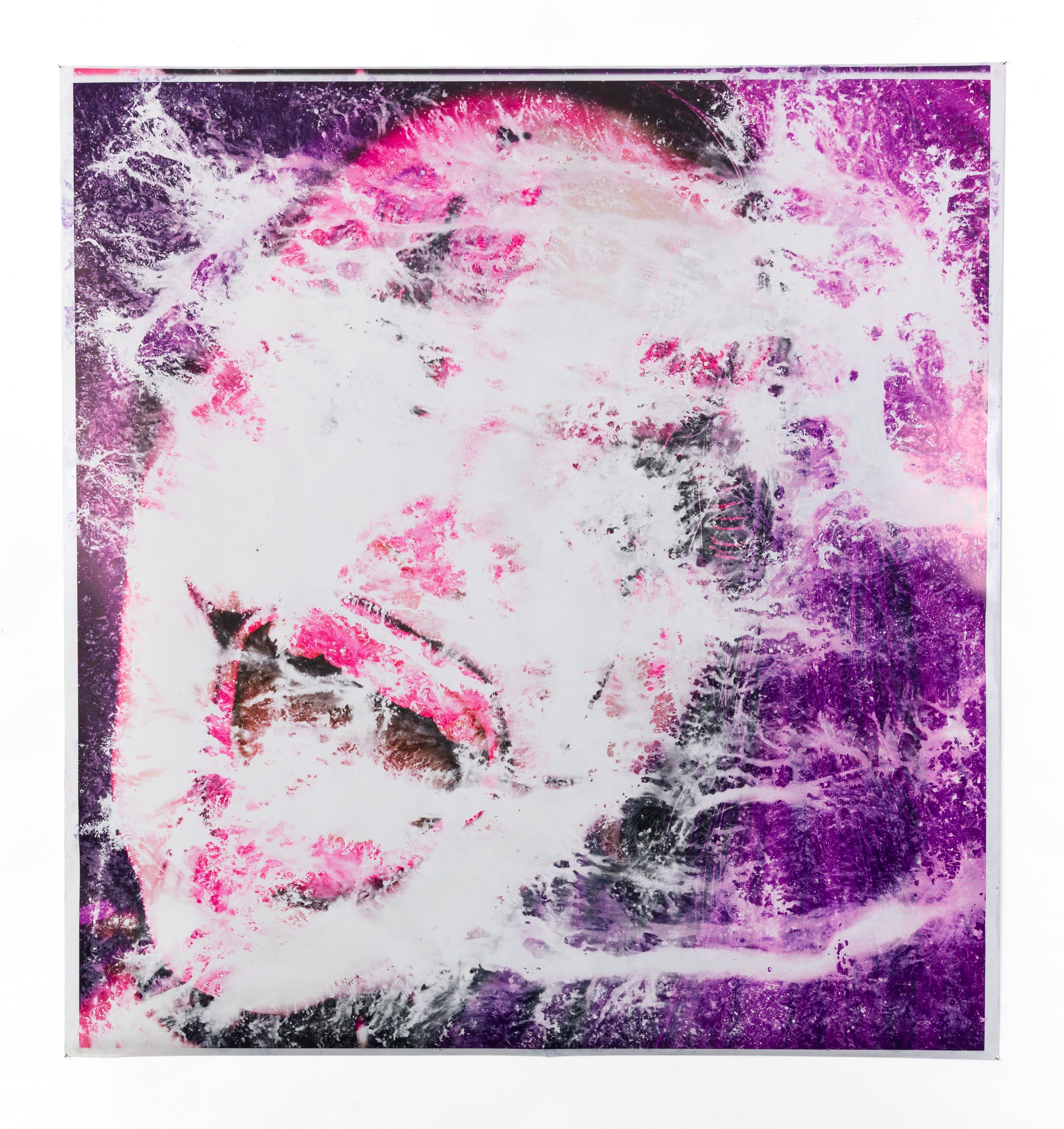
Curtis Mitchell, OMG, 2026. Giclée print, household chemicals, 63 ¼ × 60 inches. Courtesy the artist and Alex Berns.
Word count: 746
Paragraphs: 10
Alex Berns
March 6–April 4, 2026
New York
A herald of crisis and collapse, figure of disruption, disobedience, and the anti-rational, the clown is back, and Curtis Mitchell’s new show, Erased de Clowning, couldn’t come at a more opportune time. Committed to a protocol of the involuntary that bypasses expression and volition, Mitchell has produced objects that are aesthetics-proof, yet aesthetically irresistible—alien to system, theory, and exegesis.
The clown as we know him was plucked from his original community of figures in the commedia dell’arte in the early 1800s and stripped of his role in a system of social analysis and satire. Only after he was so isolated did he become what he is now popularly known as: the hapless fool, sanctioned target for ridicule and abuse, sometimes frightening even to his main audience of children, on the rise only in pornography. The fear of clowns is one of the top human phobias, and can be activated even by representations. Apparently, the outlandish makeup of the clown jams the natural expressivity of the human face, which prevents people from reading its emotions and so arouses fear and unease. The germ of Mitchell’s show is rooted in the artist’s disturbance at clowns, which has survived from childhood through today.

Installation view: Curtis Mitchell: Erased de Clowning, Alex Berns, New York, 2026. Courtesy Alex Berns. Photo: Carter Seddon.
The seven, recent, large photographic prints on view are the product of a literal collision between the dark history of the clown and a self-encrypting mode of visual production that is a parody of photography itself. Mitchell selected these stock photographs of clowns for the way they unsettled him, and then subjected them to a procedure of chemical erasure until their effect on him was neutralized.
Little remains of the original content; instead, the intervention now dominates: drips, smears, and spatter where chemical has bleached whatever it landed on, resulting in blooms and tendrils of pure white. Only the faintest vestiges remain of the original face—part of a jawline, a lip, hair—barely enough to imagine it was part of a human. The glossy finish of the paper is uniform and undisturbed as if the battle over the image took place entirely within the emulsion. The appearance of these pieces evokes satellite imagery, data from radio telescopes, x-ray crystallography, walls of a paintball arena. Hallucinatory, exuberant, wheeling, galactic. Very little suggests the work of a human hand.

Curtis Mitchell, Ripper, 2026. Giclée print, Household chemicals, 67 × 60 inches. Courtesy the artist and Alex Berns.
Mitchell’s intervention on these images was pure physics: liquid hurled at a surface where gravity and inertia were allowed to take over. There is an echo here of his show last fall at the Bridgehampton Museum, which consisted of giant plaster casts of his own head left to erode for years in the rain and snow until the skulls resembled coral or rotting vegetation. There it was nature that produced the degradation. What we have in the clown works is the artefact, or diagram, of a physical action of which there is no other evidence and no witness but the artist.
“What is” and “what was” feel incompatible, without conceivable relation, as if the intervention produced a phase change in it. The resulting pieces work on a completely different plane and might even suggest a liberation, a transubstantiation, even apotheosis of the clown beneath.
These pieces make you want to see the primary images that gave rise to them. The question that gripped the artist grips the viewer as well: what was so disturbing about these clowns? The scenario is a powerful one: an artist, deranged by clown pics, goes at them with a chemical-drenched rag to obliterate the thing that rattled him. It suggests a primal scene that another artist might have videoed. No doubt, the struggle would have been interesting to watch. But then these works would be mere accessory or merch, and narratives of motive and intention would have pushed aside other ways of seeing them. Instead, these objects on the wall are all that remain of Mitchell’s methods. What they were made from and how they were made is irrecoverable, and yet, paradoxically, fully engage the viewer’s mind.
The result resists classification. If it is photographic, it is a new mode of photography. The artist claims the work is sculpture, since it proceeds by subtraction. But unlike, for example, chipping away stone to reach the body hidden within, this process begins with a finished image and pares it to a neutral state. As an artistic process, Mitchell works backwards: begin with emotion, end when it is gone.
Teddy Jefferson, author of One Inch Leather: 14 Stories and Rorschach Tempest and numerous short stories and plays, is historical consultant for documentary filmmaker Gianfranco Rosi (Below the Clouds, 2025).