Yoko Ono: Music of the Mind
Word count: 915
Paragraphs: 11

Installation view, Yoko Ono: Music of the Mind, MCA Chicago, 2025–2026. Photo: Bob. (Robert Chase Heishman).
Museum of Contemporary Art
October 18, 2025–February 22, 2026
Chicago
Curator Juliet Bingham’s Yoko Ono: Music of the Mind arrived in the United States at an interesting time. When it opened at the Museum of Contemporary Art (MCA) Chicago in mid-October, hundreds of Illinois National Guard members were in the process of mobilizing, after President Trump described the city as a “haven for criminals” and a “warzone.” Just two weeks before, the US had entered what would become the longest government shutdown on record, tensions with Venezuela had begun to reach a breaking point, and a shaky peace deal between Israel and Gaza appeared to be cracking at the seams.
With this in mind, a retrospective revisiting the work of an artist whose activism helped form the social consciousness of an entire generation seems timelier than ever. Walking through the exhibition, which traces Ono’s career chronologically, it struck me that the plea for peace at the core of Ono’s work appears to have fallen on deaf ears. Of course, this is nothing new for Yoko Ono.

Installation view, Yoko Ono: Music of the Mind, MCA Chicago, 2025–2026. Photo: Bob. (Robert Chase Heishman).
When she and John Lennon first unveiled their historic WAR IS OVER! IF YOU WANT IT (1969) billboard in Times Square, anti-Vietnam War sentiment was rife in the US. Calling back to newspaper headlines announcing the end of World War II such as “VICTORY! JAPAN QUITS” and “PEACE AT LAST,” Ono’s advertisement played on the anxieties of a culture besieged by images of violence and brutality, turning a public space into a platform for both political commentary and conceptual art. Though by then much of the world blamed her for breaking up the Beatles—a perception Music of the Mind works to undo—few were familiar with Ono’s already-prolific career as an artist.
Though her male contemporaries, like George Maciunas and John Cage, have long been credited with trailblazing avant-garde movements like Conceptualism and Fluxus, Music of the Mind reminds us that Ono’s contributions to the midcentury artistic cutting edge were just as original and influential. As early as 1955, Ono’s instruction pieces were changing the way audiences thought about art, as with Lighting Piece (i.e., “Light a match and watch till it goes out”), which Ono often performed seated on a piano bench on stage, shocking audiences who had expected her to play music. While her early conceptual pieces introduced audience participation as a radical new way of interacting with art, later works like Cut Piece (1964)—a performance piece in which the artist kneels in the center of a stage as audience members cut away at her clothing with scissors—began to introduce more politically or socially pointed themes.
Music of the Mind arranges documentation of Ono’s early performances alongside her more infamous participatory installations, like Painting to Shake Hands (1961/62), a large blank canvas hanging in the center of the room with a fist-sized hole in its center, and White Chess Set (1966), an all-white chess board that Ono famously gifted to US President Ronald Reagan and Soviet General Secretary Mikhail Gorbachev with the instructions, “Play It By Trust.” With this structure, the exhibition captures the formation of Ono’s awareness that the importance of her work lay in its function as both “anti-art” and a politically charged form of activism.
Deeper within the exhibition’s labyrinth of rooms, many of Ono’s films are projected on massive screens—her famously controversial FILM NO. 4 (‘BOTTOMS’) (1966–67), for example, which showcases a series of bare bottoms walking in close up—inviting visitors to immerse themselves in their strangeness. Nearby, a soundproofed, circular room presents Ono’s musical production, playing through each album in sequence—both those recorded with John Lennon and her later solo records.

Installation view, Yoko Ono: Music of the Mind, MCA Chicago, 2025–2026. Photo: Bob. (Robert Chase Heishman).
Perhaps the most moving participatory work, Add Color (Refugee Boat) (1960/2016), is the hinge at the exhibition’s center. I’m told the large room—empty except for a dinghy in its center and covered with overlapping blue streaks, smudges, symbols, and phrases that range from “Free Palestine” to “MAGA”—has been one of the more charged fixtures of the exhibition. Though the piece originally addressed the refugee crisis in Europe, today it seems to offer a void into which viewers can scream anything they need to express.
Juxtaposed with documentation of one of Ono’s seminal instruction scores, Sky Piece to Jesus Christ (1965), which sees orchestra members wrapped in gauze throughout their performance until none of them are able to continue playing, the gravity of Add Color (Refugee Boat) begins to make more sense. While one work imagines a world in which artists are silenced, eerily manifesting that silencing by degrees, the other flips the script entirely, offering viewers a kind of “blank canvas” opportunity to create art and meaning themselves.
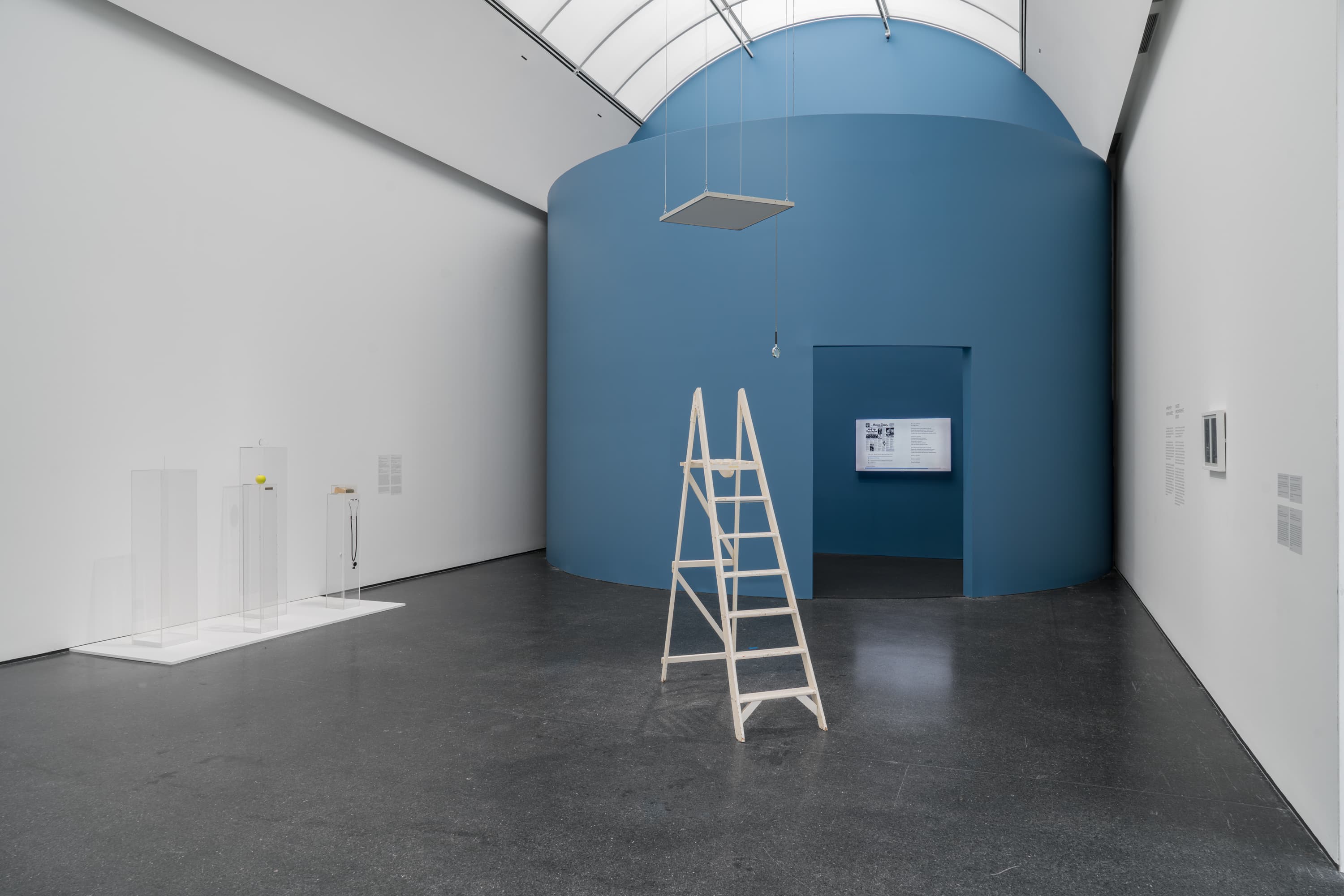
Installation view, Yoko Ono: Music of the Mind, MCA Chicago, 2025–2026. Photo: Bob. (Robert Chase Heishman).
This careful curation of Ono’s most influential works sets Music of the Mind apart, not only as a timely reassessment of a pioneering artist, but also as a reminder of the inexhaustibility of her work. Walking through Yoko Ono’s career chronologically— watching as she developed her ability to surprise and engage audiences as a conceptual artist and, following her explosion into the mainstream, used her place in the spotlight to advocate for peace—brought home to me how vital Ono’s work was for not just one, but several generations following World War II. What struck me most forcefully was the power of Yoko Ono’s empathy. Mirror Piece (1964) captures this perfectly: “Instead of obtaining a mirror, / obtain a person. / Look into him.”
Justin Duyao is a writer and editor based in San Diego, CA.